
Choosing the right kitchen tools is the secret to making your premium non-stick pans last a lifetime, and the debate between Teflon whisks and ceramic whisks is at the heart of cookware preservation. While both options are designed to prevent the dreaded metal-on-metal scratches, they offer distinct advantages: Teflon (PTFE) provides a classic, flexible glide that's perfect for delicate emulsions, whereas ceramic-reinforced tools boast superior heat resistance and a PFAS-free profile for the eco-conscious chef. Whether you are whipping up a sensitive hollandaise or a high-heat gravy, understanding the nuances in durability and thermal limits between these two materials will ensure your best cookware remains pristine and high-performing for years to come.
| Feature | Teflon (PTFE) Whisk | Ceramic Whisk |
|---|---|---|
| Scratch Protection | High; soft surface prevents abrasions. | Excellent; smooth, hard non-marring finish. |
| Heat Threshold | Up to 500°F (begins to degrade higher). | Up to 600°F+ (superior thermal stability). |
| Material Flex | Highly flexible; best for bowl contours. | Rigid and sturdy; better for thick batters. |
| Chemical Profile | PFOA-free (modern), contains PTFE. | Naturally PFAS, PFOA, and PTFE-free. |
| Durability | Prone to peeling/flaking over time. | Resistant to chips; longer aesthetic life. |
| Best Use Case | Delicate sauces and light vinaigrettes. | High-heat stovetop cooking and stews. |
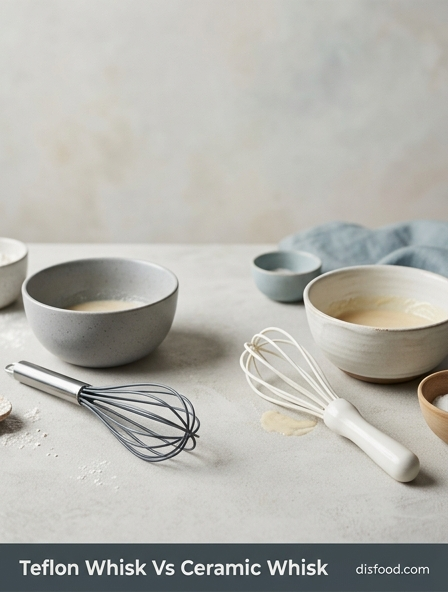
Teflon vs Ceramic Whisk Comparison Guide
When navigating the world of nonstick kitchen utensils, the choice between Teflon-coated and ceramic-coated whisks often boils down to a balance of performance, safety, and compatibility with your existing cookware. Teflon whisks, made from a synthetic fluoropolymer called polytetrafluoroethylene (PTFE), have been a kitchen staple for decades. They are prized for their extreme slipperiness and flexibility, making them ideal for delicate tasks like whipping cream or blending light batters. Because the coating is relatively soft, these whisks are exceptionally gentle on the delicate surfaces of nonstick frying pans and saucepots.
On the other hand, ceramic whisks represent a more modern, "eco-friendly" alternative to traditional plastics. These coatings are typically derived from inorganic minerals, specifically a silica-based sol-gel process. Unlike the flexible nature of Teflon, ceramic coatings are incredibly hard and heat-resistant. While both materials serve the primary purpose of preventing scratches on your pans, they interact with heat and food differently. The following factors are typically considered when comparing the two:
- Material Flexibility: Teflon is usually coated over thinner wires, providing more spring.
- Surface Hardness: Ceramic is significantly harder and more resistant to abrasion.
- Chemical Profile: Ceramic is marketed as being free of PFAS, PFOA, and PTFE.
- Release Properties: Teflon generally offers superior "food release" for sticky ingredients.
Understanding these fundamental differences is essential for any home cook looking to preserve their investment in high-end cookware while ensuring the best possible results in sauce-making and baking.
Durability and Longevity of Whisk Coatings
The lifespan of a coated whisk is largely determined by how the surface handles mechanical stress and thermal cycles. Teflon whisks are known for their resilience against impact; if you drop a Teflon-coated whisk, the coating is unlikely to crack because the polymer is inherently flexible. However, the primary weakness of Teflon is its susceptibility to "flaking" over time. As the whisk wires flex during vigorous mixing, the bond between the PTFE and the underlying metal can weaken, eventually leading to small bits of the coating peeling off into your food.
Ceramic coatings offer a different set of durability trade-offs. Because the ceramic layer is a glass-like substance, it is highly resistant to scratches from other utensils or abrasive sponges. You will find that a ceramic whisk maintains its aesthetic "newness" longer than Teflon. However, the rigidity that makes ceramic scratch-resistant also makes it brittle. If a ceramic whisk is dropped on a hard tile floor or struck sharply against the side of a heavy cast-iron pot, the coating may chip. Once a chip occurs, the underlying metal is exposed to moisture, which can lead to rust and further degradation of the coating bond.
| Feature | Teflon (PTFE) | Ceramic (Sol-Gel) |
|---|---|---|
| Scratch Resistance | Moderate to Low | Very High |
| Impact Resistance | High (Flexible) | Low (Brittle) |
| Long-term Peeling | Common over time | Rare (unless chipped) |
In short, Teflon is better for those who are "heavy-handed" with their tools, while ceramic is superior for those who prioritize a surface that stays smooth and unscratched through years of standard use.
Heat Resistance and Cooking Safety Standards
Heat resistance is perhaps the most critical technical difference between these two kitchen tools. Teflon has a defined thermal limit, typically around 500°F (260°C). When a Teflon whisk is used in a pan that exceeds this temperature-which can happen surprisingly fast if a pan is left dry on a high burner-the PTFE can begin to break down. This degradation results in the release of polymer fumes. While these fumes are generally only dangerous to pet birds or in high concentrations to humans (causing "polymer fume fever"), many cooks prefer to avoid the risk entirely by choosing materials with higher thermal thresholds.
Ceramic-coated whisks are the clear winner in high-heat applications. Because they are mineral-based, they can often withstand temperatures up to 800°F (425°C) without any structural change or off-gassing. This makes them much safer for making high-temp roux, candies, or thick gravies where the whisk remains in contact with the bottom of a hot pan for extended periods. When using ceramic, there is no risk of the coating melting onto the whisk wires or releasing toxic chemicals into the steam of your dish. This thermal stability not only ensures food safety but also prevents the whisk from becoming "gummy" over time, a common issue with plastic or low-quality silicone-based coatings that are often confused with Teflon.
Protecting Nonstick Pans from Surface Scratches
The primary reason a chef reaches for a coated whisk instead of a traditional stainless steel one is to protect the integrity of their nonstick pans. Even the most "metal-utensil safe" pans will eventually develop micro-scratches if subjected to the repetitive scraping of steel wires. These scratches cause food to stick and eventually lead to the failure of the pan's nonstick properties. Both Teflon and ceramic whisks solve this problem, but they do so with different levels of "softness."
Teflon whisks are arguably the gentlest option available. The PTFE coating is essentially a lubricant in solid form; it glides over the pan surface with virtually zero friction. This makes it impossible for the whisk to scratch even the softest nonstick coatings. Ceramic whisks, while also safe for nonstick pans, are much harder. While the ceramic itself won't scratch the pan in normal use, if the ceramic coating on the whisk is chipped, the exposed sharp edges of the ceramic or the underlying metal wire can become quite abrasive. To maximize the life of your cookware, consider the following:
- Always inspect coated whisks for chips or peeling before use.
- Avoid "banging" the whisk on the rim of the pan to dislodge food.
- Store coated whisks in a way that they don't rub against metal spatulas.
- Use Teflon for delicate ceramic pans and Ceramic whisks for hard-anodized pans.
By using these specialized tools, you can extend the life of your nonstick cookware by several years, making the small investment in a coated whisk highly cost-effective.
The Pros and Cons of Teflon Coated Whisks
Teflon whisks remain popular because they offer a specific tactile experience that many cooks find superior for light mixing. The "Pro" list for Teflon is dominated by its nonstick efficiency. Almost nothing sticks to PTFE; whether you are mixing honey, thick batters, or egg whites, the whisk remains relatively clean during the process. This makes the physical act of whisking feel lighter and less labored. Additionally, Teflon whisks are generally more affordable and widely available in various shapes, from balloon whisks to flat French whisks.
However, the "Cons" are significant for the health-conscious or high-intensity cook. The most obvious drawback is the limited lifespan. As a soft plastic-like material, it is prone to gouging. If you use a Teflon whisk to scrape the bottom of a pan where crusty bits have formed, you might actually shave off tiny amounts of the coating. Furthermore, there is the environmental concern regarding the manufacturing of PTFE. While modern Teflon is PFOA-free, the production still involves various PFAS chemicals that are persistent in the environment. For many, the risk of the coating eventually "disappearing" from the wires and into the diet is a deterrent that outweighs the benefit of its superior nonstick glide.
Key Advantages of Ceramic Coated Whisks
Ceramic whisks have surged in popularity as the "cleaner" alternative to Teflon. One of the most significant advantages is their chemical composition. Most manufacturers produce ceramic whisks using a "Green" label, as they are free of lead, cadmium, and PFAS. This provides peace of mind for parents and health enthusiasts who worry about chemical leaching at high temperatures. Beyond safety, ceramic coatings are incredibly smooth and create a very sleek aesthetic; they are often available in bright whites or vibrant colors that don't fade like Teflon black.
Another advantage is the structural rigidity ceramic adds to the whisk. A ceramic-coated whisk often feels "sturdier" in the hand. For tasks that require a bit more force, such as breaking up lumps in a thick béchamel or mixing a heavy muffin batter, the ceramic coating holds up better than a thin Teflon layer. Key benefits include:
- Environmental Safety: Often produced with a lower carbon footprint and fewer toxic byproducts.
- Odor Resistance: Ceramic is non-porous and does not absorb food smells or stains.
- High Thermal Limit: Safe for use in the hottest professional-grade pans.
- Aesthetic Longevity: Resists the dulling and graying common with older Teflon tools.
For the modern kitchen that prioritizes both style and safety, ceramic offers a premium feel that Teflon simply cannot match.
Chemical Composition and Food Safety Concerns
The debate between Teflon and Ceramic is often a debate about chemistry. Teflon is a brand name for PTFE, a long-chain polymer. In the past, the manufacturing process used PFOA, a chemical linked to various health issues. While PFOA has been phased out of production since 2013, Teflon is still a plastic product. At extremely high temperatures (above 570°F), the molecular structure begins to break down, releasing particulates. While the FDA considers PTFE inert and safe for food contact under normal conditions-stating that even if small flakes are swallowed, they pass through the body without reacting-many consumers remain skeptical of plastic-based food contact surfaces.
Ceramic coatings are technically "sol-gel" coatings. They are primarily composed of silica (sand) and other inorganic minerals. There are no carbon-based polymers involved, which means there is no risk of releasing toxic fumes. Ceramic is generally considered the "gold standard" for food safety in the nonstick world because it is chemically inert even at temperatures far exceeding standard home cooking. However, it is important to check for the quality of the ceramic; low-end "ceramic" whisks might use a hybrid coating that still contains some plastics. Truly ceramic whisks will be labeled as 100% PTFE and PFOA free, ensuring that your cooking process remains as natural and untainted as possible.
Ease of Cleaning and Dishwasher Compatibility
Cleaning a whisk can be one of the most frustrating tasks in the kitchen, as food particles often get trapped at the point where the wires meet the handle. Both Teflon and ceramic coatings aim to alleviate this by preventing food from bonding to the wires. Teflon is theoretically easier to hand-wash because of its hydrophobic nature; water and grease simply bead off. However, Teflon is often sensitive to the harsh detergents and high-pressure sprays found in modern dishwashers. The combination of heat and chemicals can accelerate the peeling of the Teflon coating, so hand-washing is usually recommended to preserve its life.
Ceramic whisks are generally more "dishwasher friendly" in terms of heat resistance, but they face a different risk: mechanical damage. In a crowded dishwasher, if a ceramic whisk rattles against a ceramic plate or a heavy pot, it is liable to chip. Many high-end ceramic whisk manufacturers recommend hand-washing simply to prevent these accidental impacts.
| Cleaning Method | Teflon Whisk | Ceramic Whisk |
|---|---|---|
| Dishwasher Safe | Not Recommended (peeling) | Yes (but watch for chips) |
| Stain Resistance | High | Very High |
| Ease of Hand-washing | Excellent | Excellent |
Ultimately, both tools are significantly easier to clean than stainless steel whisks, where eggs and flour can practically "weld" themselves to the metal. A quick soak and a light brush are usually all that is needed for either material.
Whisk Performance in High Temperature Cooking
When you are standing over a stove making a custard, lemon curd, or a roux, the whisk is your primary tool for heat distribution. In these scenarios, the whisk is constantly rubbing against the bottom of a hot pan. Teflon whisks are often preferred by pastry chefs for delicate stovetop work because the wires have more "give." This flexibility allows the whisk to conform to the corners of a saucepan, ensuring no part of the sauce is left to burn. However, if the sauce thickens and the heat rises, the cook must be careful not to let the whisk sit idle in the pan, as the base of the pan can quickly exceed the Teflon safety limit.
Ceramic whisks perform exceptionally well in high-temperature "savory" cooking. If you are deglazing a pan to make a red wine reduction or whisking a heavy gravy over a high flame, the ceramic coating provides a sturdy, heat-proof interface. Because ceramic doesn't soften with heat, the wires maintain their tension better than Teflon-coated wires might when they get very hot. This makes ceramic the superior choice for "long-cook" sauces where the whisk is exposed to heat for 20 minutes or more. While you lose a tiny bit of the "spring" found in Teflon, the peace of mind regarding heat stability makes ceramic the workhorse of the high-heat kitchen.
Final Verdict Choosing the Best Kitchen Whisk
The "best" whisk depends entirely on your cooking habits and your priorities regarding safety and longevity. If you are a casual cook who primarily whisks cold ingredients, makes occasional pancakes, and values the easiest possible cleanup at a low price point, a Teflon-coated whisk is a practical choice. Its superior nonstick properties and flexibility make it a joy to use for light tasks, provided you are willing to replace it every few years when the coating inevitably begins to show signs of wear.
However, for the serious home chef or the health-conscious consumer, the ceramic-coated whisk is the superior long-term investment. Despite the risk of chipping if mishandled, its ability to withstand high temperatures and its clean chemical profile make it a more versatile and safer tool for a wide range of culinary applications. When making your final decision, consider the following checklist:
- Choose Teflon if: You want the most flexible wires, lowest price, and maximum "glide" for cold batters.
- Choose Ceramic if: You frequently cook sauces on the stovetop, worry about PFAS chemicals, or want a tool that stays scratch-free for years.
- Avoid both if: You exclusively use cast iron or stainless steel pans and prefer the indestructible nature of a classic all-steel whisk.
In the modern kitchen, having one of each can actually be the smartest move-a Teflon whisk for the baking bowl and a ceramic whisk for the stovetop.

Comments