
Choosing the right whisk is the secret to achieving that perfect batter consistency, whether you're aiming for a cloud-like sponge or a dense, velvety ganache. Piano wire whisks, characterized by their thin, flexible loops, are the masters of aeration, expertly folding air into light mixtures to create volume and lift. Conversely, rigid wire whisks-frequently referred to as French whisks-feature thicker, sturdy wires designed to provide the high-torque resistance needed to power through heavy, viscous batters and eliminate stubborn lumps. By matching the wire gauge to your ingredient density, you ensure an ideal emulsion and superior mouthfeel in every bake.
| Feature | Piano Wire Whisk | Rigid Wire Whisk |
|---|---|---|
| Wire Gauge | Thin, flexible, and springy | Thick, stiff, and reinforced |
| Primary Goal | Aeration and maximum volume | Blending and emulsification |
| Ideal Texture | Light, fluffy, and airy | Smooth, dense, and uniform |
| Best For | Egg whites, cream, thin batters | Roux, custards, heavy sauces |
| Resistance | Low; bends under heavy weight | High; maintains shape in thick mix |
| Lump Removal | Best for fine powders in liquids | Best for shearing thick clumps |
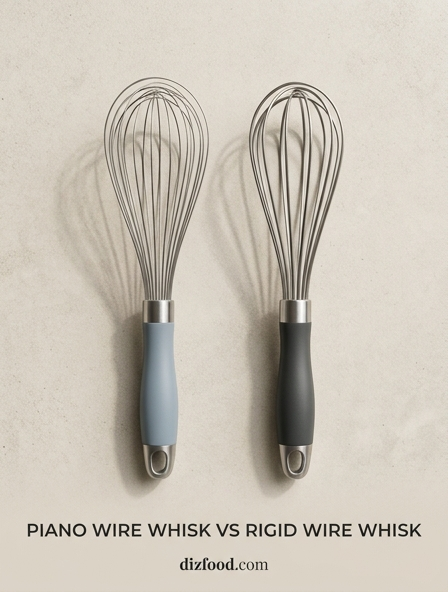
Piano Wire vs Rigid Wire Whisk Key Differences
The primary distinction between piano wire whisks and rigid wire whisks lies in their structural flexibility and intended resistance. A piano wire whisk, as the name suggests, features thin, high-tensile wires similar to those found in a musical instrument. These wires are designed to vibrate and spring back when they encounter resistance, allowing for maximum movement within a liquid medium. Conversely, rigid wire whisks-often referred to as French whisks or heavy-duty whisks-utilize much thicker gauges of steel. These wires do not yield easily, maintaining their shape even when pushed through dense or viscous substances.
| Feature | Piano Wire Whisk | Rigid Wire Whisk |
|---|---|---|
| Wire Thickness | Thin and flexible | Thick and stiff |
| Primary Goal | Aeration and volume | Blending and emulsifying |
| Common Shape | Bulbous balloon | Narrow and tapered |
| Resistance | Low resistance | High resistance |
Because of these physical differences, the way they interact with ingredients varies significantly. The piano whisk is built to bounce around inside a bowl, hitting as much surface area as possible to incorporate air. The rigid whisk is built for torque and leverage, ensuring that thick mixtures are thoroughly combined without the wires bending out of shape or tangling. Choosing between them is not about quality, but about matching the tool's mechanical properties to the density of the ingredients.
Best Uses for Flexible Piano Wire Whisks
Flexible piano wire whisks excel in tasks where the objective is to introduce air or combine low-viscosity liquids quickly. Their light construction makes them ideal for prolonged manual whisking, as they require less wrist force to move through thin fluids. The "spring" in the wires creates a chaotic motion that is far more efficient at breaking up surface tension in liquids like water, milk, or egg whites. If you are aiming for a light, airy finish, the piano whisk is the indispensable tool in your drawer.
- Whipping Egg Whites: Necessary for meringues, soufflés, and angel food cakes where peak volume is critical.
- Heavy Cream: The thin wires quickly shear fat globules, leading to faster peaks without overworking the cream.
- Thin Vinaigrettes: Perfect for rapidly emulsifying oil and vinegar into a stable dressing.
- Sifting Dry Ingredients: Often used as a substitute for a sifter to break up lumps in flour or cocoa powder.
- Frothing Milk: Ideal for creating foam for lattes or hot chocolate without specialized equipment.
The balloon shape often associated with piano whisks allows them to reach the bottom and sides of rounded bowls effectively. This ensures that no pockets of unmixed ingredients remain. However, because the wires are so thin, they should never be used for heavy doughs or thick batters, as the wires can easily warp, cross over one another, or even snap at the handle insertion point if pushed beyond their physical limits.
Why Professional Chefs Use Rigid Wire Whisks
In a professional kitchen, the rigid wire whisk is often the workhorse for stovetop cooking and high-volume prep. Professional chefs prefer these tools because they provide the necessary leverage to scrape the corners of heavy pots and pans, preventing scorched bottoms. When a sauce is thickening over heat, a piano whisk would simply glide through without effectively moving the denser layers at the base of the vessel. The rigid wires act almost like a spatula and a whisk combined, offering the structural integrity needed for "heavy lifting" in culinary applications.
Moreover, the durability of rigid whisks is a significant factor in commercial environments. They are less likely to deform when stored in large bins or run through industrial dishwashers. Chefs also favor the narrower profile of many rigid whisks, which allows them to fit into smaller saucepans or narrow bains-marie. When creating a roux or a mother sauce like Béchamel, the rigid wires are essential for cutting through the paste-like consistency of butter and flour before the liquid is added. The resistance offered by these whisks provides better tactile feedback to the cook, allowing them to feel the texture and thickness of the sauce as it develops. This precision is vital for maintaining consistency across hundreds of servings in a restaurant setting where speed and reliability are the highest priorities.
Aeration and Texture with Piano Wire Whisks
Aeration is a mechanical process where air is trapped within a liquid to create volume and change texture. Piano wire whisks are specifically engineered to maximize this effect. Because the wires are thin and numerous, they create a high number of "cutting edges." As you whisk, these wires slice through the liquid, creating tiny air pockets. The more wires a whisk has, and the faster they vibrate, the more bubbles are created. This is why piano whisks are the gold standard for achieving the "stiff peaks" required in delicate pastry work.
The texture produced by a piano whisk is characterized by its lightness and uniformity. In the case of a sabayon or a sponge cake batter, the goal is to create a foam that is stable enough to hold its shape but light enough to melt in the mouth. The flexibility of piano wires allows the user to use a wide, sweeping motion that incorporates air from the surface of the bowl down into the center. This creates a vertical lift that rigid whisks simply cannot replicate. Without the ability to flex and "snap" back, a whisk moves the liquid rather than aerating it. By using a piano whisk, you ensure that the density of your final product remains low, resulting in the fluffy, ethereal textures that define high-end desserts and light breakfast items like omelets or pancakes.
Mixing Heavy Batters with Rigid Wire Tools
When dealing with heavy batters, the physics of mixing change from aeration to homogenization. Ingredients like thick muffin batter, brownie mix, or heavy pancake batter offer significant resistance. If a piano whisk is used in these scenarios, the wires will bend outward, losing their ability to cut through the mixture and often trapping clumps of flour in the center of the whisk "bulb." Rigid wire tools are designed to solve this problem by maintaining their spacing and alignment even under high pressure.
- Roux Production: Creating the base for gravies and stews requires stirring a thick paste of fat and flour. Rigid wires prevent the paste from sticking to the tool.
- Thick Custards: As pastry cream or pudding cools and thickens, a rigid whisk is required to keep the mixture smooth and prevent lumps.
- Emulsifying Mayonnaise: While it starts thin, real mayonnaise becomes very thick; a rigid whisk provides the torque needed to continue incorporating oil.
- Pan Sauces: Rigid whisks are perfect for deglazing a pan, as they can effectively scrape up "fond" (browned bits) from the metal surface.
The lack of "give" in a rigid whisk means that every ounce of force from your arm is transferred directly into the batter. This efficiency is crucial when time is limited or when the physical effort of mixing thick substances becomes fatiguing. For any preparation that feels "heavy" to the hand, the rigid whisk is the safer and more effective choice for both the cook and the longevity of the kitchen equipment.
Comparing Wire Gauge and Flexibility Levels
The technical difference between these two whisks is measured in wire gauge. In the world of kitchen manufacturing, a lower gauge number indicates a thicker wire. Rigid whisks typically utilize 12 to 14-gauge stainless steel wires, which provides significant structural strength. Piano whisks, on the other hand, usually feature 18 to 22-gauge wires. This thinner profile allows for the characteristic "bounce" and flexibility. When selecting a whisk, understanding these levels helps in predicting how the tool will behave under stress.
Flexibility is not just about the thickness of the wire, but also the "temper" of the steel. High-quality piano whisks use spring-tempered stainless steel, which allows the wires to deform significantly and return to their original shape without permanent bending. Rigid whisks use a stiffer temper to ensure that they stay straight and parallel. The number of wires also plays a role; piano whisks often have 10 to 12 loops (20 to 24 wire ends), whereas rigid whisks may have as few as 5 or 6 loops. This difference in density affects how much liquid passes through the whisk versus how much is pushed by it. A higher wire count with high flexibility creates a fine mesh-like effect during motion, which is ideal for breaking down small lumps in thin liquids, while a low wire count with high rigidity is better for moving large masses of dense material.
Durability and Longevity of Whisk Types
When considering the lifespan of kitchen tools, rigid wire whisks generally outlast their piano-wire counterparts. The thickness of the wires makes them resistant to the most common cause of whisk failure: wire detachment. In many whisks, the wires are held into the handle by epoxy or a compression fit. Thick, rigid wires have more surface area for the adhesive to grip, and they are less likely to vibrate loose over time. Piano whisks, because they are designed to vibrate, often suffer from fatigue at the point where the wire meets the handle, eventually leading to wires popping out or snapping.
Cleaning also impacts longevity. Piano whisks have many thin wires that are spaced closely together, making them prone to trapping food particles, especially at the "crown" or top of the whisk. If not cleaned immediately, dried batter can cause the wires to rust or corrode in those hard-to-reach spots. Rigid whisks, with fewer and wider-spaced wires, are much easier to scrub and sanitize. To extend the life of either type, it is recommended to hand wash them or ensure they are placed in a dishwasher in a way that doesn't put pressure on the wires. A piano whisk that is crushed in a drawer will quickly lose its symmetrical shape, which ruins its balance and effectiveness, whereas a rigid whisk can withstand much more "abuse" in a crowded kitchen environment without losing its utility.
Choosing the Right Whisk for Delicate Sauces
Delicate sauces, such as Hollandaise, Bearnaise, or Beurre Blanc, require a balance of gentle heat and constant motion. The choice of whisk here often depends on the shape of the vessel. For a traditional round-bottomed bowl used in a double boiler (bain-marie), a piano whisk is often preferred. Its ability to conform to the curves of the bowl ensures that the eggs are constantly moving and being aerated, which prevents them from scrambling. The lightness of the piano whisk also helps in creating the voluminous, foamy texture that defines a perfect Hollandaise.
However, if you are making a sauce that involves a reduction of vinegar or wine in a flat-bottomed saucepan, a rigid French whisk is the superior choice. The stiffer wires allow you to reach the "corners" where the bottom of the pan meets the sides. This is a critical zone where sauces often begin to overcook or stick. Furthermore, many delicate sauces are emulsified by whisking in cold cubes of butter. A piano whisk may be too flimsy to move the butter cubes around effectively as they melt, whereas a rigid whisk can easily push the solids through the liquid to speed up the emulsion process. Ultimately, if the sauce requires high volume, go with piano wires; if the sauce requires precision temperature control and pan-surface contact, go with rigid wires.
Impact of Wire Stiffness on Mixing Speed
Mixing speed is a combination of hand velocity and the resistance of the medium. Wire stiffness plays a paradoxical role here. In thin liquids like egg whites, a piano whisk allows for incredible speed. Because the wires offer little resistance, you can move your wrist at a high frequency, and the flexibility of the wires creates secondary vibrations that further agitate the liquid. This "multiplier effect" means that you can reach peak aeration much faster than you could with a stiff tool that simply "drags" through the water.
Conversely, in thick mixtures, a piano whisk actually slows you down. When the resistance of the batter exceeds the stiffness of the wires, the wires collapse inward. Instead of cutting through the batter, the whisk becomes a solid mass that you have to pull through the sludge. In this context, a rigid whisk is significantly faster. Because the wires do not bend, they maintain their cutting surface, allowing you to move through the batter with every stroke. While the hand motion might be slower due to the weight of the mixture, the actual "work" being done-the incorporation of ingredients-is much more efficient. For the home cook, this means that using a rigid whisk for muffins or thick sauces will result in a shorter mixing time and less physical strain than struggling with a flexible whisk that isn't built for the task.
Final Verdict on Piano vs Rigid Wire Whisks
In the debate between piano wire and rigid wire whisks, the "better" tool is entirely dependent on the specific culinary task at hand. No kitchen is truly complete without one of each, as they serve fundamentally different mechanical purposes. The piano whisk is a specialist tool designed for the delicate art of aeration. It is the master of eggs, cream, and light batters, providing the finesse required for top-tier pastry work and light-as-air textures. Its flexibility is its greatest strength, allowing for high-speed movement and maximum air incorporation.
On the other hand, the rigid wire whisk is the general-purpose workhorse. It is built for strength, durability, and the demanding environment of stovetop cooking. For thick sauces, heavy batters, and any task involving heat and potential sticking, the rigid whisk is the only reliable choice. It offers the leverage and scraping power that flexible wires lack. If you are a casual cook who only wants one whisk, a medium-stiffness French whisk (rigid) is likely the most versatile option. However, for those who bake frequently or enjoy making meringues and foams, the piano whisk is an essential investment. By understanding the physics of wire gauge and flexibility, you can choose the right tool to ensure your sauces are smooth, your cakes are fluffy, and your kitchen tools last for years to come.

Comments