
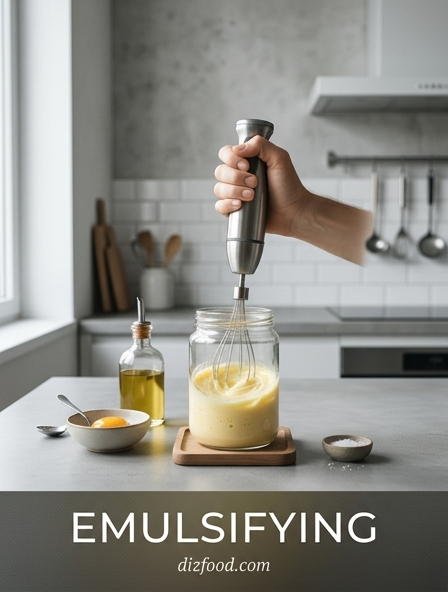
Defining the Chemistry of Emulsion
In the culinary world, an emulsion is a colloidal mixture of two liquids that are normally immiscible, such as oil and water. This chemical feat is achieved by dispersing one liquid, known as the dispersed phase, into another, known as the continuous phase. At the molecular level, water is polar, while fats and oils are non-polar. Under normal circumstances, these substances repel each other due to surface tension, with the lighter oil eventually floating atop the denser water.
To create a cohesive sauce, a chef must overcome the thermodynamic drive for these phases to remain separate. This involves the introduction of emulsifiers-molecules that possess both a hydrophilic (water-loving) head and a lipophilic (fat-loving) tail. These molecules align themselves at the interface of the droplets, reducing interfacial tension and preventing the droplets from coalescing. The following table highlights the common components involved in this chemical process:
| Phase Type | Description | Examples |
|---|---|---|
| Continuous | The base liquid that holds droplets. | Vinegar, Lemon Juice, Water |
| Dispersed | The liquid broken into tiny droplets. | Olive Oil, Clarified Butter, Lard |
The Role of Kinetic Energy in Whisking
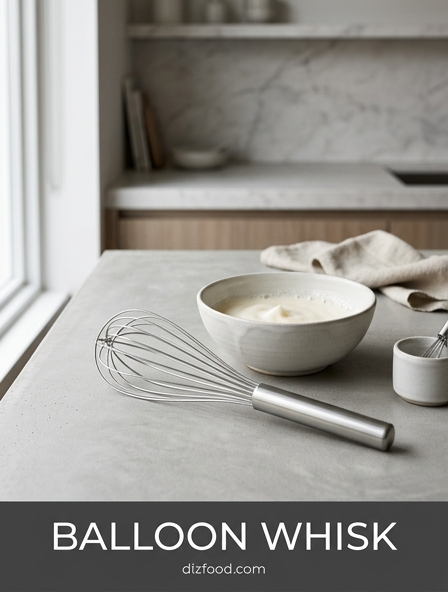
The transition from two separate liquids to a smooth emulsion requires the application of kinetic energy. In a professional kitchen, this energy is most frequently applied through the mechanical action of whisking. As the whisk moves through the mixture, it creates turbulence and physical stress that shears large globules of oil into millions of microscopic droplets. The goal is to maximize the surface area of the dispersed phase so that the emulsifying agents can coat each individual droplet effectively.
The efficiency of this process depends heavily on the technique and the speed of agitation. Without sufficient kinetic energy, the oil droplets remain too large, allowing gravity and molecular attraction to pull them back together almost instantly. Key factors in the application of kinetic energy include:
- Vigor of Agitation: Faster whisking yields smaller droplets and a more stable structure.
- Rate of Addition: Adding oil drop-by-drop ensures the energy applied can keep up with the volume of the dispersed phase.
- Tool Selection: Balloon whisks provide more wires and surface area to facilitate quicker dispersion.
Surfactants and Natural Stabilizing Agents
While mechanical force creates the initial dispersion, surfactants are the biological "glue" that maintains the emulsion's longevity. These agents are naturally occurring substances that lower the surface tension between the oil and water. Without them, even the most vigorously whisked sauce will eventually separate into its original components. In culinary applications, we rely on proteins, phospholipids, and complex carbohydrates to serve this stabilization role.
The most famous kitchen surfactant is lecithin, found in abundance in egg yolks. Lecithin is an amphiphilic molecule that creates a protective barrier around oil droplets, preventing them from merging. Other ingredients provide stability through different mechanisms, such as increasing the density of the continuous phase. Common natural stabilizers include:
- Egg Yolks: Rich in lecithin; essential for mayonnaise and hollandaise.
- Mustard: Contains complex mucilage that physically interferes with droplet collision.
- Honey: Acts as a weak stabilizer while adding viscosity to the liquid base.
- Garlic: Contains proteins and polysaccharides that help stabilize aioli.
Shear Force and Lipid Dispersion
Shear force refers to the unaligned forces pushing one part of a body in one specific direction, and another part of the body in the opposite direction. In emulsification, high shear force is the primary mechanism for lipid dispersion. When a blender blade spins at high RPMs, it creates intense shear zones that literally tear fat molecules apart. This results in a much finer dispersion than manual whisking could ever achieve, leading to a sauce with a higher degree of whiteness and a thicker, more luxurious mouthfeel.
The relationship between shear and stability is linear; as shear increases, droplet size decreases. Smaller droplets have a harder time overcoming the viscous resistance of the continuous phase to find one another. This is why a vinaigrette made in a blender is significantly more stable than one shaken in a jar. The following factors influence the impact of shear force in the kitchen:
- Blade Velocity: Higher speeds result in greater fragmentation of the oil phase.
- Container Geometry: Narrower containers force the liquid back into the blades more frequently.
- Viscosity: A thicker base liquid transmits shear force more effectively to the oil droplets.
Temperature Variables in Stable Emulsions
Temperature is perhaps the most volatile variable in the emulsification process, particularly for warm sauces like hollandaise or beurre blanc. Heat affects the kinetic energy of the molecules and the physical state of the fats involved. If the temperature is too low, saturated fats (like butter) will solidify, causing the emulsion to turn grainy or break. If the temperature is too high, the proteins acting as surfactants may denature and lose their ability to coat the oil droplets, leading to total separation.
Chefs must maintain a delicate balance to ensure the emulsion remains fluid but stable. The ideal temperature range depends on the specific fats and proteins being used. The table below outlines the critical temperature zones for common kitchen emulsions:
| Emulsion Type | Optimal Temp | Risk of Failure |
|---|---|---|
| Mayonnaise | 20°C - 25°C | Oil may solidify if too cold. |
| Hollandaise | 45°C - 62°C | Eggs will scramble above 65°C. |
| Beurre Blanc | 30°C - 45°C | Butter separates if boiled. |
Viscosity and Structural Integrity
Viscosity refers to a fluid's resistance to flow, and in the context of emulsions, it is the primary indicator of structural integrity. A well-constructed emulsion is significantly more viscous than either of its component parts. For example, oil and vinegar are both relatively thin, but a stable vinaigrette is thick and coating. This increase in viscosity occurs because the densely packed droplets of the dispersed phase interfere with the movement of the continuous phase, creating a rigid network.
The thickness of a sauce is not just a matter of aesthetics; it is a functional barrier against separation. High viscosity slows down the "Brownian motion" of the droplets, making it physically difficult for them to travel through the liquid and collide with one another. To increase the structural integrity of an emulsion, chefs often use the following techniques:
- Increasing the Oil Ratio: More droplets mean more internal friction and higher thickness.
- Reducing the Liquid: A more concentrated continuous phase provides more resistance.
- Adding Thickeners: Ingredients like xanthan gum or starch increase the viscosity of the water phase.
Vinaigrettes and Temporary Suspensions
A vinaigrette is the most common example of a temporary emulsion in culinary practice. Unlike permanent emulsions, a standard vinaigrette lack a strong surfactant in high enough concentrations to hold the oil and vinegar together indefinitely. When shaken or whisked, the oil breaks into droplets, creating a cloudy suspension. However, as soon as the mechanical agitation stops, the oil droplets begin to rise and merge due to their lower density and hydrophobic nature.
To maximize the life of a temporary suspension, chefs must utilize every available stabilizing factor. Adding a small amount of an "interfering agent" can delay the inevitable separation by several minutes, allowing the sauce to reach the plate in a unified state. The typical steps for creating a more resilient vinaigrette include:
- Combining the vinegar with salt, pepper, and a small amount of mustard or honey.
- Whisking the base to dissolve the solids and activate any minor surfactants.
- Slowly streaming in the oil while maintaining a constant, high-speed whisking motion.
- Serving immediately to ensure the suspension remains uniform during consumption.
Permanent Emulsions in Modern Sauces
Permanent emulsions are those that remain stable for days or even weeks without separating. These are achieved through a high concentration of emulsifiers and a very high ratio of dispersed phase to continuous phase. Mayonnaise is the quintessential permanent emulsion; it contains so much oil that the droplets are packed tightly together, creating a nearly solid structure. The lecithin in the egg yolk provides a permanent chemical bond that resists the natural tendency of oil to separate.
In modern professional kitchens, the definition of a permanent emulsion has expanded with the use of hydrocolloids and stabilizers like lecithin powders and mono-diglycerides. These allow for the creation of stable emulsions that were previously impossible, such as herb oils emulsified with fruit juices. Key characteristics of these stable systems include:
- Long-term Stability: Resistance to temperature fluctuations and time.
- Sheen and Opacity: A reflective surface indicating very fine droplet size.
- Creaminess: A smooth texture that coats the palate without feeling greasy.
Troubleshooting Broken Culinary Bonds
Even for experienced chefs, emulsions can "break," resulting in a greasy, curdled appearance where the oil has separated from the water base. This usually happens when the oil is added too quickly, the temperature exceeds a critical threshold, or the ratio of oil to water is surpassed. Once an emulsion breaks, it cannot be fixed by simply whisking harder; the structural integrity must be rebuilt from the ground up.
The process of fixing a broken sauce involves re-establishing a small amount of a stable "seed" emulsion and then incorporating the broken mixture into it. This requires patience and a return to the fundamentals of slow dispersion. Common methods for troubleshooting include:
- The Water Method: Placing a teaspoon of warm water in a clean bowl and slowly whisking the broken sauce into it.
- The Egg Yolk Method: Starting with a fresh egg yolk and a dab of mustard, then slowly incorporating the broken emulsion.
- Temperature Correction: Cooling a broken hollandaise or warming a cold, seized vinaigrette before attempting to re-whisk.
Advanced Tools for Professional Emulsification
Modern technology has revolutionized the way chefs approach emulsions, moving beyond the hand whisk to high-powered mechanical devices. These tools allow for a level of precision and stability that was previously unattainable. High-shear equipment can create emulsions with droplet sizes in the micron range, resulting in sauces that are incredibly light yet remarkably stable. These tools are now standard in fine-dining environments where consistency is paramount.
The choice of tool often depends on the volume of the sauce and the desired final texture. While a whisk provides a traditional "loose" feel, mechanical tools provide a "tight" emulsion. The following table lists the primary tools used for professional-grade emulsification:
| Tool | Primary Use | Energy Level |
|---|---|---|
| Immersion Blender | Large batches of mayo or soups. | Medium-High |
| High-Speed Blender | Ultra-smooth purees and herb oils. | Very High |
| Homogenizer | Micro-emulsions and delicate foams. | Extreme |
| Aerolatte/Frother | Small-scale finishing of sauces. | Medium |


Comments