
Whether you're aiming for a cloud-like meringue or a silky-smooth pan gravy, choosing between a small coil whisk and a large balloon whisk is the secret to mastering culinary textures. The iconic balloon whisk is your go-to powerhouse for maximum aeration, using its expansive wire loops to pull air into egg whites and heavy creams for incredible volume. In contrast, the nimble coil whisk (often called a spring whisk) is specifically engineered for tight spaces and shallow depths, making it the superior choice for emulsifying small-batch dressings or deglazing a skillet. By matching the whisk's geometry to your specific task, you ensure efficient mixing and perfect consistency while reducing hand fatigue during meal prep.
| Feature | Large Balloon Whisk | Small Coil Whisk |
|---|---|---|
| Primary Mechanical Goal | Aeration and high-volume expansion. | Emulsification and bottom-surface blending. |
| Ideal Ingredients | Egg whites, heavy cream, thin batters. | Vinaigrettes, pan gravies, roux, hot cocoa. |
| Vessel Compatibility | Deep, round-bottomed mixing bowls. | Shallow pans, flat skillets, narrow jars/mugs. |
| Design Architecture | Large, bulbous tines for air entrapment. | Flat, flexible spiral spring for surface contact. |
| Whisking Motion | Wide circular or figure-eight strokes. | Up-and-down pumping or flat scraping. |
| Texture Outcome | Light, fluffy, and voluminous. | Homogeneous, dense, and silky-smooth. |
Key Structural Differences Between Coil and Balloon Whisks
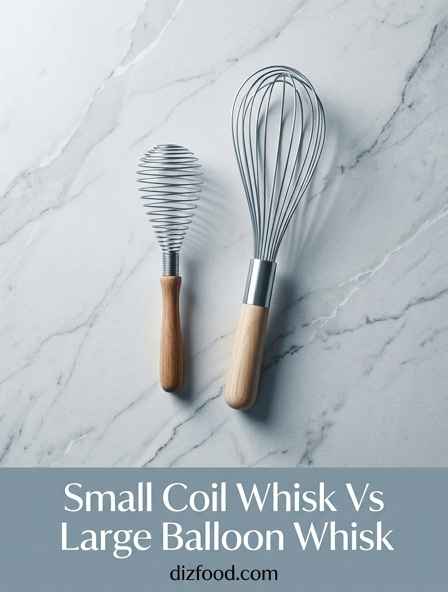
The primary distinction between a small coil whisk and a large balloon whisk lies in their geometric architecture and mechanical intent. A large balloon whisk is characterized by its series of flexible, teardrop-shaped wire loops that join at a central handle. This bulbous shape is designed to move through large volumes of liquid, creating a high degree of turbulence. The rounded end allows it to sweep the curved bottom of mixing bowls effectively, though it often struggles with the tight corners of flat-bottomed pans. Most balloon whisks feature between eight and twelve wires, providing a significant surface area for incorporating air into liquid mixtures.
In contrast, the small coil whisk, often referred to as a spring whisk or magic whisk, features a single wire that spirals into a circular, flat-headed coil. This coil is typically mounted on a long, thin handle and is set at a slight angle. Unlike the rigid yet bouncy structure of the balloon whisk, the coil whisk is highly compressible. When pressed against the bottom of a container, the spring flattens and expands, allowing it to scrape the entire surface area of a vessel. The structural differences are summarized below:
| Feature | Balloon Whisk | Coil Whisk |
|---|---|---|
| Wire Shape | Teardrop Loops | Spiral Spring |
| Primary Motion | Side-to-side/Circular | Up-and-down/Flat scraping |
| Profile | Wide and Bulbous | Slim and Angled |
Best Culinary Uses for the Small Coil Whisk
The small coil whisk is an indispensable tool for precision tasks and small-batch preparations where a standard whisk would be too cumbersome. Its unique design allows it to excel in shallow environments and narrow vessels. Because the coil is spring-loaded, it can be used with a pumping motion to break up clumps of dry powder in liquids, making it the preferred choice for making hot cocoa, mixing protein shakes, or blending matcha. It is particularly effective at emulsifying small quantities of oil and vinegar for a single-serving salad dressing, where a larger whisk would simply move the liquid around without creating enough friction.
In addition to beverage and dressing preparation, the coil whisk is a favorite for tasks involving eggs in small containers. Whether you are beating a single egg for a wash or preparing a small omelet in a ramekin, the coil whisk provides thorough homogenization without the mess. Common culinary applications include:
- Mixing cornstarch slurries to thicken soups.
- Whisking small amounts of tempered chocolate.
- Blending lumps out of individual portions of gravy.
- Incorporating yeast into warm water for bread making.
- Stirring thick sauces in shallow skillets to prevent scorching.
The versatility of the coil whisk comes from its ability to reach into the edges of a pan where sauces often begin to overcook. By maintaining constant contact with the flat bottom of a pan, it ensures that every millimeter of the mixture is agitated, providing a level of control that a balloon whisk cannot match in a shallow environment.
How Large Balloon Whisks Maximize Aeration
Aeration is the process of incorporating air into a substance to increase its volume and lighten its texture, and the large balloon whisk is the undisputed champion of this technique. The physics behind a balloon whisk involves the multiple wires acting as tiny knives that cut through the liquid. As the whisk moves, it creates a vacuum behind each wire, pulling air into the mixture. The large, open spaces between the loops allow for maximum air entrapment, which is essential for creating stable foams and light batters. This is why the balloon whisk is the standard tool for creating whipped cream or aerating flour before baking.
The efficiency of a balloon whisk is directly proportional to the number of wires and the speed of the user's wrist. As the whisking motion accelerates, the loops create a complex web of movement that breaks down large air bubbles into millions of microscopic ones. This structural integrity is what allows a heavy liquid like heavy cream to transform into a stiff, fluffy solid. Without the specific spacing and rounded shape of the balloon whisk, the air would not be distributed evenly, resulting in a dense product rather than a light, airy one. The volume achieved by a large balloon whisk can often double or triple the original size of the ingredients, a feat nearly impossible to achieve with a flat or coil-style whisk.
Small Coil vs Large Balloon for Sauces and Gravies
When preparing sauces and gravies, the choice between a coil and a balloon whisk often depends on the depth of the cookware and the desired smoothness of the roux. For pan gravies made directly in a roasting tin or a shallow skillet, the coil whisk is superior. Its flat profile allows it to scrape up the fond-those flavorful browned bits stuck to the bottom of the pan-which are essential for a rich gravy. A balloon whisk, with its rounded tip, often misses these corners, leading to wasted flavor and potential burning at the edges of the pan.
However, when moving to a deep saucepan or a stockpot to create a large batch of béchamel or velouté, the large balloon whisk becomes the better option. In a deep vessel, the volume of liquid requires the heavy-duty agitation that only the multiple loops of a balloon whisk can provide. It allows the cook to reach deep into the pot and move large quantities of liquid simultaneously, ensuring that the flour and butter mixture is fully integrated into the milk or stock. While the coil whisk is excellent for detail work, it lacks the "throw" required to move several quarts of liquid effectively. Therefore, the transition from a shallow pan to a deep pot usually necessitates a transition in whisk style to maintain efficiency and prevent the formation of lumps.
Comparing Efficiency in Flat Pans and Deep Bowls
Efficiency in the kitchen is often a matter of matching the tool to the geometry of the container. In flat-bottomed pans, such as a sauté pan or a cast-iron skillet, the small coil whisk is remarkably efficient. Because the coil is designed to be pressed flat, it covers more surface area per stroke than a balloon whisk would. A balloon whisk only touches the flat pan at a single point on its curve, which means the user must make many more passes to ensure the entire surface is covered. This makes the coil whisk the faster choice for deglazing or simmering delicate reductions.
Conversely, deep mixing bowls are the natural environment for the large balloon whisk. The curved sides of a bowl perfectly complement the rounded loops of the whisk. As the user whisks in a circular or figure-eight motion, the loops slide along the contours of the bowl, leaving no pocket of unmixed ingredients. A coil whisk in a large, deep bowl is inefficient because its small head cannot move enough volume, and its angled handle can make it awkward to reach the steep sides. The following list highlights the efficiency strengths of each:
- Coil Whisk: High efficiency in skillets, frying pans, and shallow baking dishes.
- Balloon Whisk: High efficiency in glass mixing bowls, copper bowls, and deep stockpots.
- Coil Whisk: Best for horizontal agitation and scraping.
- Balloon Whisk: Best for vertical agitation and volume building.
The Advantage of Coil Whisks in Small Containers
One of the most frustrating experiences in the kitchen is trying to use a tool that is too large for the vessel. This is where the small coil whisk shines. Its narrow diameter and slim profile allow it to fit into containers that a balloon whisk simply cannot enter, such as coffee mugs, small jars, or narrow measuring cups. When mixing a small amount of cornstarch and water to create a slurry, a balloon whisk would be obstructed by the rim of the cup, preventing the wires from reaching the bottom. The coil whisk, however, enters easily and can be used to pump the mixture, quickly dissolving the starch without splashing liquid over the sides.
Furthermore, the coil whisk is excellent for making individual portions of dressings or sauces inside small jars. If you are preparing a quick vinaigrette in a jelly jar, the coil whisk can reach the bottom and the corners where mustard or honey might settle. Its ability to work in confined spaces makes it a favorite for "micro-tasks" that occur frequently throughout the cooking process. Because it is lightweight and compact, it provides a high degree of tactile feedback, allowing the cook to feel if there are still undissolved granules of sugar or salt at the bottom of a small glass, ensuring a perfectly smooth result every time.
Whipping Egg Whites with a Large Balloon Whisk
The process of whipping egg whites into stiff peaks is a foundational skill in pastry arts, and it is a task almost exclusively reserved for the large balloon whisk. To transform liquid egg whites into a structural foam for meringues or soufflés, one must introduce a massive amount of air while denaturing the proteins. The large balloon whisk's multi-wire construction is designed for this specific purpose. Each pass of the whisk through the whites creates hundreds of tiny air pockets. As the proteins uncurl and bond together, they trap these bubbles, creating the white, opaque foam characteristic of whipped eggs.
- Start with a clean, grease-free copper or stainless steel bowl.
- Begin whisking at a moderate pace to break up the protein bonds.
- Increase speed as the whites become frothy, using wide strokes to maximize air intake.
- Continue until the desired peak (soft, medium, or stiff) is achieved.
While a coil whisk could technically agitate egg whites, it lacks the surface area to create the necessary volume. It would take significantly more time and physical effort to achieve even soft peaks with a coil whisk, and the resulting foam would likely be less stable. The balloon whisk's ability to move through the entire mass of the egg whites simultaneously ensures that the aeration is uniform, preventing a "weeping" meringue where liquid settles at the bottom of the bowl.
Ease of Cleaning and Storage Comparison
Maintenance and organization are key factors in selecting kitchen tools. The small coil whisk is generally easier to store but can be more challenging to clean depending on the ingredients used. Its slim profile allows it to fit easily into a utensil drawer or a small crock without taking up much room. However, the tight coils of the spring can trap thick batters or sticky substances like honey and melted chocolate. If these substances are allowed to dry inside the spring, they can be difficult to remove without a brush or a high-pressure spray. Most coil whisks are dishwasher safe, which mitigates this issue, but manual cleaning requires attention to the spaces between the spirals.
Large balloon whisks, while easier to wipe down due to their open-loop design, present significant storage challenges. They are bulky and often get tangled with other utensils in a drawer, which can lead to the wires becoming bent or misshapen. A bent balloon whisk is less efficient because the loops no longer move in a synchronized fashion. Many professional kitchens hang balloon whisks on hooks to avoid this problem and to keep them within easy reach. In terms of cleaning, the smooth, wide loops of a balloon whisk allow for easy access with a sponge, and they rarely trap food particles as stubbornly as the spring of a coil whisk. Overall, the coil whisk wins for space-saving, while the balloon whisk wins for quick manual cleanup.
Impact on Texture and Consistency
The choice of whisk directly influences the final mouthfeel of a dish. A large balloon whisk is the tool of choice when the goal is "lightness." By incorporating air, it creates a texture that is airy, voluminous, and soft. This is critical for pancakes, where a balloon whisk ensures the batter is not over-mixed but remains full of air bubbles that will expand in the heat of the griddle. Over-whisking with a balloon whisk can lead to too much air, but generally, it is used to provide a delicate consistency to mousses, creams, and cakes.
The coil whisk, conversely, is used when the goal is "homogeneity and smoothness" without necessarily adding volume. Because it doesn't trap as much air, it is perfect for sauces where a dense, silky texture is desired. For example, when making a chocolate ganache, you want a rich, smooth finish rather than a bubbly one. The coil whisk blends the cream and chocolate perfectly without introducing unwanted air bubbles that would ruin the glossy appearance. Similarly, in a pan gravy, the coil whisk ensures a thick, consistent liquid that coats the back of a spoon smoothly. The following table highlights these textural differences:
| Desired Result | Recommended Whisk | Texture Outcome |
|---|---|---|
| Meringue | Balloon | Light, Airy, Rigid |
| Pan Gravy | Coil | Silky, Dense, Smooth |
| Whipped Cream | Balloon | Fluffy, Voluminous |
| Vinaigrette | Coil | Emulsified, Consistent |
Selecting the Best Whisk for Your Kitchen Needs
Deciding whether to reach for a small coil whisk or a large balloon whisk depends on your primary cooking style. If you are an avid baker who frequently works with sponges, meringues, and large batches of whipped cream, the large balloon whisk is a non-negotiable requirement. Its ability to manipulate large volumes and introduce air is essential for the chemistry of baking. A high-quality balloon whisk with sturdy stainless steel wires will provide the durability needed for heavy-duty mixing while remaining flexible enough to avoid arm fatigue during long whisking sessions.
On the other hand, if your cooking style leans more toward savory dishes, pan-seared proteins with pan sauces, or small-scale daily preparations, the small coil whisk might actually be the more useful tool. Its precision in small vessels and its ability to scrape the bottom of a flat pan make it a versatile workhorse for everyday meals. For the well-equipped kitchen, having both is ideal, as they serve entirely different functional niches. However, if space is limited, consider what you prepare most often. For many home cooks, the coil whisk is a "secret weapon" that handles 80% of small tasks with greater ease, while the balloon whisk remains the specialist for high-volume aeration. Ultimately, selecting the right whisk is about understanding the physics of the task at hand-whether you need to lift and aerate or scrape and emulsify.

Comments