
Design Anatomy of the French Whisk
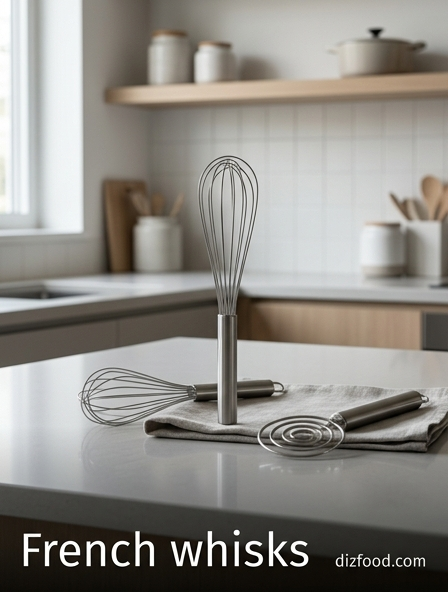
The French whisk is distinguished by its elongated, narrow profile and relatively stiff wire construction. Unlike its bulbous counterparts, the design prioritizes a slender silhouette that tapers toward the tip. Most professional-grade French whisks are constructed from high-carbon stainless steel to ensure resistance to corrosion and chemical reactions when working with acidic ingredients like citrus or vinegar. The wires are typically looped and anchored into a sealed, weighted handle that provides a counterbalanced feel during use.
Key anatomical features include:
- Wire Gauge: Thicker than standard whisks to maintain structural integrity under pressure.
- Handle Seal: Epoxy-filled or hydraulic-pressed to prevent food particles and moisture from entering the handle.
- Tapered Tip: A narrow apex designed for maneuverability in confined vessels.
- Loop Density: Generally features 8 to 12 loops, offering sufficient surface area without causing excessive drag in dense mixtures.
This specific geometry allows the tool to excel in emulsifying sauces and blending ingredients within deep, narrow containers where a wide balloon whisk would be physically restricted by the vessel's diameter.
Optimal Wire Tension for Thick Batters
Wire tension is the defining characteristic that separates the French whisk from decorative or light-duty aeration tools. In the context of thick batters, such as those used for panettone or heavy choux pastry, the tension must be high enough to resist permanent deformation. When the whisk is pressed into a dense medium, the wires must exert a reciprocal force that cuts through the viscosity rather than simply bending around the resistance. This tension ensures that dry pockets of flour are effectively integrated into the wet base.
The engineering behind this tension involves the "memory" of the stainless steel. High-quality whisks use tempered wires that return to their original shape after being stressed. This rigidity is essential for de-clumping starch molecules in heavy batters. Without optimal tension, the tool would fail to provide the mechanical energy required to break the surface tension of thick fats and sugars, leading to an uneven crumb structure in the finished baked good. Consequently, the French whisk acts as a bridge between a traditional whisk and a mixing paddle.
French vs Balloon Whisk Structural Differences
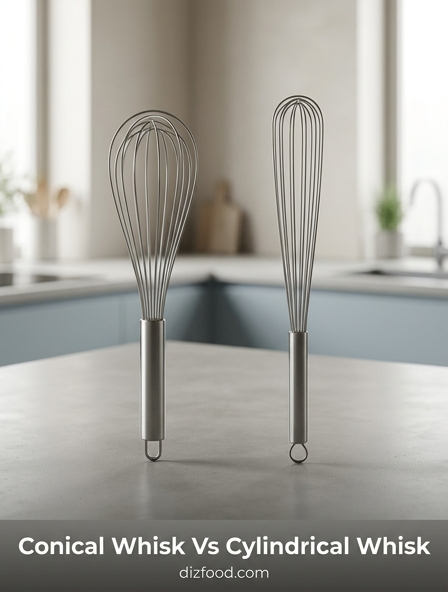
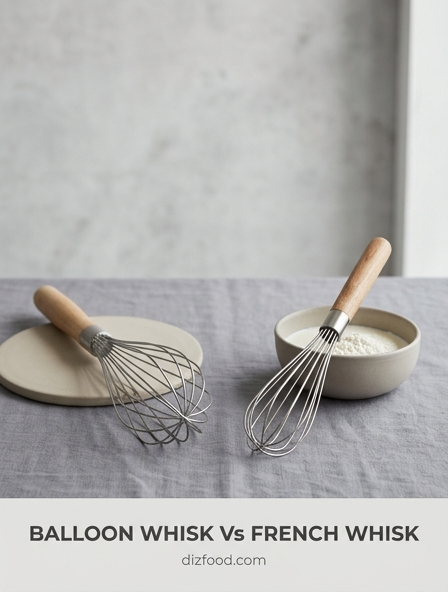
While both tools are essential in a professional kitchen, their structural differences dictate their specific utility. The balloon whisk is designed for maximum aeration, featuring a wide, spherical head that incorporates air into light proteins and creams. In contrast, the French whisk is engineered for density management and emulsion stability. The following table highlights the primary mechanical distinctions between these two common kitchen implements:
| Feature | French Whisk | Balloon Whisk |
|---|---|---|
| Shape | Narrow and Elongated | Wide and Bulbous |
| Wire Flexibility | Stiff and Rigid | Flexible and Springy |
| Primary Goal | Mixing and Emulsifying | Aeration and Volumizing |
| Best Vessel | Saucepan or Deep Bowl | Wide Mixing Bowl |
The structural rigidity of the French whisk prevents the "collapsing" effect often seen with balloon whisks when they are used in heavy ganaches or thick custards. This makes the French variant superior for tasks requiring high torque and consistent shear force across a smaller surface area.
Managing High Viscosity with Narrow Profiles
Managing high viscosity requires a tool that minimizes the total surface area contact while maximizing the force applied to the fluid. The narrow profile of the French whisk is a deliberate aerodynamic choice. In a high-viscosity liquid, such as a reduced demi-glace or a thick béchamel, a wide whisk creates a significant amount of "dead space" behind the wires, leading to inefficient mixing and potential scorching at the bottom of the pan. The slim design allows the chef to move the tool through the liquid with less physical exertion.
This profile is particularly advantageous when dealing with non-Newtonian fluids that thicken under stress. By slicing through the medium with a smaller frontal area, the French whisk prevents the entire mass from simply rotating with the tool. Instead, it forces the liquid to flow through the narrow gaps between the wires, creating localized turbulence that facilitates a more thorough incorporation of ingredients. This efficiency is critical in professional environments where speed and consistency are paramount for sauce preparation and texture control.
Enhanced Leverage for Heavy Ingredient Integration
The integration of heavy ingredients, such as cold butter into a hot reduction or thick sweeteners into dough, requires significant mechanical leverage. The French whisk provides this through its handle-to-head ratio and weighted construction. Most French whisks feature longer handles relative to the wire length compared to utility whisks. This design acts as a lever, allowing the user to apply downward and lateral pressure with minimal wrist strain. The center of gravity is typically located near the bolster, providing a balanced pivot point.
When integrating heavy ingredients, the leverage allows for:
- Crushing Power: Breaking down lumps of fat or unhydrated starch.
- Directional Control: Maintaining a steady path through resisting textures.
- Force Distribution: Evenly spreading the workload across the forearm rather than just the fingers.
This mechanical advantage is essential for preventing hand fatigue during long shifts. By utilizing the longer handle as a fulcrum, a chef can maintain a high-velocity stir even as the mixture thickens, ensuring that the heavy components do not settle or separate before the emulsion is fully stabilized.
Reaching Bowl Contours and Deep Corners
One of the primary frustrations in culinary preparation is the "dead zone" at the bottom edge of a saucepan or the deep corners of a narrow mixing bowl. Standard whisks, with their rounded bottoms, often miss these critical areas, leading to scorched flour or unmixed sugar. The French whisk addresses this through its unique geometry. The tip of the French whisk is narrower and more pointed, allowing it to penetrate the sharp angle where the wall of the vessel meets the base.
The ability to reach these contours ensures that the entire volume of the ingredients is constantly in motion. This is vital when making temperature-sensitive sauces like hollandaise or crème anglaise, where any stagnant liquid at the bottom of the pan will overcook and result in curdling. By effectively sweeping the corners, the French whisk promotes even heat distribution and prevents the buildup of caramelized solids. The slim profile also allows the tool to work around the edges of a thermometer or an immersion circulator without causing obstruction or splashing, maintaining a clean and controlled work environment.
Durability Against Dense Culinary Textures
The durability of a French whisk is a direct result of its intended use with dense culinary textures. While a balloon whisk might snap or permanently warp when forced through a heavy polenta or a thick roux, the French whisk is built to withstand such stressors. The wires are usually of a higher gauge, meaning they are thicker and more resistant to snapping at the point of insertion. The stainless steel used is often treated to handle extreme temperature fluctuations, from ice baths to boiling sugar syrups, without losing its temper.
Furthermore, the construction of the wires-often a continuous loop system-minimizes weak points. In professional kitchens, tools are subject to rigorous cleaning protocols, including high-heat dishwashers and abrasive scrubbing. The French whisk's robust design ensures that the wires do not loosen over time. This longevity is crucial for maintaining food safety, as loose wires can create crevices where bacteria might thrive. By choosing a tool engineered for dense textures, the chef ensures a reliable performance that remains consistent over thousands of uses, regardless of the resistance encountered in the mixing bowl.
Precision Agitation for Homogeneous Mixtures
Precision agitation is the process of creating a perfectly uniform mixture where every drop of liquid contains the same ratio of ingredients. The French whisk achieves this through its tight wire arrangement. Because the wires are closer together than in a balloon whisk, they create more "shear events" per rotation. As the whisk moves, the ingredients are forced through multiple narrow channels, which breaks down oil droplets into smaller spheres for a more stable emulsion.
This tool is the preferred choice for:
- Vinaigrettes: Creating a temporary emulsion that lasts longer before separating.
- Pan Gravies: Integrating fond and deglazing liquid into a smooth consistency.
- Custard Bases: Ensuring eggs and dairy are perfectly blended before heat is applied.
The lack of air incorporation is actually an advantage here; for many sauces, adding air bubbles (over-aeration) can ruin the silky mouthfeel or cause the sauce to break when heated. The French whisk provides the necessary agitation to achieve homogeneity without the unwanted side effect of excessive foam or volume increase.
Fluid Resistance and Tapered Wire Benefits
The concept of fluid resistance is central to the effectiveness of the French whisk. As a chef moves the whisk through a liquid, the liquid resists that movement. The tapered wires of the French whisk are designed to manage this resistance dynamically. Near the handle, where the wires are furthest apart, there is less resistance, allowing for a comfortable grip and control. Near the tip, where the wires converge, the resistance is higher, which is exactly where the most intense mixing action is required.
This tapering provides a graduated level of force. The narrower tip creates a "jet" effect as liquid is forced through the tightest part of the whisk, increasing the velocity of the mixture in that localized area. This helps in breaking up stubborn clumps of dry ingredients that often congregate at the bottom of a container. Additionally, the tapered shape reduces the "drag" felt by the chef, making it easier to maintain a high-speed whisking motion for extended periods. The result is a tool that works with the physics of the fluid rather than fighting against it, leading to more efficient kitchen workflows.
Professional Techniques for Mixing Stiff Batters
Using a French whisk effectively on stiff batters requires specific techniques that differ from light whisking. Professionals often employ a "figure-eight" motion rather than a simple circular stir. This technique ensures that the center of the batter is folded toward the edges and vice versa, preventing the formation of a stagnant core. Because the French whisk is rigid, it can also be used in a "chopping" motion to break up large masses of butter or shortening within a flour base before the liquid is fully incorporated.
Other professional techniques include:
- Side-to-Side Shearing: Moving the whisk rapidly across the diameter of the bowl to create high-shear zones.
- Bottom-Scraping: Utilizing the stiff tip to lift settled solids into the main body of the batter.
- Wrist-Locked Rotation: Using the power of the arm and shoulder to move the whisk through extremely high-viscosity mixtures, protecting the delicate wrist joints from repetitive strain.
By mastering these movements, a chef can fully leverage the structural advantages of the French whisk, producing smooth, lump-free batters and sauces even when working with the most challenging and resistant ingredients.

Comments