
Achieving a velvety, lump-free texture is the hallmark of a great cook, but the secret often lies in choosing the right tool for the task: the sauce whisk versus the gravy whisk. While both are designed to blend ingredients, they cater to different vessel shapes and liquid depths. A sauce whisk, typically a narrower version of a French whisk, excels at emulsifying ingredients in deep pots and incorporating air for a lighter finish. Conversely, the gravy whisk-often featuring a flat, spiral, or angled head-is specifically engineered to maintain constant contact with the bottom of shallow skillets, ensuring that flour and pan drippings are perfectly integrated without scorching. Whether you are whisking a delicate béchamel or deglazing a roasting pan, understanding these structural differences ensures a professional, smooth finish every time.
| Feature | Sauce Whisk (French Style) | Gravy Whisk (Spiral/Flat) |
|---|---|---|
| Primary Shape | Narrow, elongated wire loops | Flat coil or angled spring-head |
| Ideal Vessel | Deep saucepans and high-sided pots | Shallow skillets and roasting pans |
| Surface Contact | Concentrated at the tip/base | Maximum lateral surface coverage |
| Aeration Power | High; integrates air for volume | Low; focuses on deglazing/blending |
| Corner Reach | Moderate; better for rounded bases | Superior; hugs flat edges and corners |
| Best Used For | Emulsions, custards, and roux | Pan gravies, deglazing, and jus |
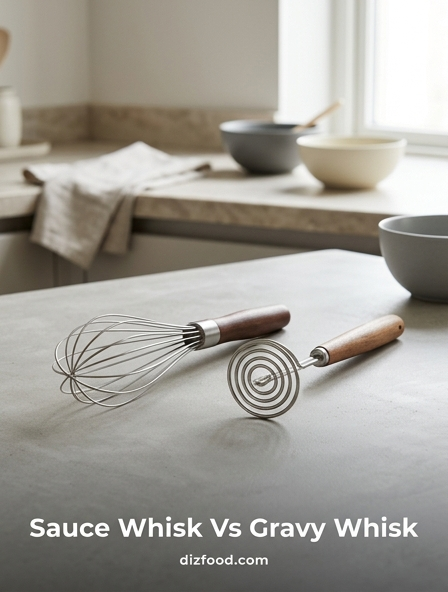
Sauce Whisk vs Gravy Whisk Key Differences
The primary distinction between a sauce whisk, often referred to as a French whisk, and a gravy whisk lies in their geometric profile and intended vessel. A sauce whisk is characterized by its elongated, narrow shape and stiff wire construction. It is designed to reach into the deep corners of heavy saucepans and high-sided pots where a traditional balloon whisk might be too wide. In contrast, a gravy whisk, frequently called a flat or roux whisk, features a flattened, spoon-like profile that allows the wires to lie flush against the bottom of a shallow skillet or roasting pan.
Functionally, the two tools serve different mechanical purposes during the cooking process. The French sauce whisk is optimized for aeration and the incorporation of heavy ingredients in deep liquid volumes, making it ideal for béchamel or pastry creams. The gravy whisk is engineered for surface contact; its flat design ensures that every millimeter of flour and fat is agitated, preventing the scorching that occurs when ingredients sit idle on a flat pan surface. When choosing between them, the depth of your cookware is usually the deciding factor.
- Vessel Compatibility: Sauce whisks for deep pots; gravy whisks for shallow pans.
- Wire Density: Sauce whisks typically have more wires for better emulsion.
- Angle of Use: Gravy whisks are used horizontally, while sauce whisks are used at a vertical or diagonal angle.
- Surface Area: Gravy whisks cover more horizontal space per stroke in a skillet.
Anatomy of a Professional French Sauce Whisk
The professional French sauce whisk is a masterpiece of ergonomic and structural engineering, tailored for the demanding environment of a commercial kitchen. Unlike the rounded balloon whisk used for whipping egg whites, the French whisk is notably slimmer. This narrow silhouette allows the chef to navigate the tight radii of professional sauciers without splashing. The wires are typically made of high-gauge stainless steel, providing enough tension to cut through thick emulsions while maintaining enough flexibility to vibrate against the pan walls.
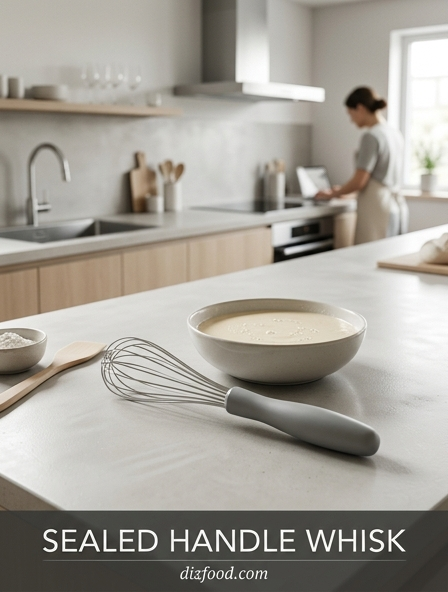
The handle of a professional-grade French whisk is often weighted to provide a balanced center of gravity, which reduces wrist fatigue during long periods of stirring. Many high-end models feature a sealed handle filled with epoxy to ensure hygiene, preventing liquid from seeping into the handle cavity. This design ensures the whisk remains a single, solid unit that can withstand the high heat of stovetop reductions. The density of the wire loops is also critical; a higher wire count allows for finer breaks in fat globules, leading to a smoother, more stable emulsion in complex sauces like Hollandaise or Bearnaise.
The tip of the French whisk is where the most action occurs. Because the loops are gathered tightly, they exert significant pressure on the bottom of the pot. This concentrated force is essential for breaking up stubborn clumps of flour or starch that may settle during the initial stages of sauce development. Whether it is a light velouté or a heavy chocolate ganache, the French whisk's anatomy is built for precision and power in narrow spaces.
Understanding the Flat Design of Gravy Whisks
The flat design of a gravy whisk is a specific solution to the challenges presented by wide, shallow cooking surfaces. When making gravy in a roasting pan or a large skillet, a standard rounded whisk is largely ineffective because only a tiny fraction of its wires actually touch the pan. This leaves large areas of the pan surface un-agitated, leading to "hot spots" where the flour in a roux can quickly burn. The flat whisk solves this by orienting its loops in a single plane, allowing the entire whisking surface to maintain contact with the pan floor simultaneously.
This design is particularly beneficial when deglazing. After roasting a piece of meat, the flavorful browned bits-known as the fond-stick to the bottom of the pan. The flat whisk acts almost like a flexible spatula, scraping these bits into the liquid while simultaneously incorporating the thickening agent. It provides the mechanical advantage of a spoon with the blending power of a whisk. By keeping the tool flat against the metal, the cook can ensure a perfectly homogeneous mixture without the need for high-walled containers.
| Feature | Benefit |
|---|---|
| Planar Alignment | Maximum contact with flat pan surfaces to prevent burning. |
| Low Profile | Easily slides under liquids in shallow roasting pans. | Conforms to the slight curves of skillet edges. |
Best Whisk Shapes for Shallow Pan Sauces
When working with shallow pans, shape is the most critical factor in achieving a successful sauce. Skillets and sauté pans offer a large surface area for evaporation, which is excellent for reductions but difficult for traditional whisks to manage. For these vessels, the flat whisk and the spiral whisk are the undisputed champions. Their geometry allows the cook to move the tool across the entire diameter of the pan without lifting the wires away from the heat source. This constant contact is what prevents the separation of fats and liquids in delicate pan sauces.
The flat whisk, often resembling a series of U-shaped wires nested together, is ideal for the initial stage of making a roux. It allows the cook to push the flour and butter around the pan like a squeegee. However, if the pan has rounded "sloped" sides, a spiral whisk might be even more effective. The spiral whisk features a single wire loop with a smaller coil wrapped around it. This design is exceptionally springy, allowing it to bounce into the "corners" where the bottom of the pan meets the wall, ensuring no pocket of flour remains dry or unmixed.
For home cooks who frequently prepare pan-seared meats followed by a quick pan sauce, having at least one flat-profile tool is essential. Using a balloon whisk in these scenarios often leads to "splash-over" because the wide wires hit the shallow liquid with too much upward force. The flat design keeps the agitation horizontal, containing the sauce within the pan while maximizing the efficiency of every stroke.
Comparing Wire Flexibility and Emulsification Power
Emulsification is the process of forced blending between two liquids that normally do not mix, such as oil and water. The power of a whisk to achieve this depends heavily on wire flexibility and the speed of the wires through the medium. A French sauce whisk usually features stiffer wires. These stiff wires are better at creating shear force in high-volume pots. When you whisk vigorously, the resistance of the stiff wires creates turbulence that breaks down oil droplets into microscopic sizes, creating a stable, creamy texture in sauces like mayonnaise or vinaigrettes.
On the other hand, the gravy whisk utilizes more flexible, thinner wires. While these are less effective at high-speed aeration, they are superior for mechanical scraping and "folding" in a shallow environment. In a gravy, emulsification is often secondary to starch suspension. The flexibility of the gravy whisk allows it to follow the contours of the pan, ensuring that the starch granules are evenly distributed throughout the fat before the liquid is added. This prevents the "clumping" that occurs when starch granules stick together and hydrate only on the outside.
In summary, if the goal is a thick, aerated emulsion like a hollandaise, the stiffness and density of a French whisk are required to provide the necessary shear. If the goal is a smooth, starch-thickened gravy where scraping the bottom of the pan is the priority, the flexible, low-profile wires of a gravy whisk are the superior choice. The interaction between wire tension and liquid resistance is what ultimately determines the silkiness of the final product.
How to Prevent Lumps in Homemade Gravy
Lumps in gravy are almost always the result of uneven hydration of starch, where the liquid hits the flour too quickly or without enough agitation. To prevent this, the choice of whisk and the technique used are paramount. Using a gravy whisk is the first step toward success because its flat bottom ensures that every part of the roux-the mixture of fat and flour-is in motion as the liquid is introduced. The goal is to create a smooth paste before expanding it into a full sauce.
- Control the Temperature: Always add cold liquid to a hot roux or hot liquid to a cold roux. This prevents the starch from gelatinizing instantly upon contact.
- The Slow Pour: Use a gravy whisk to stir the roux constantly while adding the liquid in a slow, steady stream. Start with just a few tablespoons to create a thick, smooth slurry.
- Scrape the Periphery: Lumps often hide in the edges of the pan. The flat whisk's ability to reach the junction of the pan floor and wall is essential here.
- Constant Agitation: Do not stop whisking until the sauce reaches a simmer. The heat must be distributed evenly to ensure uniform thickening.
If lumps do manage to form, a French whisk can sometimes be used to "beat" them out if the volume of liquid is high enough. However, the best defense is the preventative use of a flat whisk during the initial roux stage. By ensuring the flour is fully coated in fat and then slowly introducing the stock, the whisk acts as a mechanical barrier against clumping, resulting in a velvety texture every time.
Silicone vs Stainless Steel Kitchen Whisk Materials
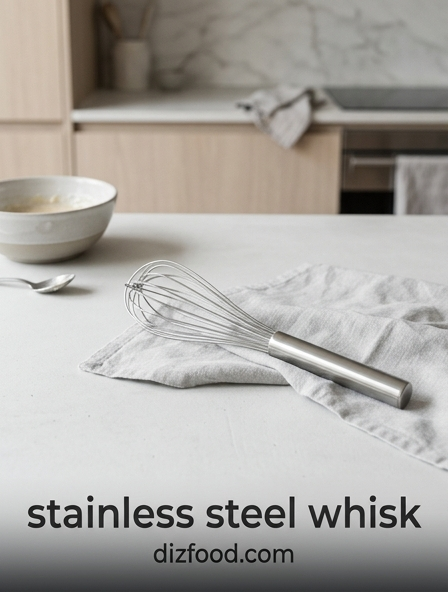
The material of your whisk is not just a matter of durability; it is a matter of protecting your cookware and achieving the right friction. Stainless steel is the traditional choice for professional chefs. Its primary advantage is its "hardness" and the thinness of the wires. Stainless steel wires can be made very thin while remaining strong, allowing them to cut through liquids with minimal resistance. Furthermore, steel is excellent for scraping the "fond" off the bottom of a stainless steel or cast-iron pan, as the metal-on-metal contact is very effective at lifting stuck-on proteins.
However, stainless steel whisks can be detrimental to non-stick or ceramic-coated cookware. This is where silicone-coated whisks become necessary. A silicone whisk features a metal core for stability, covered by a layer of heat-resistant silicone. This prevents the whisk from scratching the delicate coating of a non-stick pan, which would otherwise ruin the pan's effectiveness. While silicone whisks are safer for certain pans, they tend to have thicker "wires" because of the coating, which can make them slightly less efficient at fine emulsification.
- Stainless Steel: Best for high-heat, deglazing, and durability. Can scratch non-stick surfaces.
- Silicone: Best for non-stick pans. Generally heat resistant up to 500°F. Wires are thicker.
- Nylon: A cheaper alternative to silicone, but may melt if left against a hot pan for too long.
The Role of Spiral Whisks in Sauce Making
The spiral whisk, also known as a spring whisk or coil whisk, is a specialized variant that is often grouped with gravy whisks but offers a unique mechanical action. It consists of a single outer wire loop with a smaller wire coiled tightly around it. The unique advantage of this design is its vertical flexibility. When you press down on a spiral whisk, the coil flattens against the bottom of the pan, creating multiple contact points. This makes it perhaps the most effective tool for mixing small quantities of sauce in a shallow dish or even a coffee mug.
In the context of sauce making, the spiral whisk excels at incorporating dry ingredients into wet ones with very little effort. Because the coil is springy, it creates a slight vibration as it moves across the pan. This vibration helps to break up clumps of cocoa powder, cornstarch, or flour more quickly than a static wire would. It is also the preferred tool for making "pan gravies" where you have a very small amount of liquid and fat, as it doesn't require the depth that a French whisk needs to function correctly.
Furthermore, the spiral whisk is excellent for reaching the very bottom edges of a saucepan. While a French whisk has a rounded tip, the spiral whisk can be tilted so that the flat side of the coil scrapes the "corner" of the pot perfectly. This prevents the common problem of a ring of burnt sauce forming at the base of the pot. While it may not be suitable for heavy, thick batters, for light sauces and pan reductions, it is an incredibly efficient and underrated tool.
Choosing the Right Tool for Deglazing and Reduction
Deglazing is the culinary technique of adding liquid to a hot pan to loosen the caramelized bits of food stuck to the bottom. This is the foundation of most high-quality sauces. The choice of whisk for this task depends on the pan's material and depth. For a wide stainless steel roasting pan, a stainless steel flat whisk is the optimal choice. It allows you to apply downward pressure to "scrub" the pan floor with the wires, ensuring that every bit of flavor is incorporated into the wine or stock you have added.
As the sauce begins to reduce, its viscosity increases. Reduction is the process of simmering a liquid to evaporate water, thereby concentrating the flavors and thickening the consistency. During this stage, a sauce whisk (French whisk) becomes more useful if you are working in a deeper saucier. The French whisk's stiff wires are better at circulating the thickening liquid, ensuring that the reduction happens evenly and that the sauce doesn't catch on the bottom of the pot. The narrow profile also minimizes the surface area of the whisk that is exposed to the air, which helps maintain the temperature of the sauce.
Ultimately, the transition from deglazing to reduction may require a change in tools. Start with a flat or spiral whisk to secure the fond and establish the roux, then switch to a French whisk if you transfer the liquid to a deeper pot for the final simmering. This approach ensures that you are always using the tool that provides the most surface contact or the best circulation, depending on the current state of the sauce.
Essential Whisk Guide for Every Home Cook
Building a functional kitchen requires a strategic selection of tools, and whisks are no exception. While it is tempting to buy a single "all-purpose" whisk, having a specialized set will significantly improve the quality of your cooking. For most home cooks, a three-piece whisk kit is the gold standard. This should include a medium-sized balloon whisk for baking and aerating, a French sauce whisk for stovetop pots, and a flat gravy whisk for skillet work and deglazing.
When shopping for these tools, prioritize construction quality. Look for whisks where the wires are deeply embedded in the handle and sealed with epoxy. This prevents the common problem of wires pulling out or trapping old food and water inside the handle, which can lead to bacterial growth. If you use non-stick pans, ensure that at least your flat whisk is silicone-coated, as this is the tool most likely to be used in high-friction contact with the pan's surface. Stainless steel is fine for the French whisk, as it is often used in stainless steel sauciers.
Proper maintenance will extend the life of your whisks. While many are labeled as dishwasher safe, hand-washing is often better for preventing the wires from becoming tangled or bent. For a flat whisk, ensure you clean between the parallel wires immediately after use, as dried roux can be difficult to remove once it hardens. By matching the right whisk shape to your cookware and maintaining the tools properly, you can eliminate lumps and scorched sauces from your repertoire forever.

Comments