

The Science of Stable Emulsions
Emulsification is the culinary process of forcing two immiscible liquids, such as oil and water, into a homogenous mixture. At a molecular level, this requires breaking the surface tension of the dispersed phase into microscopic droplets that remain suspended within the continuous phase. Without a stabilizing agent or sufficient mechanical force, these droplets will naturally gravitate toward one another, causing the mixture to break or separate back into distinct layers. The stability of an emulsion relies heavily on the kinetic energy applied during the mixing phase and the presence of emulsifiers like lecithin or proteins.
To achieve a permanent emulsion, the chef must introduce high shear force. This force reduces the particle size of the oil to such an extent that Brownian motion and the viscosity of the base liquid prevent the droplets from coalescing. In the context of small-scale kitchen preparations, understanding the balance between the volume of the fat and the power of the agitation tool is essential. When the mechanical energy is concentrated correctly, the result is a creamy, opaque fluid that reflects light differently than its original components, signaling a successful molecular transformation.
Anatomy of the Small Coil Whisk
The small coil whisk, often referred to as a magic whisk or spring whisk, features a unique design tailored for specialized blending tasks. Unlike the standard rigid tines of a French whisk, this tool consists of a single wire handle that terminates in a flexible, helical coil. This coil is typically looped into a circular head, creating a spring-like mechanism that is highly responsive to pressure. The flexibility of the wire allows the head to compress and expand, ensuring that it maintains constant contact with the bottom and corners of a mixing vessel.
This specific geometry is engineered for two primary functions: shearing and scraping. The tight spacing of the coils creates a high surface-area-to-volume ratio, which is ideal for breaking down small clumps of dry ingredients or dispersing oil droplets. Because the head is flat and slightly angled, it excels in shallow containers where a larger whisk would be ineffective. The stainless steel construction provides the necessary tension to vibrate at high frequencies, which is a critical factor when attempting to aerate or emulsify dense liquids in confined spaces.
Coil Whisk versus Balloon Whisk Performance
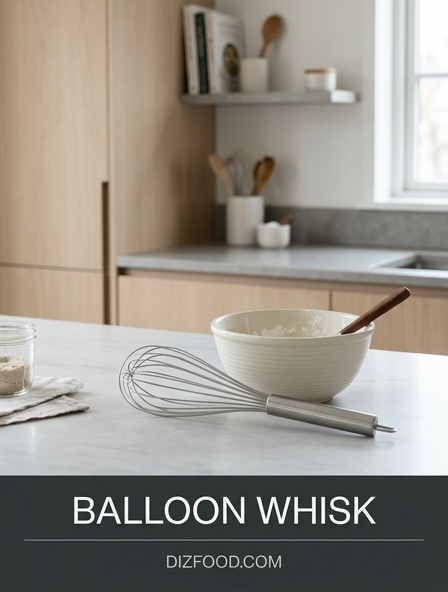
Choosing the correct tool for emulsification depends largely on the volume of the batch and the desired level of aeration. While the balloon whisk is the industry standard for large bowls of egg whites or cream, it lacks the precision required for small-diameter vessels like ramekins or narrow jars. The coil whisk provides a different mechanical advantage by focusing the energy on a horizontal plane rather than a vertical arc.
| Feature | Balloon Whisk | Coil Whisk |
|---|---|---|
| Primary Motion | Sweeping Arc | Vertical Pumping / Scraping |
| Ideal Batch Size | Large (500ml+) | Small (under 100ml) |
| Shear Force | Moderate | High (Concentrated) |
| Container Depth | Deep Bowls | Shallow or Narrow Cups |
The coil whisk outperforms the balloon whisk in scenarios where oil must be incorporated into a very small amount of mustard or vinegar. The localized agitation prevents the oil from pooling at the edges of the container, ensuring every drop is subjected to the shearing force of the spring coils.
Achieving Maximum Surface Tension in Small Batches
In small-scale cooking, such as preparing a single-serving dressing, surface tension is the primary obstacle to a smooth texture. When working with only a few tablespoons of liquid, the weight of the ingredients is insufficient to help break the interfacial tension between the oil and water. This is where the physics of the coil whisk becomes indispensable. By using the tool to create a high-frequency vibration, the chef can disrupt the surface of the oil more effectively than with a fork or a larger whisk.
To maximize this effect, one should focus on the "shearing" action. This involves moving the whisk in a way that forces the oil through the gaps in the coil at high velocity. This rapid movement slices the oil into smaller and smaller spheres. As the surface area of the oil increases through fragmentation, the emulsifying agents in the base liquid have a greater opportunity to coat each droplet. This coating reduces the tension that would otherwise cause the droplets to merge, resulting in a thick, stable suspension that holds its shape even when left to sit.
The Secret to Silky Vinaigrette Texture
A truly silky vinaigrette is distinguished by its mouthfeel and its ability to cling to greens without weeping. The secret lies in the incremental addition of fat and the use of a coil whisk to ensure total dispersion. Most failed vinaigrettes are the result of adding oil too quickly, which overwhelms the continuous phase and leads to large, greasy globules. By utilizing the coil whisk's ability to reach into the very bottom of a jar, the chef can start with a very small amount of base liquid-mustard, vinegar, and seasonings-and build the structure from the ground up.
The visual cue for a well-emulsified vinaigrette is a change in opacity and a notable increase in viscosity. As the oil is integrated, the mixture should transform from a translucent liquid into a thick, satin-like sauce. The coil whisk's design allows for constant agitation of the entire volume, ensuring that no "dead zones" exist where oil can hide. This thorough blending results in a uniform texture that provides a consistent flavor profile in every bite, preventing the sharp acidic hit that occurs when an emulsion is poorly constructed.
Why Vertical Agitation Prevents Oil Separation
Standard whisking techniques often rely on a circular or figure-eight motion. However, when using a coil whisk, vertical agitation-an up-and-down "pumping" motion-is far more effective for preventing oil separation. This motion leverages the spring-like properties of the whisk head. As the whisk is pressed against the bottom of the vessel, the coils compress, and as it is lifted, they expand. This creates a miniature vacuum and pressure cycle that pulls the liquid through the coils at high speed.
Vertical agitation is particularly effective because it forces the lighter oil downward into the heavier aqueous base, ensuring a more thorough mix than simple stirring. In a traditional stir, the oil often just floats on top or follows the path of the whisk without actually breaking down. The "bouncing" action of the coil whisk generates turbulent flow patterns that are chaotic enough to shatter oil droplets into the sub-micron range. This high-intensity turbulence is the key to creating a kinetic barrier that prevents the oil from migrating back to the surface, significantly extending the shelf life of the emulsion.
Optimal Wrist Techniques for Better Blending
Mastering the coil whisk requires a departure from the heavy arm movements used with larger whisks. Instead, the power should come almost exclusively from the wrist to maintain speed and control. The goal is to generate a high-frequency "flick" that keeps the coil in a state of constant vibration. This technique reduces fatigue and allows for the precise movements needed when working in small vessels where space is limited.
- The Pivot Grip: Hold the whisk handle lightly between the thumb and first two fingers, allowing the tool to pivot freely.
- The Rapid Flick: Move the wrist in a short, sharp up-and-down motion rather than a wide circle.
- The Edge Sweep: Occasionally tilt the whisk to let the outer edge of the coil scrape the side walls of the vessel.
- The Pulse: Increase the speed in short bursts when first adding the oil to maximize initial shear.
Consistent rhythm is more important than raw strength. By maintaining a steady, fast pace, you create a stable environment for the emulsion to form. If the motion is erratic, the droplets may have time to regroup, making it harder to achieve that desired silky consistency.
Best Mixing Vessels for Coil Whisks
The efficiency of a coil whisk is heavily influenced by the geometry of the mixing vessel. Because the whisk head is flat and flexible, it is designed to interact with flat-bottomed containers. Using a large, rounded mixing bowl with a small coil whisk is counterproductive, as the tool will not be able to apply sufficient pressure against the curved surface. Instead, narrow and tall vessels are the ideal choice for this specific tool.
Standard glass measuring cups, small jars, or even coffee mugs provide the perfect environment. The narrow diameter of these vessels keeps the ingredients concentrated around the whisk head, ensuring that every part of the mixture is subjected to the mechanical energy. Furthermore, the high walls of a jar or a narrow beaker prevent splashing during high-speed vertical agitation. When the container width is only slightly larger than the whisk head, the fluid is forced to move through the coils rather than simply flowing around them, which significantly increases the shear rate and leads to a faster, more stable emulsion.
Mastering the Art of Micro-Aeration
While emulsification focuses on liquid-in-liquid dispersion, the coil whisk is also an expert tool for micro-aeration, which is the process of incorporating tiny air bubbles into a liquid. This is distinct from the large, fluffy bubbles created by a balloon whisk. Micro-aeration results in a dense, creamy foam often seen in specialized sauces like hollandaise or for creating a frothy top on a small-batch latte. The tight coils of the whisk act as a manifold, slicing through the air-liquid interface to create bubbles so small they are barely visible to the naked eye.
To achieve micro-aeration, the whisk should be used at the surface of the liquid, partially submerged. By using a rapid, shallow vertical motion, you can "pump" air into the mixture. The result is an increase in volume and a lighter, more luxurious mouthfeel. This technique is particularly useful for final-stage finishing, where you want to add a sense of lightness to a heavy sauce without diluting the flavor. The stability of these micro-bubbles is enhanced by the proteins in the liquid, which wrap around the air to create a structural matrix.
Maintaining and Cleaning Your Specialized Whisk
Due to the tight spacing of the coils, the small coil whisk requires specific attention during cleaning to prevent the buildup of dried fats or proteins. If left to dry, residues from emulsions like mayonnaise or vinaigrettes can become trapped within the helical spring, which is both unhygienic and detrimental to the tool's flexibility. The best practice is to rinse the whisk immediately after use under high-pressure hot water, which should dislodge most particles before they have a chance to set.
For a deeper clean, the whisk can be agitated in a container of warm, soapy water using the same vertical motion used for mixing. This "self-cleaning" action uses the tool's own mechanical design to force soap through the coils. Most high-quality coil whisks are made of food-grade stainless steel and are dishwasher safe, but it is important to ensure they are placed in a position where water can flow through the head. Periodic inspection of the wire loop is also recommended to ensure the coil hasn't become over-stretched or deformed, as the tension of the spring is vital for its performance in creating stable emulsions.

Comments