
Understanding Spring Whisk Anatomy
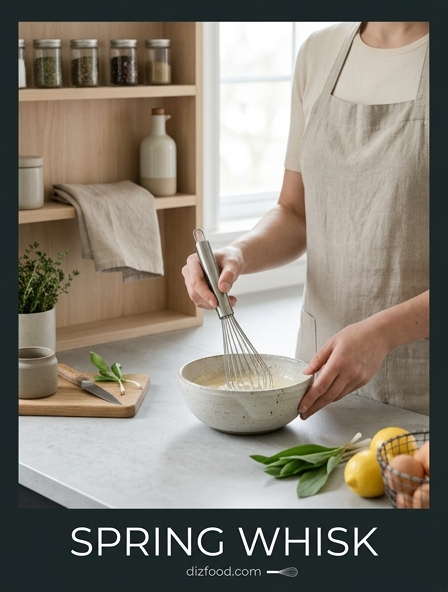
The spring whisk, often referred to as a coil whisk, is a specialized culinary tool defined by its unique wire configuration. Unlike the traditional looped wires of a balloon whisk, the spring whisk features a single, continuous wire that spirals into a circular, flattened head. This coil is typically mounted on a long, straight handle, providing a degree of flexibility that allows the head to compress and rebound during use. The anatomy is purposefully designed for vertical movement rather than the lateral sweeping motions common in baking. This design ensures that the whisk can maintain constant contact with the bottom of a vessel.
Most high-quality spring whisks are constructed from stainless steel to ensure durability and resistance to corrosion from acidic ingredients. The handle is often weighted to provide balance, while the coil itself must possess a specific tension. This tension is crucial; if the coil is too rigid, it loses its ability to navigate pan contours, but if it is too loose, it fails to agitate ingredients effectively. Key components include:
- Ergonomic handle for grip stability.
- Flexible neck for angled agitation.
- Responsive outer coil for surface scraping.
- Internal support wire to maintain the spring's shape.
The Shallow Pan Advantage
In the culinary world, the depth of your cookware often dictates the choice of tool. The spring whisk excels in shallow environments where a bulbous balloon whisk would be cumbersome and ineffective. Because the spring whisk features a flat, angled profile, it can lay flush against the bottom of a sauté pan or skillet. This allows the user to incorporate ingredients without needing a deep reservoir of liquid, making it the ideal choice for creating roux or small batches of gravy. The flat head ensures that every millimeter of the pan's surface is reached, preventing the scorching that often occurs in the center or around the edges.
When working in a shallow pan, the volume of liquid is often spread thin, increasing the rate of evaporation. A spring whisk manages this by allowing for rapid, localized stirring that keeps the mixture in constant motion. This tool transforms the way a cook interacts with a skillet, moving away from the "whipping" motion used in bowls to a "pressing and circulating" motion. This efficiency ensures that the heat is distributed evenly throughout the sauce, resulting in a more consistent texture and preventing the separation of fats from the base liquid.
Surface Blending vs Deep Aeration
Choosing between surface blending and deep aeration is essential for achieving the desired texture in a recipe. A spring whisk is primarily a surface blending tool, whereas a balloon whisk is designed for deep aeration. The coil mechanism is built to break up lumps on a flat surface rather than incorporating large volumes of air into a liquid. This makes the spring whisk unsuitable for making meringues or whipped cream, but unparalleled for emulsifying a vinaigrette or smoothing out a béchamel. The following table highlights the primary differences between these two mechanical approaches:
| Feature | Spring Whisk (Surface) | Balloon Whisk (Aeration) |
|---|---|---|
| Primary Motion | Vertical/Up-and-Down | Circular/Side-to-Side |
| Air Incorporation | Minimal | High |
| Ideal Vessel | Skillet or Shallow Pan | Deep Bowl or Pot |
| Lump Removal | Excellent on surfaces | Moderate in liquids |
By focusing on surface blending, the cook can ensure that thickeners like flour or cornstarch are fully integrated into the fat before more liquid is added. This prevents the formation of "flour pockets" that can ruin the silkiness of a professional sauce.
Mastering Deglazing and Pan Sauces
Deglazing is the process of releasing caramelized food particles, known as fond, from the bottom of a pan after searing meat or vegetables. The spring whisk is the ultimate tool for this task because the spring-loaded head acts as a gentle scraper. When a liquid, such as wine or stock, is added to the hot pan, the spring whisk can be pressed down and moved across the surface to lift the fond without scratching the cookware. The vibration of the coils further assists in breaking down these flavorful bits, integrating them into the liquid far more efficiently than a wooden spoon could.
- Add deglazing liquid to the hot skillet after removing the proteins.
- Position the spring whisk flat against the bottom of the pan.
- Use a back-and-forth motion to agitate the coils against the fond.
- Apply light downward pressure to ensure the coils reach into the microscopic ridges of the metal.
- Continue stirring as the sauce reduces to maintain a homogenous emulsion.
This process results in a pan sauce that is rich, clear, and deeply flavorful. The spring whisk's ability to combine deglazing with constant agitation prevents the sauce from breaking as it thickens.
Reaching Skillet Corners Effectively
One of the most frustrating aspects of sauce-making is the "dead zone" located at the curved junction where the pan bottom meets the side wall. Ingredients often settle in these corners, leading to localized burning or uneven thickening. A standard balloon whisk cannot reach these areas because its rounded wires are too large to fit into the tight radius of a skillet's edge. The spring whisk solves this geometric problem through its flexible, flat-bottomed design. The outer edge of the coil can be pushed directly into the corner, conforming to the shape of the pan and ensuring that no ingredient is left undisturbed.
This capability is particularly important when working with dairy-based sauces or thick reductions that are prone to sticking. By moving the spring whisk around the perimeter of the pan, the cook can maintain a clean surface throughout the entire cooking process. This total coverage ensures that the final product is free of burnt specks and has a uniform viscosity. Furthermore, the ability to reach the corners allows for a more efficient reduction, as the entire volume of the sauce is kept in motion, maximizing the surface area exposed to the heat.
Spring Whisk vs Balloon Whisk
While both tools are essential in a well-equipped kitchen, they serve distinct purposes and are not interchangeable. The balloon whisk is the "generalist," featuring a bulbous shape made of several wire loops. It is designed to trap air, making it perfect for light and fluffy mixtures. In contrast, the spring whisk is a "specialist." Its design focuses on agitation and surface contact. Understanding when to reach for each tool can significantly improve the quality of your cooking. Consider these comparative factors:
- Volume: Balloon whisks handle large volumes in deep bowls; spring whisks handle small volumes in flat pans.
- Texture: Use a balloon whisk for foams; use a spring whisk for smooth, dense emulsions.
- Action: Balloon whisks require a vigorous wrist snap; spring whisks respond best to a steady, rhythmic pumping or stirring.
- Cookware: Balloon whisks are for high-sided pots; spring whisks are for low-sided skillets.
In many professional kitchens, the spring whisk is the secret weapon for sauces, while the balloon whisk is reserved for the pastry station. Using a balloon whisk in a flat pan often results in splashing and uneven mixing, whereas using a spring whisk in a deep bowl of egg whites will yield almost no volume.
Optimal Emulsification for Dressings
Creating a stable emulsion, such as a balsamic vinaigrette or a creamy Caesar dressing, requires a tool that can break oil droplets into microscopic sizes. The spring whisk is exceptionally well-suited for this because of the high frequency of its wire coils. As the whisk moves through the oil and vinegar, the spring vibrates, creating many points of contact that shear the oil. This shearing action is far more effective for small-batch dressings than a traditional whisk, which may simply move the liquid around without fully integrating the phases.
When preparing a dressing in a small ramekin or a shallow bowl, the spring whisk's compact size is an advantage. It allows the cook to apply force without the risk of the tool flipping the container over. By using a rapid up-and-down motion, the cook can create a thick, creamy emulsion in a fraction of the time. This efficiency is vital when preparing dressings a la minute, ensuring that the oil and acid remain bound together long enough to coat the salad greens perfectly without separating on the plate.
The Science of the Coil Mechanism
The efficacy of the spring whisk lies in the physics of its coil. When the whisk is pressed against the bottom of a pan, the coil compresses, storing potential energy. As it is moved or lifted, that energy is released, causing the coil to vibrate. This vibration creates turbulence at a molecular level within the sauce or batter. This turbulence is what allows the spring whisk to break up dry clumps of flour or cocoa powder more effectively than a static wire loop. The coils act as dozens of tiny individual whisks working simultaneously on the surface of the pan.
Additionally, the coil mechanism increases the surface area of the tool that is in contact with the ingredients. Every loop of the spring provides a leading edge that slices through the liquid. This high-density contact is why the spring whisk is so effective at creating smooth textures. The physics of the spring also provides tactile feedback to the cook; you can feel the resistance of the sauce through the handle, allowing for precise control over the thickening process. This mechanical synergy between the user and the tool is what makes the spring whisk a favorite among sauce-makers.
Ergonomic Stirring for Long Reductions
Long reductions, such as those required for a demi-glace or a complex tomato sauce, can be physically taxing on the wrist and forearm. Traditional whisking involves a wide, circular motion that engages the entire arm. The spring whisk, however, allows for a more ergonomic approach. Because it is designed to be moved in a smaller, more controlled vertical or oscillating fashion, it puts less strain on the joints. The flexibility of the neck absorbs much of the impact that would otherwise be transferred to the cook's wrist, making it easier to maintain the constant stirring required for long periods.
This ergonomic advantage is particularly beneficial in professional settings where a chef might be tending to multiple pans over several hours. By reducing the range of motion required to keep a sauce from scorching, the spring whisk helps prevent repetitive strain injuries. The lightweight nature of the tool, combined with its high efficiency, means that less force is required to achieve the same results as a heavier balloon whisk. For home cooks, this translates to a more comfortable and enjoyable cooking experience, especially when tackling labor-intensive recipes that require undivided attention at the stove.
Maintaining Your Specialized Kitchen Tools
Proper maintenance of a spring whisk is essential to preserve its flexibility and hygiene. The very feature that makes it effective-the tight coil-can also trap food particles, making it more challenging to clean than a standard whisk. To ensure longevity, it is important to clean the whisk immediately after use before sauces have a chance to dry and harden within the springs. If the whisk is made of high-quality stainless steel, it is likely dishwasher safe, but manual cleaning is often more effective for reaching between the coils.
- Rinse Immediately: Run hot water through the coils right after use.
- Use a Brush: A soft-bristled kitchen brush can help dislodge stubborn debris from the spring.
- Dry Thoroughly: Ensure no moisture is trapped in the center of the coil to prevent water spots or oxidation.
- Check Tension: Occasionally inspect the spring to ensure it hasn't been stretched or deformed, which would affect its performance.
Storing the spring whisk properly is also vital. Avoid overcrowding it in a utensil drawer where the coils could become tangled with other tools. Hanging the whisk or placing it in a wide-mouthed utensil crock will keep the spring head protected and ready for its next use.

Comments