
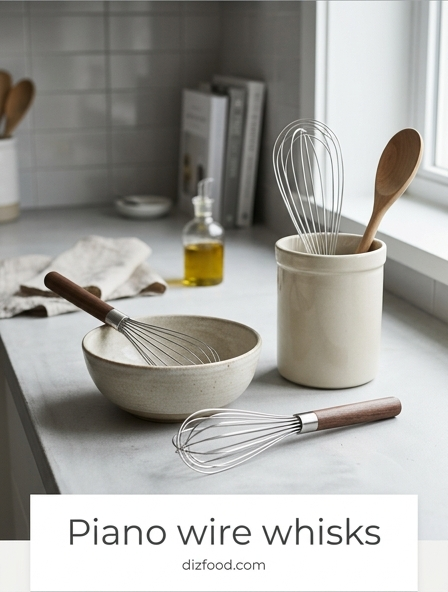
Understanding Piano Wire Density
The piano wire whisk is distinguished by its high count of thin, flexible wires, typically crafted from high-tensile stainless steel. Unlike heavy-duty balloon whisks designed for thick batters, the density of piano wires is engineered specifically for light, liquid-based tasks. The sheer number of wires allows the tool to cut through the medium multiple times in a single stroke, significantly increasing the efficiency of the mixing process. This high density is crucial for tasks requiring the suspension of solids in liquids or the rapid integration of ingredients with different viscosities.
When selecting a whisk based on wire density, consider the following characteristics:
- Wire Gauge: Thinner wires offer more flexibility, reducing the effort required for long whisking sessions.
- Wire Count: A higher number of wires creates more surface area for air entrapment.
- Spacing: Narrow gaps between wires ensure that no large clumps of dry ingredients remain unmixed.
- Material Tension: High-density wires should snap back to their original shape immediately after being flexed.
The interplay between these factors determines how effectively the whisk can emulsify or aerate. A whisk with too few wires will require twice the labor to achieve the same results as a professional-grade piano whisk.
The Mechanics of Aeration
Aeration is a physical process where air is forced into a liquid to create a foam or to lighten a mixture. The piano wire whisk is the ultimate tool for this mechanical action due to its ability to create turbulence. As the wires move through a liquid, they create a low-pressure zone behind them, drawing air into the wake. This air is then trapped by the proteins or fats present in the mixture, forming tiny bubbles. The more wires the whisk has, the more "cutting" actions occur per rotation, resulting in smaller, more stable bubbles.
- Disruption: The wires break the surface tension of the liquid, allowing air to enter.
- Fragmentation: Larger air pockets are broken down into microscopic bubbles by the fast-moving, thin wires.
- Stabilization: Ingredients like egg proteins or milk fats coat these bubbles, preventing them from collapsing.
The speed of the whisking motion is directly proportional to the rate of aeration. Using a piano wire whisk allows the chef to achieve a higher volume in a shorter period compared to using a fork or a heavier whisk, as the thin wires move with less resistance through the medium.
Mastering the Perfect Meringue
Creating a meringue is an exercise in protein denaturation and air incorporation. Egg whites consist largely of water and proteins; when whisked with a piano wire tool, these proteins unfold and bond together around air bubbles. The fine wires of the piano whisk are essential here because they provide the precision needed to build a delicate structure without overworking the proteins too quickly. Over-whisking can lead to the protein network collapsing, resulting in a grainy, watery mess. The piano whisk provides the tactile feedback necessary to stop at the exact moment of perfection.
| Meringue Stage | Visual Characteristic | Best Use |
|---|---|---|
| Soft Peak | Tips curl over when whisk is lifted | Mousses and Fold-ins |
| Firm Peak | Tips hold shape but are flexible | Pies and Toppings |
| Stiff Peak | Points stand straight up | Macarons and Meringue Cookies |
By using a high-density wire whisk, the air bubbles created are uniform in size, which leads to a smoother texture and a more predictable rise during the baking process.
Maximizing Whipped Cream Volume
To maximize the volume of whipped cream, one must manage temperature and fat distribution. Piano wire whisks are ideal for this because they do not generate excessive heat through friction, which is vital since cream must remain cold to hold air. As the whisk moves, it strips the protective membranes from fat globules, allowing them to stick together and form a skeleton that supports the air bubbles. The high wire count ensures that this process happens evenly throughout the bowl, preventing the bottom from remaining liquid while the top over-whips.
- Cold Equipment: Chill the whisk and the bowl to maintain fat stability.
- Consistent Speed: Start slow to build a base, then increase speed for volume.
- Visual Cues: Watch for the moment ripples in the cream hold their shape.
- Fat Content: Ensure the cream has at least 30% fat for optimal aeration.
A piano wire whisk excels here because its flexibility allows it to reach the transition points where the cream meets the side of the bowl, ensuring every drop is integrated into the foam. This results in a lighter, fluffier end product with maximum yield.
Optimal Bowl Geometry for Whisking
The effectiveness of a piano wire whisk is heavily influenced by the shape and material of the container. For optimal results, a spherical or copper bowl is preferred. The rounded bottom ensures that the whisk makes contact with the entire surface area of the liquid, leaving no "dead zones" where ingredients can settle. If a bowl has flat corners, the whisk cannot effectively reach the edges, leading to uneven mixing and wasted effort. The radius of the bowl should ideally complement the curvature of the whisk head to maximize the stroke's efficiency.
- Rounded Bottoms: Facilitates a continuous circular or figure-eight motion without interruption.
- Material Choice: Stainless steel is durable, while copper helps stabilize egg whites chemically.
- Depth: High-sided bowls prevent Splattering during high-speed aeration.
- Size Scaling: The bowl should be large enough to accommodate a fourfold increase in volume for foams.
Proper geometry allows the piano wires to flex slightly against the sides of the bowl, creating a scraping action that ensures all dry particles or heavy syrups are fully incorporated into the lighter components of the mixture.
Precision Control with Flexible Wires
The primary advantage of the piano wire whisk over its stiffer counterparts is the level of precision and control it offers the user. The thin, springy wires provide immediate tactile feedback through the handle, allowing the chef to feel the changing viscosity of the mixture. This is particularly important when making delicate sauces like Hollandaise or Bearnaise, where the emulsion can break if the heat is too high or the agitation is too aggressive. The flexibility of the wires allows for a gentle touch that is impossible to achieve with a rigid whisk.
This precision also manifests in the ability to switch between broad, sweeping strokes and tight, rapid vibrations. When working with small volumes in a narrow pan, the wires can be compressed to fit the space without losing their functional shape. This adaptability makes the piano wire whisk a versatile tool for both high-volume aeration and technical, small-batch emulsification. Because the wires are thin, they move through the liquid with minimal drag, allowing for subtle adjustments in speed and direction that give the cook total authority over the texture of the dish.
Proper Wrist Technique for Speed
Mastering the piano wire whisk requires moving away from whole-arm movements and focusing on the pivot of the wrist. Effective whisking is not about force; it is about frequency and rhythm. By keeping the elbow relatively stationary and using the wrist to drive the motion, the chef can maintain a high speed for a longer duration without succumbing to fatigue. The most effective motion for aeration is the "figure-eight" or a side-to-side "beating" motion, rather than a simple circular stir, as this creates the most turbulence.
- The Grip: Hold the whisk near the top of the handle, similar to a pencil or a baton, for maximum leverage.
- The Flick: Use a rapid snapping motion of the wrist to create high-velocity wire movement.
- Rhythm: Establish a steady beat to ensure uniform air distribution.
- Angle: Tilt the bowl slightly to increase the surface area exposed to the wires.
Using the correct technique ensures that the piano wires are utilized to their full potential. The speed generated by a flicking wrist allows the wires to snap through the liquid, maximizing the number of air bubbles created per second.
Achieving Stable Peak Consistency
Stability in foams is the hallmark of a skilled cook, and the piano wire whisk is the instrument of that stability. A stable foam is one where the air bubbles are small, numerous, and evenly supported by a strong network of fats or proteins. Achieving this requires a gradual build-up of speed. If you start too fast, you create large, unstable bubbles that will quickly deflate. By starting at a moderate pace and increasing intensity as the mixture thickens, you create a dense foundation of microscopic bubbles that provide the structural integrity needed for stiff peaks.
| Factor | Effect on Stability | Recommendation |
|---|---|---|
| Wire Thinness | Smaller bubbles | Use high-gauge piano wire |
| Temperature | Fat/Protein bonding | Keep cream cold; eggs room temp |
| Acid Additives | Protein strengthening | Add cream of tartar or lemon juice |
| Sugar Timing | Structure reinforcement | Add gradually after soft peaks form |
The final stage of whisking is the most critical. As the peaks begin to form, the resistance felt through the piano wires will increase. This feedback tells the chef to slow down and check the consistency frequently to avoid over-beating.
Incorporating Air into Delicate Batters
When working with delicate batters, such as those for soufflés, sponge cakes, or chiffon, the goal is to fold in aerated egg whites without deflating them. While many use a spatula for this, a piano wire whisk is often superior for the initial stages of incorporation. Because of its open structure, the whisk allows the heavy batter to pass through the wires while gently distributing the foam. This prevents the formation of large clumps of unmixed batter, which would otherwise weigh down the final product and cause an uneven rise.
To use a piano whisk for incorporation, one should use a "cut and fold" motion. This involves slicing the whisk through the center of the mixture and lifting it up the side of the bowl. The thin wires act like multiple tiny spatulas, breaking the foam into smaller sections that integrate more easily with the base liquid. This method ensures that the air you worked so hard to incorporate remains trapped within the batter, resulting in a light, airy crumb and a significant oven spring during baking. It is the preferred method for professional pastry chefs who prioritize texture and volume.
Caring for High Density Wires
A piano wire whisk is a precision instrument and requires proper maintenance to ensure its longevity and performance. Because the wires are thin and numerous, they are susceptible to bending and trapping food particles at the base where they meet the handle. If a wire becomes bent, it can disrupt the flow of the whisk and make it difficult to achieve uniform aeration. Furthermore, trapped moisture at the handle junction can lead to rust or bacterial growth, even with stainless steel models.
- Immediate Rinsing: Rinse the whisk under hot water immediately after use to prevent ingredients from drying on the wires.
- Deep Cleaning: Use a soft brush to reach the crevices where the wires are anchored.
- Drying: Hang the whisk or lay it flat on a drying rack with the wires pointed downward to drain moisture from the handle.
- Storage: Avoid overcrowding in utensil drawers; hanging the whisk prevents the delicate wires from being crushed.
With proper care, a high-quality piano wire whisk will maintain its tension and shape for years. Regular inspection of the wires for alignment ensures that every stroke remains as efficient as the first day the tool was used.

Comments