
Choosing between a classic rotary whisk and a modern immersion blender attachment often comes down to a battle between tactile precision and motorized efficiency. While the hand-cranked rotary whisk remains a nostalgic favorite for bakers who demand total control over aeration-perfect for fluffy meringues and delicate batters where over-mixing is a risk-the immersion blender attachment is a high-speed powerhouse built for rapid emulsification and heavy-duty tasks. Whether you are looking to whip up a single cup of cream without waking the house or need to transform chunky vegetables into a silky bisque in seconds, understanding the mechanical strengths of these two kitchen staples ensures you always have the right tool to master your mixing tasks with ease.
| Feature | Rotary Whisk (Manual) | Immersion Blender Attachment |
|---|---|---|
| Power Source | Manual hand-crank; muscle-powered. | Electric motor; high-torque output. |
| Best For | Aerating eggs, light batters, whipped cream. | Emulsifying mayo, smoothies, thick sauces. |
| Texture Result | Light, airy, and highly voluminous. | Ultra-smooth, dense, and homogenized. |
| Speed Control | Infinite variable control via hand speed. | Fixed multi-speed or pulse settings. |
| Cleanup | Easy; usually one-piece and dishwasher safe. | Two-piece; requires detaching drive motor. |
| Durability | High; no electronic parts to fail. | Moderate; dependent on motor/gear life. |
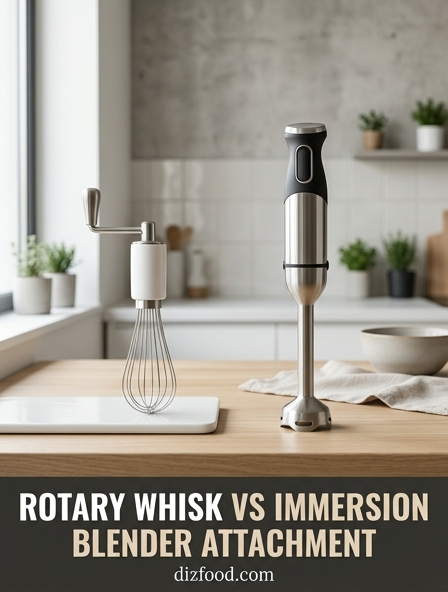
Rotary Whisk vs Immersion Blender Attachment Performance Comparison
When evaluating the performance of a manual rotary whisk against a motorized immersion blender attachment, the primary distinction lies in the source of power and the resulting torque. The rotary whisk, often referred to as an eggbeater, relies on a hand-crank mechanism that translates circular motion into high-speed rotation of two interlocking beaters. While it offers significant mechanical advantage over a standard balloon whisk, it is still limited by the user's physical stamina and speed. In contrast, the immersion blender attachment utilizes an electric motor that provides consistent, high-RPM rotation that far exceeds human capabilities.
| Feature | Rotary Whisk | Immersion Blender Attachment |
|---|---|---|
| Power Source | Manual Hand Crank | Electric Motor |
| Top Speed | Moderate | High |
| Operator Fatigue | High after 2 minutes | Minimal |
| Aeration Quality | Excellent for volume | Rapid but can over-process |
In high-viscosity tasks, such as thick cake batters, the immersion blender attachment often struggles due to the thin gauge of its wire whisk, which is designed for aeration rather than mixing heavy loads. The rotary whisk features sturdier blades that can cut through denser semi-liquids more effectively without risking motor burnout. However, for sheer speed in emulsifying liquids, the motorized option remains the superior performer in modern kitchens.
Best Tools for Whipping Cream and Fluffy Egg Whites
Achieving the perfect stiff peak in egg whites or a luxurious texture in whipped cream depends heavily on how air is incorporated into the proteins or fats. The rotary whisk is a traditional favorite for this task because the dual-beater action creates a turbulent environment that traps large volumes of air quickly. Because the user can feel the resistance of the cream thickening through the handle, there is a lower risk of over-whipping the mixture into butter.
- Soft Peaks: Both tools reach this stage quickly, but the rotary whisk offers better visual monitoring.
- Stiff Peaks: The immersion blender attachment is faster, taking approximately 60 seconds for a pint of cream.
- Volume: Manual rotary whisks often produce slightly more volume because the slower speed allows for larger air bubbles to stabilize before being broken down.
The immersion blender attachment is highly efficient for small to medium batches. However, because the whisk head is usually smaller than the beaters on a rotary tool, it may require more movement around the bowl to ensure every drop of liquid is aerated. For professional-grade fluffiness in meringues, many chefs still prefer the controlled speed of a manual tool, though the convenience of the motorized attachment is undeniable for daily meal preparation where time is the primary constraint.
Hand Powered vs Motorized Whisking Efficiency
Efficiency in the kitchen is measured by the ratio of output quality to the effort expended. Motorized whisking is objectively more efficient for repetitive, high-speed tasks. An immersion blender can maintain a steady speed of over 10,000 RPM, which is physically impossible to replicate by hand. This makes it the ideal choice for tasks that require long durations of agitation, such as making a large batch of homemade mayonnaise or whisking several egg whites for a souffle.
- Setup Time: Rotary whisks are grab-and-go, requiring no power outlets or cord management.
- Processing Time: Motorized attachments reduce whisking time by approximately 70% compared to manual cranking.
- Physical Demand: Manual whisks can cause wrist strain and forearm fatigue, making them less suitable for users with mobility issues.
Despite the speed of the motor, the rotary whisk maintains a certain "mechanical efficiency." Because it does not require electricity, it is infinitely portable and can be used in any part of the kitchen or even outdoors. The gear ratio on most rotary whisks is designed so that one turn of the handle results in multiple rotations of the beaters, which provides a satisfying level of output for minimal input. Ultimately, the choice depends on whether the user prioritizes the speed of a motor or the independence of a manual tool.
Consistency and Texture Results for Smooth Batters
Creating a smooth, lump-free batter for pancakes, crepes, or Yorkshire puddings requires consistent shearing of flour particles into liquid. The immersion blender attachment is particularly adept at this because the high-speed wire whisk can break down small clumps of dry ingredients almost instantly. The result is a highly homogenous mixture with a very fine texture. However, the high speed also increases the risk of over-developing gluten, which can lead to a tough or rubbery finished product if used for too long.
- Pancake Batter: Rotary whisks are better for leaving a few "flavor lumps" which keep pancakes tender.
- Crepe Batter: The immersion blender attachment provides the necessary silkiness for thin, delicate crepes.
- Sauces: Motorized whisks excel at smoothing out gravies and béchamels that have begun to clump.
The rotary whisk provides a more moderate agitation. It is effective at mixing but lacks the sheer force needed to pulverize stubborn flour pockets. For bakers who value a specific crumb structure, the manual tool offers more "feel" for the batter's development. You can stop the moment the ingredients are combined, ensuring the texture remains light. In contrast, the immersion blender whisk is a "set it and forget it" tool that prioritizes uniformity over structural delicacy.
Cleanup and Storage Differences for Kitchen Gadgets
Maintenance is a significant factor in deciding which tool to reach for during a busy cooking session. The immersion blender attachment is generally easier to clean because the whisk head is detachable. Most are made of stainless steel and are dishwasher safe, meaning you only have to wash the small wire component while the motorized handle remains clean on the counter. The rotary whisk, however, is a single mechanical unit that can be more cumbersome to clean due to the gears and the handle assembly.
| Factor | Rotary Whisk | Blender Attachment |
|---|---|---|
| Dishwasher Safety | Rarely (gears may rust) | Usually yes (whisk part only) |
| Storage Footprint | Bulky, needs drawer depth | Slim, fits in utensil tray |
| Assembly | None | Requires clicking onto motor |
| Maintenance | Periodic oiling of gears | Wiping down motor unit |
Storage is another area where the immersion blender attachment wins on modern convenience. Since it is just one of several attachments for a base motor, it takes up very little space in a kitchen drawer. The rotary whisk is an awkwardly shaped tool that often gets snagged on other utensils. However, the rotary whisk does not require a nearby power outlet, which simplifies the workflow in kitchens with limited electrical access or crowded countertops.
Versatility of Immersion Blender Whisk Attachments
The primary advantage of an immersion blender whisk is that it is part of a multi-functional system. When you purchase an immersion blender, you aren't just getting a whisk; you are getting a tool capable of pureeing soups, chopping nuts, and frothing milk. The whisk attachment is simply a specialized head that expands the utility of the base motor. This versatility makes it a high-value item for home cooks who want to minimize the number of standalone gadgets in their cabinets.
- Hot and Cold Use: Most attachments are designed to handle high heat, making them suitable for whisking sauces directly on the stove.
- Variable Speeds: Most modern blenders offer multiple speed settings, allowing for a range of tasks from slow stirring to high-speed aerating.
- Container Flexibility: You can whisk inside a tall beaker, a wide bowl, or even a saucepan.
Because the whisk attachment can be swapped out for a blending blade in seconds, it allows for complex recipes to be executed with a single tool. For example, you can blend a fruit base for a mousse and then immediately switch to the whisk attachment to whip the cream. This "modular" approach to kitchen work is a significant evolution over the rotary whisk, which is a single-purpose tool. While the rotary whisk does its one job very well, it cannot adapt to the various textures and techniques required in modern gourmet cooking.
When a Manual Rotary Whisk Outperforms Electric Tools
Despite the technological advantages of motorized tools, there are specific scenarios where the manual rotary whisk is the superior choice. The most prominent of these is when dealing with delicate emulsions or small volumes. An immersion blender can be too powerful for a single egg white or a small amount of salad dressing, often splattering the contents against the sides of the bowl before the whisk can even begin to incorporate air. The rotary whisk allows for a slow, controlled start that prevents mess.
- Sensitive Ingredients: Tasks like folding in chocolate or managing a temperamental Hollandaise sauce benefit from the slower, rhythmic pace of a manual crank.
- Quiet Operation: If you are cooking early in the morning or late at night, the silent operation of a rotary whisk is much more considerate than the high-pitched whine of an electric motor.
- No Cord Constraints: You are not tethered to a wall, allowing you to move around the kitchen or whisk while talking to guests in another room.
Furthermore, the rotary whisk provides a level of tactile feedback that is lost with electric tools. You can feel the exact moment a batter becomes smooth or a cream reaches the desired thickness. This sensory connection is vital for experienced cooks who rely on intuition rather than timers. In recipes where precision and "touch" are more important than speed, the manual tool remains an essential instrument for the culinary purist.
Comparing Speed and Control in Food Preparation
Speed and control are often at odds in the kitchen. The immersion blender whisk attachment offers incredible speed, but it lacks the fine-tuned control of a manual tool. When you pull the trigger on an electric blender, the acceleration is nearly instantaneous. While this is great for efficiency, it can lead to over-processing in a heartbeat. For instance, whipping heavy cream can go from liquid to over-whipped and grainy in a matter of five seconds if the user is not paying close attention.
- Acceleration: Electric tools reach top speed immediately; manual tools allow for a gradual ramp-up.
- Braking: A manual whisk stops the moment you stop cranking, whereas a motor may have a slight wind-down period.
- Depth Control: It is easier to adjust the depth and angle of a rotary whisk to catch every bit of ingredient at the bottom of a bowl.
The control offered by a rotary whisk is mechanical and intuitive. Because the user is providing the energy, they can adjust the cadence of the whisking to match the changing viscosity of the food. This is particularly useful when working with multi-stage recipes where the speed needs to vary significantly. While some high-end immersion blenders offer variable speed triggers, they still lack the "organic" response of a hand-powered gear system, making the rotary whisk the preferred tool for those who prioritize the process over the result.
Durability and Maintenance for Handheld Mixing Tools
The longevity of kitchen tools is a major consideration for sustainability and cost-effectiveness. Rotary whisks are mechanical devices that, if well-made, can last for decades. They typically feature stainless steel beaters and a heavy-duty nylon or metal gear system. However, they are susceptible to rust if the internal gears are not dried properly after washing, and the crank handle can become stiff over time if the lubricant wears off. Their durability is essentially limited by the quality of their physical components.
| Tool Type | Primary Failure Point | Typical Lifespan |
|---|---|---|
| Rotary Whisk | Gear stripping or rust | 10-20 years |
| Immersion Attachment | Bent wires or plastic clips | 5-10 years |
| Blender Motor | Electronic burnout | 3-8 years |
Immersion blender attachments are often the "weak link" in an electric set. The wires are usually thinner than those on a rotary whisk to allow for higher speeds, making them prone to bending or snapping if they hit the side of a metal bowl or are used on heavy doughs. Additionally, the plastic coupling that connects the whisk to the motor can strip over time with frequent use. While the motor itself may last a long time, the attachments often need replacing. For a tool that will truly stand the test of time without needing a power source or replacement parts, the rotary whisk is the more durable investment.
Final Recommendations for Your Essential Kitchen Toolkit
Choosing between a rotary whisk and an immersion blender attachment ultimately depends on your cooking style and the frequency with which you prepare certain dishes. If your kitchen routine involves frequent baking, making meringues, or whipping small batches of cream where precision is paramount, the rotary whisk is an invaluable classic. It offers a level of control and tactile satisfaction that motorized tools cannot replicate, and its lack of reliance on electricity makes it a reliable backup for any home cook.
- Choose the Rotary Whisk if: You value durability, enjoy the tactile process of cooking, and often work with delicate or small-volume recipes.
- Choose the Immersion Blender Attachment if: You prioritize speed, have limited storage space, and want a multi-functional tool that can handle a variety of prep tasks.
- The Hybrid Approach: Many enthusiasts keep both-using the motor for heavy lifting and the rotary whisk for finishing touches.
For most modern kitchens, the immersion blender whisk attachment is the more practical choice due to its integration with other blending tools and its ability to drastically reduce prep time. However, the rotary whisk remains a superior choice for those who appreciate traditional methods and want a tool that will last a lifetime. Evaluating your specific needs regarding speed, cleanup, and the types of recipes you most frequently enjoy will guide you to the correct decision for your culinary space.

Comments