
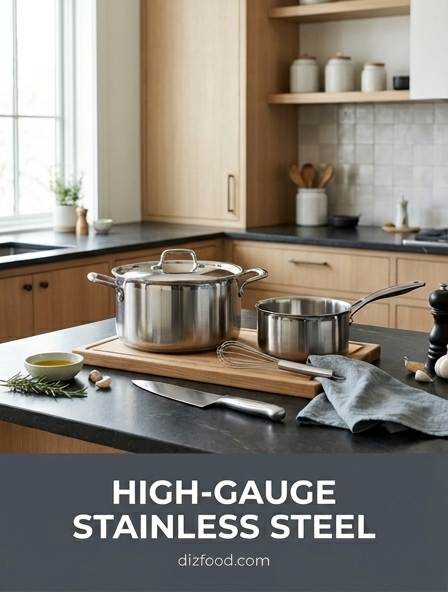
Superior Structural Integrity of High-Gauge Steel
The structural integrity of kitchen implements, particularly whisks and mixing tools, is fundamentally dictated by the gauge of the stainless steel utilized. High-gauge steel provides a robust framework that resists the common pitfalls of deformation and fatigue under heavy workloads. In a professional setting, tools are subjected to constant pressure and high-torque movements. Lower-quality metals often succumb to "bowing," where the wires lose their original shape, leading to uneven mixing and reduced efficiency. High-gauge variants maintain their geometric precision, ensuring that every stroke delivers consistent results.
- Resilience against permanent bending during heavy-duty mixing.
- Enhanced tensile strength for processing viscous batters.
- Long-term retention of wire spacing and alignment.
- Resistance to stress fractures at the handle junction.
This rigidity is not merely a matter of durability; it is a functional requirement for precision. When the wires of a whisk remain perfectly aligned, they interact with the ingredients exactly as designed, preventing the accumulation of unmixed pockets. The density of high-gauge steel also ensures that the tool can withstand the rigors of mechanical dishwashing and sterilization without compromising its metallurgical properties or structural form.
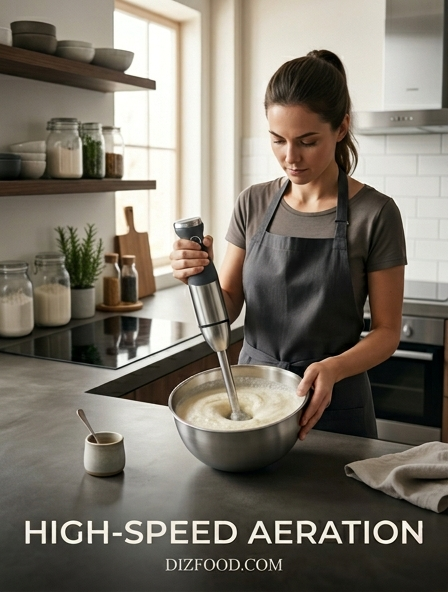
Optimizing Aeration with Rigid Stainless Tines
Aeration is a critical process in both pastry and savory cooking, requiring the rapid incorporation of air into a liquid matrix. The effectiveness of this process is heavily reliant on the rigidity of the stainless steel tines. High-gauge steel provides the necessary stiffness to "cut" through the surface tension of liquids, creating the turbulence required for air entrapment. Soft, flexible wires often yield to the resistance of the fluid, resulting in a dragging motion that fails to generate sufficient lift or volume.
When using a high-gauge whisk, the kinetic energy of the chef is transferred directly into the mixture. This efficiency allows for the creation of stable foams and emulsions in a fraction of the time required by flimsier alternatives. The rigidity ensures that the tines do not collapse toward each other under pressure, maintaining maximum surface area contact with the ingredients. This is particularly vital when working with high-protein liquids like egg whites or heavy cream, where the speed of aeration determines the final stability and texture of the product. By utilizing rigid steel, the user achieves a superior overrun and a more uniform bubble structure within the foam.
Thermal Stability for Temperature Sensitive Batters
In the preparation of delicate sauces and batters, thermal management is paramount. High-gauge stainless steel possesses specific thermal mass properties that contribute to temperature stability during the whisking process. Unlike plastic or thin-gauge metals, heavy-duty stainless steel acts as a thermal buffer, resisting rapid temperature fluctuations that can break an emulsion or curdle a custard. This is especially useful when whisking over a bain-marie or tempering hot liquids into egg-based bases.
| Property | High-Gauge Stainless | Standard Thin Wire |
|---|---|---|
| Heat Retention | Moderate-High | Low |
| Thermal Conductivity | Consistent | Rapid/Erratic |
| Structural Stability at 100°C+ | Excellent | Prone to softening |
The ability of high-gauge steel to maintain a steady temperature helps in achieving a smooth, tempered finish. When a cold whisk is introduced to a warm sauce, a thin-gauge tool may cause localized cooling too quickly, whereas a high-gauge tool provides a more gradual transition. This metallurgical advantage ensures that temperature-sensitive proteins are handled with the necessary care to prevent unwanted coagulation or separation.
The Impact of Gauge on Whisk Balance
The balance of a kitchen tool is often overlooked, yet it is the primary factor in reducing chef fatigue during repetitive tasks. High-gauge stainless steel contributes significant weight to the "head" or working end of the whisk, which must be expertly offset by the handle construction. When the gauge is optimized, the center of gravity sits near the transition point, allowing the tool to pivot naturally in the hand. This mechanical equilibrium means the user does not have to fight the tool to maintain a consistent rhythm.
A well-balanced, high-gauge whisk utilizes its own mass to assist in the mixing motion. In heavy batters, the inertia of the weighted wires helps drive the tool through the resistance, requiring less manual force from the wrist and forearm. Conversely, a tool that is too light or poorly balanced requires constant muscular correction, leading to repetitive strain injuries over time. Professional-grade implements prioritize this weight distribution, ensuring that the heavy-duty nature of the steel serves as an ergonomic benefit rather than a hindrance. The result is a tool that feels like an extension of the arm, providing feedback and control during the most intensive culinary preparations.
Non-Reactive Properties in Acidic Pastry Work
Pastry work frequently involves high-acid ingredients such as lemon juice, vinegar, and buttermilk. High-gauge stainless steel is preferred for these applications due to its non-reactive nature. Lower quality alloys or reactive metals like aluminum can leach metallic ions into the food, resulting in an off-putting "tinny" flavor and, in some cases, unappealing grey discolorations in light-colored frostings or curds. The high chromium and nickel content in professional-grade stainless steel creates a passive oxide layer that protects the integrity of the ingredients.
- Maintains the vibrant color of fruit-based reductions.
- Prevents the metallic aftertaste in delicate meringues.
- Resists pitting and corrosion caused by prolonged acid exposure.
- Ensures the chemical neutrality of leavening agents in batters.
This non-reactivity is crucial when making stable emulsions like Hollandaise or citrus curds, where the purity of flavor is the primary goal. Because high-gauge steel is less porous and more resistant to surface scratching, the protective layer remains intact even after years of heavy use. This ensures that the tool remains a neutral participant in the chemical reactions of baking, allowing the natural flavors of the high-quality ingredients to remain the focal point without interference from the tool's own chemistry.
Mechanical Advantage of Heavy-Duty Wire Gauges
The thickness of the wire, or its gauge, determines the mechanical advantage a whisk provides when moving through dense substances. Thicker wires displace more volume per stroke, which is essential when working with viscous materials like bread dough, thick ganache, or heavy roux. The increased surface area of each wire provides a larger "shoveling" effect, moving the mass more effectively than thin, whip-like wires. This mechanical advantage is a product of both the steel's rigidity and its physical dimensions.
In a commercial kitchen, where large batches are the norm, this efficiency is indispensable. A high-gauge whisk can incorporate dry ingredients into wet bases with fewer rotations, minimizing the risk of over-mixing and gluten over-development. The heavy-duty wires act as internal structural supports, allowing the whisk to maintain its shape even when buried deep within a heavy pot. This prevents the "clumping" that occurs when flexible wires are squeezed together by the pressure of a thick mixture. By providing a stable, wide-reaching sweep, high-gauge steel ensures that every part of the bowl is reached, facilitating a homogenous blend with significantly less physical effort from the operator.
Hygiene Standards of Professional Grade Stainless
Sanitation is a non-negotiable aspect of professional kitchen operations, and high-gauge stainless steel is the gold standard for hygienic design. The material is inherently non-porous, meaning it does not harbor bacteria, mold, or odors between uses. Furthermore, the strength of high-gauge steel allows for seamless construction methods. In premium whisks, the wires are often sealed into the handle with high-temperature epoxy or precision welding, eliminating the gaps and crevices where food particles often become trapped.
- Compatible with high-temperature commercial sterilization.
- Resistant to the corrosive effects of harsh sanitizing chemicals.
- Smooth surface finish prevents organic matter adhesion.
- Meets rigorous NSF (National Sanitation Foundation) requirements.
In addition to microbial resistance, the durability of high-gauge steel prevents the formation of micro-scratches. In softer materials, these tiny fissures become breeding grounds for pathogens and are nearly impossible to clean thoroughly. The hardened surface of professional-grade stainless steel remains smooth and intact, ensuring that a simple wash-and-sanitize cycle is sufficient to return the tool to a pristine state. This reliability is vital for maintaining food safety standards in high-volume environments where cross-contamination must be strictly avoided.
Maximizing Volume Through Kinetic Efficiency
Kinetic efficiency in a kitchen tool refers to how effectively the user's movement is converted into the desired physical change in the food. For tasks requiring volume, such as whipping cream or egg whites, high-gauge stainless steel provides a distinct advantage. Because the wires do not vibrate or flex uncontrollably, the energy is focused entirely on the displacement of the liquid. This stability allows the chef to maintain a high-velocity whisking motion without the "wobble" that occurs with lighter, lower-gauge tools.
The mass of the high-gauge steel also contributes to its kinetic performance. Once the whisk is in motion, its momentum helps it pass through the mixture with less resistance. This is particularly noticeable when trying to achieve stiff peaks in a meringue. The rigid tines create more significant air pockets and shear the protein chains more effectively, leading to a faster transition from liquid to foam. This efficiency is not just about speed; it also results in a better final product. A faster aeration process reduces the time the ingredients are exposed to room temperature, which is often critical for maintaining the stability of fats in whipped cream or the protein structure in delicate foams.
Wear Resistance in High-Frequency Commercial Kitchens
Commercial kitchens operate at a scale and frequency that would quickly destroy residential-grade equipment. High-gauge stainless steel is engineered to withstand this constant use. Wear resistance manifests in the tool's ability to maintain its finish and structural bonds despite being used hundreds of times a day. The abrasion resistance of high-quality stainless ensures that the wires do not thin out over time due to contact with the bottom of metal mixing bowls, which is a common failure point for cheaper implements.
| Feature | Commercial High-Gauge | Residential Grade |
|---|---|---|
| Daily Cycles | 100+ cycles | 5-10 cycles |
| Connection Point | Reinforced/Encapsulated | Punched/Crimped |
| Surface Hardness | High (300 series) | Low (Variable) |
The long-term cost-effectiveness of high-gauge steel is undeniable. While the initial investment is higher, the replacement cycle is significantly longer. A professional high-gauge whisk can last for years, whereas thinner alternatives often suffer from wire breakage or handle separation within months of heavy use. This reliability ensures that the kitchen workflow is never interrupted by tool failure, and the consistency of the output remains high throughout the life of the instrument.
Precision Control for Delicate Meringues and Creams
While high-gauge steel is often associated with power and durability, it also offers unparalleled precision for delicate work. Precision in whisking is the ability to stop exactly at a specific stage of aeration, such as moving from soft peaks to medium peaks without over-beating. The rigid nature of high-gauge wires provides immediate tactile feedback to the chef. You can feel the change in the mixture's resistance through the handle, allowing for micro-adjustments in speed and technique that are impossible with "mushy" or flexible wires.
This feedback loop is essential for high-end pastry work where the difference between a perfect mousse and a grainy, over-whipped one is a matter of seconds. The stability of the high-gauge whisk allows for a "folding" motion that is both gentle and effective, incorporating ingredients without deflating the carefully built air structure. Furthermore, the uniform spacing maintained by rigid steel ensures that the aeration is consistent throughout the entire bowl, preventing the formation of over-beaten clumps in one area while another remains liquid. For the professional chef, high-gauge stainless steel is as much a tool for finesse as it is for heavy lifting.

Comments