
Design Benefits of the Flat Spiral Head
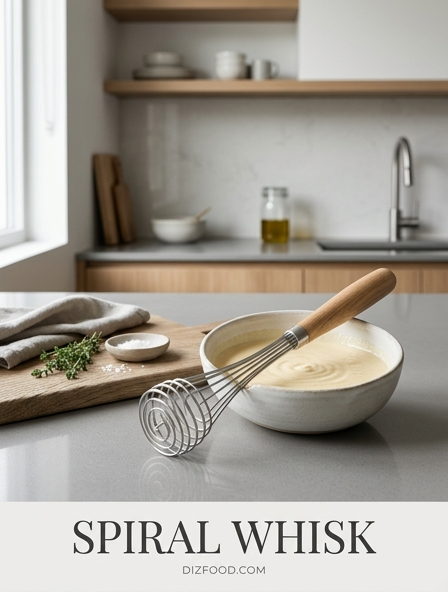
The flat spiral whisk, often referred to as a coil whisk, features a unique geometry that sets it apart from traditional kitchen tools. Its primary design benefit lies in the flexible, spring-like wire that loops around a central frame. Unlike the rigid structure of a balloon whisk, this spiral head is designed to bend and contour to the shape of the vessel. This flexibility allows the user to exert consistent pressure across a flat surface, ensuring that no ingredient is left untouched at the bottom of a pan or bowl.
- Angled orientation for ergonomic handling during rapid mixing.
- Spring-loaded coils that vibrate to break up stubborn dry clumps.
- Low-profile height, allowing it to slide under shallow liquids easily.
- Durable stainless steel construction that resists warping under pressure.
The intentional spacing between the coils facilitates the passage of liquids while simultaneously creating enough turbulence to incorporate air or combine ingredients. This design is particularly effective for heavy or viscous liquids where a standard whisk might encounter too much resistance or fail to reach the corners of the cookware.
Maximizing Surface Contact in Small Bowls
When working with limited quantities of ingredients, such as a single egg or a small portion of cornstarch slurry, traditional whisks often prove too bulky. The spiral whisk excels in these scenarios because its flat head maximizes surface contact with the bottom of the bowl. While a balloon whisk only touches the container at a few tangential points, the spiral whisk lays flat, allowing the entire circumference of the coil to sweep the surface. This eliminates the "dead zones" where dry flour or thick syrups tend to settle and hide from the mixing action.
Furthermore, the small diameter of the head makes it ideal for prep bowls and ramekins. Users can achieve a thorough mix without the splashing that occurs when using a tool that is too large for the vessel. By maintaining constant contact with the base, the spiral whisk ensures that every rotation contributes to the homogeneity of the mixture. This efficiency is vital for high-precision tasks where the ratio of ingredients must be perfectly balanced without any residue remaining unmixed on the sides or bottom.
Mastering Emulsification in Shallow Pans
Emulsification is the process of forcing two immiscible liquids, like oil and vinegar, into a stable mixture. This task is notoriously difficult in shallow pans where the liquid depth is insufficient to submerge a standard whisk. The spiral whisk is the definitive tool for this challenge because it operates effectively in as little as a quarter-inch of liquid. The horizontal movement of the coils creates the necessary shear force to break down oil droplets into microscopic sizes, facilitating a smooth and lasting emulsion.
- Begin by placing the base ingredients in a wide, shallow skillet.
- Slowly drizzle the oil while moving the spiral head in a circular motion.
- Use the flat edge to scrape the pan, ensuring all stabilizers are incorporated.
- Increase speed as the mixture thickens, utilizing the coil's vibration.
Because the whisk stays in constant contact with the pan, it also helps regulate temperature by moving the liquid across the heated surface. This prevents the emulsion from breaking due to localized hotspots, resulting in a professional-grade sauce or dressing every time.
The Science of Efficient Liquid Incorporation
The efficiency of a spiral whisk is rooted in fluid dynamics. As the whisk moves through a liquid, the coils create a series of vortices that pull surrounding fluid into the path of the wire. This creates a high-shear environment without the need for high-speed mechanical agitation. Unlike balloon whisks which primarily incorporate air to create volume, the spiral whisk is engineered for integration and smoothing. This makes it the superior choice for applications where aeration is undesirable, such as in custards or heavy gravies.
| Feature | Spiral Whisk | Balloon Whisk |
|---|---|---|
| Motion Type | Horizontal/Scraping | Vertical/Aerating |
| Best For | Pan Sauces & Roux | Meringues & Cream |
| Liquid Depth | Shallow to Deep | Moderate to Deep |
The science also accounts for the "spring action" of the coils. When the whisk hits the side of a pan, the coil compresses and then releases, adding an extra burst of kinetic energy to the mixing process. This mechanical advantage reduces the physical effort required by the cook to achieve a perfectly smooth texture.
Navigating Narrow Containers and Jars
Kitchen tasks often involve mixing ingredients directly inside storage jars or narrow drinking glasses. A standard whisk cannot fit through the mouth of a Mason jar, and a fork often fails to reach the corners. The slender profile of the spiral whisk's handle combined with its compact, flat head allows it to navigate these tight spaces with ease. It is particularly useful for re-emulsifying natural peanut butter, mixing protein shakes in tall glasses, or stirring concentrated juices inside their original containers.
The flexibility of the head is the key to its success in narrow vessels. Upon reaching the bottom, the whisk can be tilted so the coils press against the side walls, effectively scraping away any sediment. This ability to perform "edge-to-edge" mixing in a confined vertical space prevents the common problem of unmixed sediment at the bottom of a container. For home cooks who value convenience and minimize cleanup by mixing and storing in the same vessel, the spiral whisk is an indispensable asset that bridges the gap between a spoon and a full-sized whisk.
Why Spiral Whisks Outperform Balloon Designs
While the balloon whisk is a staple in many kitchens, it is often not the most efficient tool for daily stovetop tasks. The primary advantage of the spiral whisk over the balloon design is its ability to interact with the flat surfaces of skillets and sauté pans. Balloon whisks are designed to pull air into liquids, which is excellent for whipping cream but detrimental when trying to create a dense, silky reduction. The spiral whisk focuses its energy on the bottom of the pan, where heat is most intense and sticking is most likely to occur.
- Better at scraping fond from the bottom of a pan.
- Easier to clean as there are no overlapping wires at the base.
- Requires less storage space in crowded kitchen drawers.
- Superior performance in small-batch cooking and dressings.
Additionally, the spiral whisk offers a different ergonomic experience. It allows for a more natural "stirring" motion rather than the vigorous "beating" motion required by balloon designs. This makes it a more versatile tool for a wider range of temperatures and vessel shapes, proving that specialized geometry can significantly outperform traditional general-purpose designs.
Eliminating Lumps in Thick Pan Sauces
Creating a perfectly smooth gravy or béchamel requires the immediate dispersal of flour into fat. If the flour is not integrated quickly, it forms starch-encapsulated lumps that are nearly impossible to break. The spiral whisk is specifically engineered to combat this. The flat, wide surface area of the coil ensures that as soon as liquid is added to a roux, the whisk can cover the entire surface of the pan, forcing the flour and liquid to bond before lumps can stabilize.
- Prepare the roux by whisking flour and fat until golden.
- Add a small amount of liquid, using the spiral head to create a thick paste.
- Gradually pour in remaining liquid while sweeping the whisk across the pan.
- Use the edge of the spiral to clear the corners where lumps often hide.
Because the spiral whisk provides constant agitation against the heat source, the starch granules swell evenly. This results in a sauce with a uniform consistency and a professional sheen. For any cook who has struggled with lumpy white sauces, switching to a spiral whisk is a simple yet transformative solution for achieving culinary consistency.
Ergonomic Advantages for Quick Mixing
Repetitive whisking can lead to wrist strain and fatigue, especially when dealing with thick batters or long reduction times. The spiral whisk offers significant ergonomic advantages by altering the mechanics of the mixing motion. Because the head is set at an angle to the handle, the user can maintain a neutral wrist position while the whisk remains flat against the bottom of the vessel. This reduces the need for the awkward, high-angle grip often required when using a balloon whisk in a shallow pan.
The light weight of the tool also contributes to ease of use. Most spiral whisks are constructed with a single, continuous wire for the head, reducing the overall mass compared to multi-wire designs. This allows for faster, more agile movements with less physical exertion. For professional chefs who spend hours preparing sauces or for home cooks with limited hand strength, the ergonomic efficiency of the spiral whisk provides a more comfortable and sustainable cooking experience. By minimizing the effort needed for thorough incorporation, it encourages better technique and more frequent whisking, which ultimately leads to higher quality food outcomes.
Perfect Vinaigrettes in Record Time
A great vinaigrette is defined by its balance and its texture. The spiral whisk is the ideal tool for achieving a stable emulsion because it can vigorously combine oil and acid in a very small volume of liquid. Unlike using a fork, which merely stirs the ingredients, the spiral coils act as a series of tiny blades that shear the oil into the vinegar. This creates a creamy, cohesive dressing that clings to salad greens rather than sliding off to the bottom of the bowl.
- Use a spiral whisk to blend mustard and vinegar first for a stable base.
- Incorporate dry herbs effectively by keeping them suspended in the liquid.
- Emulsify cold oils directly from the refrigerator without extra effort.
- Whip small amounts of honey or maple syrup into the mix with ease.
The speed at which a spiral whisk works is particularly beneficial in a fast-paced kitchen environment. It can turn a separated mixture into a fully bound vinaigrette in seconds, ensuring that dressings are fresh and perfectly combined just before serving. Its ability to work in shallow dishes also means you can mix your dressing in the same bowl you plan to serve the salad in, saving time and cleaning.
Essential Maintenance for Durable Kitchen Tools
To ensure the longevity of a spiral whisk, proper maintenance is essential. While most are made from high-quality stainless steel, the unique coil design can trap food particles if not cleaned promptly. The coils are flexible, which is a benefit for mixing, but it also means they should be handled with care to avoid permanent deformation. Maintaining the spring tension of the whisk ensures it continues to provide the necessary surface contact for effective mixing and scraping.
- Rinse the whisk immediately after use with warm, soapy water.
- Use a soft brush to clear any debris from between the tight coils.
- Dry the whisk thoroughly to prevent any mineral buildup or spotting.
- Store the whisk in a way that prevents the head from being crushed or bent.
If the whisk is dishwasher safe, it is still recommended to check the coils for trapped food before the drying cycle begins. Periodic inspection of the handle attachment is also wise to ensure no moisture is trapped where the wire meets the grip. With these simple steps, a spiral whisk can remain a reliable and effective part of a kitchen's arsenal for many years, providing consistent performance across a variety of culinary tasks.

Comments