
Selecting the right tool for your kitchen can transform a tedious chore into a seamless experience, especially when deciding between the precision of a ball whisk and the raw power of a Danish dough whisk. While the ball whisk excels at aerating light batters and reaching into tight corners with its weighted vibrating beads, the Danish dough whisk is a heavy-duty specialist designed to slice through thick, shaggy doughs without overworking the gluten. Whether you are whipping up a delicate meringue or prepping a hearty sourdough boule, understanding the unique structural advantages of these whisks ensures you achieve perfect consistency with minimal effort and significantly less cleanup time.
| Feature | Ball Whisk | Danish Dough Whisk |
|---|---|---|
| Best For | Light batters, sauces, and meringues. | Heavy bread doughs, cookies, and muffins. |
| Design | Straight wires with weighted silicone/steel balls. | Rigid, concentric stainless steel loops. |
| Aeration | High; excellent for incorporating air. | Low; designed to prevent over-mixing. |
| Mixing Power | Ideal for liquids and fine powders. | High torque; handles stiff, hydrated doughs. |
| Cleanup | Easy; open wires prevent clogging. | Very easy; dough slides off the thin loops. |
| Reach | Superior for flat pans and tight corners. | Best for deep bowls and heavy clumps. |
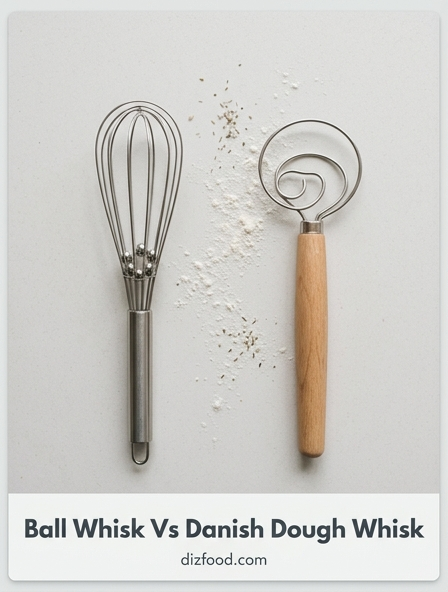
Ball Whisk vs Danish Dough Whisk Design Comparison
The visual and structural differences between a ball whisk and a Danish dough whisk are immediately apparent to any home cook. The ball whisk is a modern variation of the traditional balloon whisk, featuring a series of straight, independent stainless steel wires. Each wire is capped with a small, weighted silicone or stainless steel bead. This design allows the individual tines to vibrate and move independently, covering a larger surface area than traditional looped wires. The absence of a closed loop at the end prevents ingredients from becoming trapped inside the whisk head, which is a common grievance with standard kitchen tools.
In contrast, the Danish dough whisk, often referred to as a "brodpisker," features a stiff, flat head composed of three concentric loops of varying sizes. Typically constructed from heavy-gauge stainless steel wire and attached to a sturdy wooden or metal handle, this tool is designed for strength rather than flexibility. The loops are arranged in a single plane, allowing the whisk to cut through thick mixtures with minimal resistance. While the ball whisk focuses on vibration and reach, the Danish whisk prioritizes torque and the ability to incorporate dry ingredients into wet ones without the tool bending or snapping under pressure.
| Feature | Ball Whisk | Danish Dough Whisk |
|---|---|---|
| Primary Structure | Straight wires with weighted beads | Concentric thick wire loops |
| Flexibility | High (vibrating tines) | Low (rigid and sturdy) |
| Best For | Aeration and liquid emulsions | Heavy doughs and thick batters |
Best Tool for Heavy Bread and Pizza Dough
When dealing with heavy bread and pizza doughs, the Danish dough whisk is the undisputed champion. These doughs require a tool that can handle high resistance as the flour hydrates and gluten begins to develop. The heavy-gauge wire of the Danish whisk acts like a combination of a wooden spoon and a fork, cutting through the shaggy mass of ingredients to ensure every pocket of flour is hydrated. Because the surface area of the wire is relatively small compared to a solid spoon, it moves through thick dough with far less physical effort from the baker. This makes it ideal for the initial mixing stages of sourdough, ciabatta, and rustic pizza crusts.
The ball whisk, while innovative, is generally unsuitable for heavy dough applications. The independent wires are designed for flexibility; when faced with a stiff bread dough, the tines will simply bend outward or become buried in the mass, failing to provide the leverage needed for thorough incorporation. Furthermore, heavy dough can easily overwhelm the thin wires, potentially leading to permanent deformation of the whisk. For bakers who frequently work with high-gluten flours or low-hydration recipes, the Danish whisk provides the structural integrity necessary to move the dough efficiently before transitioning to hand kneading.
- Highly effective for high-hydration sourdough.
- Reduces the "clumping" effect found in standard whisks.
- Provides better leverage for thick pizza dough.
- Minimizes the mess by keeping hands clean during the initial mix.
Aeration and Sauce Mixing with the Ball Whisk
The ball whisk excels in tasks that require the introduction of air or the emulsification of liquids. Because the tines move independently and vibrate as they strike the bottom of a bowl or pan, they create significantly more turbulence than a standard whisk. This makes it a superior tool for whipping egg whites to soft peaks or creating a frothy top on a homemade latte. When mixing vinaigrettes, the weighted balls act as agitators, breaking down oil droplets more effectively to create a stable emulsion. The design ensures that even the smallest amount of liquid is engaged, which is particularly useful when whisking a single egg or a small portion of dressing.
In the realm of sauce making, the ball whisk is a professional favorite for creating smooth gravies, béchamels, and hollandaise. The flat orientation of the tines allows the user to scrape the entire bottom of a saucepan, ensuring that no flour or starch settles and burns. As the balls bounce off the pan surface, they break up lumps of roux instantly. This "jackhammer" effect is something a Danish dough whisk cannot replicate, as its rigid loops are designed to move mass rather than disperse fine particles. For any recipe where a silky texture is the ultimate goal, the ball whisk is the preferred instrument.
- Whisking egg whites and heavy creams.
- Emulsifying salad dressings and marinades.
- Blending smooth, lump-free gravies and sauces.
- Whipping protein powders or cocoa into milk.
Danish Dough Whisk Benefits for Sourdough Baking
Sourdough baking is a delicate process where the hydration of flour and the preservation of fermentation gases are paramount. The Danish dough whisk is specifically tailored for this craft. During the initial "autolyse" phase, where flour and water are first combined, the whisk's loops cut through the mixture to ensure even distribution without overworking the dough. Its ability to incorporate inclusions-such as seeds, nuts, or dried fruit-without deflating the air pockets makes it a favorite among artisanal bakers. The open-loop design allows the sticky sourdough starter to pass through the wires without getting stuck in a clump, which is a frequent issue with traditional whisks.
Furthermore, the Danish dough whisk is excellent for folding high-hydration doughs. Since many sourdough recipes require a "no-knead" or "stretch and fold" technique, this tool helps transition the shaggy mass into a cohesive ball with minimal friction. The rigid handle provides enough torque to scrape the sides of the proofing bowl, ensuring that no expensive flour or levain is wasted. By reducing the surface area contact between the tool and the dough, the Danish whisk prevents the "gluey" buildup that often occurs when using a spatula or spoon, making the entire preparation phase more hygienic and efficient.
Typical sourdough applications include:
- Mixing the initial flour and water for autolyse.
- Incorporating the levain into the dough mass.
- Distributing salt evenly after the resting period.
- Mixing in heavy inclusions like olives or walnuts.
Structural Differences and Mixing Efficiency
Understanding the physics behind these two tools reveals why they cannot be used interchangeably. The mixing efficiency of the Danish dough whisk comes from its "cutting" ability. Because the loops are thin yet rigid, they act like a series of knives that slice through thick batters and doughs. This reduces the total force required to achieve a homogenous mixture. The single-plane design means that the tool encounters very little drag, which is why it is often preferred for muffins, brownies, and quick breads where over-mixing can lead to a tough, rubbery crumb. It prioritizes the mechanical integration of wet and dry components over the incorporation of air.
The ball whisk, conversely, relies on the principle of vibration and surface contact. The efficiency here is measured by how quickly the tool can break down small clumps and introduce air. Because the wires are not connected to one another, they can spread out or compress depending on the shape of the vessel. This flexibility allows for a more chaotic movement of the liquid, which is exactly what is needed to create foams or to blend powders into liquids. However, this same flexibility is a liability when dealing with structural mass. If you attempt to mix a thick cookie dough with a ball whisk, the wires will lose their orientation and fail to move the ingredients, resulting in poor mixing efficiency for that specific context.
Efficiency factors depend on:
- Viscosity: Danish whisks handle high viscosity; ball whisks handle low viscosity.
- Aeration Needs: Ball whisks maximize air; Danish whisks minimize it.
- Drag: Danish whisks cut through; ball whisks vibrate through.
Why the Ball Whisk Reaches Every Corner
One of the most significant advantages of the ball whisk is its geometric versatility. Standard balloon whisks have a rounded, bulbous end that often prevents the wires from making contact with the "corner" of a flat-bottomed saucepan or the tight radius of a bowl. The ball whisk solves this problem with its flat, fan-like array of tines. As you move the whisk across the bottom of a pan, the individual beads can reach directly into the edges. This is crucial when making custards, puddings, or roux-based sauces, as the ingredients at the edges are the most prone to overheating and scorching.
The independent movement of the wires also allows the ball whisk to adapt to different container shapes. Whether you are whisking in a narrow graduated cylinder, a wide skillet, or a deep stockpot, the tines can splay out to cover the maximum possible area. This "adaptive reach" ensures that no dry pockets of flour or unmixed spices remain hidden in the crevices of your cookware. Because the beads are often made of silicone or polished steel, they glide over surfaces without scratching non-stick coatings, making the ball whisk a safer choice for delicate cookware compared to the rigid, heavy wire of a Danish dough whisk.
Key benefits of the ball whisk's reach include:
- Elimination of burnt spots in sauces.
- Complete incorporation of dry ingredients in bowl corners.
- Ability to work in shallow pans or tall, thin jars.
- Effective scraping of flat surfaces during reduction.
Preventing Overmixed Batter with a Danish Whisk
In the world of baking, over-mixing is the enemy of texture. When making pancakes, muffins, or biscuits, developing too much gluten results in a dense, chewy product rather than a light, tender one. The Danish dough whisk is the perfect tool to prevent this common mistake. Because of its open-loop design, it incorporates dry ingredients into wet ones with very few strokes. A few turns of the wrist are usually enough to reach the "just combined" stage that most recipes specify. Unlike a standard whisk, which has many wires that "comb" through the batter and encourage gluten strands to bond, the Danish whisk moves the mass gently.
Furthermore, the Danish whisk does not beat air into the mixture as aggressively as a ball whisk or balloon whisk. For certain batters, such as those for fudgy brownies or specific types of cakes, excessive aeration can cause the product to rise and then collapse, or create an unwanted cakey texture. By using the rigid loops to fold and stir rather than whip, the baker maintains control over the batter's density. This makes the Danish whisk an essential bridge between a spoon (which is poor at incorporating flour) and a whisk (which is too aggressive for tender batters).
Tips for avoiding over-mixing:
- Stop mixing as soon as no large streaks of dry flour remain.
- Use the Danish whisk in a folding motion rather than a circular whipping motion.
- Allow the large loops to do the work of breaking up flour clumps.
- Clean the whisk immediately to prevent batter from drying on the wires.
Cleaning and Durability Comparison for Both Tools
Cleaning kitchen tools is a major consideration for any home cook. The ball whisk is generally considered one of the easiest whisks to clean. Because there are no overlapping wires or "cages" where food can get trapped, a simple rinse under hot water is usually sufficient to remove most residues. Most ball whisks are also dishwasher safe, as the stainless steel construction and independent tines allow water and detergent to reach every surface. However, over time, the points where the wires enter the handle can be a weak spot for moisture accumulation if the tool is not dried properly.
The Danish dough whisk, while simple in design, requires a bit more attention. Because it is often used for sticky, high-starch doughs, the batter can cling to the loops. If the dough is allowed to dry, it becomes quite difficult to remove. Most traditional Danish whisks feature wooden handles, which means they are not dishwasher safe and should not be soaked for long periods. However, the heavy-gauge wire itself is incredibly durable and unlikely to bend or break even after years of heavy use. In terms of longevity, the Danish whisk is often viewed as a "lifetime" tool, whereas the thinner wires of a ball whisk may eventually fatigue or lose their beads if used improperly.
| Factor | Ball Whisk | Danish Dough Whisk |
|---|---|---|
| Dishwasher Safe | Usually (Check handle material) | Rarely (Due to wooden handles) |
| Trap Zones | None (Open tines) | Minimal (Loop junctions) |
| Handle Strength | Moderate | Very High |
| Longevity | 5-10 years | 20+ years |
Which Whisk Should You Use for Light Batters
For light batters such as crepes, tempura, or thin pancake mixes, the choice between these two tools depends on the desired final consistency. The ball whisk is the superior choice if you want a perfectly smooth, aerated batter. Its ability to break down every tiny lump of flour ensures that the batter will be uniform, which is essential for thin applications like crepes where a single lump can ruin the texture. The aeration provided by the ball whisk also helps create a lighter, crispier fry for tempura batters. If the recipe calls for "whisking until frothy," the ball whisk is the only tool for the job.
On the other hand, if you are making a light batter that should remain relatively flat or "dense" in a specific way-such as a clafoutis or certain types of Swedish pancakes-the Danish dough whisk might be preferable. It will combine the ingredients without adding the volume that comes with trapped air. Additionally, if your light batter includes small additions like zest or finely chopped herbs, the Danish whisk will distribute them evenly without them getting tangled in the wires. For most home bakers, however, the ball whisk remains the go-to for anything that can be poured, while the Danish whisk is reserved for anything that must be scooped or shaped.
- Crepes: Use a Ball Whisk for smoothness.
- Tempura: Use a Ball Whisk for aeration.
- Muffins: Use a Danish Whisk to prevent toughness.
- Yorkshire Pudding: Use a Ball Whisk to maximize rise.
The Ultimate Kitchen Tool Guide for Home Bakers
In a well-equipped kitchen, there is a place for both the ball whisk and the Danish dough whisk. They are not competitors but rather specialized tools that cover the full spectrum of mixing needs. The ball whisk should be your primary choice for liquid-heavy tasks. From the morning scramble of eggs to the evening preparation of a delicate balsamic glaze, its ability to reach into corners and introduce air is unmatched. It is a tool of precision and refinement, perfect for the pastry chef or the sauce enthusiast who demands a perfect emulsion every time.
The Danish dough whisk is the workhorse of the bakery. It is designed for the heavy lifting that would destroy a standard whisk. If your culinary interests lean toward sourdough, rustic loaves, or thick-batter treats like banana bread, this tool will save your wrists from fatigue and your dough from over-processing. It represents the bridge between manual hand-mixing and the use of a heavy stand mixer. By choosing the right tool for the specific viscosity and aeration requirements of your recipe, you ensure better results, easier cleanup, and a more enjoyable experience in the kitchen.
Final recommendations for your collection:
- Buy a Ball Whisk if you prioritize sauces, dressings, and egg-based dishes.
- Buy a Danish Dough Whisk if you bake bread or thick batters at least once a week.
- Ensure both have stainless steel heads for food safety and durability.
- Choose silicone-tipped ball whisks if you primarily use non-stick pans.

Comments