
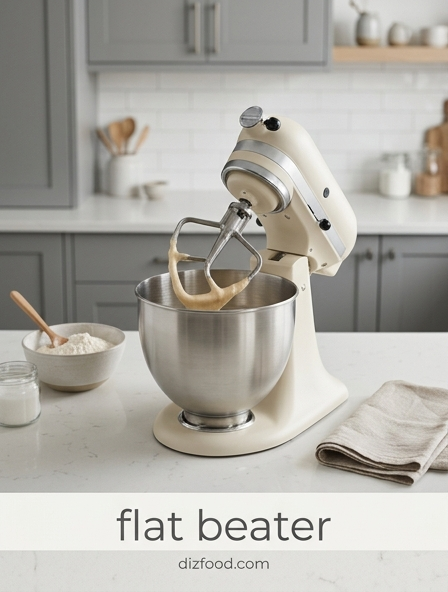
Understanding Flat Beater Mechanics
The flat beater is the primary workhorse of any planetary stand mixer, designed specifically for tasks that require forceful mixing without the intense aeration provided by a whisk. Its architecture typically consists of a rigid frame with crossbars that sweep across the diameter of the mixing bowl. This design ensures that the attachment reaches the center and the edges effectively, pushing ingredients against the sides to facilitate thorough integration. Unlike specialized hooks, the beater provides a broad surface area that handles varying viscosities with ease.
To maximize its efficiency, users must ensure the "beater-to-bowl" clearance is perfectly calibrated. If the beater sits too high, a layer of unmixed butter or flour will remain at the bottom; if too low, it may scrape the metal, causing damage. Proper mechanical alignment allows the beater to move in an orbital path, rotating on its axis while simultaneously traveling around the bowl. This dual-action motion is essential for creating a cohesive mass from diverse ingredients like cold fats, granulated sugars, and viscous liquids.
Minimizing Air for Denser Textures
While many baked goods rely on leavening, certain recipes-such as fudgy brownies, dense cheesecakes, and heavy shortbreads-require the minimization of incorporated air. The flat beater is the ideal tool for these applications because its solid profile lacks the fine wires that trap oxygen. When working at lower speeds, the beater combines ingredients through shear force rather than whipping, ensuring the final product remains moist and compact rather than cake-like or porous.
- Speed Control: Keeping the mixer on low settings prevents the formation of large air bubbles that can cause "souffléing" during baking.
- Ingredient Temperature: Using room-temperature fats allows the beater to slide through the material without creating the structural pockets common in high-aeration methods.
- Pulse Mixing: Utilizing short bursts of power helps incorporate dry ingredients without overworking the mixture or introducing unnecessary turbulence.
By focusing on these techniques, bakers can achieve a silky, velvet-like consistency in batters that demand a tight, heavy structure. This approach is particularly critical for professional-grade pastry work where texture is as important as flavor profile.
Perfecting Heavy Cake Batters
Heavy cake batters, such as those used for pound cakes or traditional fruitcakes, require a robust mixing tool that can handle significant weight and volume. The flat beater excels here by providing the torque necessary to move thick masses of sugar and butter combined with heavy additions like dried fruits or nuts. Because these cakes rely on a fine, sturdy crumb, the beater's ability to homogenize without over-aerating is vital for preventing the cake from collapsing under its own weight.
When preparing such batters, it is helpful to follow a specific sequence of additions to maintain the structural integrity of the mixture. This process ensures that every gram of flour is hydrated and every fat molecule is evenly dispersed. The following table highlights common heavy batter ingredients and the beater's role:
| Ingredient Type | Beater Function |
|---|---|
| Cold Butter | Breaking down solids into malleable paste. |
| Granulated Sugar | Creating micro-abrasions to start the emulsion. |
| Heavy Flour | Folding and binding without excessive gluten development. |
Science of Creaming with Flat Beaters
The "creaming method" is a cornerstone of baking science, involving the mechanical aeration of fat and sugar. When using a flat beater, the sugar crystals act as tiny abrasives that carve small pockets into the solid fat. As the beater rotates, these pockets fill with air. While a whisk might introduce too much air, the flat beater provides the controlled aeration necessary for a sturdy but tender crumb. This balance is what allows a cake to rise predictably in the oven while remaining dense enough to support frosting.
During this phase, the color of the butter-sugar mixture will transition from a deep yellow to a pale ivory. This visual cue indicates that the beater has successfully emulsified the ingredients. It is essential to scrape the sides of the bowl frequently during this process. This ensures that every portion of the fat is subjected to the same mechanical force, preventing "streaking" in the finished bake. Mastery of this phase ensures that the later addition of liquids does not cause the batter to break or curdle.
Optimizing Cookie Dough Consistency
Cookie dough presents a unique challenge because it often transitions from a soft creamed base to a very stiff, high-viscosity dough once the flour and inclusions are added. The flat beater is specifically engineered to handle this increasing resistance. Its rigid frame allows it to plow through thick doughs that would bend or clog a wire whisk. This is particularly important when adding heavy mix-ins like chocolate chunks, whole nuts, or oats, as the beater distributes them evenly without pulverizing the delicate additions.
- Initial Creaming: Use medium speed to blend fats and sugars until lightened.
- Emulsification: Add eggs one at a time, allowing the beater to fully incorporate each before adding the next.
- Dry Integration: Reduce speed to the lowest setting and add flour; stop as soon as white streaks disappear.
- Inclusions: Fold in chips or nuts using the lowest speed or the "pulse" function to maintain texture.
Following this structured approach prevents overworking the dough, which can lead to tough, rubbery cookies. The flat beater ensures the fat remains encapsulated, leading to the desired spread and chewiness during the baking process.
Flat Beater vs Wire Whisk Dynamics
Choosing the correct attachment is fundamental to successful baking. While both the flat beater and the wire whisk move in the same orbital pattern, their interaction with the ingredients differs drastically. The whisk is designed to introduce maximum volume by trapping air within liquids, whereas the beater is designed for mass movement and ingredient integration. Using the wrong tool can lead to catastrophic textural failures, such as muffins that are too airy or meringues that won't peak.
| Feature | Flat Beater | Wire Whisk |
|---|---|---|
| Primary Goal | Blending and Creaming | Aeration and Volumizing |
| Material Focus | Heavy fats, doughs, thick batters | Egg whites, cream, thin liquids |
| Air Incorporation | Low to Moderate | High |
| Shear Force | High | Low |
Understanding these dynamics allows the baker to manipulate the final crumb. For instance, if a recipe calls for "folding" dry ingredients into a whipped base, the flat beater on the lowest setting can often mimic the hand-folding motion more consistently than a whisk, which would likely deflate the mixture.
Controlling Gluten in Dense Bakes
Gluten development is a primary concern when mixing flour-based recipes. Once flour meets liquid, mechanical action begins to align proteins into elastic strands. While this is desired for bread, it can be detrimental to cakes and pastries. The flat beater offers excellent control over this process because it can homogenize a mixture very quickly. By reducing the time the flour is subjected to agitation, the baker can minimize gluten formation, ensuring a tender and "short" texture in the final product.
To control gluten effectively with a flat beater, always shift to the lowest possible speed once the dry ingredients are introduced. The beater's broad surface area moves the entire mass of the batter at once, which is more efficient than a whisk that might require more rotations to achieve the same level of incorporation. This efficiency is the key to preventing the "tunneling" often seen in over-mixed muffins or the toughness found in overworked pie crusts. Stopping the mixer just before the flour is fully integrated allows for a final manual stir, ensuring the perfect balance of structure and tenderness.
Achieving Uniform Ingredient Distribution
Consistency is the hallmark of a professional kitchen, and the flat beater is the primary tool for achieving a uniform distribution of ingredients. One of the common pitfalls in mixing is the "dead zone" at the bottom of the bowl where flour or butter can hide. The flat beater's design is meant to minimize this, but the user must still employ specific techniques to ensure a perfectly homogeneous mixture. Without uniformity, some parts of a cake may rise more than others, or cookies may spread unevenly due to varying fat concentrations.
- The Stop-and-Scrape: Periodically stopping the mixer to scrape the bottom and sides ensures no "unmixed islands" remain.
- Sifting: Pre-sifting dry ingredients allows the flat beater to distribute them more rapidly, reducing mixing time.
- Liquid Buffering: Adding liquids in stages prevents the beater from simply splashing them around, allowing for better absorption.
By monitoring the batter's appearance and using the flat beater to systematically incorporate every component, the baker ensures that every bite of the final product has the same flavor profile and textural integrity.
Structural Integrity for Rich Batters
Rich batters-those high in fat, sugar, and moisture-require a strong internal structure to prevent them from becoming greasy or collapsing. The flat beater plays a crucial role in building this structure by creating a stable emulsion. When fats and liquids are beaten together, the beater breaks the liquid into tiny droplets and suspends them within the fat. This process is essential for recipes like carrot cake or banana bread, where the heavy moisture content from the fruit must be successfully supported by the flour and fat matrix.
The mechanical action of the flat beater ensures that the starches in the flour are evenly coated by the fats, which helps to regulate how the proteins bond. This results in a bake that is rich and moist but still possesses enough "lift" to hold its shape. When the beater is used correctly, the batter should appear smooth and slightly glossy, with no signs of separation. This visual indicator confirms that the structural integrity of the batter is sufficient to withstand the expansion of gases during the baking cycle, leading to a professional-quality result.
Mastering the Ideal Crumb Density
The final objective of using a flat beater is often to achieve a specific crumb density. Crumb refers to the internal pattern of holes and the overall feel of the cake or bread. For a "tight" crumb, which is desirable in pound cakes or sandwich breads, the flat beater is indispensable. It works to ensure that the air cells created during the creaming process are small and uniform. Large, irregular holes are usually a sign of either too much air incorporation (from a whisk) or uneven mixing.
Mastering this density requires a keen eye for the batter's viscosity. A thicker batter mixed with a flat beater will generally result in a tighter crumb, while a slightly thinner batter will allow for more expansion. By adjusting the speed of the beater and the duration of the mix, the baker can fine-tune the results to suit the specific requirements of the dish. Whether the goal is a crumb that is light and springy or one that is rich and substantial, the flat beater provides the mechanical precision necessary to execute the vision perfectly every time.

Comments