
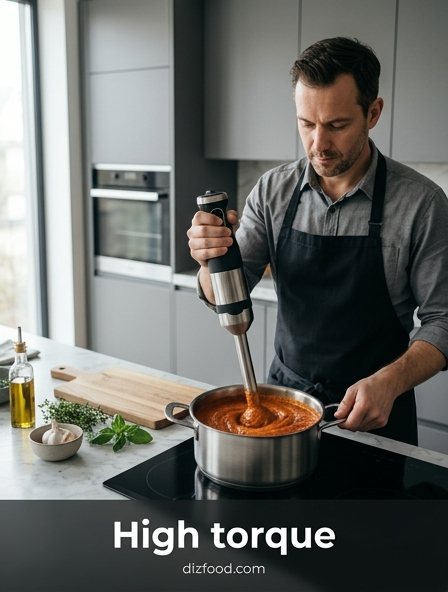
Understanding Torque in Dough Mixing
Torque represents the rotational force applied by a mixer's motor to overcome the physical resistance of ingredients. Unlike raw horsepower, which often measures top-end speed, torque is the measurement of strength at the point of contact between the dough hook and the mass of flour and water. In a kitchen environment, high torque is essential for heavy-duty tasks where a motor must turn slowly but with immense power. When a mixer begins to combine dry flour with liquid, the initial resistance is high as the ingredients have not yet formed a cohesive structure.
- Rotational Force: The actual power used to turn the attachment.
- Load Capacity: The amount of material the motor can move without stalling.
- Gearing Efficiency: How the motor translates electrical energy into physical movement.
A high-torque motor ensures that the mixing action remains constant regardless of the volume of the dough. Without sufficient torque, the motor may struggle, leading to inconsistent mixing patterns and uneven distribution of ingredients. This force is what allows commercial and high-end home mixers to handle dense bagel doughs or heavy whole-grain mixtures that would otherwise cause a standard motor to seize or overheat.
The Science of Resistance in Stiff Doughs
Stiff doughs, characterized by low hydration levels, pose a significant challenge to kitchen machinery due to their high viscosity and internal friction. As the water content decreases, the flour particles are more tightly packed, creating a dense matrix that resists deformation. This resistance is a physical manifestation of the dough's "stiffness," which requires a specific amount of mechanical energy to manipulate. High-torque mixers are designed to penetrate this dense mass, ensuring that every particle of flour is adequately reached by the mixing attachment.
When the mixer encounters this resistance, the motor draws more current to maintain its pace. If the machine lacks high torque, the physical drag of the dough creates a counter-force that slows the rotation. This interaction is not merely about movement but about the controlled application of pressure. By maintaining a steady force against the resistance of a low-hydration dough, the mixer can effectively fold and stretch the material, leading to a superior final product that is neither under-mixed nor overworked due to inconsistent mechanical application.
Preventing Motor Burnout During Heavy Mixing
Motor burnout occurs when a kitchen appliance is forced to operate beyond its thermal and mechanical limits. When mixing heavy batches, a motor without sufficient torque will experience excessive "slip," where the electrical energy is converted into heat rather than motion. This heat buildup eventually melts wire insulation or damages internal circuitry. High-torque systems utilize specialized gearing and robust motor windings to manage these heavy loads more efficiently, ensuring that the energy remains focused on the rotation of the dough hook.
- Thermal Protection: Sensors that shut down the motor if it reaches critical temperatures.
- All-Metal Gearing: Provides the structural integrity to handle high-stress rotations.
- Cooling Systems: Fans or heat sinks designed to dissipate the energy generated during heavy use.
By investing in a high-torque appliance, users protect the longevity of their equipment. These machines are engineered to operate for extended periods under stress without reaching the failure point. This reliability is crucial for professional environments where a stalled or broken mixer can halt production and lead to significant financial loss.
How High Torque Facilitates Even Hydration
Even hydration is the cornerstone of high-quality baking, ensuring that there are no dry pockets of flour within the dough. High torque facilitates this by providing the necessary force to move the moisture through a dense, resistant mass. As the mixer turns, the torque allows the attachment to shear through the dough, exposing new surfaces of flour to the liquid. This mechanical action is far more efficient than high-speed mixing, which might simply spin the ingredients without properly incorporating them.
| Dough Type | Hydration Level | Torque Requirement |
|---|---|---|
| Bagel Dough | 50-55% | Very High |
| Pizza Dough | 60-65% | Medium-High |
| Brioche | 70%+ (High Fat) | Medium |
Without the power to push through the resistance, water tends to sit on the surface of the flour, leading to an uneven "shaggy" mass. High-torque mixing ensures that the hydration process is deep and uniform, resulting in a dough that is easier to handle and yields a consistent crumb structure after the baking process is completed.
Gluten Development and Structural Integrity
Gluten is formed when the proteins glutenin and gliadin are hydrated and mechanically agitated. In bread making, the quality of this agitation determines the strength of the protein network. High-torque mixers are particularly effective at this because they can stretch and fold the dough with great force at lower speeds. This controlled stretching is essential for building a strong, elastic network that can trap carbon dioxide during fermentation, allowing the bread to rise properly.
- Protein Alignment: The physical pulling of strands into a cohesive web.
- Elasticity: The ability of the dough to bounce back after being stretched.
- Gas Retention: A direct result of a well-developed gluten structure.
In high-torque applications, the mixer does not rely on speed to develop gluten. Instead, it relies on the steady, powerful rotation to work the dough. This method is often preferred by artisan bakers as it mimics the traditional hand-kneading process but with the consistency and power that only a machine can provide. The result is a dough with superior structural integrity and a refined texture.
Managing Heat Friction with Powerful Rotations
Friction is an inevitable byproduct of mixing, especially when dealing with heavy doughs. Every time the mixer hook passes through the dough, kinetic energy is converted into heat. If the dough temperature rises too quickly or too high, it can prematurely activate the yeast or cause the fats in the dough to melt, ruining the texture. High-torque mixers manage this by being efficient at low speeds. Because they do not need to spin fast to move the dough, they generate less friction-based heat per rotation.
A powerful, high-torque motor maintains its RPM (revolutions per minute) without struggling. When a motor struggles, it often generates internal heat that can transfer to the mixing bowl. By utilizing a motor that handles the load with ease, the ambient heat transfer is minimized. This allows bakers to maintain precise control over the "final dough temperature," a critical variable in professional baking. Efficient power delivery means that the mechanical work is converted into gluten development rather than unwanted thermal energy.
Consistency Benefits of Stable RPM Under Load
Consistency in the kitchen is dependent on the ability of equipment to perform identically under varying conditions. A common issue with low-torque mixers is that the RPM drops significantly as the dough becomes tougher or as the batch size increases. This fluctuation makes it difficult to follow precise timing instructions in recipes. High-torque mixers, however, are designed to maintain a stable RPM regardless of the load, ensuring that five minutes of mixing is always the same amount of mechanical work.
- Predictable Results: Uniform dough texture across different batch sizes.
- Recipe Accuracy: Timing remains a reliable metric for dough readiness.
- Motor Stability: Reduces the "pulsing" effect often seen in weaker machines.
This stability is particularly important for commercial operations where scaling recipes is common. If a mixer slows down when doubled, the gluten development will be insufficient within the standard time frame. High torque removes this variable, providing a reliable baseline for production and ensuring that every loaf or pastry meets the established quality standards.
Why Low Speeds Require Maximum Torque
It is a common misconception that more speed equals more power. In the context of heavy dough mixing, the opposite is often true. The most demanding part of the mixing process happens at low speeds, where the physical resistance of the mass is at its peak. To move a heavy, sticky dough at a slow, controlled pace, the motor must exert maximum torque. At high speeds, momentum helps the attachment move, but at low speeds, it is pure mechanical force doing the work.
- Initial Incorporation: Breaking down the flour-water barrier.
- Kneading Phase: Stretching the developing protein strands.
- Safety: Low speeds prevent flour clouds and ingredient splashing.
High torque at low speeds is what distinguishes a professional-grade mixer from a standard household model. It allows for the gentle but firm handling of delicate ingredients while still providing the "brute strength" needed for heavy whole-wheat or rye breads. This capability ensures that the mixer is versatile enough to handle everything from a light meringue to the densest artisanal loaf.
Handling High Resistance in Artisan Breads
Artisan breads often involve ingredients that increase the mechanical load on a mixer, such as coarse whole grains, seeds, and sourdough starters with varying acidity levels. These inclusions create a "gritty" resistance that can be abrasive and difficult to move. High-torque mixers excel here because they have the "grunt" to push through the added solids without stalling. The high resistance of an enriched artisan dough, filled with nuts or dried fruits, requires a machine that can maintain its path through the inclusions.
Furthermore, artisan techniques often involve long mixing times at low speeds to maximize flavor development through slow fermentation. A mixer must be able to endure this sustained resistance without overheating. High torque provides the mechanical advantage needed to keep the dough moving smoothly, ensuring that the inclusions are distributed evenly throughout the matrix. This results in a balanced loaf where every slice contains a consistent distribution of flavor and texture, regardless of the complexity of the recipe.
Longevity and Efficiency for Heavy Dough Batches
The relationship between torque and longevity is direct: a machine that does not have to work at its absolute limit will last longer. High-torque mixers are built with heavy-duty components that are designed for high-stress environments. This means the bearings, gears, and motor brushes are all sized to handle the force required for heavy dough batches. Efficiency is also improved, as the motor operates within its optimal power band rather than straining and wasting energy as heat.
| Feature | Low Torque Mixer | High Torque Mixer |
|---|---|---|
| Component Wear | High / Frequent Replacement | Low / Extended Life |
| Energy Usage | Inconsistent / High Heat Loss | Consistent / Efficient |
| Noise Level | High (Straining) | Low (Steady) |
For high-volume kitchens, the efficiency of a high-torque motor translates to lower operational costs and less downtime. While the initial investment may be higher, the total cost of ownership is significantly lower because the machine can handle the most demanding tasks in the kitchen day after day without failure. This durability is the hallmark of professional kitchen engineering.


Comments