
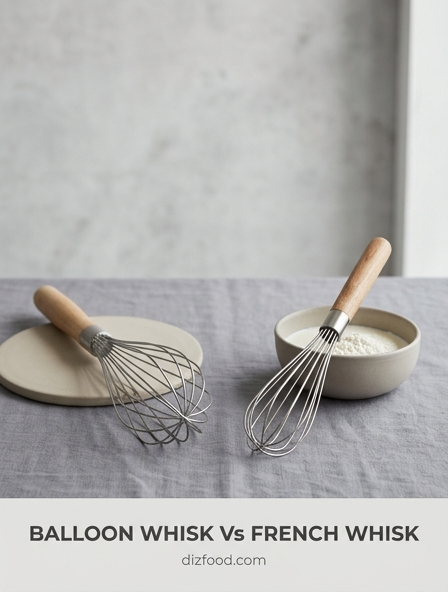
Choosing between a aeration-with-balloon-whisk">balloon whisk and a French whisk is the secret to mastering texture in your kitchen, whether you're chasing sky-high meringues or a velvet-smooth hollandaise. The iconic balloon whisk features wide, flexible loops designed to trap maximum air, making it your go-to tool for high-volume aeration in deep mixing bowls. On the other hand, the French whisk sports a slimmer, more tapered profile with stiffer wires, perfect for reaching into tight pan corners to dissolve lumps and emulsify heavy sauces without splashing. By matching the whisk's geometry to your specific task, you ensure effortless blending and professional-grade results every time you cook.
| Feature | Balloon Whisk | French Whisk |
|---|---|---|
| Shape | Large, bulbous, and spherical loops. | Narrow, elongated, and tapered design. |
| Primary Goal | Maximum aeration and volume. | Emulsification and smooth blending. |
| Wire Gauge | Thin and highly flexible. | Thick, stiff, and high-tension. |
| Best For... | Egg whites, heavy cream, thin batters. | Roux, gravies, custards, vinaigrettes. |
| Cookware Pair | Large, round-bottomed mixing bowls. | Straight-sided pans and small pots. |
| Control | Light touch for fluffy textures. | High precision for scraping corners. |
Defining the Balloon Whisk and French Whisk
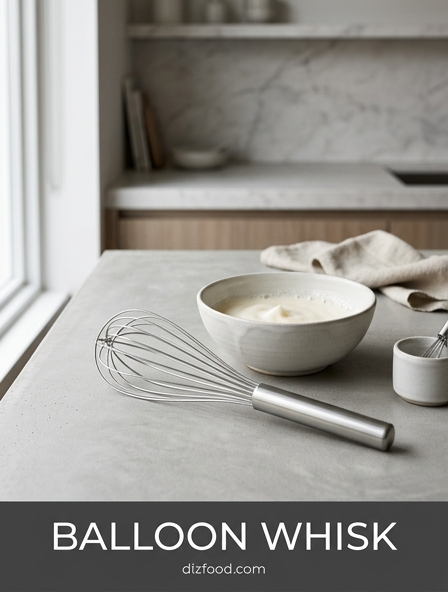
In the realm of culinary tools, few instruments are as fundamental yet misunderstood as the whisk. The balloon whisk is perhaps the most recognizable version, characterized by its wide, bulbous head and thin, flexible wires. It is the quintessential tool found in almost every home kitchen, designed primarily to incorporate air into liquid ingredients. Its rounded shape allows it to cover a large surface area within a bowl, making it highly efficient for high-volume tasks that require fluffiness and lightness.
The French whisk, by contrast, is a more specialized cousin that prioritizes precision and strength over sheer volume. It features a narrower, more elongated profile that tapers toward the end. While it shares the multi-wire construction of the balloon whisk, its wires are often stiffer and set closer together. This design makes it significantly more maneuverable in smaller vessels or pans with tight corners. Understanding these tools begins with recognizing that they are not interchangeable; rather, they are optimized for different physical reactions-aeration versus integration.
- Balloon Whisk: Large, spherical head, thin wires, designed for maximum volume.
- French Whisk: Narrow, cylindrical shape, stiff wires, designed for control and precision.
- Materials: Both are typically crafted from stainless steel, though silicone-coated versions exist for non-stick cookware.
Choosing between them requires a chef to analyze the viscosity of the ingredients and the desired final texture of the dish. While both tools can technically mix a batter, the effort required and the resulting consistency will differ vastly depending on which geometry is applied to the task.
Key Structural Differences Between Whisk Types
The structural divergence between a balloon whisk and a French whisk is rooted in geometry and physics. The balloon whisk is defined by its wide, circular loops that expand outward from the handle. This creates a large internal cage that traps air as the whisk moves through a liquid. Because the wires are generally thinner and more flexible, they can vibrate and bounce, which further aids in breaking up liquids into foam. The handle is often shorter in proportion to the head, emphasizing the broad sweeping motions used in large mixing bowls.
The French whisk utilizes a much slimmer silhouette. Its wires are arranged in a long, teardrop shape that remains relatively narrow from base to tip. This design allows the whisk to reach into the crevices of a saucepan or a narrow beaker where a balloon whisk would be too wide to fit. The wires on a French whisk are typically of a heavier gauge, providing the rigidity necessary to push through heavy emulsions or thick custards without deforming. This structural integrity is vital when working with high-viscosity fluids that would simply bend the delicate wires of a balloon whisk.
| Feature | Balloon Whisk | French Whisk |
|---|---|---|
| Head Shape | Bulbous and spherical | Long and tapered |
| Wire Gauge | Thin and flexible | Thick and rigid |
| Main Function | Aerating and fluffing | Blending and smoothing |
| Best Container | Wide mixing bowls | Narrow pans and pots |
Ultimately, the balloon whisk is built for the horizontal and vertical expansion of ingredients, while the French whisk is engineered for the deep, focused penetration of mixtures in confined spaces.
Best Uses for a Balloon Whisk
The balloon whisk is the undisputed king of aeration. Its primary purpose in the kitchen is to introduce as much air as possible into a substance in the shortest amount of time. This makes it the essential tool for creating structural foams. When whipping heavy cream, the thin wires of the balloon whisk cut through the fat globules, allowing air to be trapped in a stable matrix. Similarly, when beating egg whites for a souffle or a meringue, the wide cage of the whisk ensures that every stroke maximizes the volume of the proteins, leading to a light and airy result.
Beyond foam creation, the balloon whisk is excellent for sifting dry ingredients. Many bakers prefer using a large balloon whisk to combine flour, baking powder, and salt, as the many wires mimic the action of a sifter by breaking up clumps and ensuring an even distribution of leavening agents. It is also the preferred choice for light batters, such as those used for crepes or pancakes, where over-mixing can lead to gluten development. The flexibility of the wires allows for a gentle touch that incorporates the ingredients without the aggressive shearing that might occur with a stiffer tool.
- Whipping egg whites to soft or stiff peaks for meringues.
- Creating whipped cream for desserts and toppings.
- Whisking air into sabayon or hollandaise bases before thickening.
- Blending dry ingredients to remove lumps without a sieve.
- Mixing thin, pourable batters for breakfast items.
When the goal is to make something "fluffy," the balloon whisk is almost always the correct instrument to reach for in the utensil drawer.
Why Professional Chefs Prefer French Whisks
In a professional kitchen, efficiency and durability are the primary drivers of tool selection. Many chefs favor the French whisk because of its versatility across a wide range of temperatures and viscosities. Unlike the balloon whisk, which can be unwieldy in a crowded line setting, the French whisk's slim profile allows it to be used directly in deep stockpots or shallow saucers. Chefs often work with "sauciers"-pans with rounded sides-and the French whisk is perfectly contoured to sweep along the bottom edge, preventing the scorching of delicate sauces.
Furthermore, the French whisk offers superior control during the emulsification process. When making a vinaigrette or a mayonnaise, the chef needs to break oil droplets into a water-based liquid. The stiffer wires of the French whisk provide the necessary "torque" to shear the oil efficiently. Professionals also appreciate the weight of a French whisk; the heavier wires provide better feedback, allowing the cook to feel the consistency of a sauce as it thickens. This tactile response is crucial for achieving the perfect "nappe" consistency in classic French mother sauces.
- Precision: Reaches into the corners of pans to prevent burning.
- Strength: Can handle heavy roux and thick gravies without bending.
- Durability: Thicker wires are less likely to snap or warp under heavy daily use.
- Size Variety: Available in very small sizes for individual portions or large sizes for catering.
For the professional, a French whisk is a workhorse that bridges the gap between a simple stirrer and a heavy-duty mixer, making it indispensable for saucier work and savory preparations.
Aeration vs Emulsification Which Whisk Wins
The choice between a balloon whisk and a French whisk often comes down to the scientific requirement of the recipe: do you need to add air, or do you need to combine two unmixable liquids? Aeration is the process of trapping gas bubbles in a liquid or solid. This requires a tool with high surface area and significant "open space" within the head to allow air to flow through. The balloon whisk wins the aeration battle every time. Its round shape creates a turbulent wake that pulls air into the mixture with every rotation, making it the only choice for meringues and foams.
Emulsification, however, is a different physical challenge. It involves the mechanical breakdown of one liquid into tiny droplets that are then dispersed throughout another liquid. This process requires "shear force." The French whisk, with its denser wire arrangement and increased rigidity, is the superior tool for emulsification. It cuts through the liquids with more resistance, providing the energy needed to force oil and vinegar or butter and water into a stable emulsion. While a balloon whisk can emulsify, it often lacks the structural "backbone" to do so quickly or effectively with thicker ingredients.
In summary, if the recipe calls for "light and airy," the balloon whisk is the winner. If the recipe calls for "smooth and integrated," particularly when dealing with fats and oils, the French whisk is the superior choice. Understanding this distinction prevents common kitchen failures, such as flat meringues or broken sauces, by ensuring the mechanics of the tool match the physics of the food.
Ideal Tasks for the Flexible Balloon Whisk
The balloon whisk excels in environments where flexibility is an asset rather than a liability. One of its most underrated uses is in "folding" ingredients. While a spatula is traditional for folding, a large balloon whisk can actually be more efficient at incorporating light egg whites into a heavier cake batter. The large gaps between the wires allow the heavier mixture to pass through without deflating the air bubbles, ensuring the final cake remains buoyant. This delicate touch is what makes the balloon whisk a favorite for pastry chefs working with mousses and chiffons.
Another ideal task is the "whisking in" of cold butter into a hot sauce-a technique known as monter au beurre. The flexibility of the balloon whisk allows the chef to gently swirl the butter without overworking the sauce or splashing. It is also the perfect tool for mixing instant puddings or custards that are prepared in a large bowl. Because the balloon whisk covers so much volume, it can hydrate starches and sugars almost instantly, preventing the formation of "fish eyes" or dry pockets in the mixture.
- Folding delicate foams into batters for angel food cake.
- Incorporating air into chilled chocolate mousse.
- Blending milk and eggs for French toast to ensure a streak-free custard.
- Quickly hydrating cocoa powder into milk for hot chocolate.
- Whipping air into gelatin-based desserts as they set.
Because the balloon whisk is so effective at moving volume, it is the best choice for any task that involves a large quantity of thin liquid that needs to be agitated quickly and thoroughly.
Handling Thick Sauces with a French Whisk
Thick sauces present a unique challenge in the kitchen: they create significant drag. When a sauce like a Bechamel or a Veloute begins to thicken due to the gelatinization of starches, it becomes heavy and resistant. A balloon whisk's thin wires will often flex and bow under this pressure, making it difficult to maintain a smooth consistency. The French whisk is designed specifically to counter this drag. Its stiff wires act like multiple small spatulas, cutting through the thickening mass to ensure that the flour and butter roux is perfectly integrated with the liquid.
Furthermore, the French whisk is essential for sauces that require constant agitation over heat. When making a custard or a pastry cream, the mixture must be kept moving to prevent the eggs from curdling or the bottom from burning. The tapered shape of the French whisk allows it to maintain constant contact with the bottom of the pan. This ensures that no part of the sauce remains stationary long enough to overheat. For savory chefs, this tool is the primary choice for reducing gravies or finishing a pan sauce with a thick balsamic reduction, where the goal is a silky, lump-free finish.
When dealing with a heavy roux, the French whisk allows you to apply downward pressure to mash out any stubborn lumps against the side of the pot. This level of physical force would likely damage a more delicate balloon whisk, proving that for the "heavy lifting" of the sauce world, the French whisk is the only tool for the job.
Comparing Wire Count and Flexibility
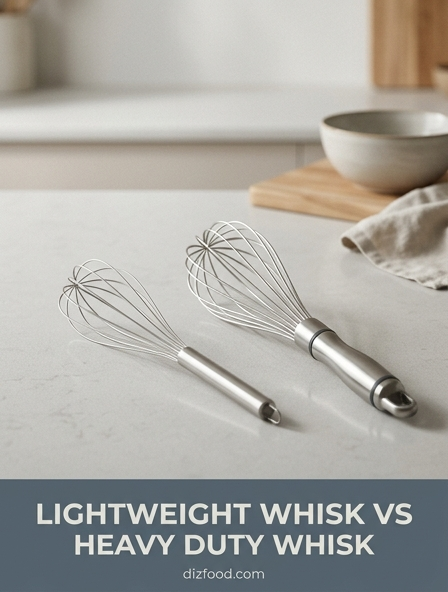
The performance of a whisk is largely determined by two factors: how many wires it has and how much those wires can move. A standard balloon whisk typically features between 8 and 12 wires. These wires are relatively long and are anchored only at the handle, allowing them to spread out and flex independently. This high level of flexibility is what allows the whisk to "bounce" against the bottom of a bowl, creating the rapid movements necessary to trap air. However, too few wires can make the whisk inefficient, while too many can make it difficult to clean and heavy to use.
The French whisk often has a similar number of wires, but they are bundled more tightly. This creates a narrower "cage." The flexibility of a French whisk is much lower; the wires are designed to stay in formation even when pushed through a thick batter. This lack of flex is actually a feature, not a bug, as it provides the user with more leverage. In some high-end French whisks, the wires are even slightly intertwined or reinforced at the base to ensure they remain rigid. When comparing the two, you can think of the balloon whisk as a spring and the French whisk as a comb.
Bakers often prefer a "medium flex" whisk which sits between these two extremes, but for most tasks, the distinction is clear. If you need the tool to give way and move with the liquid, choose flexibility. If you need the tool to force the liquid to move, choose the rigid wire count of the French model. This technical balance is why most well-equipped kitchens will keep at least two of each type in varying sizes.
Choosing the Right Tool for Every Recipe
Deciding which whisk to use can drastically alter the outcome of a recipe. A common mistake is using a balloon whisk for a heavy pan gravy, which leads to lumps because the wires cannot reach the corners of the pan. Conversely, using a French whisk to whip egg whites will take twice as long and result in a lower volume because the tool isn't designed to pull in air. To choose the right tool, first look at your container. If it is a wide, shallow bowl, the balloon whisk is your best friend. If it is a deep pot or a small saucepan, the French whisk is the correct choice.
Next, consider the final texture. Do you want the dish to be "aerated" or "emulsified"? This simple question usually dictates the tool. For home cooks, the balloon whisk is often the "default," but introducing a French whisk into the rotation for savory cooking can be a revelation in terms of sauce quality. Below is a quick reference guide for common recipes:
| Recipe/Task | Recommended Whisk | Reasoning |
|---|---|---|
| Meringue/Egg Whites | Balloon | Maximum air incorporation |
| Bechamel/Roux | French | Stiffness to prevent lumps |
| Vinaigrette | French | Better shear for emulsion |
| Pancake Batter | Balloon | Gentle mixing of light fluids |
| Pastry Cream | French | Reaches pan edges to prevent burning |
By matching the tool to the task, you reduce arm fatigue and ensure that the culinary techniques you are applying-whether whisking, beating, or folding-are as effective as possible.
Essential Whisk Maintenance for Longevity
A high-quality whisk is an investment that can last for decades if properly maintained. The most common point of failure for any whisk is the handle-to-wire junction. Over time, water and food particles can seep into the handle, leading to rust or bacterial growth. To prevent this, it is highly recommended to hand wash whisks whenever possible. While many are labeled dishwasher safe, the high-pressure spray can sometimes misalign the wires, and the intense heat can degrade the epoxy or seals used to hold the wires in place inside the handle.
When cleaning, pay special attention to the area where the wires overlap at the tip. Food debris, especially dried egg or flour paste, can become trapped here. Using a small kitchen brush can help dislodge these particles. After washing, whisks should be dried immediately. It is best to store them hanging on a rack or upright in a utensil crock. Shoving them into a crowded drawer can cause the wires to become bent or tangled, which ruins the "balance" of the whisk. A bent balloon whisk will no longer rotate smoothly, and a warped French whisk will lose its ability to scrape the bottom of a pan evenly.
- Rinse immediately after use to prevent starches or proteins from hardening.
- Use a bottle brush or dish brush to clean between dense wires.
- Dry thoroughly, handle-side up, to ensure no water remains trapped in the base.
- Periodically check for loose wires; a loose wire can be a safety hazard in food.
- Avoid using metal whisks on non-stick pans to prevent scratching the coating.
By following these simple steps, you ensure that your whisks remain hygienic, effective, and ready for any culinary challenge you encounter.

Comments