
Ever wondered why your morning toast fluctuates between "barely warm" and "charred remains"? The secret to hitting that elusive, picture-perfect golden brown lies in the battle between Analog Dials and Digital Shade Control. While analog dials offer a nostalgic, tactile simplicity that allows for quick, intuitive adjustments, they often lack the repeatable precision required for gourmet consistency. Conversely, digital shade control utilizes internal microprocessors and precise countdown timers to ensure that whether it's your first slice or your fifth, the heat intensity remains perfectly calibrated. Choosing the right interface isn't just about kitchen aesthetics; it's about mastering the science of the Maillard reaction to achieve the ultimate crunch every single time.
| Feature | Analog Dial Control | Digital Shade Control |
|---|---|---|
| Precision | Estimated; variable increments | Exact; calibrated to the second |
| Consistency | Lower; affected by residual heat | High; sensor-compensated cycles |
| User Feedback | Manual tick marks only | LED displays & countdown timers |
| Ease of Use | Instant, one-motion adjustment | Multi-press or menu navigation |
| Customization | Limited to basic heat range | Presets for bagel, defrost, & gluten-free |
| Reliability | High; fewer electronic failure points | Moderate; relies on PCB longevity |
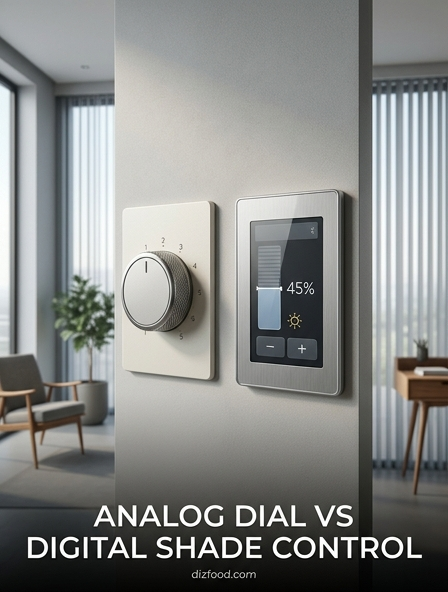
Tactile Precision of Analog Dials
In the heart of a busy kitchen, the tactile precision of an analog dial for shade control remains an unparalleled advantage for many homeowners. When your hands are covered in flour from baking or damp from rinsing vegetables, the physical presence of a knob or dial provides a reliable point of contact that does not require the clean, dry touch necessary for many modern screens. Analog dials offer a direct, mechanical link to the shade mechanism, allowing for micro-adjustments based on the shifting glare of the afternoon sun hitting a polished granite countertop.
The feedback provided by a physical dial is immediate and intuitive. Unlike digital systems that might have a slight latency between a touch and the motor's response, an analog dial moves in real-time with the user's hand. This is particularly beneficial in a kitchen setting where lighting needs can change rapidly-perhaps to block a sudden blinding reflection off a stainless steel appliance or to let in more light for a precision cutting task. The following benefits highlight why analog remains a staple:
- Operability with messy or gloved hands during intensive food preparation.
- Immediate "at-a-glance" confirmation of the shade's setting based on the dial position.
- Zero reliance on internet connectivity or software stability.
- Resistance to the steam and humidity common near stovepipes and sinks.
Furthermore, the simplicity of the analog dial minimizes the learning curve for guests or family members who may not be tech-savvy. There are no menus to navigate; there is simply a physical rotation that results in a predictable movement of the kitchen shades.
Digital Shade Interface Efficiency
Digital shade interfaces bring a level of high-tech efficiency to the kitchen that analog systems simply cannot match. Through sleek touch panels or integrated smartphone applications, users can control multiple windows simultaneously with a single tap. In large, open-concept kitchens with numerous windows, the ability to synchronize every blind to the exact same height creates a clean, architectural look that is difficult to achieve manually. Digital systems allow for "scenes"-pre-set heights for different times of day or specific culinary activities.
The efficiency of digital control is best illustrated when comparing the granularity of settings. A digital interface can be programmed to open shades to an exact percentage, ensuring consistency across the entire room. This is especially useful for managing heat gain in south-facing kitchens, where precise light filtering can keep the room cool without sacrificing a view of the garden. Consider the following comparison of digital interface features:
| Feature | Benefit for Kitchen Users |
|---|---|
| Multi-Zone Control | Adjust breakfast nook and prep area shades separately from one panel. |
| Preset Scenes | Instantly switch from "Morning Coffee" to "Privacy" mode. |
| Visual Feedback | High-resolution screens show the exact status of every window in the house. |
| Remote Access | Close shades from the grocery store if you realize the sun is heating up the pantry. |
While digital interfaces require a stable power source and occasionally a software update, the streamlined nature of their operation saves significant time during a morning rush. The lack of protruding knobs also contributes to a flatter, easier-to-clean wall surface.
Smart Home Ecosystem Compatibility
Modern kitchens are increasingly defined by their connectivity, and digital shade controls are the backbone of a truly integrated smart home ecosystem. Unlike analog dials, which operate in isolation, digital shades can communicate with smart ovens, lighting systems, and voice assistants. For instance, a "Cooking" voice command can simultaneously brighten the under-cabinet LEDs and lower the window shades to prevent screen glare on a smart refrigerator. This level of synergy transforms the kitchen from a collection of appliances into a responsive environment.
Integration extends to environmental sensors that further automate the kitchen experience. When a light sensor detects that the sun has reached a specific intensity, it can trigger the shades to lower, protecting delicate herbs on a windowsill from scorching. The compatibility with ecosystems like Apple HomeKit, Amazon Alexa, or Google Home allows for hands-free operation-a crucial feature when both hands are occupied with a heavy roasting pan or a delicate dough. Key integration points include:
- Geofencing: Shades close automatically when you leave the house to maintain kitchen temperature.
- Voice Control: "Alexa, open the kitchen shades 50%" for instant light adjustment.
- Inter-device Logic: If the kitchen smoke detector triggers, shades can automatically open to provide visibility for exits.
- Energy Monitoring: Integration with smart meters to lower shades during peak electricity price hours.
This connectivity ensures that the kitchen remains an efficient hub of the home, where the environment adapts to the user's schedule and the external weather conditions without manual intervention.
Mechanical Durability vs Digital Innovation
When evaluating the longevity of kitchen shade controls, one must weigh the proven mechanical durability of analog dials against the rapid innovation of digital systems. Analog dials are fundamentally simple machines; they consist of gears, springs, and physical stops. In the harsh environment of a kitchen-where grease, steam, and heat are constant-this simplicity is a virtue. There are no capacitors to leak, no screens to crack, and no processors to overheat. If an analog dial fails, the issue is usually a visible mechanical break that can be easily diagnosed.
Digital controls, however, represent the cutting edge of innovation, offering features that mechanical systems can never replicate. While they are more susceptible to electrical surges or software glitches, modern digital controllers are increasingly "hardened" for kitchen use. They offer the ability to improve over time through firmware updates, adding new features or improving motor efficiency long after the initial installation. The trade-offs between these two philosophies are outlined below:
- Mechanical Resilience: Dials often last decades with minimal maintenance, resisting the "planned obsolescence" cycle of high-tech gadgets.
- Digital Adaptability: As smart home standards (like Matter) evolve, digital controls can be updated to stay relevant, whereas a dial is limited to its original function.
- Environmental Sensitivity: Analog dials are less affected by the static electricity generated by kitchen appliances, while digital screens may require shielded wiring.
- Component Availability: Replacing a 20-year-old knob is often easier than finding a proprietary circuit board for a discontinued digital model.
Ultimately, the choice depends on whether the homeowner prioritizes the "install and forget" nature of mechanical parts or the evolving capabilities of modern silicon.
User Experience and Tactile Feedback
The user experience (UX) of kitchen shade control is heavily influenced by the type of feedback the system provides. Tactile feedback-the sensation of a click, a notch, or the resistance of a spring-serves as a non-visual confirmation of an action. For an amateur chef focused on a recipe, the ability to reach out and feel the position of a dial without looking away from the stove is a significant ergonomic advantage. The "haptic" nature of analog controls provides a satisfying, high-quality feel that evokes a sense of craftsmanship and permanence.
Digital systems are countering this with advanced haptic engines and auditory cues. Modern touchscreens can mimic the "click" of a mechanical button using vibration, and mobile apps often provide a sliding sound effect to indicate the shade is moving. However, these are simulations of the physical world. The digital experience prioritizes visual clarity and information density, showing the user exactly what is happening through icons and animations. The choice often comes down to the following sensory preferences:
- Analog: Heavy, weighted movement; distinct physical start and stop points; audible mechanical clicks.
- Digital: Smooth glass surfaces; vibrant color-coded status indicators; silent operation or customizable chime feedback.
For many, the "analog experience" feels more premium in a traditional or transitional kitchen, whereas the "digital experience" aligns with the clean lines and silent operation of a contemporary, high-tech culinary space. Accessibility also plays a role, as those with visual impairments may find the physical landmarks of a dial easier to navigate than a flat screen.
Programming Flexibility for Automation
Digital shade controls offer a level of programming flexibility that is simply impossible for analog dials. In a kitchen, where light requirements change based on the task-from bright morning light for coffee to dimmed, ambient light for a dinner party-automation ensures the environment is always perfect. Digital systems allow users to create complex schedules that account for the time of year, daylight savings, and even local weather forecasts. For example, the shades can be programmed to close halfway when the external temperature exceeds 85 degrees, reducing the load on the kitchen's cooling system.
The programming logic can be highly specific to kitchen workflows. Using a centralized hub, a homeowner can set "If-Then" parameters that enhance both comfort and utility. This flexibility is best visualized through common automation routines:
| Routine Name | Trigger Action | Shade Response |
|---|---|---|
| Sunrise Prep | 6:00 AM Daily | Open 100% to wake up the space. |
| Afternoon Glare | Sun at 240° Azimuth | Lower to 30% to protect the dining table. |
| Evening Privacy | Sunset + 15 mins | Close fully and lock for security. |
| Chef Mode | Kitchen Light On | Adjust to "anti-glare" height for tablet viewing. |
Analog dials, by contrast, are strictly manual. While some motorized shades with analog wall switches exist, they lack the memory and logic required to perform these automated tasks. For the user who wants their kitchen to "just work" without constant manual adjustment, the digital path is the only viable option.
Modern Design and Aesthetic Appeal
The aesthetic impact of shade controls on kitchen design cannot be overstated. As the kitchen has evolved into a primary social space, the look of wall-mounted hardware has become a key design consideration. Analog dials often cater to specific "heritage" or "industrial" aesthetics. A knurled brass dial can be a stunning accent in a kitchen with matching cabinet hardware and a farmhouse sink. It adds a layer of texture and "old-world" charm that feels substantial and intentional.
On the other hand, digital controls appeal to the minimalist. A flush-mounted glass touchscreen or a simple, buttonless interface integrates seamlessly into a backsplash or a side panel of a kitchen island. These devices are often customizable, allowing the user to change the background wallpaper or the color of the LED backlighting to match the kitchen's color palette. Design considerations often fall into two camps:
- Traditional/Rustic: Prefer visible mechanics, organic shapes, and classic materials like bronze, nickel, or porcelain dials.
- Ultra-Modern/Technological: Prefer hidden tech, flat surfaces, and "invisible" interfaces that don't distract from the cabinetry.
Furthermore, digital interfaces can reduce "wall clutter." Instead of five separate dials for five different windows, a single digital panel can manage everything, leading to a much cleaner architectural finish. This is particularly important in kitchens with minimal wall space due to large expanses of cabinetry or open shelving.
Installation and Wiring Requirements
The complexity of installation is a major differentiating factor between analog and digital shade controls. Analog systems are generally simpler to wire, often utilizing a basic low-voltage circuit that connects the dial directly to the shade motor. Because there is no data transmission involved, the requirements for shielding and interference are minimal. For a kitchen remodel where walls are already open, an analog setup is straightforward for any qualified electrician. However, analog systems usually require a dedicated wire for every single shade, which can lead to thick bundles of cabling in a large kitchen.
Digital systems, while appearing more complex, can actually be more efficient to install in certain scenarios. Many modern digital shades utilize wireless protocols like Zigbee, Z-Wave, or Wi-Fi, meaning they only require a power source-sometimes just a battery pack or a slim DC wire-rather than a direct data link to the wall switch. This makes them ideal for retrofitting into existing kitchens where running new wires through backsplash tile would be prohibitively expensive. The installation process typically involves:
- Mounting the motorized shade housing in the window frame.
- Connecting to a power source (Hardwired, Plug-in, or Battery).
- Pairing the device with a central bridge or the home Wi-Fi network.
- Configuring the software limits and user interface preferences.
Digital systems do require a robust home network. If the Wi-Fi signal is weak in the kitchen-often due to the interference of large metal appliances like refrigerators-installers may need to add range extenders or use a mesh networking system to ensure reliable shade operation.
Maintenance and Long Term Reliability
Maintenance requirements for kitchen shade controls vary significantly based on their underlying technology. Analog dials are prone to physical wear; over thousands of rotations, the internal potentiometers or gears can develop "play" or start to stick. In a kitchen, airborne grease is the primary enemy of analog hardware. Grease can seep into the crevices of a dial, attracting dust and creating a gummy residue that interferes with the mechanical movement. Regular cleaning with a damp cloth and occasionally a specialized electronic cleaner is necessary to keep them turning smoothly.
Digital controls face different long-term challenges. Their physical maintenance is generally easier because a flat glass screen can be wiped clean in seconds with a microfiber cloth. However, their "reliability" is often tied to software stability. A firmware update that goes wrong or a change in the manufacturer's cloud service can render a digital interface frustrating to use. To ensure long-term reliability in a digital kitchen, users should consider:
- Choosing reputable brands with a history of long-term software support.
- Ensuring the kitchen has a dedicated, stable power circuit to prevent digital "brownouts."
- Using local-control protocols (like Matter or Thread) that don't rely on an active internet connection to function.
- Checking battery health annually for wireless digital shades.
While an analog dial might feel "gritty" after ten years, it will likely still move the shade. A digital panel might still look brand new after ten years but could be functionally obsolete if the operating system it relies on is no longer supported. This makes the choice a balance between physical hygiene and digital longevity.
Choosing Between Manual and Digital Control
Deciding between analog dial and digital shade control for a kitchen ultimately depends on the homeowner's lifestyle, the kitchen's architectural style, and the desired level of interaction. For those who view the kitchen as a place of tactile, hands-on craft, the analog dial offers a satisfying connection to the environment. It is the "manual transmission" of home automation-reliable, physical, and devoid of complexity. It is the best choice for high-traffic kitchens where simplicity and speed are prioritized over high-level features.
Conversely, for the modern homeowner who values data, automation, and a clean aesthetic, digital control is the superior choice. The ability to coordinate the kitchen's lighting with the rest of the house, combined with the convenience of voice and app control, fits perfectly into a fast-paced, tech-integrated life. When making the final decision, consider the following criteria:
| Factor | Choose Analog If... | Choose Digital If... |
|---|---|---|
| Frequency of Use | You adjust shades once or twice a day. | You want shades to move constantly with the sun. |
| User Demographic | The kitchen is used by children or seniors. | The users are tech-savvy and want "smart" features. |
| Kitchen Style | Farmhouse, Industrial, or Craftsman. | Minimalist, Contemporary, or High-Tech. |
| Budget | Lower initial cost and zero subscription fees. | Higher upfront cost for convenience and integration. |
Ultimately, a hybrid approach is also possible, using digital motors for the convenience of automation while maintaining a high-quality analog wall dial for quick, manual overrides. This provides the best of both worlds: the reliability of a physical touchpoint and the power of a digital ecosystem.

Comments