
Unlocking the perfect breakfast starts with mastering the Maillard reaction, the chemical magic behind that irresistible toasted aroma. Achieving the ultimate golden crunch is less about luck and more about understanding how heat transforms moisture and sugars into a crisp, caramelized surface. This delicate balance of temperature and duration ensures your bread develops a firm texture without losing its soft, pillowy interior. By diving into the essential science of heat distribution, you can transform a simple slice into a culinary masterpiece every single morning. To find your ideal browning level, consider the precision offered by analog dial vs digital shade control settings.
The Chemistry of the Maillard Reaction
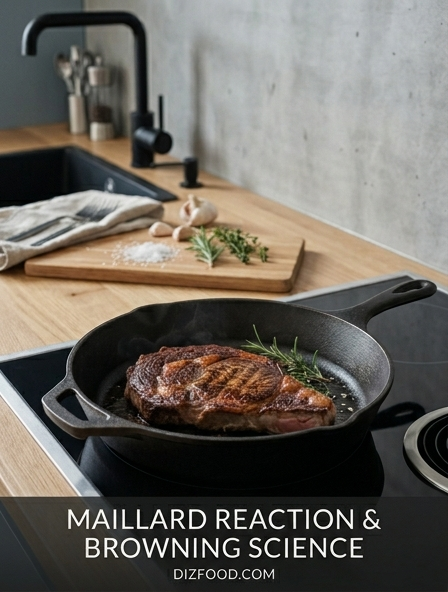
The Maillard reaction is a fundamental chemical process in the kitchen, occurring when heat triggers a reaction between amino acids and reducing sugars. This complex series of transformations is responsible for the savory, umami-rich flavors and the characteristic brown color observed in toasted bread, seared steaks, and roasted coffee. Unlike simple browning, this reaction produces hundreds of different flavor compounds, which subsequently break down to form even more new flavor molecules. The process typically accelerates at temperatures between 140°C and 165°C (285°F to 330°F).
- Reducing Sugars: Glucose, fructose, and lactose that provide the carbonyl group.
- Amino Acids: The building blocks of proteins that react with the sugars.
- Melanoidins: Brown nitrogenous polymers that create the final visual pigment.
- Amadori Rearrangement: An intermediate stage that stabilizes the initial sugar-amine bond.
The complexity of the Maillard reaction is what distinguishes professional culinary results from simple heating. By manipulating the types of sugars and proteins present, chefs can influence the specific aromatic profiles, ranging from floral and nutty to meaty and toasted notes.
Moisture Evaporation and Texture Development
Before the Maillard reaction can reach its full potential, the surface moisture of the food must be significantly reduced. Water acts as a thermal buffer, preventing the temperature of the food from rising above 100°C (212°F) due to evaporative cooling. As heat is applied, a "dry zone" forms on the exterior, allowing the surface temperature to climb into the range required for browning. This dehydration is critical for the development of a crisp texture, as it transforms the soft crumb into a rigid, brittle crust.
- Initial heating drives free water molecules toward the surface.
- Surface evaporation creates a localized concentration of solutes.
- The temperature rises once the surface water activity drops.
- Cross-linking of polymers occurs, resulting in a hardened structural matrix.
This textural evolution is a race against time and heat intensity. If moisture evaporates too slowly, the interior may become excessively dry or "stale" before the surface browns. Conversely, if the heat is too high, the surface may char while the interior remains damp and spongy, leading to an unbalanced sensory experience.
Heat Transfer Methods in Toasting
The efficiency and uniformity of the Maillard reaction are dictated by the method of heat transfer employed. In a kitchen environment, toasting primarily relies on radiation and convection, though conduction plays a role when using pans or griddles. Each method influences the speed at which the "golden brown" state is achieved and affects the gradient of doneness between the crust and the core.
| Method | Mechanism | Culinary Effect |
|---|---|---|
| Radiation | Infrared waves from heating elements | Rapid surface browning with minimal internal drying. |
| Convection | Circulating hot air currents | Even moisture removal and consistent color across surfaces. |
| Conduction | Direct contact with a hot surface | Intense localized browning and potential for searing patterns. |
Radiation is the most common method in vertical toasters, allowing for high-intensity energy to hit the bread surface without the need for an intermediate medium. However, convection ovens provide a more controlled environment for thicker items, ensuring that the moisture evaporation is uniform across all exposed areas, preventing localized burning.
Caramelization and Flavor Profiles
While often confused with the Maillard reaction, caramelization is a distinct pyrolytic process that involves the oxidation of sugars without the presence of amino acids. In the context of toasting bread or roasting vegetables, both processes often occur simultaneously, creating a multifaceted flavor profile. Caramelization requires higher temperatures than Maillard reactions and results in a different set of aromatic compounds, such as diacetyl for buttery notes and esters for fruity aromas.
- Sucrose: Breaks down at 160°C to produce classic caramel tones.
- Fructose: Begins to caramelize at a lower 110°C, adding sweetness.
- Bitterness: Over-caramelization leads to carbonization and acridity.
- Volatile Compounds: Thousands of molecules that contribute to the "toasted" scent.
The interplay between these two reactions defines the complexity of the crust. While the Maillard reaction provides the savory depth and "toasted" bite, caramelization contributes the subtle sweetness and rich amber hues. Balancing these two chemical paths is essential for achieving the perfect golden-brown finish without introducing the bitterness associated with burning.
The Role of Bread Density and Porosity
The physical structure of bread significantly dictates how it reacts to heat. Density and porosity determine the rate of thermal penetration and the total surface area available for the Maillard reaction. A highly porous bread, such as sourdough or ciabatta, features large air pockets (alveoli). These pockets increase the effective surface area, allowing for more extensive browning and a more complex crunch. The thin walls of these pores heat up rapidly, reaching the Maillard threshold almost instantly.
In contrast, dense breads like rye or whole-wheat sandwich loaves have a tighter crumb structure. The higher density increases the thermal mass, meaning it takes longer for the heat to penetrate and for moisture to escape. In such breads, the browning is often more uniform but less intense at the microscopic level. The steam trapped within smaller pores can also delay the browning process by maintaining a humid micro-environment. Understanding these structural differences allows a cook to adjust timing and temperature settings, ensuring that a dense brioche is toasted as effectively as a light, airy baguette.
Protein and Sugar Interaction Dynamics
The specific ratio of proteins to sugars within a food item governs the intensity of the Maillard reaction. This interaction begins with the condensation of a sugar's carbonyl group and a protein's amino group to form an unstable N-substituted glycosylamine. As heat continues, this molecule undergoes Amadori rearrangement, which serves as the gateway to the flavorful compounds we associate with cooking. The presence of specific amino acids, such as lysine, can accelerate these reactions because of their highly reactive nature.
- Lysine: A key amino acid that reacts quickly at lower temperatures.
- Glucose: A common reducing sugar that fuels the reaction in dough.
- Pentose Sugars: Often react faster than hexose sugars like glucose.
- Intermediate Scission: The stage where small, aromatic molecules like furfural are born.
In the kitchen, adding ingredients like milk or eggs increases the protein and sugar availability, leading to a darker, richer crust at lower temperatures. This is why enriched doughs brown much faster than lean doughs consisting only of flour, water, and salt. Controlling these dynamics is the key to fine-tuning flavor.
Optimal Temperature for Golden Browning
Achieving the perfect "golden brown" is a matter of precise temperature control. The sweet spot for the Maillard reaction generally falls between 140°C and 165°C (285°F to 330°F). Within this window, the chemical reactions proceed fast enough to develop flavor and color before the food becomes overly dry, but slow enough to prevent the onset of pyrolysis (burning). If the temperature remains below 130°C, the food will eventually dry out and become hard without developing the complex aromas associated with toasting.
When temperatures exceed 170°C (340°F), caramelization begins to dominate, and eventually, the food will begin to char. Charring produces acrylamide and bitter carbonized layers, which can mask the delicate flavors created by the Maillard reaction. Therefore, consistent heat application is vital. In a professional kitchen, maintaining this thermal window ensures that the exterior reaches the desired crispness and hue while the interior retains its intended moisture content. The use of infrared thermometers or calibrated ovens helps in monitoring this critical thermal threshold for consistent culinary results.
Surface pH and Crust Formation
The acidity or alkalinity of a food's surface plays a dramatic role in the speed and quality of the Maillard reaction. The chemical process is hindered in acidic environments because the amino groups become protonated, making them less reactive toward sugars. Conversely, an alkaline environment accelerates the reaction, leading to faster browning and a deeper flavor profile. This is a common technique used in professional baking and pretzel making to achieve a distinct dark crust.
- Lowering pH (increasing acidity) slows down browning and keeps crusts pale.
- Increasing pH (adding baking soda) promotes rapid, dark browning.
- Lye baths for pretzels represent an extreme version of pH manipulation.
- Maillard reactions are most efficient when the pH is slightly above 7.0.
Chefs often utilize this knowledge by brushing surfaces with alkaline solutions or protein-rich washes (like egg wash) to encourage crust formation. Understanding pH allows for the correction of doughs that refuse to brown or the prevention of over-browning in sugary batters that contain acidic leaveners like buttermilk.
Starch Retrogradation and Crunch Longevity
The "crunch" of toasted bread is not just about the Maillard reaction; it is also heavily influenced by starch retrogradation and the state of the bread's crystalline structure. During the toasting process, heat drives out moisture, causing the gelatinized starch to dehydrate and form a rigid, glass-like state. This is what provides the initial snap. However, as soon as the toast begins to cool, it starts to absorb moisture from the surrounding air and the moist interior crumb.
- Amylose: Recrystallizes quickly to provide structural stiffness.
- Amylopectin: Influences the long-term staling process.
- Moisture Migration: The movement of water from the center to the crust.
- Glass Transition: The temperature at which the crust moves from crisp to rubbery.
To maintain crunch longevity, it is essential to allow toast to cool in a way that steam can escape (such as on a wire rack). If placed on a flat plate immediately, the escaping steam becomes trapped against the crust, rehydrating the starch and turning the Maillard-transformed surface from crispy to soggy in a matter of seconds.
Thermal Equilibrium for Even Toasting
Achieving uniform browning requires the food to reach thermal equilibrium across its entire surface. Hot spots in a toaster or pan can lead to uneven Maillard reactions, resulting in some areas being burnt while others remain undercooked. This is often caused by the geometry of the heating elements or the way air circulates within the cooking chamber. Thermal equilibrium ensures that every millimeter of the surface undergoes the same chemical transformations at the same rate.
| Factor | Impact on Equilibrium | Solution |
|---|---|---|
| Distance from Heat | Uneven radiation intensity | Adjusting rack height or rotating food. |
| Air Flow | Static pockets of cool air | Using convection fans to distribute heat. |
| Surface Geometry | Edges heat faster than centers | Pre-heating the cooking vessel thoroughly. |
In practice, a well-preheated oven or a toaster with balanced elements is required to reach this state. When the heat is applied evenly, the Maillard reaction progresses predictably, resulting in a consistent golden-brown finish. This equilibrium is the difference between a mediocre piece of toast and a perfectly executed culinary component that provides a consistent flavor and texture in every bite.



Comments