
Choosing between the clinical precision of sous vide and the primal energy of live-fire cooking is the ultimate culinary crossroads for any host aiming to deliver a memorable dinner party. While sous vide offers the "set it and forget it" luxury of edge-to-edge thermal perfection-guaranteeing your expensive Wagyu or salmon never overcooks-live fire brings the raw spectacle, smoky depth, and charred textures that turn a meal into an immersive performance. Whether you prioritize a stress-free, predictable workflow that lets you mingle with guests or the sensory-rich, high-stakes drama of managing an open flame, understanding these two polar opposite techniques is essential for mastering the art of modern entertaining.
| Feature | Sous Vide (Precision) | Live Fire (Searing) |
|---|---|---|
| Consistency | 100% predictable; edge-to-edge doneness. | Variable; relies on skill and hot spots. |
| Flavor Profile | Pure, clean, and infused (herbs/oils). | Smoky, charred, and deeply Maillard-rich. |
| Hands-on Time | Passive; "set and forget" for 1-48 hours. | Active; requires constant fire management. |
| Texture | Ultra-tender; breaks down tough fibers. | Contrast-heavy; crispy skin and firm bite. |
| Host Dynamics | Low stress; allows for maximum socializing. | High spectacle; host becomes the performer. |
| Ideal For | Large groups; delicate fish; tough cuts. | Steaks; charred vegetables; outdoor events. |
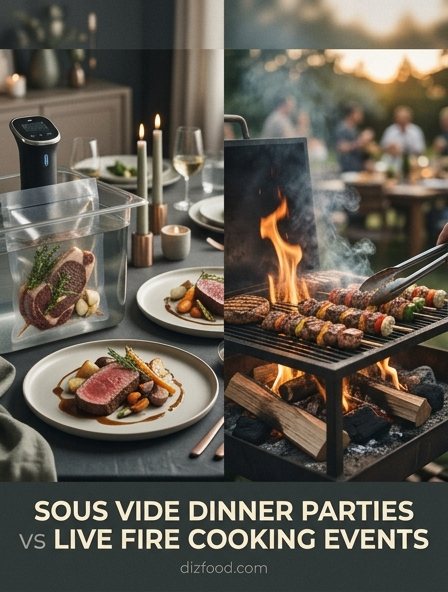
Sous Vide vs Live Fire Hosting Styles
Hosting a dinner party revolves heavily around the personality of the cook and the desired energy of the evening. Sous vide hosting is defined by its quiet, almost invisible presence. The host who chooses this method often prioritizes conversation and hospitality over culinary performance. Because the food is held at a precise temperature in a water bath, there is no frantic checking of the oven or pan. This creates a serene environment where the host can engage fully with guests, drink in hand, knowing the main course is already perfectly cooked and merely waiting for a quick sear before serving.
In contrast, live fire cooking events are high-energy, participatory spectacles. The host is inextricably linked to the heat source, often standing at the center of a swirling cloud of aromatic smoke. This style of hosting attracts those who view cooking as a performance art. Guests naturally gravitate toward the flames, drawn by the primal heat and the rhythmic sound of fat rendered over glowing coals. While the sous vide host is a relaxed facilitator, the live fire host is a conductor of elements, managing air flow, fuel, and flare-ups. The hospitality here is found in the shared experience of the flame, making the preparation of the meal as much a part of the entertainment as the eating itself.
Precision Water Baths vs Primal Open Flames
The fundamental difference between these two methods lies in the management of energy and the predictability of the outcome. A precision water bath relies on an immersion circulator to move water at a constant, hyper-accurate temperature. This method removes the variable of time as a stressor, as the thermal conductivity of water ensures the protein reaches the exact internal temperature set by the user, from edge to edge, without the risk of overcooking. It is a sterile, scientific approach that favors the perfectionist who demands repeatable results every single time.
On the other end of the spectrum, primal open flames introduce a level of chaos that requires intuition and experience to master. Unlike the digital interface of a circulator, wood and charcoal are living heat sources that change by the minute. The cook must account for the type of wood, the ambient humidity, and the oxygen levels within the grill or fire pit. This is not about scientific precision but about "reading" the food. The heat is aggressive and uneven, requiring constant movement and adjustment. While the water bath offers a safety net of modern engineering, the open flame offers the thrill of taming a volatile force of nature. One is about the elimination of risk; the other is about the mastery of it.
Modern Consistency Meets Traditional Charred Flavor
When comparing the sensory outputs of these two methods, the debate often centers on the trade-off between internal texture and external character. Sous vide provides a level of consistency that is physically impossible to achieve with high-heat methods. For instance, a steak cooked at 131 degrees Fahrenheit for three hours will be perfectly medium-rare from the very center to the microscopic layer just beneath the surface. However, because it is cooked in a vacuum-sealed bag, it lacks the initial Maillard reaction and smoky depth that define traditional outdoor cooking.
| Feature | Sous Vide Result | Live Fire Result |
|---|---|---|
| Internal Doneness | Uniform edge-to-edge color | Gradient (Bullseye) effect |
| Flavor Profile | Pure, concentrated protein | Smoky, charred, and complex |
| Fat Rendering | Soft, buttery, and translucent | Crispy, charred, and rendered |
| Surface Texture | Requires secondary searing | Naturally crusty (Bark) |
To bridge this gap, many modern chefs utilize a hybrid approach, using the water bath for the internal "doneness" and a scorching live fire for the finishing "crust." This allows for the benefits of modern technology while retaining the ancient, primal flavors that only wood and charcoal can impart. Without the fire, sous vide food can sometimes feel overly clinical; without the precision of the bath, live fire can occasionally result in a dry, overcooked exterior.
The Atmosphere of High Tech vs High Heat
The atmosphere of a sous vide dinner party is typically one of refined minimalism. The kitchen remains cool, the air is free of smoke, and the sounds are limited to the gentle hum of the circulator and the clinking of wine glasses. This environment suits indoor settings, urban apartments, or formal occasions where the goal is a sophisticated, multi-course tasting menu. It feels like a high-end restaurant experience where the "magic" happens behind the scenes, and the food arrives at the table as if by clockwork, perfectly tempered and beautifully plated.
Live fire events, however, demand an outdoor setting where the environment is transformed by the heat. The atmosphere is rustic and sensory-heavy; the smell of burning hickory or oak permeates the air, and the heat from the pit creates a natural gathering point for guests. It is an "apron and beer" kind of vibe, where the boundaries between the kitchen and the social space are blurred. The crackle of wood and the occasional spark add a layer of excitement that a kitchen appliance cannot replicate. While high-tech cooking is about the quiet pursuit of perfection, high-heat cooking is about the loud celebration of the process, making it the preferred choice for casual summer gatherings and boisterous celebrations.
Technical Kitchen Control vs Backyard Culinary Theater
Technical kitchen control is the hallmark of the sous vide enthusiast. By utilizing vacuum sealers and immersion circulators, the cook gains absolute power over the molecular structure of the ingredients. This control extends to long-duration cooks-such as 48-hour short ribs-that transform tough connective tissues into something as tender as butter without losing a drop of moisture. It is a controlled laboratory environment where the results are guaranteed by physics. This appeals to the "culinary nerd" who enjoys documenting temperatures and experimenting with infusion techniques that occur under pressure inside the bag.
Live fire cooking, conversely, is pure culinary theater. Every movement of the griller is scrutinized by the guests. Managing a large brisket or a whole lamb over an open pit requires a physical commitment that involves hauling wood, shoveling coals, and monitoring the wind. There is a narrative arc to the evening: the lighting of the fire, the management of the "clean smoke," and the dramatic carving of the meat. This style of cooking creates a story. The host isn't just serving a meal; they are presenting a feat of endurance and skill. The lack of buttons and sensors means the cook must rely on their senses-smell, touch, and sight-to determine when the food is ready, turning the act of cooking into a visceral, engaging performance.
Texture Profiles of Immersion vs Live Smoke
The structural changes that occur in food depend heavily on the medium of heat transfer. Immersion cooking uses water to surround the food with gentle, constant energy. This results in a texture that is remarkably tender and succulent because the cell walls of the protein do not contract violently. For fish, this means a flake that is moist and almost translucent. For poultry, it means a breast that is consistently juicy. However, the lack of air movement means there is no evaporation, which can sometimes result in a "soft" texture that some traditionalists find lacking in character.
Live smoke and fire utilize convection and radiant heat, which dries the surface of the food to create a "bark" or crust. This texture is the holy grail of barbecue and grilling. The combination of smoke particles and the Maillard reaction creates a complex, chewy, and flavorful exterior that provides a necessary contrast to the tender interior.
- Sous Vide Texture: Uniform, silky, tender, and high-moisture.
- Live Fire Texture: Contrasting, crunchy, fibrous, and intensely flavored.
- Hybrid Texture: The "best of both worlds" with a silky interior and a fire-finished crust.
Effortless Dinner Parties vs Active Grilling Events
The "effort" involved in these two styles is distributed differently throughout the day. Sous vide is the king of the "set it and forget it" philosophy. The bulk of the work-seasoning, bagging, and sealing-is done hours or even days in advance. When the guests arrive, the host has virtually zero active cooking duties. This makes it the ideal choice for those who find cooking for a crowd stressful. The kitchen stays clean, the dishes are minimal, and the risk of a "kitchen disaster" is nearly zero. It is an effortless way to produce professional-grade food without the professional-grade stress.
Live fire events require an "all-in" approach from the moment the match is struck. The host must be active throughout the process, tending to the fire and rotating the food. This is not to say it is "work" in a negative sense; for many, the activity is the highlight of the event. However, it requires the host to be physically present at the grill for long stretches.
- Prep Phase: Sous vide requires precision bagging; Live fire requires wood prep and fire building.
- Active Phase: Sous vide is passive; Live fire requires constant monitoring and heat management.
- Finishing Phase: Sous vide needs a quick sear; Live fire needs resting and slicing.
Sous Vide Reliability vs Live Fire Adaptability
Reliability is the primary selling point of the sous vide method. Because the water bath cannot exceed the set temperature, it is physically impossible to overcook the food in the traditional sense. If a guest is running thirty minutes late, the steak can simply stay in the water bath without any loss in quality. This level of reliability is a massive psychological relief for hosts. It allows for a flexible schedule where the food waits for the people, rather than the people waiting for the food. It is the ultimate insurance policy against ruined expensive proteins.
Live fire cooking, however, is all about adaptability. The cook must be able to pivot when the wind picks up, when the wood burns faster than expected, or when the charcoal starts to die out. There is no "pause" button on a fire. This requires the cook to be in tune with the environment. If the fire is too hot, the meat must be moved to a cooler zone. If the smoke is too bitter, the airflow must be adjusted. This adaptability is what makes a great pitmaster. While it lacks the "guarantee" of the water bath, it provides a sense of accomplishment that comes from successfully navigating the variables of the natural world. The "win" feels more earned when you have fought the elements to deliver a perfect meal.
Equipment Needs for Science and Smoke Enthusiasts
The gear required for these two hobbies reflects their underlying philosophies. The sous vide setup is compact, electronic, and fits easily into a kitchen drawer. It is a kit designed for the modern, tech-savvy cook who values efficiency and space-saving design. On the other hand, live fire equipment is bulky, heavy, and often requires a dedicated outdoor space. It is a kit for the enthusiast who doesn't mind a bit of soot and ash in exchange for authentic flavor.
- Sous Vide Essentials: Immersion circulator, vacuum sealer, BPA-free bags, and a large stockpot or polycarbonate container.
- Live Fire Essentials: Charcoal kettle, offset smoker, or fire pit; high-quality fuel (lump charcoal/hardwood logs); heat-resistant gloves; and a reliable chimney starter.
- The Cross-Over Tool: A high-powered propane torch or a cast-iron skillet, used by both styles to achieve the perfect final sear.
Starting with sous vide is generally more affordable and accessible for apartment dwellers. Live fire cooking requires a larger initial investment in both equipment and space, not to mention the ongoing cost of fuel. However, the longevity of a well-built steel grill often outlasts the electronic components of a circulator, making it a "buy it for life" investment for the dedicated outdoor cook.
Choosing Your Culinary Vibe: Precision or Primal
Choosing between a sous vide dinner party and a live fire cooking event ultimately comes down to the "vibe" you want to project. If the goal is a sophisticated, calm, and intellectually driven evening where the food is a topic of conversation due to its impossible texture and perfection, then sous vide is the clear winner. It is the choice of the modern host who values time, precision, and the ability to serve a high-end menu without breaking a sweat. It is culinary science at its most accessible and impressive.
If the goal is a visceral, sensory-rich, and communal experience where the act of cooking is as much a part of the party as the meal itself, live fire is the only way to go. It appeals to the primal side of our nature, bringing people together around a flickering heat source and filling the air with the unmistakable scent of woodsmoke. It is for the host who wants to be a hero, taming the flames to produce something rugged and undeniably delicious. Whether you choose the precision of the water bath or the primal heat of the fire, the best choice is the one that allows you to connect with your guests and share your passion for the craft of cooking.

Comments