
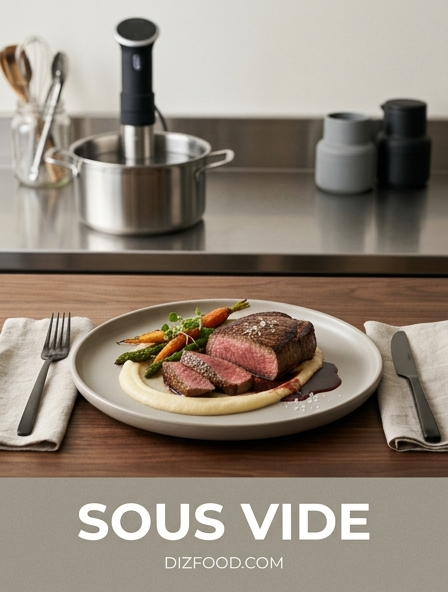
Mastering Heat Management for Stress-Free Hosting
The primary challenge of hosting dinner parties often revolves around the narrow window of perfection for proteins. Traditional roasting and pan-searing methods require split-second timing to ensure the center is cooked through without over-drying the exterior. Sous vide technology fundamentally alters this dynamic by decoupling the cooking process from the serving time. By maintaining a constant, precise temperature, an immersion circulator allows the host to keep ingredients at their ideal doneness for extended periods without the risk of overcooking.
- Eliminates the "rush hour" stress during the final thirty minutes of meal preparation.
- Ensures meat remains juicy regardless of minor delays in guest arrivals.
- Provides a predictable timeline for side dish completion and plating.
- Reduces kitchen heat and clutter by utilizing a compact water bath.
This thermal stability provides a safety net that traditional ovens simply cannot offer. Instead of hovering over a stove, the host can focus on the social aspects of the evening, knowing the main course is held in a state of culinary perfection. The result is a relaxed atmosphere where the quality of the food is guaranteed by physics rather than constant manual monitoring.
Essential Tools for Culinary Precision and Consistency
To achieve professional-grade results in a home kitchen, selecting the right equipment is paramount. While the immersion circulator is the heart of the system, supporting tools ensure the environment remains controlled and efficient. A high-quality vacuum sealer is necessary to remove air, preventing bags from floating and ensuring maximum heat transfer from the water to the food. Furthermore, the vessel used for the water bath should be properly insulated to maintain energy efficiency and temperature stability during long cook times.
| Tool | Primary Function | Benefit to Chef |
|---|---|---|
| Immersion Circulator | Regulates water temperature | Edge-to-edge perfection |
| Vacuum Sealer | Removes air from packaging | Enhanced flavor infusion |
| Polycarbonate Container | Holds the water bath | Visibility and durability |
| Insulation Sleeve | Prevents heat loss | Energy efficiency |
Beyond the basics, specialized weights and racks can be employed to keep multiple bags organized and submerged. These tools work in unison to eliminate the variables that typically lead to inconsistent meals. By investing in a dedicated setup, the cook ensures that every steak, fillet, or vegetable is treated with the same rigorous standard of heat application every time.
The Art of Resting Meat for Flavorful Results
In traditional cooking, resting meat is a critical step used to allow fibers to relax and reabsorb juices that were pushed to the center by high heat. With sous vide, the temperature gradient is non-existent, meaning the muscle fibers do not contract as violently. However, resting still plays a vital role when a post-bath sear is involved. To achieve the best results after removing meat from the water, one should follow a specific sequence to ensure the exterior is crisp while the interior remains at the target temperature.
- Remove the protein from the vacuum bag and pat it thoroughly dry with paper towels.
- Allow the meat to air-dry for several minutes to facilitate a faster Maillard reaction.
- Sear the meat quickly in a high-smoke-point oil or with a culinary torch.
- Let the meat rest for three to five minutes to allow the surface heat to stabilize.
This brief resting period after the sear prevents the internal temperature from spiking too high, which can happen if the meat is carved immediately. By managing this transition carefully, the chef preserves the uniform pinkness of the interior while delivering a flavorful, crusty exterior that satisfies the palate.
Balancing Technical Accuracy with Social Grace
Modern entertaining often suffers when the host is confined to the kitchen, preoccupied with thermometers and timers. Sous vide cooking acts as a silent assistant, handling the technical heavy lifting while the host engages with their guests. This balance is achieved through the "set and forget" nature of immersion circulation. Once the water bath reaches the desired temperature and the food is submerged, the active labor phase effectively ends until it is time for the final finish.
This method transforms the kitchen from a high-stress workstation into a communal space. Because the food cannot overcook in the bath, conversations can flow naturally without the host needing to constantly check the oven. Technical accuracy is maintained by the circulator's microprocessor, which handles temperature fluctuations within a fraction of a degree. Consequently, the host can serve a multi-course meal with the confidence of a professional chef, all while remaining a present and attentive participant in the social gathering. This seamless integration of technology and hospitality is the hallmark of the modern kitchen.
Advanced Methods for Reliable Oven Performance
While the water bath is the primary tool for sous vide, the oven can serve as a powerful secondary tool for finishing and holding. When preparing large quantities for a crowd, a conventional oven set to its lowest possible temperature can act as a warming chamber. For more advanced setups, combi-ovens that offer steam control can mimic the sous vide environment, though they lack the precise heat transfer of water. For most home cooks, the oven is best utilized for the "reverse sear" finishing touch or for heating plates to ensure the meal stays hot.
- Preheat the oven to 200°F for gentle holding of seared proteins.
- Use the broiler setting for a rapid, even crust on larger roasts.
- Utilize convection fans to dry the surface of the meat before searing.
- Place serving platters in a low oven to prevent thermal shock to the food.
By coordinating the strengths of the immersion circulator with the capacity of the oven, the chef can manage high-volume dinners with ease. This hybrid approach ensures that while the core is cooked perfectly in the bath, the presentation and serving temperature are maintained by the oven's ambient heat.
Sustaining Optimal Temperatures from Kitchen to Table
The transition from the cooking vessel to the guest's plate is where many gourmet meals lose their impact. Since sous vide proteins are often cooked at lower temperatures than traditional roasts, they can lose heat rapidly once exposed to room air. Sustaining the optimal temperature requires a strategic approach to plating and service. Utilizing a combination of rapid searing and pre-warmed equipment can bridge the gap between the water bath and the first bite.
| Action Item | Target Temperature | Reasoning |
|---|---|---|
| Plate Warming | 120°F - 140°F | Prevents food from cooling on contact |
| Final Sear | 450°F+ Surface | Adds texture and aromatic complexity |
| Sauce Temp | 160°F | Provides a thermal "blanket" for meat |
| Resting Period | Room Temp | Equalizes internal and external heat |
By paying attention to these thermal details, the chef ensures that the precision achieved during the long cook is not wasted. A hot plate and a steaming sauce act as insulators, keeping the delicately cooked protein at its peak flavor profile throughout the duration of the meal.
Predictive Cooking Strategies for Modern Entertaining
Successful hosting relies on predictive strategies that account for varying cook times across different proteins and vegetables. Sous vide allows for a "staggered start" approach, where items requiring long durations-such as tough cuts of beef-are started days in advance, while delicate items like fish are added shortly before serving. Understanding the thermal properties of different ingredients is the key to a synchronized dinner service where every component peaks simultaneously.
- Identify proteins that require long-term collagen breakdown (24-48 hours).
- Schedule vegetables that require higher temperatures (183°F) for earlier in the day.
- Utilize an ice bath to chill long-cook items for reheating later.
- Synchronize the final "warm-up" of all components in a single bath at the serving temperature.
This methodology removes the guesswork from the afternoon of the event. By having the majority of the cooking completed and the items held in their vacuum-sealed bags, the chef only needs to focus on the final assembly. Predictive cooking ensures that complexity does not lead to chaos, allowing for sophisticated menus that would otherwise be impossible for a single cook to manage.
Achieving Uniform Texture in Every Dish
One of the most profound benefits of sous vide is the achievement of uniform texture. In traditional high-heat cooking, a "bullseye" effect occurs, where the outermost layers are overcooked and gray, while only the very center reaches the desired temperature. Sous vide eliminates this gradient entirely, providing edge-to-edge consistency. This is particularly important for proteins where texture is as vital as flavor, such as duck breast or thick-cut pork chops. By maintaining a single temperature throughout the entire thickness of the meat, the chef provides a superior mouthfeel that is impossible to replicate with other methods.
The consistency extends beyond just meat; vegetables cooked via sous vide retain a distinct snap and vibrant color because their cell walls are softened without being obliterated by boiling water. This uniformity means every guest receives an identical portion of the highest quality. There are no "end pieces" that are drier than the rest, and no one is left with an undercooked center. This reliability is the cornerstone of professional-level culinary output in the home environment, ensuring that the last bite is just as perfect as the first.
How Thermal Control Enhances the Guest Experience
The guest experience is defined by the quality of the food and the demeanor of the host. Thermal control via sous vide enhances both by ensuring the meal is served at the absolute peak of its potential. Guests are often struck by the incredible tenderness and moisture levels of sous vide dishes, which frequently surpass what is found in high-end restaurants. This level of quality creates a memorable dining event that feels both exclusive and expertly crafted.
- Delivers perfectly rendered fats and gelatin for a rich culinary experience.
- Allows for the service of rare or medium-rare meats with total food safety.
- Maintains the nutritional integrity and natural juices of the ingredients.
- Reduces the likelihood of serving cold food due to timing errors.
Furthermore, because the host is not preoccupied with the kitchen, they can provide better hospitality, explaining the techniques used or simply enjoying the company. The precision of the cooking becomes a conversation starter, bridging the gap between home cooking and molecular gastronomy. Ultimately, the guest feels cared for through the obvious attention to detail and the relaxed, confident service of a perfectly prepared meal.
Simplified Systems for Flawless Multi-Course Dinners
Organizing a multi-course dinner is a logistical puzzle that sous vide simplifies through standardized systems. By using multiple immersion circulators or a large enough bath, a chef can prepare several courses at once. For instance, a starter of poached eggs can be held at the same temperature as the main course steak, or vegetables can be cooked at a high temperature and then held in the same bath as the meat once it is lowered to the protein's target temp. This versatility is essential for complex menus.
- Pre-cook all components and store them in their sealed bags in the refrigerator.
- Lower the water bath to the serving temperature of the primary protein.
- Drop all pre-cooked bags into the bath thirty minutes before the first course is served.
- Pull bags as needed for each course, searing and plating in minutes.
This "reheat and sear" system is the secret behind many successful catering operations. It allows for a level of variety and sophistication that would traditionally require a full kitchen staff. By adopting these simplified systems, the home cook can execute flawless, restaurant-quality multi-course dinners with minimal effort and maximum precision.


Comments