
Understanding Glutenin and Gliadin Synergy
Gluten development begins with two primary proteins found in wheat flour: glutenin and gliadin. These proteins exist in a disordered state within dry flour, but once water is introduced, they begin to bond and form a complex web. Glutenin molecules are long and fibrous, responsible for providing the dough with its strength and elasticity. This ensures the dough can hold its shape and trap gases or moisture during the cooking process. Conversely, gliadin is a smaller, globular protein that provides extensibility and plasticity, allowing the dough to stretch without immediately tearing.
The synergy between these two proteins creates the unique viscoelastic properties essential for high-quality pasta and bread. Without glutenin, the dough would be too weak to maintain structure; without gliadin, it would be too brittle to manipulate. The ratio of these proteins determines the final mouthfeel of the product. The following table summarizes their specific contributions to the dough matrix:
| Protein Type | Key Characteristic | Mechanical Function |
|---|---|---|
| Glutenin | Elasticity | Provides resistance and structural "snap-back." |
| Gliadin | Extensibility | Allows the dough to flow and stretch easily. |
The Role of Hydration in Dough Elasticity
Water serves as the catalyst for gluten development, acting as the medium through which protein molecules move and interact. When flour is hydrated, the proteins absorb water and begin to uncoil, exposing bonding sites that allow for cross-linking. The amount of water used significantly alters the dough's mechanical behavior. High-hydration doughs, such as those used for certain artisan breads, result in a more flexible and open network, while low-hydration doughs, common in traditional pasta making, require more physical energy to develop the gluten but result in a firmer, more resilient texture.
Effective hydration is not merely about the quantity of liquid but also the distribution of moisture. Evenly hydrated flour ensures that no pockets of dry starch remain, which could create weak points in the gluten lattice. Factors influencing hydration include:
- Ambient humidity levels in the kitchen environment.
- The specific absorption rate of the flour variety.
- The presence of other liquids, such as eggs or oils, which modify protein interaction.
- The temperature of the water, which affects the rate of absorption.
Flour Selection and Protein Profile Impact
The protein content of flour is perhaps the most critical variable in determining the potential for gluten development. Flours are categorized based on their protein percentages, which typically range from 7% to 15%. Soft wheat flours, such as cake flour, have low protein levels and are designed to produce tender, crumbly textures. In contrast, hard wheat flours, like bread flour or Durum semolina, possess high protein concentrations necessary for creating a robust gluten network capable of withstanding boiling or long fermentation periods.
Selecting the correct flour requires an understanding of the desired end product. For Italian pasta, "00" flour is often preferred for its fine grind, though its protein content can vary. For chewy noodles or dumplings, a medium-to-high protein all-purpose flour is standard. The following list ranks common flours by their typical protein strength:
- Durum Semolina (Highest strength, ideal for pasta).
- Bread Flour (High elasticity, ideal for chewy noodles).
- All-Purpose Flour (Versatile, balanced protein profile).
- Pastry Flour (Low strength, used for tender wraps).
- Cake Flour (Minimal gluten, used for delicate structures).
Kneading Techniques for Optimal Protein Alignment
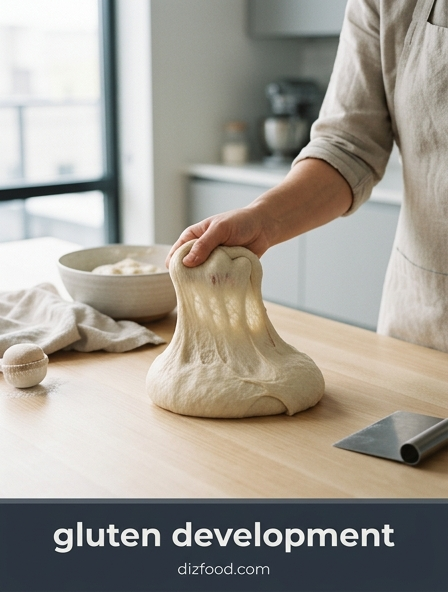
Kneading is the process of applying mechanical energy to the hydrated flour to organize the gluten proteins into a structured, aligned network. Initially, the protein strands are tangled and chaotic. Through repeated folding, stretching, and pressing, these strands begin to align in parallel rows, significantly increasing the dough's strength. This alignment is what allows the dough to be rolled into thin sheets for ravioli or pulled into long strands for hand-pulled noodles without snapping.
The technique used can vary based on the desired level of development. Manual kneading provides the cook with tactile feedback, allowing them to feel when the dough transitions from "shaggy" to "smooth." Over-kneading is a risk with mechanical mixers, as excessive energy can eventually break the disulfide bonds, leading to a "broken" dough that is sticky and lose. Optimal kneading is achieved when the dough passes the "windowpane test," where a small piece can be stretched thin enough to see light through it without it tearing, signaling a fully developed and aligned protein matrix.
Temperature Variables in Pasta and Dumpling Science
Temperature plays a pivotal role in the kinetics of gluten formation and the behavior of starch. In dumpling preparation, the choice between cold, warm, or boiling water changes the dough's fundamental nature. Boiling water doughs are common for Chinese dumplings because the heat partially denatures the proteins and gelatinizes some of the starch. This results in a softer, more "plastic" dough that is easier to pleat and has a more tender bite after steaming or pan-frying.
In contrast, cold water doughs favor a stronger gluten network, which is essential for boiled dumplings that must maintain their integrity in turbulent water. Temperature also affects enzyme activity; warmer temperatures accelerate the action of protease enzymes, which can begin to break down gluten if the dough is left for too long. Managing the kitchen environment and the temperature of the raw ingredients allows the cook to control the rate of development and the final suppleness of the dough, ensuring it is neither too tough nor too fragile for its specific cooking method.
The Critical Importance of Resting for Relaxation
After the mechanical stress of kneading, dough requires a period of rest, often referred to as relaxation. During this phase, the tension within the gluten network dissipates. If a cook attempts to roll out dough immediately after kneading, it will exhibit "snap-back," shrinking back to its original shape. This occurs because the gluten strands are tightly coiled and under high internal stress. Resting allows these strands to slacken and rearrange into a more stable, less tense configuration.
Resting also allows for more complete hydration of the flour particles. Even after the dough appears smooth, moisture is still migrating toward the center of the starch granules. A resting period of 30 minutes to two hours is standard for most pasta and dumpling doughs. During this time, the dough should be covered to prevent the surface from drying out and forming a "skin." This enzymatic and structural pause is what transforms a difficult, rubbery mass into a silky, extensible dough that can be rolled to paper-thin translucency for delicate wrappers or fine fettuccine.
Starch Gelatinization and Gluten Network Stability
While gluten provides the framework, starch serves as the filler and structural stabilizer within the dough. During the cooking process, specifically in boiling water, the starch granules embedded within the gluten matrix begin to absorb water and swell, a process known as gelatinization. This expansion puts pressure on the gluten network. If the gluten is well-developed, it acts as a cage, containing the swollen starch and preventing the pasta from becoming a mushy, disintegrated mass.
The interaction between starch and gluten determines the final mouthfeel of the dish. In high-protein pastas, the dense gluten network limits starch leaching, resulting in a clean, firm bite. In lower-protein doughs, more starch may escape into the cooking water, which can be beneficial for creating emulsified sauces but may result in a softer texture. The stability of the gluten network during the transition from raw to cooked state is the hallmark of professional-grade dough. This balance ensures that the finished product maintains its geometric shape and structural integrity even under the intense heat and agitation of boiling.
Achieving the Ideal Al Dente Texture
The term "al dente," meaning "to the tooth," refers to the specific point in the cooking process where the pasta offers a slight resistance to the bite. Achieving this requires a precise balance between gluten strength and the degree of starch gelatinization. As pasta cooks, water migrates from the outside toward the center. The al dente state occurs when the outer layers are fully hydrated and soft, while the very center retains a slightly firm, under-hydrated core of protein and starch.
To achieve this texture, the dough must have sufficient protein content to resist over-softening. Factors such as the thickness of the dough and the salinity of the water influence the speed of this process. The following steps are essential for monitoring the transition to an ideal texture:
- Using a large volume of water to maintain a constant boil.
- Testing the pasta frequently in the final minutes of cooking.
- Removing the pasta slightly before it reaches the desired firmness, as residual heat will continue the process.
- Understanding that fresh pasta reaches this state much faster than dried, often in under three minutes.
The Chemistry of Salt and Dough Strength
Salt is more than a seasoning; it is a functional ingredient that alters the physical properties of the gluten network. Chemically, salt provides ions that interact with the charged amino acids in the gluten proteins. These ions help to shield the charges, allowing the protein strands to move closer together and form more frequent and stronger bonds. This results in a dough that is tighter, more elastic, and less sticky. Without salt, dough can feel "slack" and may tear more easily during the rolling or shaping process.
Furthermore, salt inhibits the activity of certain enzymes that break down proteins. In long-fermented doughs or those resting for extended periods, salt preserves the structural integrity of the gluten. The concentration of salt is usually small-typically 1% to 2% of the flour weight-but its impact is profound. In some noodle traditions, such as alkaline noodles, other salts like sodium carbonate are used to further increase the pH, which creates an even firmer, more yellow, and springier texture by significantly altering the protein cross-linking environment.
Collaborative Cooking and Communal Dough Crafting
Dough preparation is frequently a communal activity in various culinary cultures, from Italian families making orecchiette to Asian households folding dumplings. This collaborative approach serves both a social and a practical purpose. When working with large quantities of dough, the physical labor of kneading can be distributed, ensuring that every batch receives the necessary mechanical energy for proper gluten development without exhausting a single cook. Consistency is easier to maintain when a group follows a shared rhythm and standard for texture.
Communal crafting also allows for a natural division of labor that respects the stages of gluten science. For example, one person may focus on the initial mixing and hydration, another on the heavy kneading, and others on the delicate task of rolling and shaping after the dough has rested. This workflow ensures that the dough does not sit out too long and dry out, and it facilitates the rapid processing required for fresh pasta. The collective expertise of the group ensures that the tactile cues-the "feel" of the dough-are monitored throughout the entire development process.




Comments