
Choosing between the high-octane energy of an espresso bar and the disciplined grace of a traditional tea ceremony offers a fascinating study in social dynamics. At a modern espresso bar, the atmosphere is defined by "mingling"-a fast-paced, spontaneous exchange where the hiss of steam and the clatter of ceramic provide a backdrop for rapid networking and casual updates. In stark contrast, the tea ceremony is a sanctuary of "traditional mindfulness," where etiquette is elevated to an art form and every movement is a deliberate exercise in presence and respect. While the espresso bar thrives on social vibrancy and the democratic "third space" vibe, the tea ceremony invites you into a choreographed ritual that prioritizes silence, seasonal appreciation, and a deep, soul-level connection between host and guest.
| Feature | Espresso Bar Mingling | Tea Ceremony Etiquette |
|---|---|---|
| Core Philosophy | Social vibrancy, efficiency, and "The Third Space." | Mindfulness (Ichigo Ichie), harmony, and respect. |
| Pace & Rhythm | High-tempo; typical interactions last 5-15 minutes. | Slow-tempo; ritual spans 45 minutes to 4 hours. |
| Communication | Informal, loud, and spontaneous multi-tasking. | Regulated, quiet, and focused on singular presence. |
| Physical Posture | Fluid; standing, leaning, or "on-the-go" movement. | Static; Seiza (kneeling) or prescribed seating. |
| Sensory Focus | Auditory stimulation (music, grinders, chatter). | Visual and tactile (ceramics, scrolls, tea whisking). |
| Social Barrier | Low; strangers often interact via proximity. | High; strict host-guest roles and hierarchical flow. |
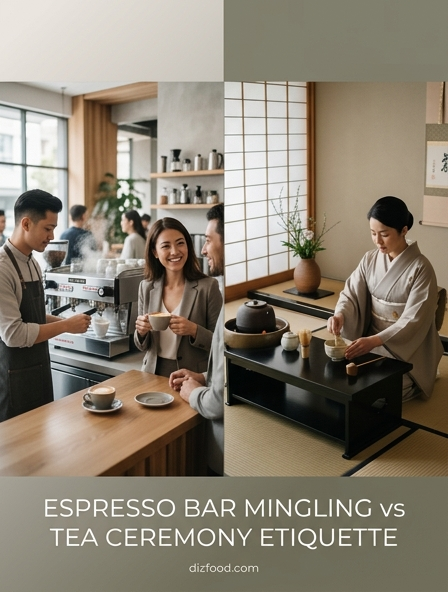
The Rush vs the Ritual: Social Dynamics of Coffee and Tea
The social landscape of the kitchen and beverage service is often divided into two distinct temporal zones: the high-velocity world of the espresso bar and the meditative, slow-motion atmosphere of the tea ceremony. In the espresso bar, the social dynamics are fueled by caffeine and immediacy. It is a space of democratic hustle where patrons from all walks of life intersect briefly. The energy is kinetic, driven by the rhythmic thumping of portafilters and the hiss of steam wands. Interaction is characterized by "thin" social ties-nodding to the barista, exchanging brief pleasantries with a stranger, and navigating a crowded counter with physical agility. The goal is efficiency and a shared momentum toward the rest of the day.
Conversely, the tea ceremony, particularly in the Chanoyu tradition, is an exercise in intentional slowing. The social dynamics here are rigid and hierarchical, yet deeply intimate. Every participant has a defined role, and the host's movements are calculated to foster a sense of "wa" (harmony) and "kei" (respect). Unlike the espresso bar, where the environment is often loud and chaotic, the tea room demands a heightened awareness of one's surroundings. The social contract involves a mutual agreement to leave the outside world at the door. Key differences in social expectations include:
- Time Perception: Espresso is measured in seconds; tea is measured in moments of presence.
- Physicality: Standing and leaning versus kneeling and precise posture.
- Communication: Verbal banter versus non-verbal cues and symbolic gestures.
These two modes of beverage consumption reflect broader cultural attitudes toward productivity and rest. While the espresso bar celebrates the rush of urban life, the tea ceremony offers a sanctuary from it, transforming the simple act of drinking into a profound social ritual.
Espresso Bar Etiquette vs Tea Ceremony Silence
Etiquette at an espresso bar is largely unwritten, yet strictly enforced through social pressure. It is a language of efficiency. In a traditional Italian setting, for instance, one must pay at the register first and then present the receipt to the barista. The social noise is a vital component of the experience; the clinking of ceramic and the roar of the grinder provide a backdrop for rapid-fire conversation. Silence in this context would be perceived as awkward or indicative of a lack of patronage. The etiquette involves knowing your order, moving quickly, and making room for the next guest as soon as your cup hits the saucer.
In sharp contrast, the tea ceremony is governed by a profound silence that is considered medicinal. This is not a void of communication but a deliberate choice to prioritize the sensory experience of the tea over verbal exchange. The only sounds permitted are those intrinsic to the ritual: the whisking of the matcha, the pouring of water, and the purposeful placement of utensils. When speech does occur, it is highly stylized and restricted to specific inquiries about the tea or the seasonal decorations. The table below highlights the divergent approaches to sound and space:
| Element | Espresso Bar | Tea Ceremony |
|---|---|---|
| Primary Sound | Mechanical and Vocal | Natural and Fluid |
| Conversation | Spontaneous and Loud | Scripted and Whispered |
| Focus | External Socializing | Internal Reflection |
| Barista/Host Role | Service Professional | Spiritual Guide |
Navigating these two worlds requires a shift in one's internal frequency. The espresso bar asks you to tune in to the collective hum of the city, while the tea ceremony asks you to tune out the noise to hear the subtle nuances of the whisk.
Standing at the Bar: Modern Espresso Social Norms
The modern espresso bar, particularly in its European roots, is a theater of standing. Unlike the American coffee shop model designed for long-term laptop use, the traditional bar is designed for transit. Standing while drinking your espresso is a social norm that dictates a specific set of behaviors. It signifies that you are "in between" states-not quite at work, but no longer at home. This posture encourages a unique form of mingling where patrons are physically closer than they would be at tables. Because you are standing, your stay is naturally limited, which prevents the stagnation of the social flow.
The protocols for standing at the bar are as follows:
- Claim Your Territory: Find a small gap at the counter without obstructing the path of others.
- The Receipt Placement: Place your receipt on the bar with a coin if a tip is customary, signaling you are ready.
- The Quick Sip: Espresso is meant to be consumed in two or three quick sips while the crema is still intact.
- The Clear Out: Once finished, move your saucer slightly forward to indicate completion and vacate the space immediately.
This "standing" culture fosters a democratic environment. A CEO and a construction worker might stand shoulder-to-shoulder, sharing a thirty-second experience of a high-quality shot. There is no hierarchy of seating, only the shared urgency of the caffeine hit. Modern espresso norms prioritize this accessibility and speed, turning the kitchen counter into a communal hub of brief but intense human connection.
The Art of Stillness: Navigating Tea Ceremony Protocol
Entering a tea ceremony room is akin to entering a different dimension where the laws of physics and social interaction are altered. The "art of stillness" is not merely about staying quiet; it is about the controlled economy of movement. Every gesture-from how you walk across the tatami mats to how you hold the tea bowl-is part of a choreographed dance intended to minimize distraction. Protocol begins before the tea is even served. Guests must often crawl through a low door, a symbolic act that humbles all participants regardless of their social status outside the room.
Once seated, the protocol for receiving the bowl of matcha is highly specific. One must acknowledge the guests sitting nearby with a slight bow before accepting the bowl from the host. The bowl is placed in the palm of the left hand and supported by the right. A crucial part of the etiquette involves rotating the bowl twice clockwise. This ensures that the "front" or most beautiful side of the bowl is not where you place your lips, an act of humility and appreciation for the craft. After drinking, the rim is wiped with the fingers, and the bowl is rotated back to its original position before being returned. This sequence ensures that the guest remains fully present in the physical reality of the objects and the person serving them. Stillness here is a tool for mindfulness, allowing the participant to notice the steam rising, the texture of the ceramic, and the subtle variations in the green of the tea.
Coffee House Chaos vs Chando Zen: Cultural Comparisons
The sensory contrast between coffee house "chaos" and Chando (the way of tea) Zen reveals deep cultural divides in how we perceive peace and productivity. A coffee house is a symphony of industrial sounds. The "chaos" is not disorganized; rather, it is a layering of sensory inputs: the smell of roasted beans, the heat of the machines, and the visual clutter of syrups and pastries. Culturally, this represents the Western ideal of the "Third Place"-a vibrant community center that bridges the gap between home and work. It is a place of active creation, where business deals are struck and creative ideas are birthed over a double shot.
Chando Zen, by contrast, operates on the principle of "Sei" or purity. The tea room is intentionally sparse, often featuring only a single scroll or a seasonal flower arrangement (chabana). This minimalism is designed to remove the "clutter" of the mind. Culturally, while the coffee house celebrates the "more" (more speed, more flavor, more talk), the tea ceremony celebrates the "less." The comparison can be seen in how each environment handles the concept of a break. In a coffee house, a break is a "recharge" meant to propel you back into work. In Chando, a break is a "removal," a temporary exit from the cycle of desire and achievement. The espresso bar is the engine room of modern life, while the tea room is its sanctuary. Understanding these cultural comparisons helps one navigate the kitchen world by recognizing whether the goal of the beverage is to stimulate the nervous system or to soothe the spirit.
Quick Conversations: Mastering the Italian Espresso Bar
In the Italian espresso bar, conversation is an art form that must be executed with brevity and wit. Mastering this environment requires understanding that the barista is the conductor of the social orchestra. Unlike a quiet tea master, the barista is often shouting orders and greeting regulars simultaneously. To mingle effectively, one must learn the rhythm of the "quick conversation." These are not deep philosophical debates but rapid exchanges about local news, sports, or the quality of the blend. The social expectation is to be "present but passing."
A master of the espresso bar knows that the conversation should last no longer than it takes for the espresso to cool. There is a specific etiquette to these interactions:
- Avoid the "Phone Zone": Using a phone at the bar is often seen as a breach of the communal spirit.
- The Eye Contact Rule: Acknowledge the barista and those immediately to your left and right with brief eye contact.
- Shared Frustrations: Common topics often involve lighthearted complaints about the weather or local transit, creating a "we're all in this together" vibe.
The espresso bar serves as a social lubricant that dissolves barriers for a few minutes each day. It is a high-frequency mingle where the noise of the machine provides a safe cover for brief, unpressured human contact. For the regular patron, these micro-interactions provide a sense of belonging and community that is vital in an increasingly digital and isolated urban world.
Formal Grace: Understanding Traditional Tea Room Manners
Traditional tea room manners are centered on the concept of "Grace," which is defined as beauty in movement and consideration for others. In this setting, your manners are a reflection of your respect for the host's preparation. Every object in the tea room, from the bamboo whisk to the iron kettle, has been chosen with great care, often to reflect the specific season or a poetic theme. Ignoring these details is considered a major faux pas. Formal grace involves "reading" the room through its objects and responding with appropriate gestures of appreciation.
One of the most important aspects of tea room manners is the treatment of the bowl. Guests are expected to inspect the bowl (haiken) with a specific technique, keeping their elbows low and the bowl close to the tatami mat to prevent damage if it were to fall. This shows a deep reverence for the history of the object. Furthermore, the timing of the "slurp" at the end of drinking is a crucial signal. It is a deliberate, audible sound that informs the host that the tea was enjoyed to the last drop and that the guest is finished. This is one of the few times where making noise is encouraged, acting as a functional piece of communication within the silent ritual. Formal grace is thus a blend of humility, observational skill, and the ability to follow a complex set of non-verbal cues that have remained largely unchanged for centuries.
Modern Mingling vs Ancient Rituals: Beverage Conduct Decoded
Decoding beverage conduct requires looking at the architecture of the space and the intent behind the drink. Modern mingling in an espresso bar is "horizontal"-it is about expanding one's social reach and staying connected to the grid. Ancient rituals like the tea ceremony are "vertical"-they are about deepening one's connection to the self and the present moment. The conduct required for each is diametrically opposed. At the espresso bar, multitasking is the norm; you might be drinking, paying, and checking your watch simultaneously. In the tea ceremony, multitasking is impossible, as the ritual requires both hands and your full visual attention.
The following table illustrates the decoded expectations of both environments:
| Social Variable | Modern Espresso Bar | Ancient Tea Ritual |
|---|---|---|
| Eye Contact | Direct and Brief | Averted or Focused on Tools |
| Footwear | Shoes On (Ready to Move) | Shoes Off (Sign of Respect) |
| Apparel | Casual/Business Casual | Formal or Neutral/Clean |
| Interaction Goal | Networking/Stimulation | Transcendence/Harmony |
In modern settings, we often see a hybrid of these behaviors, but the core expectations remain. Understanding whether you are in a "speed" zone or a "sacred" zone allows you to adjust your conduct accordingly. Misapplying these rules-such as being too loud in a tea room or too slow at a busy espresso counter-disrupts the social equilibrium of the space and signals a lack of cultural literacy.
From Espresso Shots to Matcha Whisks: Social Expectations
The physical properties of the beverages-the concentrated espresso shot versus the frothed matcha-dictate the social expectations of the consumer. An espresso shot is a "kick," a volatile substance that loses its essence within minutes as the crema dissipates and the temperature drops. This creates a social expectation of intensity. The interaction between the customer and the barista is transactional and high-pressure. You are expected to know exactly what you want. The "shot" culture mirrors the fast-paced, results-oriented nature of modern society where every second is quantified.
The matcha whisk, however, produces a beverage that is built through labor and precision. The whisking process (temae) is a performance that the guest is expected to witness with full attention. The social expectation here is one of patience. You are not just waiting for a drink; you are participating in its creation through your witness. The green froth of the matcha represents a moment of "frozen" time. While the espresso is about the "after" (the energy you get once you leave), the matcha is about the "during" (the experience of drinking it). This difference manifests in the kitchen as a shift from tool-centric efficiency (the espresso machine) to hand-centric craftsmanship (the whisk). Socially, this means the espresso drinker is expected to be an active participant in the city, while the tea drinker is expected to be a passive, respectful observer of the ritual.
Urban Speed vs Sacred Space: Etiquette for Coffee and Tea
The final distinction in beverage etiquette lies in the perception of space. The espresso bar is an extension of the street-an urban "non-place" that facilitates movement. Etiquette here is about managing "urban speed." It involves navigating the "buffer zones" between people at the counter and understanding the choreography of the "stand-up" cafe. You are a ghost in the machine, contributing to the energy of the room without becoming an obstacle. The etiquette is largely about non-interference and shared efficiency.
The tea room, however, is a "sacred space," often literally separated from the rest of the house or garden by a dedicated path (roji). This path serves as a psychological transition, shedding the "dust" of the world. Etiquette in this sacred space is about "Ma"-the meaningful gap or pause. It is about the careful placement of the fan in front of one's knees to create a boundary of respect, and the understanding that the space between people is as important as the people themselves. In the tea room, you are not a ghost; you are a vital, present element of a temporary universe. Whether you are navigating the rapid-fire exchange of a Roman coffee bar or the hushed reverence of a Kyoto tea house, the underlying principle of etiquette remains the same: a deep awareness of the social environment and a willingness to conform your personal pace to the collective rhythm of the room.



Comments