
Choosing between a classic farmhouse sink and a modern professional prep station is a pivotal decision that dictates your kitchen's daily efficiency. While the iconic apron-front farmhouse sink is celebrated for its deep basin and ergonomic design-perfect for soaking oversized cookware and adding timeless character-the professional prep station (or workstation sink) is a high-performance culinary hub. These integrated systems utilize built-in ledges to support sliding accessories like cutting boards, colanders, and drying racks, allowing you to chop, rinse, and strain directly over the basin. Whether you prefer the expansive, unobstructed volume of a farmhouse silhouette or the multi-functional, space-saving versatility of a precision-engineered workstation, selecting the right model depends on whether you value traditional capacity or a streamlined, zonal workflow.
| Feature | Farmhouse (Apron-Front) Sink | Professional Prep Station |
|---|---|---|
| Core Workflow | Traditional; focused on heavy-duty washing and soaking. | Multi-tasking; integrated prep, wash, and dry zones. |
| Accessories | Rarely included; relies on external countertop tools. | Built-in ledges for cutting boards, racks, and colanders. |
| Ergonomics | Forward-facing apron reduces reaching and back strain. | Elevated "over-the-sink" tasking reduces counter clutter. |
| Volume/Depth | Maximum basin capacity for large stockpots and pans. | Slightly reduced volume due to accessory ledge tiers. |
| Material Options | Varied: Fireclay, Cast Iron, Copper, and Stone. | Primarily high-gauge Stainless Steel for durability. |
| Installation | Requires specialized cabinet cutouts and support. | Standard undermount or drop-in; fits modern cabinetry. |
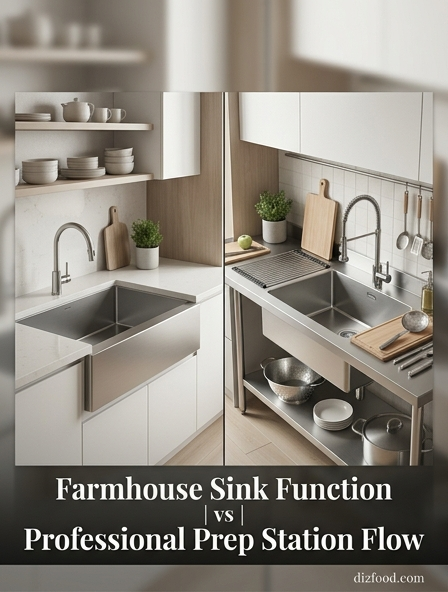
Traditional Farmhouse Basins Versus Modern Workstation Hubs
The debate between traditional farmhouse basins and modern workstation hubs centers on the evolution of the kitchen from a place of simple cleanup to a high-speed culinary production zone. Traditional farmhouse sinks, often referred to as apron-front sinks, are celebrated for their deep, singular basins and timeless aesthetic. Historically designed to hold large volumes of water for hand-washing laundry or scrubbing oversized farm pots, they prioritize volume and depth. Their primary function is containment, providing a massive, unobstructed space that accommodates the largest items in a household.
In contrast, modern workstation hubs represent a paradigm shift toward integrated functionality. Rather than serving as a passive vessel, the workstation sink acts as an active tool. By incorporating built-in ledges, these sinks allow for a variety of interchangeable accessories to sit flush with the countertop. While the farmhouse sink offers a "bucket" approach to utility, the workstation offers a "system" approach. Choosing between them often depends on whether the homeowner prioritizes the visual weight and historical charm of the apron front or the tiered, multi-functional efficiency of the professional-grade prep station.
- Farmhouse sinks prioritize raw volume and unobstructed interior space.
- Workstation hubs focus on tiered functionality and accessory integration.
- Traditional basins often feature materials like fireclay or cast iron, whereas workstations lean toward industrial-grade stainless steel.
The Ergonomics of Apron Front Depth for Daily Use
Ergonomics play a vital role in the long-term satisfaction of a kitchen layout, and the farmhouse sink is specifically engineered to reduce physical strain. The defining characteristic of an apron-front sink is that it replaces the standard section of the cabinetry and countertop that usually sits between the user and the basin. By eliminating this 3-to-4-inch barrier, the user is able to stand directly against the sink, bringing the work area closer to the body. This significantly reduces the need to lean forward, which in turn alleviates pressure on the lower back and shoulders during extended periods of dishwashing or food preparation.
However, the depth of these basins requires careful consideration. Traditional farmhouse sinks can be 9 to 10 inches deep. When undermounted, the bottom of the sink sits even lower, which may require taller users to bend more than they would with a shallower drop-in model. Conversely, for many, the proximity to the basin outweighs the depth concern. The lack of a countertop "lip" also makes it easier to slide heavy pots directly from the counter into the sink without lifting them over a rim, facilitating a smoother mechanical flow that protects both the user's joints and the integrity of the surrounding stonework.
Optimizing Culinary Flow with Integrated Prep Ledges
The "prep station" philosophy is built entirely around the concept of the integrated ledge. These are subtle tracks machined into the interior walls of the sink, usually at one or two different heights. These ledges allow the sink to transition through various phases of meal preparation without requiring the user to move to a different part of the kitchen. By keeping the mess contained within the perimeter of the basin, the surrounding countertops remain dry and clear of debris. This is particularly beneficial for home chefs who manage complex recipes that involve multiple ingredients and frequent rinsing.
When optimized, the culinary flow follows a linear progression within the sink itself. A user might start with a colander on the lower ledge for rinsing vegetables, then slide a heavy-duty cutting board onto the upper ledge to chop those vegetables. Because the board is positioned directly over the sink, scraps can be swiped into a built-in disposal or a scrap bin located at one end of the basin. This eliminates the "drip path" that occurs when moving wet produce from a traditional sink to a separate cutting board on the counter, thereby maintaining a cleaner and more hygienic workspace.
- Dual-tier ledges allow for simultaneous tasks, such as drying and dicing.
- Custom-fit accessories prevent sliding or instability during heavy knife work.
- Integrated ledges reduce the footprint of meal prep by utilizing vertical space.
Deep Basin Utility for Large Cookware Management
Managing oversized cookware is a primary pain point in kitchen design, and this is where the farmhouse sink excels. For those who frequently use commercial-sized baking sheets, 12-quart stockpots, or cast-iron Dutch ovens, a standard double-bowl sink often feels restrictive. The divider in a traditional split sink frequently prevents large items from laying flat, leading to awkward soaking angles and splashing. A deep, wide-open farmhouse basin allows these items to be fully submerged, ensuring that stubborn residues are loosened effectively without water spilling onto the kitchen floor.
| Cookware Type | Standard Split Sink | Farmhouse Single Basin |
|---|---|---|
| Half-Sheet Pan | Must lean against divider | Lies flat on bottom |
| 12qt Stockpot | Handle often sticks out | Fully submerged |
| Roasting Pan | Difficult to rotate | Easy 360-degree cleaning |
Beyond cleaning, the depth of these basins provides a secondary benefit during the prep stage. They act as a "containment zone" for high-splatter tasks, such as scaling fish or cleaning leafy greens that require multiple water changes. The high walls of the basin keep the mess below the sightline of the countertop, maintaining the visual order of the kitchen even during the height of a busy dinner service. While workstation sinks also offer depth, the sheer cubic volume of a dedicated farmhouse basin remains the gold standard for heavy-duty cookware management.
Seamless Transitions from Rinsing to Chopping
The bridge between cleaning and cutting is often the messiest part of the cooking process. In a traditional kitchen setup, this involves moving wet ingredients across the counter, often leaving trails of water that must be wiped up later. Professional prep stations solve this issue through mechanical integration. The workflow is designed to be continuous. Once the produce is rinsed in a basin-mounted colander, it is shifted inches to a cutting board that sits on the same track. This "one-stop" approach ensures that all moisture and organic waste stay within the confines of the stainless steel or composite walls.
- Rinse produce in a suspended mesh strainer to allow for 360-degree drainage.
- Slide the cutting board over the basin to create an immediate work surface.
- Chop ingredients and use the sink's faucet sprayer to clear the board instantly.
- Transfer processed items to a bowl while pushing waste into the disposal.
This seamless transition is not just about cleanliness; it is about rhythm. In a professional environment, every second saved and every movement eliminated contributes to a more efficient output. By keeping the chef in one position, the prep station minimizes the physical steps required to prepare a meal. This "pivot point" efficiency is the hallmark of a well-designed modern kitchen, transforming the sink from a chore-heavy cleaning zone into the most productive square footage in the home.
Maximizing Counter Space Through Multilevel Sink Systems
In urban kitchens or smaller homes where counter space is at a premium, the multilevel workstation sink is a revolutionary spatial solution. By utilizing the vertical volume of the sink, homeowners essentially gain extra "invisible" counter space. When the sink is not in use for washing, a large wood or composite cutting board can be placed over the basin, effectively extending the countertop. This allows for a continuous work surface that can be used for staging ingredients, rolling out dough, or even serving appetizers during a gathering.
Multilevel systems often include accessories like drying racks that roll out across the top of the sink. This eliminates the need for a bulky, permanent dish rack on the counter, which is one of the most common sources of kitchen clutter. Because these accessories can be stacked or nested within the sink's ledges, the user can customize the configuration based on the task at hand. For instance, one might have a small prep bowl on the lower level for discarded peels and a large board on the upper level for slicing. This three-dimensional use of space ensures that even a modest kitchen can function with the efficiency of a much larger professional space.
Comparing Aesthetics and High Performance Kitchen Output
The choice between these two sink styles often involves a trade-off between "homey" aesthetics and "industrial" performance. Farmhouse sinks are visual anchors; their exposed fronts are designed to be seen, often showcasing beautiful materials like hand-hammered copper, glazed fireclay, or matte stone. They evoke a sense of warmth and tradition, making them the centerpiece of farmhouse, transitional, or "shabby chic" designs. Their beauty is architectural, but their performance is largely limited to their capacity and the quality of the material itself.
| Feature | Farmhouse Basin | Workstation Prep Sink |
|---|---|---|
| Visual Impact | High (Focal Point) | Moderate (Functional) |
| Material Focus | Fireclay, Stone, Copper | Stainless Steel, Granite Comp |
| Accessory Support | External/Third-party | Integrated/Proprietary |
| Design Language | Traditional/Rustic | Modern/Professional |
Professional workstations, while available in attractive finishes, prioritize high-performance output. They are the "Swiss Army Knives" of the kitchen. While a farmhouse sink looks stunning in a photograph, the workstation sink proves its value during the actual act of cooking. It is designed for those who view the kitchen as a laboratory or a workshop. For high-output households where multiple people are prepping simultaneously, the performance benefits of a workstation usually outweigh the singular aesthetic statement of a traditional apron-front basin.
Streamlining Meal Prep Efficiency in Professional Sinks
Efficiency in a professional-style sink is measured by the reduction of "dead time." In a standard sink, time is wasted moving back and forth to the trash can, fetching colanders from deep cabinets, and drying surfaces. A professional prep station streamlines these actions by keeping all necessary tools within arm's reach. Many of these sinks come with specialized kits that include colanders, drying racks, cutting boards, and even condiment trays. This organization mimics the "mise en place" philosophy used by professional chefs, where every tool and ingredient has a designated, logical home.
- Integrated knife blocks and utensil holders keep sharp tools safe and dry.
- Bottom grids protect the sink surface while allowing water to flow freely under dishes.
- Offset drains create more usable space on the sink floor and more storage in the cabinet below.
Furthermore, the use of high-grade stainless steel in these sinks allows for rapid cleaning and sanitization. The material is non-porous and heat-resistant, meaning you can move a boiling pot directly into the sink or handle raw proteins on a sink-mounted board with minimal risk of cross-contamination. When the prep work is finished, the accessories can typically be tossed into the dishwasher, and the sink can be sprayed down in seconds. This speed of transition from "messy prep" to "clean kitchen" is a significant advantage for those who cook frequently and want to minimize post-dinner cleanup time.
Durability and Maintenance of Farmhouse versus Workstations
Durability profiles vary significantly between the two styles, largely due to the materials used. Farmhouse sinks are frequently made of fireclay or enameled cast iron. These materials are incredibly heavy and resistant to heat, but they can be prone to chipping if a heavy pot is dropped at the wrong angle. Once the glaze is compromised, the underlying material may be susceptible to staining. Maintenance involves using non-abrasive cleaners to preserve the shine of the enamel and occasionally buffing out "metal marks" left by silverware. Their longevity is legendary, often lasting as long as the house itself, provided they are treated with care.
Workstation sinks are most commonly constructed from T304 stainless steel, typically in 16-gauge thickness for maximum durability. Stainless steel is virtually indestructible in terms of cracking or chipping, making it ideal for high-traffic, "rough" kitchen use. However, it is prone to fine scratches and water spots, which can dull the finish over time. Many workstations now use PVD finishes or "nano-coatings" to repel water and resist scratches. Maintenance for these sinks is generally easier, as they can handle more aggressive cleaning agents, but the complex ledges and tracks require extra attention to prevent the buildup of grime or food particles in the corners.
Transforming Your Kitchen Sink Into a Dynamic Prep Zone
The ultimate goal of choosing a high-function sink is to transform a static fixture into a dynamic prep zone. To achieve this, homeowners should look beyond the sink itself and consider the ecosystem of accessories. A truly dynamic zone evolves with the user's needs. During a morning routine, it might serve as a coffee station with a drying rack for mugs. By lunch, it becomes a salad prep station with a colander and chopping board. By dinner, it transforms into a heavy-duty cleaning station for large pans and roasting sheets.
- Assess your cooking style: Do you do more heavy scrubbing or intricate dicing?
- Select a sink depth that balances ergonomic comfort with the size of your largest pots.
- Invest in high-quality accessories like silicone-rimmed boards that won't rattle during use.
- Consider a faucet with a high-arch spray head to reach every corner of the larger basin.
Whether you choose the expansive volume of a farmhouse basin or the tiered complexity of a workstation, the key is integration. By treating the sink as the central hub of the "work triangle"-the space between the stove, refrigerator, and water source-you can significantly increase the speed and enjoyment of cooking. The modern kitchen is no longer just a place to store food; it is an active environment where the right sink acts as the ultimate multi-tool, bridging the gap between raw ingredients and a finished meal.




Comments