
When it comes to mastering plant-based cuisine, choosing between the Usuba and the Nakiri is the ultimate fork in the road for any enthusiast. While both Japanese blades feature a distinctive rectangular profile designed to tackle everything from hardy root vegetables to delicate herbs, their internal geometry tells two different stories. The Nakiri is the approachable, double-bevel workhorse perfect for home cooks who value efficient, vertical chopping and easy maintenance. Meanwhile, the Usuba is a single-bevel precision instrument traditionally reserved for professional chefs, offering the surgical accuracy needed for intricate tasks like katsuramuki (rotary peeling). Whether you are looking for an everyday kitchen companion or a specialized tool for decorative garnishes, understanding these subtle differences in edge craft is key to selecting the ideal blade for your culinary style.
| Feature | Nakiri (Home Specialist) | Usuba (Pro Precision) |
|---|---|---|
| Edge Grind | Double-Bevel (Ryoba); V-shaped | Single-Bevel (Kataba); Flat-sided |
| Skill Level | Beginner to Intermediate | Professional / Advanced |
| Primary Use | Daily slicing, dicing, and chopping | Paper-thin slicing and decorative work |
| Maintenance | Simple sharpening; user-friendly | Demanding; requires whetstone mastery |
| Blade Weight | Light and agile for speed | Substantial; provides stability for thin cuts |
| Cutting Path | Straight, vertical travel | Slightly veers (requires technique adjustment) |
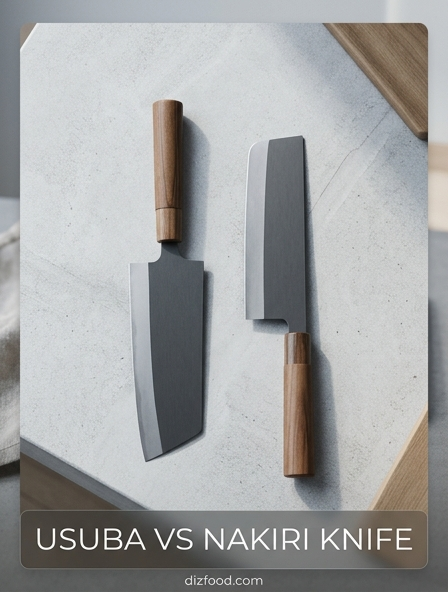
Usuba vs Nakiri Knife Comparison
The culinary world of Japanese cutlery is renowned for its specialized tools, and among the most distinctive are the Usuba and the Nakiri. At a glance, these two knives appear nearly identical to the untrained eye, characterized by their tall, rectangular profiles and blunt, squared-off tips. Both are dedicated vegetable knives designed to maximize contact with the cutting board, ensuring clean, efficient slices through everything from delicate greens to dense root vegetables. However, their similarities are primarily aesthetic, as they are engineered for different users and distinct levels of precision within the kitchen hierarchy.
The primary divergence between the Usuba and the Nakiri lies in their blade geometry and edge construction. The Nakiri is a double-beveled knife, meaning it is sharpened on both sides of the blade, much like a standard Western chef's knife. This makes it an intuitive tool for home cooks and professionals alike who require a versatile, easy-to-maintain blade for daily meal preparation. In contrast, the Usuba is a single-beveled knife, a hallmark of traditional Japanese craftsmanship. It features a razor-sharp edge on one side and a hollow-ground back on the other, allowing for unparalleled precision. While the Nakiri favors ease of use and straight downward cuts, the Usuba is a specialized instrument capable of the paper-thin slicing and decorative work essential in haute Japanese cuisine, such as Kaiseki.
Defining the Nakiri Vegetable Knife
The Nakiri, which literally translates to "leaf cutter," is the quintessential vegetable knife for the Japanese home kitchen. Its design is focused on efficiency and accessibility. Unlike the multi-purpose Santoku or the Gyuto, the Nakiri features a completely flat edge or one with a very subtle curve. This geometry is intentional; it allows the entire length of the blade to make contact with the cutting board simultaneously. This eliminates the need for a rocking motion, instead favoring a "push-cut" or "pull-cut" technique that prevents the common "accordion" effect, where vegetable slices remain connected by thin threads of skin.
Because it is double-beveled, the Nakiri is balanced symmetrically. When you cut through a potato or a carrot, the blade moves straight down through the center of the food without veering to the left or right. This makes it exceptionally user-friendly for those accustomed to Western cutlery. The blade is typically thinner and lighter than a Usuba, reducing hand fatigue during long sessions of chopping cabbage or dicing onions. While it lacks the extreme precision required for artistic garnishes, its ability to process large volumes of produce with speed and safety makes it a favorite among vegetarians and home chefs who prioritize functional performance over the steep learning curve of professional-grade tools.
Understanding the Traditional Usuba
The Usuba is widely regarded as one of the most difficult Japanese knives to master, reserved almost exclusively for professional chefs. The name "Usuba" translates to "thin blade," which refers to its incredibly fine edge rather than the overall thickness of the spine. Its construction follows the "Kataba" style, or single-bevel grind. This design allows the knife to be sharpened to a significantly more acute angle than any double-bevel blade, resulting in a level of sharpness that can slice through cells without bruising the produce. This preservation of cell structure is vital in high-end Japanese cooking, as it maintains the flavor, texture, and color of the vegetables.
There are two regional variations of the Usuba: the Kanto style from Tokyo, which has a square tip, and the Kansai style from Osaka (also known as the Kamagata Usuba), which features a curved, pointed tip. The Kamagata style is particularly useful for intricate tasks and decorative "mukimono" work. The back of the Usuba blade is slightly concave, a feature known as "Urasuki." This creates an air pocket during slicing, which reduces friction and prevents food from sticking to the blade. Using an Usuba requires a specialized technique; because the edge is only on one side, the knife naturally wants to pull in one direction, requiring the chef to compensate with their grip and wrist movement to achieve a perfectly straight cut.
Single Bevel vs Double Bevel Edges
Understanding the difference between bevel types is crucial for selecting the right knife, as it dictates how the blade interacts with the food and how it must be maintained. The bevel refers to the angle of the edge that actually performs the cutting. The following table highlights the core differences between the Nakiri's double bevel and the Usuba's single bevel.
| Feature | Nakiri (Double Bevel) | Usuba (Single Bevel) |
|---|---|---|
| Edge Symmetry | V-shaped, sharpened on both sides. | Chisel-like, sharpened on one side. |
| Path of Cut | Follows a straight vertical line. | Naturally pulls toward the non-beveled side. |
| Precision | High, suitable for most tasks. | Extreme, suitable for translucent slices. |
| Ease of Use | Very easy; no special training needed. | Difficult; requires technique adjustment. |
| Ambidexterity | Works for both left and right hands. | Right or left-hand specific versions required. |
The double bevel of the Nakiri provides a stable, predictable cutting experience that distributes pressure evenly. Conversely, the Usuba's single bevel creates a wedge effect. This is why the Usuba is preferred for "Katsuramuki," the art of rotary peeling a daikon radish into a continuous, paper-thin sheet. The flat side of the blade acts as a guide, while the beveled side pushes the slice away. Because of this asymmetrical geometry, Usubas must be purchased specifically for the user's dominant hand, with left-handed versions often costing significantly more due to their rarity.
Blade Geometry and Cutting Techniques
Both the Nakiri and the Usuba are designed with a specific geometry that dictates a particular style of knife work. Unlike the curved belly of a French or German chef's knife, which encourages a rocking motion where the tip stays on the board, these Japanese knives feature a flat profile. This means the primary technique used is the vertical push-cut. The chef moves the blade forward and down in one smooth motion, allowing the entire length of the edge to sever the vegetable fibers simultaneously. This is the most efficient way to chop through fibrous vegetables like celery, leeks, or scallions, ensuring that every slice is clean and separated.
However, the Usuba's geometry allows for a more advanced technique called "slicing in the air" or "chopping against the thumb," though most professional work is done on the board. The height of both blades is also a functional design choice; it provides ample knuckle clearance, preventing the cook's fingers from hitting the board. Additionally, the flat, wide surface of the blade serves as a makeshift spatula for scooping up chopped ingredients to transfer them to a pan or bowl. While the Nakiri is limited to these standard tasks, the Usuba's geometry allows for "shearing" cuts, where the knife is used to shave layers off a vegetable with micro-precision that a double-beveled Nakiri simply cannot replicate.
Professional Precision vs Home Versatility
The choice between a Usuba and a Nakiri often comes down to the environment in which the knife will be used. The Usuba is a professional tool found in the kits of "Itamae" (sushi chefs) and those specializing in traditional Japanese cuisine. In these settings, the visual presentation of food is just as important as the taste. The Usuba's ability to create perfectly uniform, translucent slices of ginger, radish, or cucumber is essential for garnishes that define the aesthetic of the dish. The trade-off for this precision is fragility; the Usuba's edge is so fine that it can chip easily if used on hard materials or handled with poor technique.
The Nakiri is the workhorse of the home kitchen and the busy commercial prep station. Its versatility stems from its robust nature. While it cannot achieve the same microscopic thinness as the Usuba, it excels at the daily realities of cooking: prepping mirepoix for a soup, shredding cabbage for coleslaw, or dicing squash. Because the edge is more substantial, it can withstand the rigors of high-volume chopping without the constant fear of edge failure. For the home cook who wants the benefits of a flat-profile Japanese blade without the high maintenance and steep learning curve of a single-bevel tool, the Nakiri is the superior choice. It offers 90% of the performance with significantly less risk and effort.
Key Material and Construction Differences
Materials play a significant role in how these knives perform and feel. Historically, Usuba knives are crafted using the "Awase" method, where a hard high-carbon steel core (Hagane) is laminated with a softer iron cladding (Jigane). The most common steels used are White Steel (Shirogami) or Blue Steel (Aogami). These steels can be hardened to a very high Rockwell C scale rating (62-65), allowing them to take and hold an incredibly sharp edge. However, these materials are reactive, meaning they will rust if not dried immediately and will develop a patina over time. The construction of a Usuba is often heavier than a Nakiri, providing the "heft" needed to drive the single-bevel edge through dense vegetables.
Nakiri knives are available in a wider variety of materials, catering to a broader audience. While many are made with traditional high-carbon steel, many modern Nakiris utilize stainless steels like VG-10 or Ginsan (Silver 3). These materials offer a balance of edge retention and corrosion resistance, making them more practical for users who do not want to worry about their knife rusting mid-prep. Furthermore, Nakiris often feature "Tsuchime" (hammered) or Damascus finishes, which serve the dual purpose of aesthetic beauty and reducing food suction. The tang construction also varies; Usubas almost always feature a traditional hidden-tang "Wa" handle, whereas Nakiris are frequently found with Western-style full-tang handles (Yo-handles) for those who prefer a more handle-heavy balance.
Sharpening and Maintenance Requirements
Maintaining these knives requires a commitment to whetstone sharpening, as pull-through sharpeners or honing rods can destroy the specialized edges. Sharpening a Nakiri is relatively straightforward for anyone familiar with sharpening a chef's knife. The user maintains a consistent angle (typically 12-15 degrees) on both sides of the blade until a burr forms, then polishes the edge. Because it is double-beveled, it is forgiving of minor inconsistencies in technique, and the symmetry makes it easier to keep the blade centered.
Sharpening a Usuba is a much more complex endeavor that requires understanding the "Urasuki" (hollow back). You do not sharpen both sides equally. The beveled side is sharpened at a very shallow angle to create the primary edge, while the flat back side is only lightly touched to remove the burr, a process called "Uraoshi." If the back side is sharpened incorrectly, the hollow ground will be ruined, and the knife will lose its ability to make clean, non-stick cuts. Additionally, because many Usubas are made of reactive carbon steel, they require regular oiling with camellia oil and meticulous cleaning. For the average cook, the maintenance of a Usuba can be a full-time hobby, whereas the Nakiri is a tool that requires only occasional professional or DIY whetstone sessions to stay functional.
Pros and Cons of Each Blade Shape
When weighing the two shapes, it is helpful to look at their specific advantages and drawbacks in a comparative list. This allows the user to align the knife's characteristics with their own cooking habits and skill level.
- Nakiri Pros: Excellent for beginners; double-bevel is easy to control; requires less maintenance; generally more affordable; available in stainless steel.
- Nakiri Cons: Lacks the extreme precision for decorative work; cannot produce paper-thin slices as effectively as a Usuba.
- Usuba Pros: Unmatched sharpness; capable of professional decorative techniques (Katsuramuki); Urasuki back prevents food from sticking; produces cleaner cuts that preserve food freshness.
- Usuba Cons: Very high learning curve; fragile edge prone to chipping; difficult to sharpen; must be purchased for a specific hand (right or left); usually more expensive.
Ultimately, the Nakiri is about speed and utility, while the Usuba is about ritual and perfection. The Nakiri's rectangular shape provides a safe guide for the knuckles, making it a fast and reliable dicing tool. The Usuba, however, is a specialist's blade. If you are not planning to spend hours practicing the specific wrist movements required for a single-bevel knife, the "cons" of the Usuba will likely outweigh its "pros" in a standard kitchen environment.
Choosing the Best Japanese Vegetable Knife
Deciding between a Usuba and a Nakiri requires an honest assessment of your culinary goals and your willingness to maintain your tools. If you are a home cook who enjoys preparing vegetable-heavy meals like stir-fries, salads, and soups, the Nakiri is almost certainly the better choice. It offers the unique flat-profile experience of a Japanese vegetable knife without the technical frustrations of a single-bevel blade. It is a friendly, efficient tool that will instantly improve the quality of your vegetable prep without requiring you to relearn how to hold a knife.
On the other hand, if you are a professional chef, a culinary student, or a dedicated hobbyist interested in the art of Japanese "Washoku," the Usuba is a rewarding investment. It is more than just a knife; it is a teacher that forces you to improve your technique and precision. Owning a Usuba opens the door to advanced decorative skills that a Nakiri cannot facilitate. However, before purchasing, ensure you have a high-quality set of whetstones and the patience to learn how to use them. Whether you choose the accessible Nakiri or the demanding Usuba, both knives represent a significant upgrade over a standard Western chef's knife for vegetable work, providing cleaner cuts and a more tactile connection to the ingredients you are preparing.

Comments