
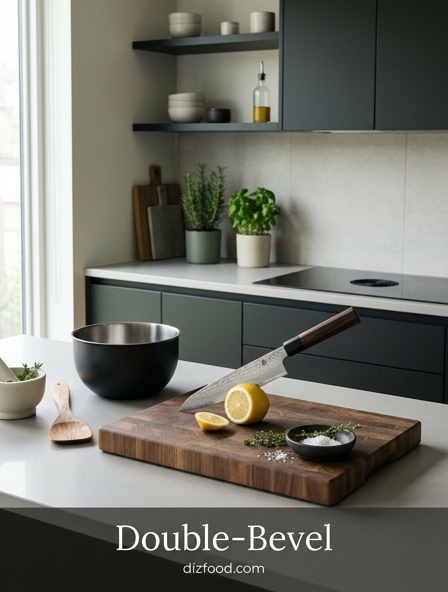
Understanding the Double Bevel Nakiri Geometry
The double bevel Nakiri is a specialized Japanese vegetable knife characterized by its rectangular profile and lack of a pointed tip. Unlike the traditional Usuba, which features a single-sided grind, the double bevel Nakiri is sharpened on both sides of the blade, typically at a symmetrical 50/50 angle. This specific geometry creates a V-shaped edge that allows the knife to pass straight through produce without the lateral steering common in single-bevel tools. The blade is exceptionally thin, often measuring less than 2mm at the spine, which minimizes wedging in dense vegetables like sweet potatoes or carrots.
The core design philosophy focuses on maximizing surface area contact with the cutting board. Because the edge is almost entirely flat from heel to toe, it facilitates a clean cut through every fiber of the vegetable. This geometry is particularly advantageous for home cooks who prioritize ease of use and maintenance, as the symmetrical edge is far simpler to sharpen on whetstones compared to the complex concave "urasuki" found on professional-grade single-bevel knives.
Efficiency Benefits of the Flat Blade Profile
The primary advantage of the double-bevel Nakiri lies in its flat edge profile, which eliminates the "rocking" motion required by a French chef's knife or a Santoku. When using a blade with a significant belly, a cook must roll the edge to complete a cut, often leaving "accordion" vegetables held together by a thin thread of skin. The Nakiri's flat profile ensures that the entire length of the blade makes contact with the board simultaneously.
- Eliminates incomplete cuts through onion skins and celery fibers.
- Facilitates high-speed "push-cutting" and "pull-cutting" techniques.
- Maximizes the usable edge length for processing large bunches of greens.
- Reduces the vertical travel distance required for each stroke.
This design allows for a rhythmic, vertical chopping motion that is significantly faster than rocking. For high-volume vegetable preparation, such as mirepoix or stir-fry, the efficiency gained by the flat profile translates to reduced physical effort and faster results. The absence of a tip also makes the knife safer for rapid work, as there is no sharp point to catch on fingers or the cutting board during aggressive movements.
Superior Precision for Daily Vegetable Prep
Precision in the kitchen is often a result of blade thinness and edge stability. The double-bevel Nakiri excels in this regard because its symmetrical grind provides a balanced feel during the descent. When slicing through a delicate tomato or a crisp radish, the knife moves downward in a perfectly vertical plane. This predictability is essential for creating uniform slices that cook at the same rate, a fundamental requirement for professional-level culinary results.
The height of the blade also serves as a guide against the knuckles, providing a stable surface that allows the cook to regulate thickness with extreme accuracy. Whether you are aiming for a paper-thin translucent shave or a robust batonnet, the tall blade prevents the knife from tilting mid-cut. This stability is particularly beneficial when dealing with round or rolling produce, such as potatoes or beets, where a slip could result in uneven cuts or injury. By combining a thin spine with a tall face, the double-bevel Nakiri offers a level of control that more general-purpose knives struggle to match in a dedicated vegetable context.
Comparing Single Versus Double Bevel Performance
While both styles are used for vegetables, the performance characteristics of single and double bevel blades differ significantly. Single-bevel knives, like the Usuba, are designed for decorative Japanese cutting techniques but require a steep learning curve. In contrast, the double-bevel Nakiri is optimized for utility and speed in a modern kitchen environment.
| Feature | Single Bevel (Usuba) | Double Bevel (Nakiri) |
|---|---|---|
| Ease of Use | Difficult; steers to the left | Easy; cuts straight down |
| Sharpening | Complex; requires multi-step process | Simple; standard 50/50 honing |
| Versatility | Specialized for thin peeling | General purpose vegetable prep |
| User Preference | Professional Japanese chefs | Home cooks and global pros |
The double-bevel version is generally preferred by those who do not want to compensate for the "steering" effect where the blade naturally drifts away from the bevel side. This makes the Nakiri an approachable tool for left-handed and right-handed cooks alike, providing immediate proficiency without the need for specialized training.
The Ergonomics of Faster Home Slicing
Ergonomics play a vital role in how a knife performs during long prep sessions. Double-bevel Nakiris are typically lighter than Western chef knives, reducing wrist fatigue during repetitive tasks. The balance point is usually situated slightly forward of the bolster, encouraging a pinch grip that gives the cook better leverage over the blade. This forward balance works in harmony with gravity, allowing the weight of the knife to do much of the work during the downward stroke.
Furthermore, the clearance between the handle and the cutting board is significant due to the blade's height. This ensures that the cook's knuckles never hit the board, even when working at high speeds. Many Nakiris feature traditional Japanese "Wa" handles, which are octagonal or D-shaped and made of light wood, or Western-style handles for a more familiar, secure grip. The combination of a lightweight build and a tall profile creates a mechanical advantage that allows for a more relaxed grip, which is key to maintaining speed and accuracy without developing strain over time.
Optimizing Push Cut Techniques for Speed
To truly unlock the speed of a double-bevel Nakiri, one must master the push-cut. This technique involves moving the knife forward and down simultaneously, rather than simply pressing straight down. Because the Nakiri lacks a curve, the push-cut utilizes the entire edge to shear through fibers cleanly. This motion is not only faster but also results in less bruising of delicate herbs and vegetables.
- Position the vegetable on the board and hold it with a "claw" grip.
- Place the flat of the blade against your knuckles for guidance.
- Push the knife forward and downward in one fluid motion.
- Lift the blade slightly and reset for the next slice.
When executed correctly, the push-cut produces a satisfying "clack" against the board, indicating a full through-cut. This technique is especially effective for julienning peppers or dicing onions. Because the double-bevel edge is symmetrical, there is no lateral resistance, allowing the blade to glide through the produce with minimal friction. This efficiency is why the Nakiri remains a favorite for chefs who need to process large quantities of vegetables in a short window of time.
Why Symmetry Matters for Amateur Cooks
For the amateur cook, symmetry in blade geometry is synonymous with predictability. A double-bevel Nakiri behaves exactly as one would expect; it goes where it is pointed. Single-bevel knives often require the cook to angle their wrist to maintain a straight cut, which can be frustrating for those not trained in traditional Japanese techniques. Symmetry also means that the knife is truly ambidextrous, making it a versatile tool in households with both left and right-handed users.
Maintenance is another area where symmetry shines. Sharpening a symmetrical blade is straightforward, as the user applies equal pressure and the same number of passes to both sides of the edge. This eliminates the guesswork involved in maintaining asymmetrical grinds (like 70/30 or 90/10) or the complex flat-and-concave sides of a single-bevel knife. For a home cook, a tool that is easy to maintain is a tool that stays sharp longer, ensuring that the kitchen experience remains enjoyable rather than a chore involving specialized equipment or professional sharpening services.
Achieving Consistent Uniformity in Every Slice
Uniformity in vegetable prep is not just about aesthetics; it is a critical factor in the chemistry of cooking. When vegetables are sliced to the same thickness, they reach the desired level of doneness simultaneously, preventing a mix of mushy and undercooked pieces in a single dish. The double-bevel Nakiri is specifically engineered to facilitate this level of consistency through its tall, flat-ground face.
- Uniform slices of zucchini for even grilling.
- Perfectly squared-off potato batons for consistent frying.
- Consistent ribbons of cabbage for balanced slaw textures.
- Equal-sized dice for slow-cooked stews and ragouts.
The lack of a distal taper near the edge means the thickness of the cut remains the same whether you use the front, middle, or back of the blade. This uniformity is much harder to achieve with a curved blade, where the angle of attack changes depending on which part of the edge is making contact. By providing a consistent platform, the Nakiri allows even novice cooks to produce professional-grade knife work with minimal practice.
Reducing Prep Time with Blade Versatility
While the Nakiri is a specialist for vegetables, its design offers secondary benefits that streamline the entire prep process. The wide, rectangular blade acts as a natural bench scraper. Once the vegetables are sliced, the cook can simply slide the flat side of the blade under the pile to transfer it to a bowl or pan. This eliminates the need to reach for additional tools and keeps the workspace clean and organized.
The versatility of the double-bevel grind also means it can handle a wider range of vegetable densities. While it is perfect for delicate leafy greens, it is robust enough to handle thick-skinned squashes and fibrous root vegetables. Because the pressure is distributed evenly across both bevels, the blade is less likely to chip when encountering a tough bit of produce compared to the extremely fragile edge of a single-bevel Usuba. This durability, combined with the "scoop" functionality of the tall blade, makes the Nakiri a highly efficient centerpiece of a plant-focused kitchen, effectively reducing the time spent transitioning between different prep tasks.
Selecting the Right Steel for Peak Performance
The performance of a double-bevel Nakiri is heavily influenced by the type of steel used in its construction. High-carbon steels offer the sharpest possible edge and are easier to sharpen, but they require diligent care to prevent rust. Stainless steels, on the other hand, are more forgiving in a busy kitchen environment but may require more effort on the whetstones. The choice often depends on the user's willingness to maintain the tool.
| Steel Type | Edge Retention | Maintenance | Toughness |
|---|---|---|---|
| VG-10 Stainless | High | Low | Medium |
| Blue #2 Carbon | Very High | High | High |
| AUS-8 Stainless | Medium | Low | High |
| White #1 Carbon | Extreme | Very High | Medium |
For most home cooks, a high-quality stainless steel like VG-10 or Ginsan provides an excellent balance of edge life and corrosion resistance. Professional chefs might opt for "Aogami" (Blue Steel) for its legendary edge retention during long shifts. Regardless of the steel, the double-bevel Nakiri remains one of the most effective tools for vegetable-heavy diets, combining ancient geometry with modern metallurgical advancements to deliver a superior cutting experience.

Comments