
The Origins of Katsuramuki Artistry
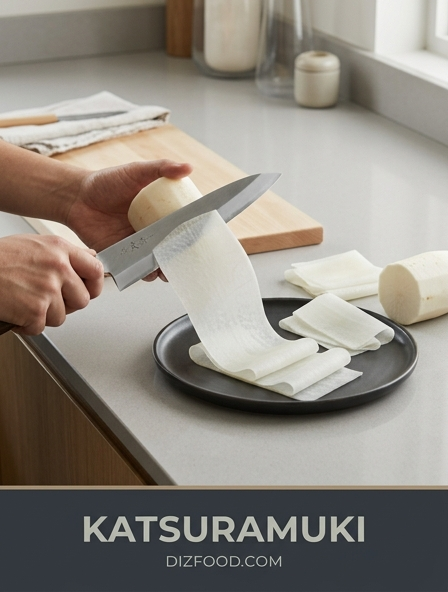
The art of katsuramuki represents one of the most fundamental yet demanding skills in traditional Japanese cuisine. Its origins are deeply rooted in the Edo period, a time when the aesthetic presentation of food became as vital as its flavor. The term itself is derived from the katsura tree; the process of peeling a vegetable into a continuous, paper-thin sheet mirrors the traditional method of stripping bark from these trees. Historically, mastering this technique was the primary hurdle for young apprentices in a washoku kitchen, often requiring years of daily practice before they were permitted to handle more complex tasks.
- Cultural Significance: It demonstrates a chef's discipline, patience, and technical precision.
- Symbolism: Long, unbroken sheets symbolize longevity and the seamless flow of nature.
- Evolution: While originally a test of skill, it evolved into a necessary step for creating delicate garnishes like ken and tsuma.
In classical training, a chef's proficiency was judged by the translucency and length of the sheet produced. A perfect katsuramuki sheet should be thin enough to read a newspaper through, showcasing the intersection of culinary utility and visual poetry that defines Japanese gastronomy.
Essential Usuba Knife Selection Guide
To execute katsuramuki correctly, the choice of cutlery is non-negotiable. The Usuba, a traditional Japanese vegetable knife, is the specific tool designed for this task. Unlike Western knives, the Usuba features a single-bevel edge (kataba), which allows the blade to glide through vegetable fibers without crushing them. This design is essential for achieving the flat, wide surface area needed for rotary peeling. When selecting a knife, the balance between the spine thickness and the edge sharpness is paramount for maintaining a consistent depth.
| Feature | Kamagata Usuba | Azumagata Usuba |
|---|---|---|
| Tip Shape | Curved/Pointed | Square/Blunt |
| Origin | Kansai (Osaka) | Kanto (Tokyo) |
| Best Use | Intricate carving and peeling | Heavy chopping and peeling |
High-carbon steel, such as Shirogami or Aogami, is preferred for its ability to take an incredibly fine edge. While these materials require more maintenance to prevent rust, the surgical precision they offer during the rotary slicing motion is unmatched by stainless steel alternatives. A blade length of 180mm to 210mm is generally considered ideal for most hand sizes.
Best Vegetables for Rotary Slicing
Not every vegetable is suitable for the rigorous demands of katsuramuki. The ideal candidate must have a dense, uniform structure and a relatively cylindrical shape. The white radish, or daikon, is the quintessential vegetable for this practice. Its high water content and lack of tough internal fibers make it forgiving for beginners while allowing experts to produce sheets exceeding several meters in length. Beyond the daikon, other root vegetables and firm fruits provide different colors and textures for the plate.
- Daikon Radish: The gold standard for its crisp texture and brilliant white appearance.
- English Cucumber: Excellent for vibrant green ribbons, though the seeds must be avoided.
- Carrots: Difficult due to their hardness, but provide stunning orange highlights.
- Japanese Sweet Potato: Often used for tempura wraps or decorative frying.
- Jicama: A modern alternative that offers a sturdy, starchy consistency.
Selecting the right specimen involves checking for straightness and a lack of soft spots. Any internal voids or pithy sections will cause the knife to snag, instantly breaking the continuous sheet. Therefore, seasonality and freshness play a critical role in the success of the rotary slice.
The Proper Grip and Blade Motion
Success in katsuramuki is dictated by the ergonomics of the grip and the fluid movement of the blade. The chef holds the vegetable cylinder in the left hand and the Usuba in the right. The right thumb serves as the "rudder," resting against the face of the vegetable to regulate the thickness of the peel. It is not a sawing motion; rather, it is a rhythmic, vertical "shimmy" combined with a steady rotation of the vegetable toward the blade. This coordination ensures that the knife edge stays perfectly parallel to the center of the cylinder.
- Position the right hand so the index finger rests on the spine for stability.
- Place the left thumb at the point where the blade meets the vegetable to gauge thickness.
- Apply gentle, even pressure while moving the blade up and down in short strokes.
- Rotate the vegetable slowly with the left hand fingers, keeping the tension constant.
Maintaining a relaxed posture is essential to avoid muscle fatigue, which leads to jagged edges. The motion should feel like a dance between the hands, where the blade remains relatively stationary in space while the vegetable yields its layers in a continuous, flowing ribbon.
Achieving Paper Thin Vegetable Sheets
The hallmark of a master is the translucency of the vegetable sheet. Achieving this level of thinness requires an intimate understanding of the vegetable's resistance and the knife's sharpness. As the blade penetrates the outer layer, the chef must maintain a constant "feel" for the distance between the blade and the skin. If the sheet is too thick, it will be brittle and difficult to fold; if it is too thin, it will tear under its own weight. The goal is to produce a sheet so uniform that light passes through it evenly without any visible "ribbing" or gouges.
Uniformity is maintained by ensuring the vegetable cylinder is perfectly centered before starting. Any eccentricity in the rotation will result in oscillating thickness. Professionals often use the "translucency test," where the sheet is held up to the light to check for shadows. Constant moisture is also vital; a dry vegetable becomes tough and prone to snapping. Sprinkling the work surface with water helps the sheet slide away from the blade smoothly, preventing the friction that often causes the delicate fibers to catch and rip during the high-precision peeling process.
Turning Sheets into Fine Garnishes
Once a perfect sheet is produced, it serves as the raw material for various garnishes, most notably "ken." To create these needle-thin strips, the sheet is stacked and sliced vertically with extreme precision. These strips are then soaked in ice water, which causes them to curl and crisp up, providing a refreshing textural contrast to the soft fish in a sashimi platter. The versatility of the sheet allows for more than just strips; it can be transformed into structural elements that hold other ingredients.
- Ken (Strips): The sheet is rolled or stacked tightly and cut into microscopic julienne.
- Nets (Amigasa): The sheet is folded and notched to create a lattice pattern when opened.
- Wraps: Using the sheet as a "nori" substitute to wrap fish, sprouts, or other vegetables.
- Fans: Small sections of the sheet are pleated to create cooling, decorative fans.
The transformation from a solid root vegetable to a delicate, hair-like garnish is the ultimate expression of the katsuramuki technique. These elements do more than decorate; they cleanse the palate between different types of fish, making them functional components of the meal.
Creating Decorative Japanese Vegetable Knots
Decorative knots, or "Musubi," represent the pinnacle of vegetable presentation. Using the flexible sheets generated from katsuramuki, chefs can tie intricate designs that symbolize unity and celebration. These are most commonly seen in Osechi Ryori (New Year's cuisine) or at wedding banquets. Because the vegetable sheet is thin and pliable, it can be manipulated much like a silk ribbon. To prevent the vegetable from snapping while tying the knot, it is often lightly salted to draw out moisture and increase elasticity.
- Musubi-Daikon: A simple overhand knot made from a thin daikon strip.
- Hana-Giri: Flower-shaped knots used to decorate clear soups.
- Warabi: Knots shaped to resemble the coiled fronds of a fern.
After the knot is tied, it is often blanched or pickled to "set" the shape. The precision required to tie these knots without tearing the delicate sheet is immense. It requires a gentle touch and a deep understanding of the vegetable's structural limits. When placed in a clear dashi broth, these knots appear to float weightlessly, adding a layer of sophisticated elegance that characterizes high-end kaiseki dining.
Common Mistakes in Traditional Peeling
Even for experienced cooks, katsuramuki presents several pitfalls that can ruin the final product. One of the most frequent errors is using a double-bevel (Western-style) knife. Because a double-bevel blade tapers on both sides, it naturally wants to "wedge" or push away from the vegetable, making a flat, thin sheet nearly impossible to maintain. Another common mistake is the "sawing" motion, where the chef pulls the knife back and forth too aggressively, creating a ragged, uneven surface on the sheet.
- Inconsistent Pressure: Applying too much force causes the blade to dive deep into the core.
- Dry Produce: Working with old or dry vegetables leads to cracking and snapping.
- Thumb Positioning: Failing to use the thumb as a guide results in sheets that vary in thickness.
- Stopping Mid-Peel: Hesitation creates "steps" or lines in the sheet that are visible to the eye.
Mastery requires a continuous, confident flow. Many beginners find themselves looking at the knife rather than feeling the vegetable. True proficiency comes when the chef can sense the thickness of the sheet through the vibrations in the handle and the resistance felt by the guiding thumb, allowing for real-time micro-adjustments.
Honing Your Blade for Precision Cuts
A dull knife is the enemy of katsuramuki. Because the technique relies on the blade gliding through the vegetable with minimal resistance, the edge must be kept at a surgical level of sharpness. This requires regular maintenance on whetstones. For a single-bevel Usuba, the sharpening process is specialized, focusing on the "uraosh" (the flat back) and the "kiriha" (the primary bevel). Maintaining the slight concavity on the back of the blade is essential to prevent food from sticking.
| Stone Grit | Purpose | Frequency |
|---|---|---|
| #1000 (Medium) | Setting the edge and removing nicks | Weekly/Monthly |
| #6000 (Fine) | Polishing and removing the burr | Daily |
| #10000+ (Ultra-Fine) | Mirror finishing for maximum glide | Special Occasions |
During the katsuramuki process, chefs will often give their blade a few passes on a high-grit finishing stone or a leather strop every few vegetables. This "honing" ensures the edge remains keen enough to slice through individual cells rather than tearing them, which preserves the vegetable's juices and improves the luster of the final sheet.
Elevating Plate Presentation with Katsuramuki
The ultimate goal of katsuramuki is to elevate the diner's experience through visual and textural harmony. In Japanese cuisine, the arrangement of the plate is intended to reflect the seasons and the natural landscape. The translucent sheets and needle-like garnishes provide a foundation of "white space" and height. For instance, a mound of daikon ken provides a crisp, airy bed for fatty tuna sashimi, lifting the fish off the plate and allowing air to circulate, which enhances the aroma and flavor perception.
Furthermore, the use of these techniques signals to the guest that the chef possesses a high level of dedication and skill. It transforms humble root vegetables into works of art. Whether it is a translucent veil of cucumber draped over a sunomono salad or a delicate daikon knot in a bowl of Owan, the inclusion of katsuramuki elements adds a layer of refinement that distinguishes professional washoku from home cooking. The play of light through the vegetable sheets creates a sense of freshness and purity, which is the cornerstone of the Japanese culinary aesthetic, making every dish feel like a curated experience rather than just a meal.

Comments