
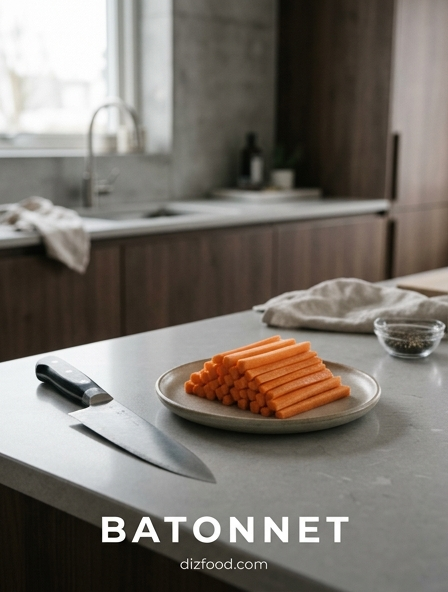
Mastering the Batonnet Cut Technique
The batonnet is one of the most fundamental knife cuts in the culinary arts, serving as the cornerstone for several other advanced techniques. Derived from the French word for "little stick," the batonnet transforms bulky, irregular vegetables into uniform rectangular batons. Mastering this skill requires a combination of patience, hand-eye coordination, and a deep understanding of geometric precision. For professional chefs, the ability to produce consistent batonnet cuts is a sign of disciplined craftsmanship and attention to detail. This cut is not merely for aesthetics; it provides the structural basis for creating the small dice, or macédoine, by simply turning the sticks and cutting them into cubes.
To begin mastering the technique, one must focus on the rhythm of the knife. It involves a "rocking" motion where the tip of the chef's knife rarely leaves the cutting board. Beginners should prioritize accuracy over speed, ensuring that each slice is perpendicular to the board to avoid tapered edges. As muscle memory develops, the process becomes fluid, allowing the cook to process large quantities of produce quickly. This foundational skill elevates the quality of home-cooked meals to professional standards, ensuring that every component of a dish is treated with the same level of care and mathematical exactness.
Essential Tools for Precision Slicing
Achieving a perfect batonnet is nearly impossible without the correct set of culinary instruments. The most critical tool is a sharp 8-inch or 10-inch chef's knife. A dull blade will crush the cell walls of the vegetable rather than slicing through them cleanly, leading to jagged edges and uneven dimensions. High-carbon stainless steel is often preferred for its edge retention and durability. Furthermore, a stable cutting surface is vital; a heavy wooden or composite cutting board provides the necessary grip to prevent the vegetable from sliding during the squaring-off process.
- Chef's Knife: A balanced blade for controlled, rhythmic slicing.
- Bench Scraper: Used to clear the workspace and move uniform cuts without bruising them.
- Measuring Ruler: Essential for novices to calibrate their eyes to the 1/4 inch standard.
- Honing Steel: Keeps the knife edge centered and sharp throughout long prep sessions.
- Peeler: A high-quality Y-peeler ensures the surface of the vegetable is smooth before cutting begins.
In addition to these tools, many chefs use a damp paper towel or a non-slip mat underneath their cutting board. This prevents any shifting that could lead to injury or inaccurate dimensions. When the tools are maintained and organized, the workflow remains efficient and the output remains consistent.
Standard Dimensions for Professional Batonnet
In the culinary industry, standardized dimensions are strictly followed to maintain uniformity across different kitchen stations. A batonnet must adhere to specific measurements to be technically correct. While some regional variations exist, the classic French culinary standard is widely accepted in professional schools and Michelin-starred establishments. The primary goal is to create a stick that resembles a thick matchstick, providing a substantial bite while remaining elegant on the plate.
| Dimension | Measurement (Imperial) | Measurement (Metric) |
|---|---|---|
| Width | 1/4 inch | 6 mm |
| Thickness | 1/4 inch | 6 mm |
| Length | 2 to 2.5 inches | 5 to 6 cm |
Consistency in these dimensions is the hallmark of a skilled prep cook. If the sticks are too thin, they may be mistaken for julienne; if they are too thick, they border on the "pont neuf" or large fry cut. Adhering to these measurements ensures that when the batonnet is further processed into a macédoine dice, the resulting cubes are exactly 1/4 inch on all sides. This mathematical precision is what separates professional vegetable fabrication from casual home chopping.
Best Hearty Vegetables for Uniform Cuts
Not all vegetables are suitable for the batonnet cut. The technique requires produce with a firm, dense structure that can hold its shape when sliced into thin, long sticks. Soft or watery vegetables like tomatoes or cooked zucchini will collapse under the knife, making it impossible to achieve the sharp, clean angles required for a professional presentation. Root vegetables are the primary candidates for this cut, as their fibrous nature allows for precise squaring and planking without the vegetable splitting or crumbling.
- Russet Potatoes: The classic choice for traditional French fries and starch sides.
- Carrots: Their bright color and firm texture make them ideal for practicing uniform dimensions.
- Parsnips: Similar to carrots but with an earthy sweetness, perfect for roasted medleys.
- Celery Root (Celeriac): A dense bulb that produces beautiful, creamy-white batons.
- Jicama: A crisp, raw option often used for crudité platters and refreshing salads.
- Daikon Radish: Offers a sharp, peppery crunch and holds its shape exceptionally well in pickles.
When selecting these vegetables, it is best to look for specimens that are relatively straight and thick. This minimizes the amount of "trim" or waste generated when squaring the vegetable into a rectangular block. Utilizing seasonal, firm produce ensures that the batonnet retains its structural integrity during the subsequent cooking processes.
Step by Step Squaring and Planking
The transition from a round vegetable to a rectangular baton is achieved through a process known as squaring off. This ensures that the vegetable sits flat on the cutting board, which is essential for both safety and precision. Without a flat base, the vegetable will roll, leading to slanted cuts and potential injury. Follow these steps to prepare the vegetable for the final batonnet slices:
- Top and Tail: Cut off both ends of the vegetable to create two flat, parallel surfaces.
- Create a Base: Slice a thin strip off one rounded side so the vegetable can sit securely on the board.
- Square the Sides: Trim the remaining three rounded sides until you have a rectangular block, or "carre."
- Slice into Planks: Cut the block lengthwise into even slabs that are exactly 1/4 inch thick.
- Stack and Cut: Stack two or three planks on top of each other and cut them lengthwise into 1/4 inch strips.
The resulting sticks should be uniform in every direction. It is important to save the trimmings; while they are not used for the batonnet, they are perfect for stocks, soups, or purees. This systematic approach reduces the likelihood of "wedged" pieces and ensures that every batonnet in the batch is identical to the next, reflecting a high level of culinary discipline.
Achieving Even Cooking Through Consistency
While the batonnet cut is visually stunning, its primary purpose in the kitchen is functional. Uniformity in size ensures that every piece of vegetable cooks at exactly the same rate. When vegetables are chopped into irregular shapes, smaller pieces tend to overcook and become mushy or burnt before the larger pieces have softened. This is particularly problematic in high-heat applications like deep-frying or roasting, where a few seconds can mean the difference between a golden-brown exterior and a charred surface.
By maintaining a consistent 1/4 inch thickness, the heat penetrates the center of each baton simultaneously. This leads to a superior mouthfeel and texture across the entire dish. Furthermore, the increased surface area of a batonnet compared to a rough chop allows for better caramelization and seasoning adherence. Whether you are blanching carrots for a vegetable medley or frying potatoes, the mathematical regularity of the batonnet ensures a reliable and professional result. This predictability allows chefs to time their service perfectly, knowing that each component of the plate will reach the ideal level of doneness at the same moment.
Knife Safety Tips for Hard Vegetables
Hard root vegetables, which are the standard for batonnet cuts, pose a higher risk of knife slips due to their density and tendency to roll. Safety must be the priority during vegetable fabrication. A sharp knife is actually safer than a dull one because it requires less downward pressure to bite into the vegetable, reducing the chance of the blade jumping or sliding. Maintaining a clean and uncluttered workspace also helps prevent accidents during repetitive cutting tasks.
- The Claw Grip: Always tuck your fingertips inward and use your knuckles to guide the blade.
- Flat Surface Rule: Never attempt to slice a round vegetable without first creating a stable, flat base.
- Focus on the Lead: Keep your eyes on the guide hand, ensuring the knife stays vertical and away from skin.
- Stabilize the Board: Ensure your cutting board is anchored with a non-slip grip to prevent shifting.
- Moderate Pace: Speed comes with experience; start slowly to maintain control over the dense vegetable fibers.
If you feel the knife sticking in a particularly hard vegetable like a large sweet potato, do not force it downward with your palm. Instead, gently rock the knife or remove it and start the cut again. By respecting the tool and the resistance of the ingredient, you can produce professional-grade cuts without compromising your safety in the kitchen.
Batonnet vs Other Classic Knife Cuts
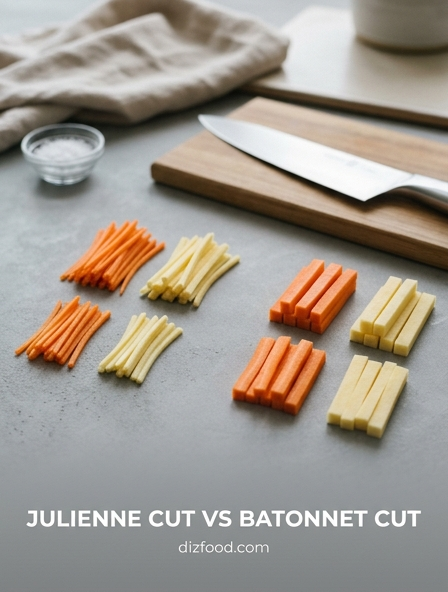
Understanding the hierarchy of French knife cuts is essential for any cook. The batonnet sits in the middle of this hierarchy, acting as a bridge between the delicate julienne and the more substantial large cuts. Each cut is defined by its specific dimensions and is chosen based on the desired cooking time and final presentation of the dish. Distinguishing between these cuts allows a chef to follow recipes with precision and adapt their technique to the specific needs of the ingredients.
| Cut Name | Dimensions (Inches) | Common Use |
|---|---|---|
| Fine Julienne | 1/16 x 1/16 x 2 | Garnish, Salads |
| Julienne | 1/8 x 1/8 x 2 | Stir-fry, Slaws |
| Batonnet | 1/4 x 1/4 x 2 to 2.5 | Fries, Roasting |
| Allumette | 1/8 x 1/8 x 2 | Matchstick Potatoes |
| Pont Neuf | 1/2 x 1/2 x 3 | Thick Steak Fries |
While the names might seem interchangeable to a novice, the difference of an eighth of an inch significantly impacts the texture. A julienne cut will wilt and caramelize almost instantly, whereas a batonnet provides a sturdy structure that can withstand longer cooking times, such as roasting or braising. Mastery of the batonnet is particularly important because it is the prerequisite for the macédoine (small dice), just as the julienne is the prerequisite for the brunoise.
Culinary Applications for Large Matchsticks
The batonnet cut is highly versatile and appears in numerous classic and modern dishes. Perhaps its most famous application is the standard French fry. When potatoes are cut into uniform batons, they fry evenly, resulting in a crisp exterior and a fluffy interior. Beyond the deep fryer, batonnet-cut vegetables are a staple in vegetable medleys. Carrots, parsnips, and turnips prepared this way offer a sophisticated look for side dishes, often glazed with butter and honey to highlight their clean edges and uniform shape.
In cold preparations, the batonnet is the preferred cut for crudité platters. The size is perfect for dipping into hummus or ranch, providing enough structural integrity to scoop up sauces without breaking. They are also frequently used in hearty stews where the vegetables need to maintain their shape over a long simmer. In Asian cuisine, though often referred to by different names, the batonnet size is ideal for certain types of stir-fries where the vegetable needs to remain "al dente" despite the high heat. The uniformity of the sticks ensures that every bite provides a consistent crunch and flavor profile, elevating the overall dining experience.
Common Mistakes in Vegetable Fabrication
Even seasoned cooks can fall into bad habits that compromise the quality of their batonnet. One of the most common errors is failing to "square off" the vegetable properly. In an attempt to reduce waste, cooks often leave rounded edges on their sticks. This results in pieces that look amateurish and cook unevenly. To avoid this, one must accept that vegetable fabrication involves some trim, which should be repurposed rather than forced into the final dish. Another frequent mistake is "tapering," where the cut starts at 1/4 inch but narrows toward the end because the knife was not held perfectly vertical.
- Eyeballing: Not using a guide or ruler when learning, leading to "batonnet" that are actually too thick.
- Dull Blades: Using a knife that hasn't been honed, resulting in crushed or ragged vegetable fibers.
- Inconsistent Length: Forgetting to "top and tail" the vegetable, leading to sticks of varying lengths.
- Poor Stacking: Trying to stack too many planks at once, causing the pile to slide and the cuts to become crooked.
- Discarding Scraps: Throwing away the trimmings instead of using them for stocks or purees.
By recognizing these pitfalls, a cook can focus on the technical precision required for excellence. Taking the time to measure, stabilize, and slice carefully will eventually lead to a natural proficiency that requires less conscious effort, resulting in perfect vegetable batons every time.

Comments