
Understanding Single Bevel Blade Precision
Single bevel blades, often associated with traditional Japanese cutlery, are characterized by a grind on only one side of the blade while the other remains flat or slightly concave. This unique geometry allows for an incredibly acute angle, often reaching between 10 and 15 degrees. Because the edge is so thin and sharp, it is capable of making surgical-grade cuts with minimal cell damage to the food. This precision is particularly vital in sushi preparation, where the integrity of the fish's surface dictates both flavor and aesthetic appeal.
The flat side of the blade, known as the urasuki, creates a pocket of air that prevents food from sticking, facilitating effortless separation during slicing. However, this design introduces a steering effect, where the knife naturally pulls to one side during a cut. Mastering this tool requires significant practice and specialized techniques to compensate for the lateral movement. While they excel at specific tasks like filleting or fine vegetable work, they are less versatile for general kitchen duties compared to their symmetrical counterparts.
Benefits of Double Bevel Kitchen Knives
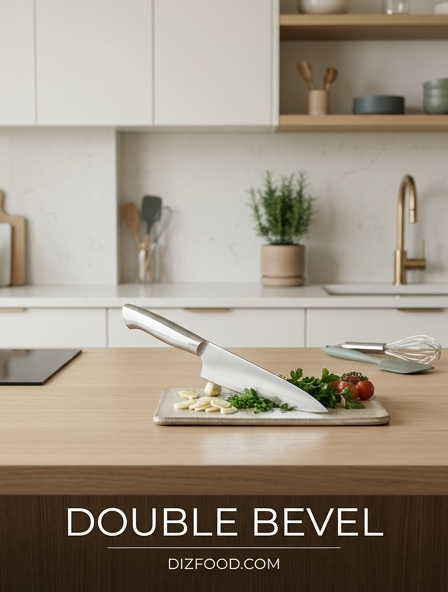
Double bevel knives are the workhorses of both professional and home kitchens due to their balanced design and intuitive handling. Unlike specialized single-sided blades, double bevel tools are ground on both sides, typically forming a "V" shape. This symmetry ensures that the knife moves straight through ingredients without veering to the left or right, making them accessible to both left-handed and right-handed users. Their versatility allows them to handle a wide range of tasks, from heavy-duty chopping to delicate mincing.
- Ambidextrous Use: The symmetrical edge profile works equally well for all users regardless of dominant hand.
- Structural Integrity: The thicker wedge shape provides better support for the edge, making it less prone to chipping during demanding tasks.
- Ease of Maintenance: These blades are generally easier to sharpen on standard whetstones or pull-through sharpeners.
- Predictable Tracking: The blade follows a straight vertical path, which is essential for uniform dicing and chopping.
Because the weight is distributed evenly, users experience less hand fatigue during repetitive prep sessions. This balance makes the double bevel an ideal choice for a primary chef's knife or Santoku.
Essential Slicing Techniques for Different Edges
The physical geometry of a blade dictates the kinetic approach required for an efficient cut. When using a double bevel knife, the most common technique is the "rocking motion," where the curved belly of the blade stays in contact with the cutting board while the handle moves up and down. This is highly effective for mincing herbs or dicing onions, as the symmetrical edge provides a stable pivot point. Alternatively, the "push-cut" involves moving the blade forward and down simultaneously, utilizing the entire length of the edge for clean separation.
- The Draw Cut: Best for single bevels, pulling the blade toward the body to utilize the extreme sharpness.
- The Rocking Stroke: Ideal for double bevel chef knives to achieve rapid, rhythmic dicing.
- The Vertical Chop: Used with heavier double bevel blades for dense root vegetables.
Single bevel blades require a "pull-cut" or "draw-slice" to maximize their precision. Because they tend to steer, the chef must slightly angle the wrist to maintain a straight trajectory. Understanding these nuances prevents unnecessary strain and ensures the longevity of the blade's edge by avoiding lateral pressure that could cause micro-chipping.
Comparing Japanese and Western Knife Grinds
The distinction between Japanese and Western knife grinds often centers on the bevel angle and the hardness of the steel used. Western knives are traditionally double-beveled with a wider angle, usually between 18 and 22 degrees per side. This creates a durable edge that can withstand contact with bone or hard surfaces. In contrast, Japanese knives-even those with double bevels-feature much narrower angles and harder steel, allowing for a sharper but more brittle edge. The following table highlights the primary differences between these two common kitchen standards.
| Feature | Western Double Bevel | Japanese Double Bevel |
|---|---|---|
| Edge Angle | 18° - 22° per side | 10° - 15° per side |
| Steel Hardness | 56-58 HRC (Softer) | 60-64 HRC (Harder) |
| Edge Retention | Moderate | High |
| Durability | High (Resists Chipping) | Moderate (Prone to Chipping) |
While Western grinds prioritize toughness and ease of honing, Japanese grinds focus on surgical precision and long-term sharpness. Choosing between them depends largely on the user's cutting style and willingness to perform regular maintenance.
How Bevel Design Impacts Food Texture
The way a blade enters and exits an ingredient significantly alters the cellular structure and, consequently, the mouthfeel of the food. A single bevel knife acts like a chisel; it shears through fibers cleanly without crushing them. This is why sashimi sliced with a Yanagiba has a glossy, glass-like surface. When cell walls remain intact, the natural juices are retained inside the food rather than spilling onto the cutting board, which preserves the original flavor profile and extends the shelf life of the ingredient.
Double bevel knives, while slightly more disruptive due to their "V" shape, provide a uniform wedge that is excellent for heartier vegetables and meats. The dual-sided pressure helps push the food away from the blade on both sides, which is beneficial for creating consistent cubes or slices in high-volume cooking. However, if a double bevel knife is dull, it will bruise the food, leading to oxidation and a mushy texture. Proper bevel maintenance is therefore not just about speed, but about respecting the ingredient's structural integrity to ensure the best possible culinary results for the final dish.
Selecting the Ideal Edge for Professional Slicing
Professional chefs often curate a collection of knives with varying bevels to address specific culinary challenges. For tasks requiring high-volume prep, such as dicing fifty pounds of potatoes, a robust double bevel French chef knife is the industry standard. Its symmetry allows for rapid, repetitive motions with predictable results. In contrast, when the task involves delicate protein fabrication or the preparation of decorative garnishes, the precision of a single bevel knife becomes indispensable. The choice is often dictated by the specific resistance of the material being cut.
A Sujihiki, which is a double bevel slicing knife, is often preferred by Western chefs for carving roasts because it tracks straight through large muscles. Meanwhile, a Japanese chef might reach for a single-beveled Yanagiba to slice raw fish, valuing the clean release and lack of friction. Professional selection also considers the sharpening curve; single bevels require specialized whetstone techniques that many line cooks may not have mastered. Ultimately, the ideal edge is one that balances the required level of precision with the user's technical proficiency and the physical demands of the professional kitchen environment.
Maintenance Tips for Single and Double Bevels
Maintaining the edge of a kitchen knife requires an understanding of its specific geometry to avoid rounding off the apex. Double bevel knives are relatively straightforward to maintain; they require equal attention to both sides of the blade. Using a honing rod between tasks can realign the edge, while a medium-grit whetstone is used periodically to sharpen both bevels at a consistent angle. It is crucial to maintain the same degree of tilt on both sides to keep the knife's path centered during use.
- Whetstone Choice: Use 1000 grit for sharpening and 6000 grit for polishing the edge.
- Single Bevel Technique: Sharpen the primary bevel and only "lap" the flat side to remove the burr.
- Angle Consistency: Use a guide if necessary to ensure the "V" or "chisel" shape remains true.
- Avoid Honing Rods: Hard Japanese single bevels can chip if used with a traditional steel honing rod.
Single bevel maintenance is more complex, involving the "uraoshi" process where the flat back is slightly polished to ensure the edge remains perfectly straight. Improperly sharpening a single bevel can ruin its unique steering properties and compromise its ability to make paper-thin slices.
The Role of Blade Geometry in the Kitchen
Beyond the simple count of bevels, the overall geometry of the blade-including its thickness, taper, and grind style-plays a critical role in kitchen performance. A "full flat grind" on a double bevel knife provides a thin profile that glides through soft vegetables, whereas a "convex grind" (Hamaguri) adds meatiness behind the edge to help push food away, reducing suction and sticking. These geometric nuances determine how much drag the cook feels during a long shift of preparation work.
Single bevel knives utilize a "concave" back (urasuki) to create a pocket of air, which is a masterclass in functional geometry. This design minimizes the surface area in contact with the food, allowing the blade to pass through sticky proteins like raw tuna with zero resistance. In the kitchen, the interplay between the bevel angle and the blade's "shoulders" dictates how easily the knife wedges in hard produce like carrots or squash. A well-designed double bevel will have a gradual taper to prevent wedging, while a specialized single bevel is designed specifically to avoid the surface tension that plagues standard flat-ground cutlery.
Mastering Thin Slices with Specialized Blades
The pursuit of the perfect thin slice is often what leads a cook from standard double bevel knives to specialized single bevel tools. Techniques such as "Katsuramuki"-the art of rotary peeling a radish into a continuous, translucent sheet-are nearly impossible without a single-beveled Usuba. The flat side of the blade allows the chef to guide the knife against the ingredient with extreme proximity, using the fingers as a gauge for thickness. Because there is no bevel on the back side, the knife can sit perfectly flush against the vegetable.
For those using double bevel knives, achieving thin slices requires a "tapered" blade profile and a very high level of grip control. While a Santoku can produce thin slices, it will never reach the microscopic thinness of a dedicated Japanese vegetable knife. The specialization of the blade allows for culinary expressions that are both visual and textural. Mastery involves learning how to use the "shinogi" line-the boundary where the bevel meets the flat of the blade-as a visual guide to control the depth of every cut. This level of control transforms vegetable preparation from a chore into a highly disciplined craft.
Choosing Your Primary Kitchen Knife Edge
Selecting the right primary knife edge is a balance between your cooking style, your maintenance habits, and your comfort level with knife skills. For the vast majority of home cooks and general culinary tasks, the double bevel knife is the superior choice. Its intuitive tracking, ease of sharpening, and durable edge make it a reliable partner for everything from chopping garlic to slicing a cooked steak. It is the "all-rounder" that accommodates the widest variety of ingredients and techniques without requiring a steep learning curve.
However, if your culinary focus is specialized-such as traditional Japanese cuisine, precision fish butchery, or decorative vegetable work-investing in a single bevel knife is essential. These tools offer a level of sharpness and specific functionality that a double bevel simply cannot replicate. Before choosing, consider whether you are willing to learn the specific whetstone techniques required for single-sided blades. Most professional kits consist of a primary double-bevel chef knife for bulk work, supplemented by specialized single-bevel blades for precision tasks. This hybrid approach ensures you have the right geometry for every challenge encountered at the cutting board.

Comments