
Choosing between a single bevel and a double bevel edge is the secret to transforming your culinary prep from basic chopping into masterful precision cutting. While double bevel blades are the versatile "V-shaped" workhorses found in most Western kitchens, offering stability for everyday tasks, single bevel blades-often associated with traditional Japanese craft-feature a razor-sharp chisel edge designed for paper-thin slices and surgical accuracy. Understanding these geometries allows you to match your knife to your specific needs, whether you are chasing the artistic delicacy of sashimi or the robust reliability required for heavy-duty vegetable prep. By selecting the right edge, you optimize your workflow, ensure cleaner cuts that preserve food texture, and master the art of effortless slicing.
| Feature | Single Bevel (Chisel Edge) | Double Bevel (V-Edge) |
|---|---|---|
| Edge Geometry | Sharpened on one side (10°-15°) | Sharpened on both sides (15°-22° per side) |
| Primary Use | Ultra-fine slicing, sushi, garnishes | General utility, chopping, heavy prep |
| Cutting Precision | Extreme; prevents food from sticking | Moderate; balanced and symmetrical |
| Durability | Delicate; prone to chipping on hard food | Robust; handles bone and tough rinds |
| Skill Level | High; requires specific technique | Low; intuitive for all users |
| Maintenance | Complex; requires whetstone mastery | Easy; compatible with honing rods |
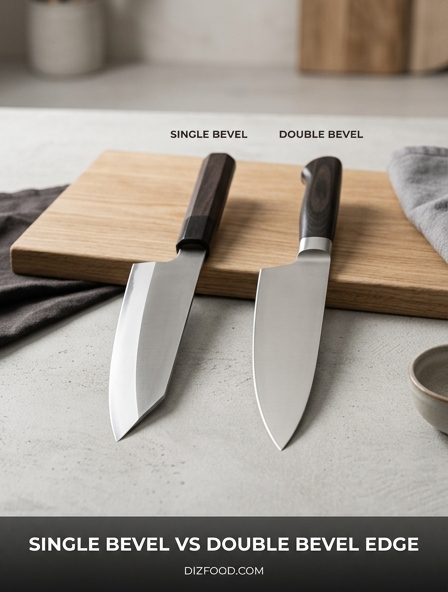
Single Bevel vs Double Bevel Knife Edges Explained
In the culinary world, the distinction between single and double bevel edges represents more than just a design choice; it defines the knife's purpose, cultural heritage, and mechanical interaction with food. A bevel refers to the surface that has been ground to form the knife's edge. When you look down the spine of a blade toward the tip, the shape of that taper determines how the steel will part the fibers of a vegetable or the proteins of a fish.
A double bevel edge, often associated with Western-style cutlery and versatile Japanese hybrids like the Santoku, is ground on both sides of the blade. This creates a symmetrical "V" shape. This design is intuitive for most users, as the force applied during a cut travels straight down through the material. Conversely, a single bevel edge, primarily found in traditional Japanese knives like the Yanagiba or Deba, is ground on only one side, while the other side remains flat or slightly concave. This asymmetrical profile creates an extremely sharp, chisel-like edge that excels in tasks requiring surgical precision. Understanding these profiles is the first step in mastering knife skills and selecting the appropriate tool for specific kitchen tasks.
Key Differences Between Single and Double Bevel Blades
The primary differences between these two edge profiles lie in their geometry, symmetry, and intended trajectory through food. Double bevel blades are designed for balance and stability, making them the standard for general-purpose kitchen work. Single bevel blades, however, are specialized tools that require a specific technique to master, as they tend to "steer" or pull to one side during a cut due to their asymmetrical grind.
| Feature | Single Bevel | Double Bevel |
|---|---|---|
| Edge Shape | Chisel-like (7:0 or 9:1 ratio) | V-shape (5:5 or 6:4 ratio) | Sharpness Potential | Extremely high due to acute angles | High, but limited by durability needs | Ambidextrous | Specific to Right or Left hand | Yes | Common Use | Precision slicing, sushi, filleting | Chopping, dicing, general utility |
Beyond physical shape, the "Urasuki"-the slightly concave back side of a single bevel knife-creates an air pocket that prevents food from sticking to the blade. This feature is entirely absent in standard double bevel knives, which rely on finish textures or thinness to manage food release. Consequently, the choice between them often boils down to whether the chef prioritizes specialized precision or versatile, straight-line cutting.
The Precision Advantage of Single Bevel Cutting
The single bevel edge is the undisputed champion of precision in the kitchen. Because the blade is only ground on one side, the cutting edge can be honed to a much more acute angle-often between 10 and 15 degrees-without compromising the thickness of the spine. This allows the knife to enter food with minimal resistance, preserving the cellular structure of the ingredients. This is particularly vital in Japanese cuisine, where the texture and appearance of raw fish are as important as the flavor.
When a chef uses a single bevel knife, such as a Usuba for vegetables, they can achieve paper-thin slices that are translucent and uniform. The flat side of the blade acts as a guide, allowing the chef to shave off layers with incredible control. Key benefits include:
- Minimal cell damage, which keeps juices inside the food.
- Superior food release due to the concave back (Urasuki).
- The ability to perform decorative cuts like Katsuramuki (rotary peeling).
- Clean, glossy surfaces on sliced proteins that enhance mouthfeel.
However, this precision comes with a learning curve. Because the wedge effect only happens on one side, the blade naturally drifts. A skilled chef compensates for this "steering" by subtly adjusting the angle of their wrist, a technique that takes years of practice to perfect.
Double Bevel Versatility and General Use Benefits
For the vast majority of home cooks and many professional chefs in high-volume environments, the double bevel knife is the preferred choice. Its symmetrical "V" grind ensures that the blade moves straight through the food without veering to the left or right. This predictability is essential for rapid chopping, dicing, and mincing, where speed and consistency are paramount. Whether you are splitting a butternut squash or dicing onions, the double bevel profile provides the necessary stability.
Another significant benefit is ambidexterity. Most double bevel knives feature a 50/50 grind, meaning they can be used equally well by both right-handed and left-handed individuals. This makes them a more practical investment for shared kitchen environments. Furthermore, the double bevel edge is generally more robust. By distributing the force of the cut across two angled surfaces, the edge is less prone to chipping or rolling when it encounters harder materials like carrot cores or small poultry bones.
The versatility of the double bevel is why the Western Chef's knife and the Japanese Santoku have become the global standards for kitchen cutlery. They offer a "jack-of-all-trades" performance that can handle 95% of kitchen tasks with ease, making them the most cost-effective and user-friendly option for the average culinary enthusiast.
Comparing Blade Geometry and Edge Performance
The performance of a blade is dictated by its geometry-the way the thickness of the metal transitions to the sharpness of the edge. In a double bevel knife, the geometry is straightforward: the metal tapers from the spine down to the edge on both sides. This creates a sturdy wedge that pushes food apart symmetrically. While effective, this creates more friction than a single bevel, as both sides of the blade are in constant contact with the food being cut.
Single bevel geometry is significantly more complex. It consists of the "Shinogi" line (where the taper begins), the "Kiri-ha" (the primary bevel), and the "Urasuki" (the concave back). This geometry allows the blade to be exceptionally thin at the very edge while maintaining a thick, rigid spine. When cutting, only the very edge and the "Shinogi" line touch the food on one side, while the concave back minimizes contact on the other. This results in:
- Reduced drag and friction during the stroke.
- Enhanced "feel" for the ingredient's texture.
- Lower force required to initiate and complete a cut.
- Better preservation of delicate ingredients like sea urchin or fatty tuna.
While the double bevel offers better tracking and durability, the single bevel's specialized geometry allows for a level of finesse that is physically impossible to achieve with a symmetrical blade. It is the difference between a multi-tool and a scalpel.
Maintenance and Sharpening for Single vs Double Bevels
Sharpening these two types of blades requires fundamentally different approaches and skill sets. For a double bevel knife, the goal is to maintain the same angle on both sides, typically between 15 and 20 degrees. Most users can achieve a functional edge using pull-through sharpeners, honing rods, or basic whetstone techniques. The symmetry makes it relatively easy to feel when the edge is centered.
Single bevel knives, however, demand the use of whetstones and a deep understanding of Japanese sharpening traditions. You cannot use a pull-through sharpener or a standard honing rod on a single bevel blade without ruining its geometry. The process involves:
- Sharpening the primary bevel (the Kiri-ha) at a very shallow angle.
- "Uraoshi" sharpening, which involves laying the flat/concave back side nearly flat on the stone to remove the burr.
- Maintaining the Shinogi line to ensure the blade's "steering" characteristics remain consistent.
- Using a series of grit levels, from coarse to polishing, to achieve a mirror finish.
Because single bevel knives are often made of harder, more brittle high-carbon steel, maintenance is more frequent and more delicate. A double bevel knife is far more forgiving of neglect, whereas a single bevel knife is a high-maintenance instrument that requires dedicated care to retain its superior performance.
Durability and Strength in Different Blade Bevels
Durability in kitchen knives is often a trade-off with sharpness. The double bevel edge is inherently more durable due to its symmetrical support. When the edge hits a cutting board or a hard seed, the stress is distributed across both sides of the "V." This makes double bevel knives less likely to chip or "flea-bite." They are designed to withstand the lateral stresses of rocking motions and the impact of heavy chopping.
In contrast, the single bevel edge is fragile. Because the angle is so acute and the steel is often hardened to a high Rockwell scale (60+ HRC), the edge is thin and brittle. It is designed for slicing with a pulling motion, not for chopping or twisting. If a single bevel knife is used improperly-such as trying to cut through a frozen item or a bone-the edge will likely chip or even shatter. This lack of impact resistance means these knives must be handled with extreme care and used only on appropriate cutting surfaces like soft wood (Hinoki) or synthetic rubber.
Ultimately, the double bevel is the "workhorse" of the kitchen, built for longevity and toughness. The single bevel is a "specialist," built for a specific type of performance where strength is sacrificed for an unsurpassed level of sharpness. For heavy-duty tasks, the double bevel is the only logical choice to ensure the blade remains intact over years of use.
Kitchen Performance: Choosing the Best Edge Profile
Choosing between a single and double bevel edge depends entirely on your cooking style and the tasks you perform most frequently. If your daily kitchen routine involves dicing onions, mincing garlic, and portioning chicken, a double bevel Chef's knife or Santoku is the most efficient tool. It offers the balance, ease of use, and straight-tracking capability needed for diverse recipes. Most home cooks find that a high-quality double bevel knife provides more than enough sharpness for any standard dish.
However, if you are a culinary enthusiast who focuses on traditional Japanese cuisine, sashimi, or intricate vegetable garnishes, adding a single bevel knife to your kit is transformative. The single bevel's ability to slice fish without tearing the fibers or to create paper-thin radish sheets is irreplaceable. When choosing, consider the following:
- Skill Level: Are you willing to learn the specific "pull" stroke and steering compensation required for single bevels?
- Maintenance: Do you have the whetstones and the patience to sharpen a chisel-edged blade?
- Handedness: Remember that single bevel knives are usually right-handed; left-handed versions are often much more expensive.
- Task Specificity: Do you slice more than you chop? Slicing favors single bevel; chopping favors double.
Many professional chefs find a middle ground by owning a set of double bevel knives for general prep and a few select single bevel knives for specialized finishing work and delicate proteins.
Understanding the Anatomy of Single and Double Bevels
To fully appreciate the engineering behind these blades, one must look at their anatomical components. A double bevel knife is symmetrical; if you cut it in half vertically, both sides would be mirror images. The "edge angle" is the sum of the angles on both sides. For example, a 15-degree grind on each side results in a 30-degree total edge angle. This simplicity is what makes it universally accessible.
The anatomy of a single bevel knife, specifically a traditional Japanese "Kataba" blade, is much more complex. It features several distinct zones that must be maintained:
- Shinogi: The ridge line where the flat part of the blade starts to taper toward the edge.
- Kiri-ha: The actual slanted surface of the bevel.
- Ura: The back side of the blade, which is not actually flat but slightly concave (Urasuki).
- Uraoshi: The thin, flat rim that surrounds the concave Ura, providing structural support to the edge.
This anatomy allows for a "non-stick" effect and a sharpness that a double bevel cannot replicate. By hollowing out the back of the blade, the manufacturer reduces the surface area that touches the food. This sophisticated design is why single bevel knives are often more expensive, as they require expert hand-forging and grinding to ensure all these anatomical features work in harmony.
Single vs Double Bevel for Woodworking and Crafting
The logic of bevel profiles extends beyond the kitchen into woodworking and crafting, where the stakes for precision are equally high. In woodworking, the choice between a single and double bevel is often determined by whether the tool is meant for "paring" (precision shaving) or "chopping" (removing bulk material). Most wood chisels and plane irons are single-beveled. This allows the flat side of the tool to be used as a reference surface, ensuring that the cut follows a perfectly straight line relative to the wood's surface.
In contrast, axes and certain heavy-duty carving knives use a double bevel. Just like in the kitchen, the double bevel in woodworking provides strength and prevents the tool from "diving" too deeply into the material. It allows for a more controlled wedge effect that can split wood fibers without the tool getting stuck or veering off-course. For crafters, the single bevel is the tool of choice for detail work, such as leather skiving or fine joinery, where the user needs to see exactly where the edge meets the line.
Whether in the kitchen or the workshop, the principles remain the same: the single bevel offers a reference plane for extreme accuracy and thinness, while the double bevel offers a centered, stable edge for power and versatility. Both have their place in a master's toolkit, and knowing when to reach for each is the mark of a true craftsman.

Comments