
The Essence of the Japanese Usuba
The Usuba is the quintessential traditional Japanese vegetable knife, representing the pinnacle of precision in the culinary arts. Unlike western utility knives, the Usuba features a single-bevel edge, known as Kataba, which allows for incredibly thin and delicate cuts. Historically used by professional chefs in the Kansai and Kanto regions, this blade is designed exclusively for vegetables. Its name literally translates to "thin blade," reflecting its specialized geometry that minimizes cellular damage to the produce. By preserving the integrity of the vegetables, the Usuba ensures that flavors remain vibrant and textures stay crisp. In a professional Japanese kitchen, mastering this knife is often considered a rite of passage for apprentice chefs.
- Kamagata Usuba: Characterized by a curved tip, popular in the Kansai region.
- Azumagata Usuba: Features a square tip, traditional to the Kanto region.
- Purpose: Designed for peeling, slicing, and shaving vegetables with microscopic precision.
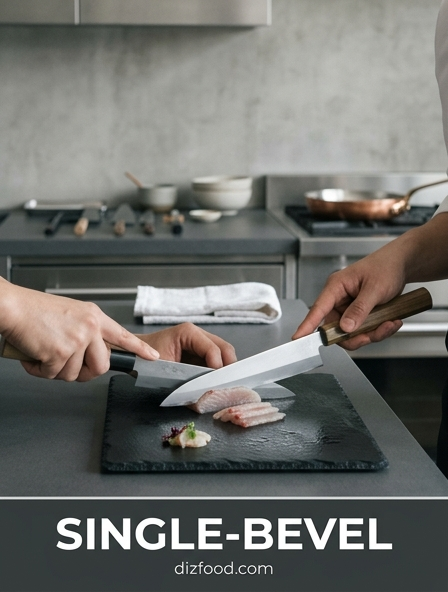
Single Bevel Geometry and Sharpness
The secret behind the Usuba's performance lies in its single-bevel geometry. One side of the blade is ground to a sharp angle, while the other side is slightly concave. This asymmetric design allows the knife to glide through vegetables with almost zero resistance. Because the edge is only sharpened on one side, it can be honed to a much finer degree than double-bevel knives. This creates a "chisel" effect, where the blade tracks perfectly straight during vertical cuts or peels. However, this geometry requires a specific technique, as the blade tends to pull slightly to one side if the user is not accustomed to the offset pressure required for a single-bevel tool.
| Feature | Single Bevel (Usuba) | Double Bevel (Nakiri) |
|---|---|---|
| Edge Angle | Extremely Acute (10-15°) | Standard (15-20°) |
| Sharpness | Superior/Surgical | High/General Purpose |
| Maintenance | Complex (Whetstone) | Moderate |
Mastering the Katsuramuki Technique
Katsuramuki is perhaps the most famous technique associated with the Usuba, involving the rotary peeling of a vegetable into a continuous, translucent sheet. Typically performed on daikon radish or cucumbers, this skill demonstrates a chef's total control over the blade. The chef holds the vegetable in one hand and the Usuba in the other, slowly rotating the produce against the razor-sharp edge. The resulting sheet of vegetable is often so thin that newsprint can be read through it. This technique is not merely for show; it serves as the foundation for creating delicate garnishes like Ken (shredded strips) which accompany sashimi.
- Select a uniform, cylindrical section of daikon radish.
- Position the Usuba blade parallel to the vegetable's surface.
- Use a steady thumb-guided motion to rotate the radish against the edge.
- Maintain a consistent thickness of roughly one millimeter throughout the process.
Usuba versus Nakiri Blade Differences
While both the Usuba and Nakiri are used for vegetables, they serve very different roles in the kitchen. The Nakiri is a double-bevel knife designed for home cooks and general efficiency; it is easy to sharpen and cuts straight down without pulling. In contrast, the Usuba is a professional tool with a single-bevel edge. The Usuba's flat profile ensures that the entire edge makes contact with the cutting board simultaneously, preventing "accordion" cuts where vegetable slices remain connected by a thin thread. Professionals choose the Usuba for high-end presentation where the aesthetic of the cut is just as important as the flavor of the dish.
- User Level: Nakiri (Beginner/Home); Usuba (Professional).
- Edge Type: Nakiri (V-shaped); Usuba (Chisel-shaped).
- Primary Benefit: Nakiri (Speed and Ease); Usuba (Precision and Surface Finish).
The Role of the Concave Urasuki
On the backside of a single-bevel Usuba, there is a subtle but vital concave grind known as the Urasuki. This hollowed-out section creates a pocket of air between the blade and the food being cut. Without the Urasuki, the flat surface of the blade would create a vacuum effect, causing wet vegetable slices to stick firmly to the steel. By reducing the surface area in contact with the food, the Urasuki ensures that delicate slices of radish or carrot fall away cleanly from the blade. This design also facilitates easier sharpening, as only the outer rim of the back side (the Uraoshi) needs to touch the whetstone, allowing for a perfectly flat and stable edge alignment during the honing process.
Steel Selection for Professional Slicing
High-quality Usuba knives are forged from specialized Japanese high-carbon steels, which are chosen for their ability to hold a terrifyingly sharp edge. The two most common types are White Steel (Shirogami) and Blue Steel (Aogami). White Steel is prized for its purity and ease of sharpening, offering the crispest possible edge, though it requires meticulous care to prevent rust. Blue Steel contains added tungsten and chromium for increased wear resistance and toughness, making it a favorite for chefs who perform high volumes of prep work. The choice of steel impacts the knife's reactivity, edge retention, and the tactile feedback the chef receives while cutting through dense root vegetables.
| Steel Type | Key Characteristic | Best For |
|---|---|---|
| White #1 | Highest Purity | Ultimate Precision |
| White #2 | Balance | Daily Professional Use |
| Blue #2 | Durability | High Volume Preparation |
Precision Vegetable Cutting Methods
Using an Usuba requires a departure from the rocking motion used with Western chef knives. Instead, chefs employ a "push-cut" or "pull-cut" technique to take full advantage of the flat blade profile. Because the Usuba has no belly or curve, it is ideal for decorative tasks such as Mukimono (the art of vegetable carving). The sharp corner of the blade can be used to score vegetables or create intricate patterns. When julienning, the Usuba produces perfectly square edges that improve the mouthfeel of the dish. This level of precision is essential in Japanese cuisine, where the visual harmony and the way a vegetable releases its juices on the tongue are paramount.
- Sengiri: Fine julienne strips, usually for garnishes.
- Wagiri: Round slices made with a consistent downward stroke.
- Sogigiri: Angled slicing to increase surface area for marinating.
Traditional Forging of Single Bevel Blades
The construction of a professional Usuba typically involves a process called Kasumi, where a hard high-carbon steel core (Hagane) is forge-welded to a softer iron jacket (Jigane). This combination provides the best of both worlds: a razor-sharp, hard edge supported by a more flexible and durable spine. Some elite Usubas are made using the Honyaki method, forged from a single piece of high-carbon steel. Honyaki knives are incredibly difficult to craft and even more difficult to use and maintain, but they offer the ultimate in edge retention and feedback. The forging process includes precise heat treatment and quenching, often in water, to reach a high Rockwell hardness that allows the single bevel to function without chipping.
Maintenance and Proper Sharpening Techniques
Maintaining an Usuba is an intensive process that requires a series of high-grit whetstones. Unlike double-bevel knives, you must respect the Shinogi line-the ridge where the blade starts to taper toward the edge. Sharpening involves laying the primary bevel flat against the stone and moving in a controlled motion to maintain the angle. The back side requires a special technique called Uraoshi, where the blade is laid completely flat on a fine stone to remove the burr and polish the perimeter of the Urasuki. Consistent maintenance is required to prevent the edge from rounding over, which would destroy the knife's ability to perform precision tasks like Katsuramuki.
- Soak whetstones until air bubbles stop rising.
- Start with a medium grit (1000) to establish the edge.
- Progress to high grits (5000-8000) for a mirror polish.
- Perform Uraoshi on a flat finishing stone to refine the back.
Achieving Paper Thin Vegetable Slices
The ultimate goal of using an Usuba is to achieve slices that are nearly invisible. When executed correctly, the single-bevel edge shears through vegetable fibers rather than crushing them. This clean shear prevents the oxidation of the produce, meaning the vegetables stay brighter for longer. For dishes like Sunomono (vinegared salad) or as a bed for Sashimi, the thinness of the vegetable determines the elegance of the plate. A chef's ability to produce uniform, paper-thin sheets is a testament to their discipline and the quality of their tool. This mastery allows for a unique culinary experience where the texture of the vegetable is transformed into something delicate, silky, and refined.

Comments