
Tired of turning your fresh produce into a pulpy mess? Achieving the perfect, paper-thin tomato slice is a culinary rite of passage that often comes down to a battle between the specialized tomato slicer and the reliable scalloped knife. While a dedicated tomato slicer uses a series of ultra-sharp, pre-set blades to deliver restaurant-quality uniformity in seconds, a scalloped (serrated) knife offers a more tactile, versatile approach, using its tiny teeth to "saw" through slick skins without crushing the delicate interior. Whether you prioritize the lightning-fast efficiency of a countertop tool or the multi-purpose precision of a hand-held blade, choosing the right gear ensures your salads and sandwiches stay beautiful, intact, and-most importantly-mess-free.
| Feature | Tomato Slicer (Mandoline/Manual) | Scalloped / Serrated Knife |
|---|---|---|
| Blade Design | Multiple parallel, fixed-width blades. | Single blade with rounded serrations. |
| Slice Uniformity | Extreme consistency; identical thickness. | Variable; depends on user's hand stability. |
| Speed | High-volume; slices whole tomato in one stroke. | Slower; one slice at a time. |
| Versatility | Low; specialized for specific produce sizes. | High; works for bread, citrus, and cakes. |
| Safety | Safe with guards; risky if used carelessly. | Standard knife safety; low slip risk on skins. |
| Best For | Batch prep, sandwiches, and professional kitchens. | Home cooking, daily prep, and delicate skins. |
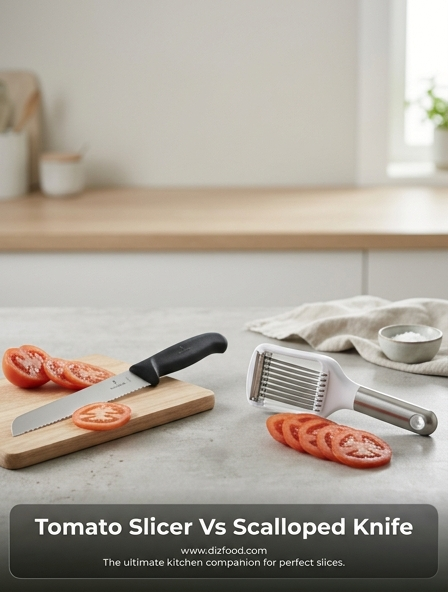
Tomato Slicer vs Scalloped Knife Key Differences
When comparing a dedicated tomato slicer to a standard scalloped knife, the primary distinction lies in the specificity of design versus general-purpose utility. A tomato slicer is a precision instrument engineered specifically to tackle the unique structural challenges of a tomato, which features a slippery, high-tension skin and a soft, high-moisture interior. These tools often feature a very thin blade profile and ultra-fine serrations that allow for micro-trauma to the skin without applying downward pressure that would crush the fruit. In contrast, a scalloped knife, often referred to as a scalloped utility or bread knife, features broader, wavy indentations along the cutting edge. These are designed to reduce friction and prevent sticking when slicing through various textures, ranging from crusty loaves to soft cakes.
| Feature | Tomato Slicer | Scalloped Knife |
|---|---|---|
| Edge Type | Fine-tooth serrations | Wide, wavy scallops |
| Blade Profile | Thin and flexible | Thicker and more rigid |
| Forked Tip | Commonly included | Rarely included |
| Primary Use | Soft-skinned produce | Bread, deli meats, citrus |
The tomato slicer frequently includes a forked tip, a feature almost never found on a scalloped knife. This pronged end is used to lift and move delicate slices after they have been cut, ensuring the presentation remains intact. While both tools utilize a sawing motion rather than a straight-down chop, the tomato slicer's teeth are significantly more aggressive at a microscopic level, ensuring it bites into the wax-like skin of the tomato immediately upon contact.
Understanding the Specialized Tomato Slicer Blade
The specialized tomato slicer is a testament to ergonomic engineering focused on a single ingredient. The blade is typically crafted from high-carbon stainless steel, allowing it to remain extremely thin while maintaining the necessary rigidity for straight cuts. The most defining characteristic of this tool is its microscopic serrations. Unlike the large "teeth" found on a bread knife, these serrations are often so small they are difficult to see with the naked eye, yet they provide the necessary "bite" to penetrate the tomato's skin without the user needing to apply significant force.
- Thin Blade Geometry: Reduces the volume of metal passing through the fruit, which minimizes juice displacement.
- Dual-Pointed Tip: Allows for the easy removal of seeds or the lifting of thin slices for plating.
- Lightweight Construction: Facilitates rapid, repetitive slicing during high-volume meal preparation.
- Flexibility: The blade can often bend slightly, allowing for better control when navigating the curves of the fruit.
Because the tomato is a fruit that is easily bruised, the slicer's blade is designed to glide through the flesh once the initial skin barrier is broken. This prevents the "squishing" effect that occurs when a dull chef's knife is used. The result is a clean, uniform slice that retains its structural integrity and internal juices, which is essential for both flavor and aesthetic appeal in professional and home cooking environments.
The Mechanics of Scalloped Knife Edges
The mechanics of a scalloped edge differ fundamentally from traditional serrations. While serrated edges feature pointed teeth that tear into a surface, scalloped edges consist of rounded, wavy indentations. This design is specifically engineered to reduce the surface area of the blade that comes into contact with the food. By reducing this contact area, the knife experiences significantly less friction and suction, which is particularly useful when cutting through items that tend to stick to the flat side of a blade, such as soft cheeses or moist cakes.
In the context of the kitchen, the scalloped edge acts as a series of miniature arches. Each arch distributes the pressure of the cut more evenly across the length of the blade. This allows the user to maintain a straight line even when cutting through materials with varying densities. For example, when a scalloped utility knife hits a hard crust or a firm skin, the "peaks" of the scallops concentrate the force to break the surface, while the "valleys" allow the blade to pass through with minimal resistance. This makes the tool exceptionally versatile, as it can handle everything from a delicate tomato to a fibrous cured meat or a crusty baguette without requiring a change in technique.
Furthermore, the scalloped design helps preserve the sharpness of the edge. Because the "valleys" of the scallops do not touch the cutting board, those sections of the blade remain sharp for much longer than a straight-edge knife. This makes the scalloped knife a low-maintenance workhorse in busy kitchens where frequent sharpening is not always practical.
Precision Slicing and Tomato Skin Resistance
Precision slicing in the culinary world is often hindered by the physical properties of the ingredient being processed. Tomatoes present a unique challenge because their skin is composed of a tough, waxy cuticle that protects a delicate, gelatinous interior. To achieve a perfect slice, the tool must overcome this skin resistance instantly. Both the tomato slicer and the scalloped knife use a sawing motion to achieve this, but the efficiency of the "first bite" varies between the two.
A tomato slicer excels here because its teeth are designed to snag the wax-like surface of the skin. Once the teeth have pierced the skin, the thinness of the blade ensures that the rest of the cut requires almost no energy. This is vital for creating paper-thin slices for sandwiches or carpaccio-style dishes. If the knife fails to pierce the skin immediately, the pressure from the hand will compress the tomato, causing the internal seed cavities to collapse and the juice to spray out, ruining the texture of the fruit.
The scalloped knife, while effective, requires a slightly longer sawing motion to achieve the same result. Because the scallops are rounded and wider, they do not "grab" the skin with the same immediacy as a serrated tomato slicer. However, once the cut is initiated, the scalloped edge provides a smoother glide through the flesh. Users often find that a scalloped knife is better for thicker wedges, while the tomato slicer is the undisputed king of thin, translucent slices. Understanding this relationship between skin resistance and blade geometry allows a cook to choose the tool that matches their desired final presentation.
Comparing Blade Material and Durability
The longevity and performance of both tomato slicers and scalloped knives are heavily influenced by the materials used in their construction. Most modern versions of these knives are made from various grades of stainless steel, but the specific alloy can vary based on the intended use. High-carbon stainless steel is the gold standard, as it combines the rust resistance of chromium with the edge retention provided by carbon. This is particularly important for tomato tools because tomatoes are highly acidic. Over time, the acid can pit and dull lower-quality steel, making durability a primary concern.
- Corrosion Resistance: Necessary to withstand the high acidity of tomato juices and frequent washing.
- Hardness (Rockwell Scale): A higher HRC (56-58) ensures the fine teeth of a tomato slicer don't bend or break under pressure.
- Edge Retention: Scalloped knives generally stay "functional" longer because their cutting edges are recessed and protected from board contact.
- Ease of Care: Most tomato slicers are designed for utility and are often dishwasher safe, though hand-washing is always recommended to preserve the edge.
Durability in a tomato slicer is often about the resilience of the fine serrations. If these teeth become chipped or folded, the knife becomes effectively useless, as sharpening such fine teeth is difficult. Scalloped knives, on the other hand, are generally more robust. Their thicker spines and larger edge patterns make them less prone to damage when used on harder surfaces or varied food items. While a tomato slicer is a delicate instrument that requires careful storage, a scalloped utility knife can usually handle the rigors of a crowded knife drawer without immediate loss of performance.
Best Use Cases for Scalloped Utility Knives
While the tomato slicer is a "one-trick pony," the scalloped utility knife is one of the most versatile tools in a chef's kit. Its design allows it to bridge the gap between a chef's knife and a paring knife, handling tasks that require more finesse than a large blade but more power than a small one. The scalloped edge is particularly effective for foods that have a "hard-soft" contrast-items with a firm exterior and a squishy interior.
- Citrus Fruits: Perfectly zips through the pith and skin of lemons, limes, and oranges for garnishes.
- Salami and Cured Meats: The scallops prevent the fatty meat from sticking to the blade while cutting through the tough casing.
- Small Breads: Ideal for slicing rolls, bagels, or small baguettes where a full-sized bread knife would be unwieldy.
- Stone Fruits: Great for slicing peaches or plums, where the skin can be surprisingly resilient.
- Soft Cheeses: The reduced surface area of the scallops prevents brie or camembert from clumping on the blade.
The utility of this knife extends to everyday tasks like slicing a sandwich in half or preparing a quick snack. In a home kitchen where drawer space is at a premium, the scalloped utility knife often wins out over a tomato slicer simply because it can be used for twenty different tasks, whereas the tomato slicer is mostly reserved for a single ingredient. For those who do not slice tomatoes daily, the scalloped utility knife provides the most "bang for the buck" while still delivering acceptable performance on soft-skinned produce.
Tomato Slicer vs Scalloped Knife Cutting Performance
When analyzing cutting performance, we must look at the quality of the finish and the effort required by the user. A tomato slicer is designed to produce a "clean" cut with minimal cell wall damage. This is evident by the lack of juice left on the cutting board after the task is finished. Because the blade is so thin, it displaces very little of the tomato's mass as it moves through, leading to a more flavorful result as the juices stay within the slice rather than leaking out.
| Metric | Tomato Slicer Performance | Scalloped Knife Performance |
|---|---|---|
| Skin Penetration | Instantaneous; no slipping. | Requires a small sawing motion. |
| Slice Uniformity | High; thin slices are easy. | Moderate; better for thick slices. |
| Internal Tearing | Minimal; very clean edges. | Slight; scallops can "rip" soft pulp. |
| Speed | Fast for single items. | Fast for variety of items. |
The scalloped knife, by comparison, can sometimes "tear" the internal structure of a very overripe tomato. The wider scallops create more vibration as they pass through the flesh, which can dislodge seeds and create a slightly more ragged edge. However, on firmer tomatoes, the difference is negligible. The scalloped knife excels in speed when the user needs to transition from cutting a tomato to slicing a piece of cheese or a roll for a sandwich, whereas the tomato slicer would struggle with the denser materials. Overall, the tomato slicer wins on pure precision, while the scalloped knife wins on general efficiency and versatility.
Kitchen Safety and Grip Comparison
Safety is a critical consideration when using any serrated or scalloped tool, as these edges can cause jagged wounds that are harder to heal than clean cuts from a straight blade. The safety of a tomato slicer often comes down to its specialized handle and blade length. Most tomato slicers are relatively short, between 4 and 5 inches, which gives the user a high degree of control. The presence of a forked tip also increases safety, as it allows the user to move the food without placing their fingers near the sharp edge of the blade.
Scalloped knives are often slightly longer and feature a more substantial handle. This can be a benefit or a drawback depending on the user's hand size. A larger handle provides a more secure "power grip," which is useful when cutting through tougher skins or rinds. However, the extra length can make the knife feel less precise when dealing with a small cherry tomato. Many scalloped utility knives also feature an offset handle, which keeps the user's knuckles off the cutting board, reducing the risk of scraping and allowing for a more ergonomic cutting motion.
One specific safety advantage of the tomato slicer is the aggressiveness of its teeth. Because it "grabs" the tomato skin instantly, there is less chance of the blade slipping off the round surface of the fruit and striking the user's fingers. A dull scalloped knife, or one with very shallow waves, can occasionally slide off a particularly waxy tomato if the user applies too much pressure. Therefore, maintaining a sharp edge-regardless of the style-is the most important safety factor in the kitchen.
Maintenance and Sharpening Requirements
Maintaining the edge of a serrated or scalloped knife is significantly more complex than maintaining a traditional straight-edge chef's knife. Because the cutting edge is not a single continuous line, standard whetstones cannot be used in the traditional manner. For the tomato slicer, the fine teeth are often too small to be sharpened by the average home cook. Fortunately, these knives are usually inexpensive enough that many users treat them as semi-disposable, replacing them after several years of heavy use.
- Ceramic Honing Rods: A thin ceramic rod can be used to manually sharpen each individual scallop or serration by rubbing the rod through the "valleys."
- Professional Sharpening: Some professional services have specialized equipment to regrind scalloped edges, though this can be costly.
- Single-Sided Grinds: Most tomato slicers are "chisel ground," meaning they are only sharp on one side. This makes it easier to touch up the flat side to remove burrs.
- Proper Storage: Using a magnetic strip or a knife block prevents the teeth from banging against other metal tools, which is the leading cause of dulling.
Scalloped knives tend to hold their "effective" sharpness longer than tomato slicers because the points of the scallops take the brunt of the contact with the cutting board, while the actual cutting arcs remain protected. If a scalloped knife feels dull, it is often because the tips of the scallops have flattened out. A light honing can often restore much of the knife's performance. For the tomato slicer, once the microscopic points are gone, the knife will begin to "push" rather than "cut," indicating it is time for a replacement or a professional sharpening.
Choosing the Best Tool for Your Kitchen
The decision between a tomato slicer and a scalloped utility knife ultimately depends on your culinary habits and the volume of produce you process. If you are a professional chef or a home cook who prepares fresh tomato salads, salsas, or sandwiches on a daily basis, the specialized tomato slicer is an indispensable tool. Its ability to produce consistent, beautiful slices with zero waste and zero effort makes it worth the dedicated drawer space. The forked tip and thin blade offer a level of finesse that a multi-purpose knife simply cannot match.
However, for the minimalist cook or the person who values versatility above all else, the scalloped utility knife is the superior choice. It performs at 80-90% of the efficiency of a tomato slicer while providing the added benefit of being able to cut bread, cheese, citrus, and meat. It is the ultimate "utility player" in the kitchen. If you only have room for one small serrated knife, the scalloped utility knife is the practical winner. It handles the challenges of a tomato skin with ease while remaining useful for the other 90% of your meal prep tasks.
Consider your budget as well. High-end tomato slicers can be expensive specialty items, whereas quality scalloped utility knives are available at every price point and from nearly every major cutlery brand. In many cases, the best solution is actually a hybrid: a high-quality scalloped utility knife for general tasks and a budget-friendly, highly-rated tomato slicer for those occasions when only a perfect, translucent tomato slice will do. By understanding the mechanical differences in their edges, you can ensure your kitchen is equipped for any slicing challenge.

Comments