
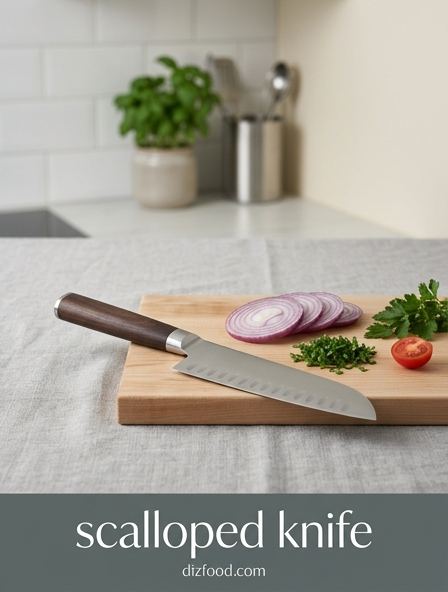
The Science of Scalloped Edges
The scalloped edge, often referred to as a serrated or wavy edge, operates on principles of physics that differ significantly from a straight-edge blade. The primary advantage lies in the geometry of the blade's profile, which consists of a series of "teeth" or arched recesses. These peaks concentrate the force of the cut into a smaller surface area, allowing for higher pressure at the point of contact. This mechanical advantage is crucial when dealing with materials that possess a hard or slippery exterior but a soft interior.
- Point Pressure: The protruding tips of the scallops pierce the surface with minimal downward force.
- Edge Length: The curved nature of the scallops increases the total linear cutting surface compared to a flat blade.
- Sawing Action: The design facilitates a back-and-forth motion that shears through fibers rather than crushing them.
When the blade moves across a food item, the recessed scallops reduce the total surface area touching the food. This reduction in surface contact significantly lowers friction, preventing the blade from dragging or sticking. This is why a scalloped knife remains effective even as it begins to lose its initial factory sharpness, as the protected valleys of the scallops stay sharp longer than the exposed tips.
Perfect Slices for Ripe Tomatoes
The tomato is perhaps the most famous adversary of the dull kitchen knife. Its skin is remarkably resilient and glossy, designed by nature to protect the watery, delicate pulp within. A standard straight-edge knife often fails this test if it is not razor-sharp; instead of biting into the skin, it slides off or requires excessive downward pressure that eventually crushes the internal structure, resulting in a bruised mess and lost juices.
A scalloped knife solves this dilemma through its specialized architecture. The sharp points of the scallops act as microscopic hooks that catch the slick skin of the tomato instantly. Once the skin is breached, the curved sections of the blade glide through the tender flesh without compressing it. This allows the cook to achieve paper-thin slices that retain their circular shape and internal moisture. For the best results, use a light "sawing" motion rather than a hard chop. This technique ensures that the weight of the knife does the work, preserving the aesthetic and textural integrity of the fruit, making it ideal for salads, sandwiches, and garnishes where presentation is paramount.
Preserving Integrity in Soft Produce
Soft produce, ranging from overripe stone fruits like peaches and plums to delicate leafy greens, requires a gentle touch that many knives cannot provide. The challenge with these items is their lack of structural rigidity; any excess force applied during the cutting process results in bruising or "weeping," where the cellular walls collapse and release internal fluids. A scalloped edge acts as a precision instrument in these scenarios, slicing through the outer layers with surgical accuracy.
- Stone Fruits: Easily maneuvers around the pit while maintaining the skin's smoothness.
- Soft Cheeses: Prevents the dense, sticky interior from clinging to the blade.
- Cakes and Pastries: Slices through sponge and cream layers without flattening the airy texture.
By utilizing the valleys of the scalloped edge, air is trapped between the blade and the food, which acts as a natural release mechanism. This is particularly beneficial for produce with high sugar or moisture content, which tend to create a vacuum effect on flat blades. Consequently, the scalloped knife is an essential tool for chefs who prioritize the visual and structural "heirloom" quality of their ingredients, ensuring every slice looks as fresh as the whole fruit.
Beyond Bread: Multi-Purpose Utility
While many home cooks relegate the scalloped knife strictly to the bread box, its utility extends across a vast range of culinary tasks. This tool is often the "hidden gem" of the knife block, capable of handling tasks that would frustrate a traditional chef's knife or a paring knife. Its ability to grip and tear makes it surprisingly efficient for heavy-duty prep and delicate finishing alike. The following table illustrates its versatility across different food categories:
| Food Category | Specific Item | Benefit of Scalloped Edge |
|---|---|---|
| Protein | Roasted Brisket | Slices through crusty bark without tearing meat. |
| Citrus | Lemons/Limes | Grips the oily, waxy zest for clean wedges. |
| Cured Meats | Salami | Powers through tough casings and dense fats. |
| Sweets | Meringue | Cuts through brittle shells without shattering. |
In a professional kitchen, a medium-sized scalloped utility knife is often preferred for "line work," where speed and reliability are key. Whether you are prepping a sandwich with multiple layers or portioning out a delicate tart, the scalloped edge provides a level of grip and consistency that flat blades cannot match.
Precision Cuts Without Extra Pressure
One of the most significant safety and performance benefits of a scalloped knife is the reduction of required downward force. When a cook has to "push" a knife through an ingredient, the risk of the blade slipping increases exponentially. This is the primary cause of kitchen accidents. A scalloped blade, however, is designed to engage the material through lateral movement-the horizontal sawing motion. This motion allows the teeth to do the heavy lifting of breaking the surface tension.
This lack of pressure is particularly advantageous when working with "squishable" items like fresh mozzarella, croissants, or overly ripe avocados. If you were to apply the pressure needed for a straight blade, these items would lose their volume and aesthetic appeal. The scalloped edge allows for a "float" over the cutting board, where the knife moves through the food like a saw through wood. This produces a cleaner exit wound on the bottom of the food item, preventing the "ragged" look often seen when a dull straight knife is forced through. Ultimately, using a scalloped edge is about finesse rather than power, making it a favorite for those who value precise, repeatable results.
Tackling Tough Skins and Soft Interiors
The juxtaposition of a hard exterior and a soft interior is a common theme in the kitchen, found in everything from crusty sourdough to winter squashes. A straight-edged knife often struggles here; it may be too thick to wedge into a pumpkin or too smooth to grip the glassy crust of a baguette. The scalloped knife excels in these "dual-density" environments because it treats the cutting process as two separate phases: the pierce and the glide.
- Phase 1: The Pierce. The sharp tips of the scallops saw into the tough skin, creating a gateway for the rest of the blade.
- Phase 2: The Glide. Once inside the softer center, the scalloped recesses prevent the blade from sticking, allowing for a smooth finish.
This is especially useful for fruits like pineapples and melons. The thick, fibrous rind of a pineapple can quickly dull a standard chef's knife, but the aggressive serrations of a scalloped blade can rip through the fibers with ease. Similarly, for a baguette, the scallops saw through the caramelized crust without compressing the airy crumb inside. This ensures the bread remains fluffy and voluminous, rather than being squeezed into a dense, chewy mass by the weight of the knife.
The Ergonomics of Offset Blades
Many high-quality scalloped knives, particularly those designed for bread or utility work, feature an "offset" design. This means the handle is positioned slightly higher than the blade, creating a "Z" or "L" shape. This ergonomic choice is specifically tailored to the sawing motion required for scalloped edges. By raising the handle, the manufacturer ensures that the cook's knuckles do not make contact with the cutting board before the slice is completed.
This clearance allows for a full, long stroke of the blade, which is essential for maintaining the "sawing" efficiency of the scallops. Without an offset handle, the user is often forced to cut at an awkward angle or stop mid-slice to avoid hitting the board. Furthermore, the offset design provides better leverage, allowing the user to apply more controlled, even weight along the entire length of the blade. This reduces wrist fatigue during repetitive tasks, such as slicing dozens of rolls for a large gathering or prepping a crate of tomatoes for sauce. When combined with a scalloped edge, the offset handle transforms the knife into a high-efficiency tool that prioritizes both the user's comfort and the quality of the final cut.
Reducing Friction for Clean Slices
Friction is the enemy of a clean slice, particularly when dealing with starchy or moist foods. When a flat blade passes through something like a potato or a dense cake, the moisture creates a vacuum, causing the food to "suction" itself to the sides of the knife. This drag makes the cutting process feel heavy and often results in the food tearing or sticking to the blade as it is lifted. Scalloped edges are an ingenious solution to this physical limitation.
The hollowed-out portions of the scallops create air pockets between the blade and the ingredient. These pockets break the vacuum seal, significantly reducing the surface area in contact with the food. This leads to several benefits:
- Uniformity: Slices fall away from the blade easily, allowing for a faster rhythm.
- Clarity: The surface of the food remains smooth and un-marred by "drag marks."
- Ease: The user feels less resistance, making the knife feel sharper than it actually is.
This reduction in friction is the reason why scalloped knives are often the preferred choice for slicing delicate smoked salmon or fatty meats. The blade glides through the fats and proteins without the "snagging" that occurs with a standard flat-ground edge, ensuring a professional, translucent finish.
Essential Maintenance for Serrated Tools
A common misconception is that scalloped or serrated knives cannot be sharpened and should be discarded once they become dull. While it is true that they do not require sharpening as frequently as straight-edge knives, they do eventually need maintenance to perform at their peak. Because the cutting edge is composed of multiple curves, a standard flat whetstone is not the appropriate tool for the job. Instead, maintenance requires a specialized approach to reach the interior of the scallops.
- Ceramic Honing Rods: Use a thin, tapered ceramic rod that fits into the individual grooves of the scallops.
- Single-Side Sharpening: Most scalloped knives are "chisel-ground," meaning they are only sharpened on one side. Work each scallop individually on the beveled side.
- Burr Removal: After sharpening the grooves, lightly run the flat side of the knife over a fine stone to remove any metal burrs.
- Proper Storage: Store in a knife block or on a magnetic strip to prevent the delicate tips from chipping against other metal utensils.
Regularly cleaning the knife by hand rather than in a dishwasher will also preserve the temper of the steel and the integrity of the handle. By following these steps, a quality scalloped knife can remain a functional part of your kitchen arsenal for decades.
Selecting the Right Scallop Depth
Not all scalloped edges are created equal. The depth, frequency, and shape of the scallops determine how the knife will interact with different textures. When shopping for a scalloped knife, it is important to match the blade's "aggressiveness" to the tasks you perform most often. Deep, pointed scallops are designed for heavy-duty work, while shallow, rounded scallops are intended for more delicate applications. Choosing the wrong depth can lead to shredded food or a knife that fails to grip.
| Scallop Type | Visual Characteristic | Best Application |
|---|---|---|
| Deep/Pointed | Sharp, saw-like teeth. | Hard-crusted breads, thick-skinned squash, pineapple. |
| Shallow/Rounded | Gentle waves or "scallops." | Soft cakes, ripe tomatoes, deli meats. |
| Micro-Serrated | Tiny, almost invisible teeth. | Fine herbs, steak knives, soft-skinned fruits. |
For a versatile "all-arounder," look for a medium-depth scallop with a rounded profile. This provides enough "bite" for a crusty sourdough but is gentle enough not to tear through a delicate sponge cake. Consider also the "pitch" or the distance between the scallops; a wider pitch allows for faster cutting in large items, while a narrow pitch offers more precision for small, intricate tasks.

Comments