
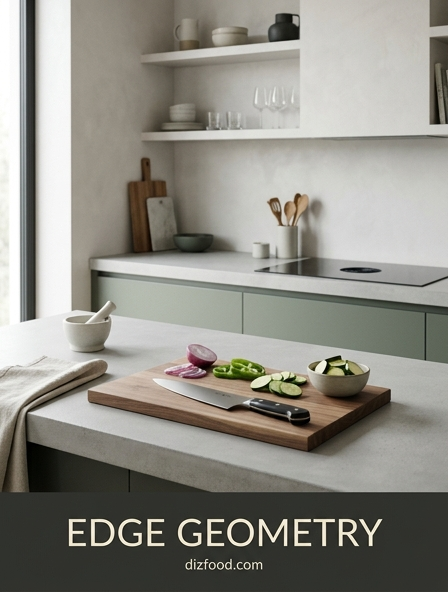
The Fundamentals of Blade Edge Angles
The performance of a kitchen knife is largely dictated by the angle at which the two sides of the blade meet to form the apex. This measurement, often expressed as degrees per side (DPS), determines the balance between keenness and structural integrity. In general, a narrower angle creates a sharper, more delicate edge capable of effortless penetration, while a wider angle provides the robustness needed for heavy-duty tasks.
- 10-15 Degrees: Common for Japanese knives, providing extreme precision for delicate proteins and vegetables.
- 15-20 Degrees: The standard for modern Western knives, offering a balance of sharpness and durability for general utility.
- 20-25 Degrees: Found on heavy cleavers and outdoor tools, prioritized for high-impact resistance.
When selecting a geometry, the chef must consider the density of the food and the hardness of the steel. A very acute angle on soft steel will roll or dull rapidly, whereas the same angle on high-hardness steel can chip if it strikes a bone or a hard cutting board. Understanding these fundamentals allows for better tool selection based on the specific requirements of the culinary prep work at hand.
Single Bevel versus Double Bevel Designs
The distinction between single and double bevel designs is central to traditional cutlery. Double bevel knives, ubiquitous in Western kitchens, are ground on both sides to form a symmetrical "V" shape. This makes them versatile, easy to control, and suitable for both left- and right-handed users. Conversely, single bevel knives are ground on only one side, while the back remains flat or slightly concave, a design highly prevalent in Japanese cuisine.
| Feature | Double Bevel | Single Bevel |
|---|---|---|
| Symmetry | Equal grinds on both sides | Asymmetrical; one flat side |
| Control | Predictable, straight paths | Requires skill to manage "steering" |
| Precision | Good for general tasks | Superior for paper-thin slicing |
Single bevel blades, such as the Yanagiba or Deba, excel at specific tasks because the flat back allows the blade to glide against the food, producing a cleaner surface. However, they naturally "steer" or pull to one side during a cut, necessitating a specific technique to achieve straight results. Double bevel blades remain the preference for general-purpose slicing and chopping due to their intuitive tracking.
Impact of Taper on Slicing Resistance
While the edge angle is critical, the overall taper of the blade-extending from the spine to the edge and from the bolster to the tip-significantly influences slicing resistance. A distal taper refers to the thinning of the blade as it reaches the point. This improves the knife's balance and allows the tip to perform intricate work with minimal drag. Without a proper distal taper, a blade can feel "front-heavy" and clumsy during fine dicing.
The cross-sectional taper, or the primary grind, dictates how the blade moves through dense materials like potatoes or carrots. A blade that remains thick too close to the edge will suffer from "wedging," where the food is forced apart rather than sliced. This mechanical resistance can be more detrimental to performance than a dull apex. Advanced makers often employ a distal taper combined with a thin primary grind to ensure that the blade encounters the least amount of surface friction possible, resulting in a "laser-like" cutting experience that requires minimal physical effort from the cook.
The Relationship Between Geometry and Sharpness
True cutting performance is the product of both apex keenness and the geometry immediately behind the edge. A knife may be sharpened to a mirror polish, but if the steel behind the edge is too thick, it will perform poorly in dense ingredients. This concept is often referred to as being "thin behind the edge." Ideally, the transition from the cutting apex to the primary grind should be smooth and gradual to facilitate deep penetration.
- Apex Keenness: The actual radius of the edge at a microscopic level.
- Shoulder Transition: The area where the edge bevel meets the blade face.
- Primary Grind: The overall shape of the blade sides.
When these geometric factors are optimized, the knife feels effortlessly sharp. Sharpness is frequently a perception of how easily the blade initiates a cut, but the geometry determines how the blade continues through the material. A well-designed blade with slightly less refined steel will often outperform a perfectly sharpened blade with poor geometry, highlighting the importance of the cross-sectional profile in professional culinary tools.
Convex Edges for Enhanced Durability
The convex edge, often referred to as the "Hamaguriba" or appleseed grind, is a geometry where the blade tapers to the edge in a gentle outward curve. Unlike a flat V-bevel, the convex shape places more steel directly behind the apex. This provides significant reinforcement, making the edge less prone to chipping or rolling under heavy use. It is a favorite among professional chefs who require a blend of extreme sharpness and long-term resilience.
Beyond durability, the convex geometry excels in food release. Because the surface of the blade is curved, it creates less surface tension between the metal and the food being sliced. As the blade passes through an ingredient, the outward curve helps to push the slice away from the blade face, preventing the "suction" effect commonly found on flat-ground knives. Although convex edges are more difficult to maintain and require specialized sharpening techniques, such as using a slack belt or a stropping motion on stones, their performance benefits in a high-volume kitchen are considerable.
Balancing Edge Thickness and Cutting Precision
The thickness of a blade directly affects its precision and structural stability. In the world of high-end cutlery, "lasers" are knives ground exceptionally thin, allowing them to pass through firm vegetables with almost zero resistance. However, this extreme thinness comes at the cost of fragility; such blades can easily warp or chip if they encounter bone or frozen items. Conversely, a "workhorse" grind is thicker at the spine and behind the edge, providing the weight and strength needed for demanding prep work.
- Measure the thickness at the spine to determine the blade's overall stiffness.
- Check the thickness approximately 1mm above the edge to gauge "behind the edge" performance.
- Evaluate the weight distribution to ensure the thickness doesn't compromise the knife's balance.
Finding the right balance depends on the user's technique and the specific ingredients. A precision-oriented chef may prefer a thin geometry for decorative garnishes, while a butcher requires a thicker geometry to withstand the lateral forces involved in jointing. Mastering the balance between these two extremes ensures the tool remains effective without becoming a liability.
How Blade Profile Influences Food Release
Food release is a critical aspect of edge geometry that determines how easily sliced ingredients fall away from the blade. When a blade is perfectly flat, moisture in vegetables like potatoes or cucumbers creates a vacuum effect, causing slices to stick stubbornly to the side of the knife. This slows down the chopping process and can be a safety hazard. Geometry is the primary solution to this common kitchen frustration.
Various geometric features are employed to break this surface tension. For example, an S-grind features a hollowed-out section in the middle of the blade face, reducing the contact area between the food and the steel. Similarly, Kullenschliff (Granton) edges utilize small indentations to trap air between the blade and the food. However, many experts argue that a continuous convex grind is the most effective method, as it uses the physical shape of the blade to pry the food away. By manipulating the geometry of the blade faces, makers can create a knife that not only cuts well but also clears the "traffic" of food efficiently.
Optimizing Geometry for Specific Culinary Tasks
No single geometry is perfect for every task in the kitchen. Different ingredients and techniques demand specific blade shapes and edge configurations to maximize efficiency and safety. A knife designed for fine herbs would be woefully inadequate for breaking down a winter squash, and a tool meant for heavy butchery would fail at the delicate task of peeling a grape.
| Task | Ideal Geometry | Key Benefit |
|---|---|---|
| Vegetable Slicing | Thin, flat primary grind | Reduces wedging in hard roots |
| Butchery/Boning | Thick spine, stiff taper | Resists twisting and lateral stress |
| Sashimi | Single bevel, hollow back | Protects delicate cellular structure |
| General Chopping | Moderate convex grind | Combines durability with food release |
By tailoring the geometry to the task, the chef minimizes fatigue and reduces the risk of damaging the tool. Professional kitchens often employ a kit of knives with varying geometries, ensuring that the right level of precision and power is available for each step of the preparation process.
The Role of Steel Hardness in Edge Retention
The geometry of a knife is only as stable as the steel it is made from. Steel hardness, measured on the Rockwell C scale (HRC), dictates how well a specific edge angle will hold up over time. Harder steels (60+ HRC) can support more acute angles because they have higher compressive strength, which prevents the apex from deforming. This allows for the high-performance geometries found in premium Japanese cutlery.
- Soft Steels (54-56 HRC): Tough and easy to sharpen, but require wider angles (20 degrees) to avoid rolling.
- Medium Steels (57-59 HRC): Standard for professional Western knives, supporting 15-18 degree angles.
- Hard Steels (60-64+ HRC): Can sustain 10-12 degree angles but are more prone to brittle chipping.
However, hardness must be balanced with toughness. If a steel is too hard and the geometry is too thin, the edge becomes brittle. The goal of modern metallurgy is to create steels that can support thin, high-performance geometries without being so fragile that they fail during normal kitchen use. Geometric integrity is thus a marriage of shape and material science.
Maintaining Geometric Integrity Through Sharpening
Sharpening a knife involves more than just refining the apex; it requires maintaining the overall geometry of the blade. Over time, as a knife is repeatedly sharpened, the metal at the edge is removed, and the "behind the edge" section becomes progressively thicker. If the user only sharpens the secondary bevel, the knife will eventually lose its ability to move through food efficiently, even if the edge feels sharp to the touch.
- Thinning: Periodically grinding the primary bevel to keep the blade thin behind the edge.
- Angle Consistency: Maintaining the same DPS to ensure predictable cutting performance.
- Refining: Using progressive grits to remove the burr without rounding the apex.
Proper maintenance involves "thinning" the shoulders of the knife to restore the original factory geometry. This ensures that the taper remains optimal throughout the life of the tool. Neglecting this aspect of maintenance leads to a knife that feels like a wedge. By understanding the three-dimensional nature of the blade, a sharpener can preserve the intended performance characteristics of a high-quality kitchen knife for decades.


Comments