
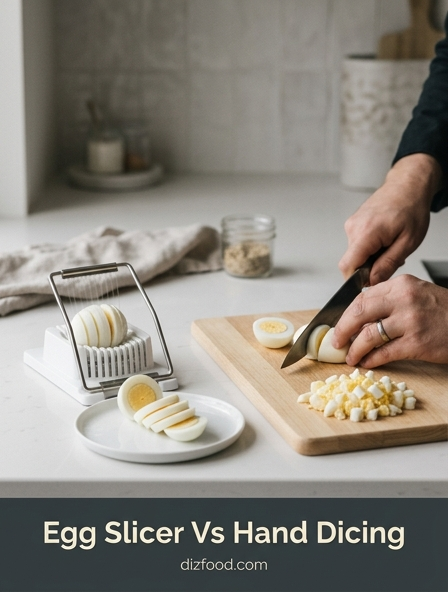
Tired of uneven egg wedges ruining your gourmet salads? Whether you're a home cook or a meal prep pro, the battle between the trusty egg slicer and traditional hand dicing is all about precision and speed. While a chef's knife offers versatility, nothing beats the mechanical consistency of an egg slicer for achieving those paper-thin, perfectly uniform rounds in just seconds. By ditching the manual struggle, you not only elevate your food presentation to a professional level but also save precious time during busy kitchen rushes, making it the ultimate secret weapon for flawlessly topped avocado toasts and classic Cobb salads.
| Feature | Egg Slicer | Hand Dicing |
|---|---|---|
| Speed | Instant (approx. 1 second) | Slow (20-40 seconds per egg) |
| Uniformity | 100% Identical thickness | Variable / Human error prone |
| Safety | High; fingers away from blades | Moderate; risk of knife slips |
| Versatility | Soft foods (mushrooms, strawberries) | Universal (all textures/sizes) |
| Skill Level | Zero; beginner-friendly | Requires developed knife skills |
| Cleanup | Single unit; dishwasher safe | Cutting board + knife sanitization |
Efficiency and Speed Comparison
When evaluating efficiency in the kitchen, the battle between the egg slicer and the chef's knife often comes down to volume and repetition. For a single hard-boiled egg, the difference in speed is negligible; however, when preparing a large batch of egg salad or garnishing several plates for a brunch gathering, the egg slicer becomes an undisputed champion of time management. The mechanical action of pushing a series of taut wires through a soft-boiled medium takes less than a second, whereas hand dicing requires a stable surface, careful positioning, and multiple controlled strokes with a blade.
Efficiency isn't just about the cutting action; it's about the preparation and transition times. A slicer requires no specialized grip or "claw" technique to protect fingers, allowing the user to process eggs in a rhythmic, rapid-fire fashion. When dicing by hand, a cook must pause to clear the blade of sticky yolk residue and reorganize the pile of slices before rotating them for the cross-cut. In a professional or high-output home environment, those extra seconds per egg accumulate into minutes of saved labor. However, for a professional chef with high-level knife skills, the "rocking" motion of a knife can be remarkably fast, though it rarely matches the instantaneous result of a dedicated mechanical press.
- Single-press action vs. multi-stroke dicing.
- Reduced downtime between individual items.
- Less frequent need to wipe the cutting surface.
- Minimal setup required for immediate use.
Precision and Uniformity Standards
The standard of precision in culinary arts is often defined by the uniformity of the cut, which ensures even texture and professional aesthetics. The egg slicer provides a mechanical guarantee of thickness that is difficult to replicate by hand without extreme concentration. Each wire is spaced at an exact interval, typically ranging from 3mm to 5mm, ensuring that every slice is a carbon copy of the last. This level of standardization is particularly crucial for layering eggs on sandwiches or arranging them in a fan shape atop a Cobb salad, where visual consistency is as important as taste.
Hand dicing, while offering more flexibility in size, is subject to human error and the physical properties of the egg. Hard-boiled eggs are notoriously slippery and fragile; the yolk can easily crumble or separate from the white if the knife pressure is uneven. While a skilled cook can achieve beautiful dice, the mechanical slicer eliminates variables such as blade angle and hand-eye coordination. To achieve a "dice" with a slicer, one simply slices once, rotates the egg ninety degrees, and slices again. This two-step process yields perfect cubes that look identical, a feat that would take significantly longer to achieve with a manual blade and a ruler-like focus.
- Fixed wire intervals ensure identical thickness.
- Elimination of human error in measurement.
- Consistent depth and clean edges through the yolk.
- Uniformity in bulk production for catering.
Versatility for Other Ingredients
The primary argument against the egg slicer is its status as a "unitasker," a term popularized by kitchen critics to describe tools with limited utility. While the name suggests a single purpose, the slicer can handle various soft foods. However, it pale in comparison to the universal versatility of a high-quality chef's knife. A knife is the foundational tool of the kitchen, capable of breaking down everything from dense root vegetables to delicate herbs. The egg slicer is physically limited by its wire tension and frame size, meaning it cannot process hard, large, or fibrous ingredients without risking permanent damage to the tool.
| Ingredient | Egg Slicer Capability | Hand Dicing Capability |
|---|---|---|
| Mushrooms | Excellent for soft varieties | Universal application |
| Strawberries | Perfectly even slices | Variable shapes/sizes |
| Potatoes | Only if very well-boiled | Raw or cooked; any style |
| Avocados | Works for firm-ripe fruit | Standard method |
| Onions | Not possible; too dense | Essential kitchen task |
Despite its limitations, the slicer excels at specific tasks that are tedious with a knife. Slicing button mushrooms for a pizza or strawberries for a tart can be done in seconds with a slicer, yielding a level of thinness and regularity that makes the final dish look professionally prepared. Nevertheless, the knife remains the superior choice for any ingredient that requires peeling, de-seeding, or heavy-duty chopping.
Safety Benefits of Egg Slicers
Safety is a paramount concern in the kitchen, especially in households with children or for individuals with limited manual dexterity. The egg slicer represents a significant safety upgrade over the traditional knife because it utilizes thin wires rather than a sharpened steel edge. While these wires are capable of cutting through soft foods, they are generally not sharp enough to cause deep lacerations to the skin under normal operation. Furthermore, the design of most slicers keeps the fingers away from the cutting zone during the pressing motion, whereas hand dicing requires the non-dominant hand to be in close proximity to a moving blade.
For elderly cooks or those with conditions like arthritis, the egg slicer offers a low-impact alternative to the gripping and downward pressure required for knife work. The ergonomic motion of pressing a lever involves larger muscle groups and less fine motor control, reducing the risk of slips or repetitive strain. Additionally, the stability provided by the slicer's base prevents the "rolling" effect often encountered when trying to dice a round, slippery egg on a flat cutting board. By removing the need for high-stakes blade control, the slicer creates a more relaxed and accessible cooking environment for a wider range of users.
Ease of Cleaning and Storage
The convenience of a kitchen tool is often judged by the effort required to clean it after the work is done. Here, the knife and cutting board often have the advantage of simplicity. A knife has flat, smooth surfaces that can be wiped clean in seconds, and a cutting board can be easily scrubbed or tossed in the dishwasher. In contrast, the egg slicer features multiple thin wires and a slotted base where bits of yolk and white can become trapped. If the egg residue is allowed to dry, cleaning a slicer becomes a tedious task requiring a brush to reach into the crevices and between the wires.
From a storage perspective, the egg slicer is a small, lightweight gadget that can fit into almost any utensil drawer. However, it does take up "real estate" that some minimalist cooks might prefer to save for more versatile tools. A knife, meanwhile, is usually kept on a magnetic strip or in a block, occupying space that is already dedicated to essential equipment. While the slicer is compact, the accumulation of several such task-specific gadgets can lead to cluttered drawers. For those who prioritize a streamlined kitchen, the ability to perform the same task with a tool already on the counter-the knife-often outweighs the minor speed benefits of the slicer.
Visual Presentation in Recipes
Visual appeal is a core component of the dining experience, and the method of cutting can drastically alter the appearance of a dish. For salads like the Niçoise or a classic Spinach salad, the egg slicer produces elegant, translucent rounds that showcase the vibrant yellow of the yolk against the stark white of the albumin. These clean lines are difficult to achieve with a knife, which can often smear the yolk across the white or cause the egg to crumble if the blade isn't perfectly sharp or moistened. The mechanical slicer ensures that each piece has a smooth, unmarred surface, reflecting light and looking "picture perfect."
When it comes to dicing for inclusions-such as in a potato salad or a creamy egg spread-hand dicing offers a more "rustic" and artisanal look. Hand-cut pieces have slight variations in size that can provide a more interesting mouthfeel and a homemade aesthetic. However, for formal presentations or catering where consistency is the hallmark of quality, the precision of the slicer is usually preferred. The slicer's ability to create cross-hatched cubes or perfectly symmetrical wedges allows for geometric plating designs that are highly valued in modern food photography and high-end restaurant service.
Manual Control and Skill Level
The use of a chef's knife is a foundational skill that most culinary enthusiasts strive to master. Hand dicing an egg allows for a level of tactile feedback and adjustment that a machine cannot provide. A cook can feel the resistance of the egg, adjusting the pressure to accommodate a slightly softer yolk or a firmer white. This manual control also allows for customization of the dice size; one can choose between a fine "brunoise" for a delicate garnish or a large, chunky "paysanne" for a hearty salad. The knife user is not bound by the fixed dimensions of a wire frame, making the knife a more creative and responsive tool.
Conversely, the egg slicer requires zero skill to operate effectively. It is an "equalizer" in the kitchen, allowing a novice to produce results that look identical to those of a seasoned professional. While this lacks the satisfaction of displaying knife mastery, it removes the barrier to entry for complex-looking dishes. For the experienced cook, the choice often depends on the goal: if the task is an exercise in craft and mindfulness, the knife is preferred. If the task is a hurdle to be cleared as quickly as possible during a busy meal prep session, the mechanical simplicity of the slicer is an attractive shortcut that requires no mental fatigue or physical precision.
Durability of Kitchen Tools
When investing in kitchenware, durability is a key factor in determining long-term value. A high-quality, forged steel chef's knife is a lifetime investment. With proper sharpening and maintenance, it can last for decades, becoming an extension of the cook's hand. The knife has no moving parts or delicate components that are prone to failure. Even if the edge becomes dull, it can be honed and sharpened back to its original state, making it a remarkably resilient tool that survives the rigors of a professional kitchen environment.
Egg slicers, on the other hand, are generally considered "consumable" kitchen gadgets. Most are constructed from plastic or light-duty aluminum with thin stainless steel wires. Over time, these wires can stretch, lose their tension, or even snap if used on an ingredient that is too firm. Once a wire breaks, the entire unit is usually rendered useless, as they are rarely designed to be repaired. While heavy-duty commercial slicers made of cast metal exist, they are significantly more expensive and still rely on the integrity of thin wires. For the home cook, a slicer might last a few years of occasional use, but it will never match the multi-generational lifespan of a well-made blade.
- Knife: Lifetime durability with no moving parts.
- Slicer: Prone to wire breakage and tension loss.
- Maintenance: Knives require sharpening; slicers cannot be fixed.
- Material: Forged steel vs. plastic or thin aluminum.
Cost Effectiveness for Home Cooks
The cost-benefit analysis of an egg slicer versus a knife depends on how one views kitchen utility. An egg slicer is an extremely affordable tool, often priced between $5 and $15. For this small investment, a cook gains a significant advantage in speed and uniformity for specific tasks. If a household consumes hard-boiled eggs frequently-perhaps as a primary protein source or in weekly meal preps-the slicer pays for itself in labor-saving very quickly. It is a low-risk purchase that adds a specific functionality to the kitchen arsenal without breaking the budget.
| Factor | Egg Slicer | Chef's Knife |
|---|---|---|
| Initial Cost | Low ($5-$20) | High ($50-$200+) |
| Versatility | Low (Soft foods only) | High (Almost all foods) |
| Longevity | Short to Medium | Long (Decades) |
| Cost Per Use | High if rarely used | Very Low (Daily use) |
However, from a broader perspective, the knife is more cost-effective because it eliminates the need for dozens of other gadgets. A cook who invests in a single high-quality knife does not need a strawberry huller, a mushroom slicer, or a specialized egg dicer. While the upfront cost of a premium knife is significantly higher, its ability to perform the work of twenty different "unitaskers" makes it the more economical choice for the serious cook. The egg slicer remains a luxury of convenience rather than a financial necessity.
The Best Method for Meal Prep
In the context of meal prep-the practice of preparing large quantities of food in advance-the egg slicer is the clear winner for most users. Meal prep is defined by the need for speed, consistency, and the minimization of effort. When processing a dozen eggs for a week's worth of lunches, the repetitive nature of hand dicing can become a chore that discourages the habit. The slicer turns a ten-minute task into a two-minute task, allowing the cook to move on to more complex elements of the meal. The uniform cubes produced by the slicer also pack more efficiently into storage containers and maintain their texture better when mixed with dressings.
That said, the "best" method ultimately depends on the specific dish being prepared. If the meal prep involves a variety of vegetables that already require the use of a cutting board and knife, it may be faster to simply dice the eggs while the equipment is already out, rather than dirtying an additional tool. However, if the eggs are the primary focus of the prep, the slicer's ability to deliver professional-grade results with zero skill requirement makes it an invaluable asset. For the modern home cook balancing a busy schedule, the egg slicer provides a mechanical advantage that simplifies healthy eating and ensures that the final result looks as good as it tastes.

Comments