
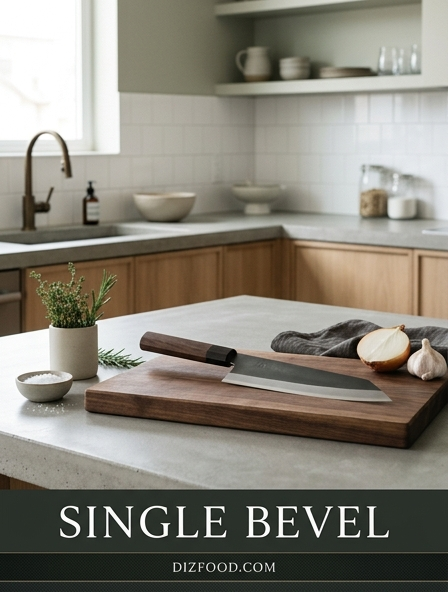
Understanding Single Bevel Blade Geometry
The single bevel blade, traditionally known as a "kataba" in Japanese cutlery, is defined by its asymmetrical cross-section. Unlike common Western knives, these tools are sharpened only on one side, creating an incredibly acute edge. The front face, or "omote," features a distinct secondary grind called the "shinogi" line, while the back side, or "ura," is slightly concave. This hollow-ground back, known as "urasuki," creates an air pocket that reduces friction and prevents food from sticking to the metal during high-precision tasks.
This unique geometry is designed for specialized culinary applications, particularly in traditional Japanese cuisine. The extreme sharpness allows the blade to pass through delicate proteins without crushing cell walls, preserving the flavor and texture of the ingredients. However, the asymmetry causes the blade to naturally steer to one side during a cut, a phenomenon that requires significant skill and practice to compensate for. Because of this design, single bevel knives are manufactured specifically for either right-handed or left-handed users, as the bevel must face the direction of the cut.
- Omote: The beveled front side of the blade.
- Urasuki: The concave back that minimizes drag.
- Shinogi: The ridge line where the blade tapers toward the edge.
The Versatility of Double Bevel Edges
Double bevel edges are the standard for most global kitchen tasks, found in everything from the German chef's knife to the Japanese Santoku and Gyuto. These blades are ground symmetrically on both sides, typically at an angle between 15 and 20 degrees per side. This V-shaped profile provides a neutral balance, allowing the knife to travel straight through ingredients without the lateral drift associated with single bevel tools. This predictability makes them the preferred choice for general-purpose prep work, including dicing onions, chopping herbs, and slicing various meats.
The structural integrity of a double bevel edge is generally higher than its single-sided counterpart. By distributing the cutting force across two balanced planes, the edge is less prone to chipping or rolling when encountering denser materials like squash or crusty bread. For professional chefs and home cooks alike, the double bevel offers an intuitive user experience. It does not require the specialized hand positioning or "steering" techniques necessary for Japanese traditional blades, making it the most efficient option for high-volume kitchen environments where speed and versatility are prioritized over extreme specialized precision.
Essential Japanese Knife Slicing Techniques
Mastering traditional Japanese knives requires a departure from the "rocking" motion common in Western kitchens. Instead, these knives are utilized with specific linear movements that take advantage of their specialized geometry. When using a single bevel Yanagiba for sashimi, the goal is to make a single, continuous pull stroke. This ensures a clean surface area on the fish, which is critical for both presentation and taste. Because the blade is so sharp, minimal downward pressure is required; the weight of the knife and the length of the stroke do the work.
- Pull Cut (Hikigiri): Starting from the heel and pulling toward the tip in one fluid motion.
- Push Cut (Pushing): Moving the blade forward and down to slice through vegetables with an Usuba.
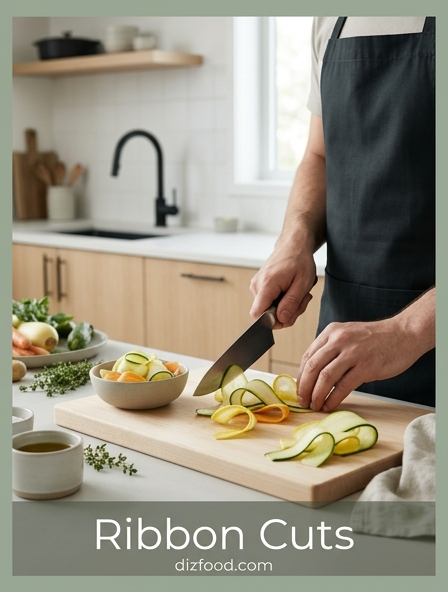
- Katsuramuki: A specialized technique for peeling vegetables into translucent, paper-thin sheets.
These techniques emphasize the preservation of the ingredient's integrity. By avoiding a sawing motion, the chef prevents the tearing of fibers, which is especially important when preparing raw fish or crisp vegetables for garnish. Consistent practice of these strokes leads to a meditative rhythm in the kitchen.
Comparing Chisel Grinds and V-Edges
The choice between a chisel grind (single bevel) and a V-edge (double bevel) depends largely on the level of precision required and the specific ingredient being handled. While both styles have their merits, they serve fundamentally different functions in the culinary arts. The chisel grind is favored for its ability to produce incredibly thin, clean slices, whereas the V-edge is prized for its durability and ease of use in diverse tasks.
| Feature | Chisel Grind (Single) | V-Edge (Double) |
|---|---|---|
| Primary Use | Precision Slicing/Sashimi | General Prep/Chopping |
| Edge Angle | Very Acute (10-12°) | Moderate (15-20°) |
| Ease of Use | High Learning Curve | Intuitive/Symmetrical |
| Maintenance | Specialized Whetstones | Standard Sharpening |
A chisel grind allows the chef to get closer to the product, such as when removing skin from a fillet or creating decorative vegetable garnishes. However, the V-edge remains the workhorse of the kitchen. It can handle a variety of angles and pressures without the risk of the edge failing under the stress of heavy impact or twisting movements.
Achieving Surgical Precision with Single Bevels
The primary advantage of a single bevel knife lies in its ability to achieve "surgical" precision. In professional Japanese kitchens, tools like the Usuba (vegetable knife) and Yanagiba (sashimi knife) are indispensable for this reason. The flat back of the blade allows it to glide perfectly against the knuckles or a guide, while the incredibly thin edge creates a separation so clean that the cells of the food remain intact. This is why a piece of fish cut with a high-quality single bevel knife often has a glossy, reflective sheen; the surface is so smooth it reflects light.
This precision is not merely for aesthetics; it significantly impacts the flavor profile of the dish. When cell walls are cleanly sliced rather than crushed, the release of enzymes and bitter compounds is minimized. For instance, an onion sliced with a single bevel Usuba will stay fresh longer and taste sweeter than one crushed by a dull or thick-edged blade. This level of refinement is what separates professional-grade culinary preparation from standard home cooking, turning simple ingredients into elevated culinary experiences through superior mechanical separation.
Daily Prep Efficiency with Double Bevels
While specialized knives have their place, the double bevel knife is the undisputed king of daily kitchen efficiency. Its symmetrical design allows the cook to switch between different types of cuts-such as julienne, dice, and chiffonade-without adjusting for the lateral pull of a single bevel. This speed is essential in a fast-paced "mise en place" environment where a chef must process pounds of produce in a limited timeframe. The double bevel's versatility also means fewer tool changes are necessary during a shift.
Maintenance and durability further contribute to its efficiency. Most double bevel knives are made from steels that strike a balance between hardness and toughness. This means they can withstand the rigors of a commercial kitchen, including accidental contact with bones or hard cutting boards, better than the more brittle single bevel blades. Furthermore, they are easier to hone on a ceramic rod during service, ensuring the edge remains functional throughout the day.
- Ambidextrous: Can be used by anyone on the line regardless of dominant hand.
- Predictable: Follows a straight vertical path through the ingredient.
- Resilient: Higher edge stability for heavy-duty vegetable prep.
Sharpening Strategies for Bevel Consistency
Maintaining a single bevel knife is a sophisticated process that involves more than just creating a sharp edge; it involves preserving the complex geometry of the blade. Sharpening starts on the "omote" (the beveled side) by laying the primary bevel flat against the whetstone. The goal is to maintain the original factory angle and the position of the "shinogi" line. A progression of stones is used, typically starting from a 1000-grit for setting the edge and moving up to 6000 or 8000-grit for a polished, mirror-like finish.
The "ura" (the back side) requires a different approach called "uraoshi." Because this side is concave, only the edges of the perimeter touch the stone. To sharpen it, the blade is laid completely flat on a high-grit finishing stone and moved lightly to remove the burr created by sharpening the front side.
- Soaking: Ensure whetstones are fully saturated before use.
- Angle Consistency: Use finger pressure to keep the bevel flat against the stone.
- Deburring: Gently flip the knife to the flat side to remove the wire edge.
- Stropping: Use leather or balsa to refine the microscopic apex.
Optimal Blade Angles for Professional Slicing
The angle at which a blade is sharpened dictates the balance between sharpness and durability. In the world of high-end cutlery, these angles are measured with precision. Single bevel knives boast the most aggressive angles, often honed to a total inclusive angle of 10 to 15 degrees. This creates a razor-like edge capable of effortless penetration. In contrast, double bevel knives are typically sharpened to 15 degrees per side, resulting in a 30-degree inclusive angle, which provides the necessary support for the edge during high-impact tasks.
| Knife Type | Bevel Type | Standard Angle |
|---|---|---|
| Yanagiba | Single | 10° - 12° |
| Usuba | Single | 11° - 14° |
| Gyuto | Double | 15° per side |
| Western Chef | Double | 20° per side |
Professionals often customize these angles based on the specific steel type and the tasks at hand. A harder steel (62+ HRC) can support a more acute angle without folding, whereas a softer steel requires a steeper, more obtuse angle to maintain its integrity over time. Choosing the right angle is a calculated decision involving the physics of cutting and the metallurgy of the tool.
Material Science of Premium Kitchen Steels
The performance of a beveled edge is deeply rooted in the metallurgy of the blade. High-end Japanese knives often utilize carbon steels like Shirogami (White Steel) or Aogami (Blue Steel). White steel is prized for its purity and ability to take an incredibly fine edge, making it the preferred choice for single bevel sashimi knives. Blue steel, which contains added tungsten and chromium, offers better edge retention and slightly more corrosion resistance, making it suitable for both single and double bevel applications where longevity is key.
Modern stainless steels, such as VG-10 or SG2 (powdered steel), have also become popular. These materials offer high Rockwell hardness (HRC) while remaining resistant to rust and staining. The choice of steel impacts how the bevel reacts to sharpening and use.
- High Carbon: Easiest to sharpen but prone to oxidation and patina.
- Powdered Metallurgy: Provides extreme hardness and long-lasting sharpness.
- Cladding: Soft iron or stainless steel layers protecting a hard core (San Mai).
Mastering the Push and Pull Stroke
The efficiency of a kitchen knife is fully realized only when the user masters the fundamental strokes: the push and the pull. The pull stroke is the hallmark of the single bevel Yanagiba. By utilizing the entire length of the blade, the chef minimizes downward force, allowing the sharpness of the edge to glide through proteins. This is essential for maintaining the delicate fats in fish like Toro. The motion should be fluid, starting at the heel and finishing at the tip, ensuring the slice is completed in one singular pass.
Conversely, the push stroke is often used with double bevel knives or the single bevel Usuba for vegetables. In this motion, the knife moves forward and down simultaneously. For a double bevel Gyuto, this might involve a slight rocking motion, whereas the Usuba stays parallel to the board. Mastering these strokes prevents "accordion" cuts-where pieces of food remain attached at the bottom-and ensures that the edge remains in contact with the board for the shortest time possible, preserving the sharpness of the bevel for a longer duration of the prep shift.


Comments