
Elevating your culinary game begins with mastering the precision of French knife skills, specifically the classic debate between the Julienne and the Batonnet cut. While both techniques transform vegetables into uniform sticks to ensure even cooking and a professional aesthetic, they serve very different roles on your plate. The Julienne, often called the "matchstick" cut, creates delicate 1/8-inch strips perfect for quick sautés or raw garnishes that melt in your mouth. In contrast, the Batonnet-meaning "little stick"-is the sturdy foundation of knife work, measuring 1/4-inch thick, making it the ideal choice for hearty roasted vegetables or the first step toward a perfect dice. Choosing the "best" skill depends entirely on your recipe's texture requirements, but understanding the dimension and utility of each will instantly transition your home cooking from amateur to gourmet.
| Feature | Julienne Cut | Batonnet Cut |
|---|---|---|
| Standard Dimensions | 1/8" x 1/8" x 2 inches | 1/4" x 1/4" x 2 to 2.5 inches |
| Common Alias | Matchstick cut | Small baton / French fry cut |
| Best Applications | Slaws, stir-frys, and garnishes | Roasting, crudités, and stews |
| Cooking Speed | Ultra-fast; softens quickly | Moderate; retains structural bite |
| Ideal Vegetables | Ginger, carrots, cucumbers | Potatoes, parsnips, zucchini |
| Next-Step Dice | Leads to Brunoise (1/8" cube) | Leads to Small Dice (1/4" cube) |
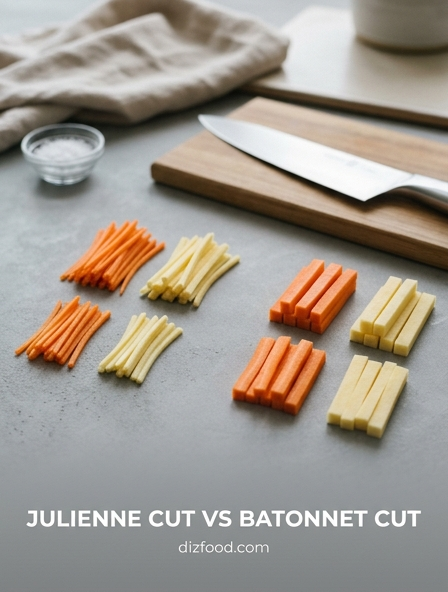
Defining Julienne and Batonnet Cuts
In the realm of classical French culinary arts, precision is the foundation upon which all professional cooking is built. Among the various knife techniques taught to aspiring chefs, the stick cuts-specifically the julienne and the batonnet-are perhaps the most fundamental. These cuts involve transforming irregular, round vegetables into uniform, rectangular sticks. The primary purpose of these standardized cuts is twofold: ensuring that all pieces of food cook at the same rate and enhancing the visual presentation of the final dish. By creating uniform shapes, a chef eliminates the risk of some pieces being overcooked while others remain raw.
- Julienne: Often referred to as a "matchstick cut," this is a thin, delicate strip used for garnishes and quick-cooking preparations.
- Batonnet: Translated literally as "little stick," this cut serves as the starting point for larger dice and is commonly seen in sturdier vegetable preparations.
- Consistency: Both cuts require the vegetable to be squared off first, a process known as "oblonging," to ensure every side is flat and manageable.
Mastering these two cuts allows a cook to progress to more advanced techniques, such as the brunoise and the small dice, which are derived directly from the julienne and batonnet respectively. Without a firm grasp of these linear dimensions, achieving the geometric perfection required in high-end culinary environments is nearly impossible. These skills separate the amateur home cook from the professional technician in the kitchen.
Precise Dimensions of the Batonnet
The batonnet is the largest of the standard stick cuts and serves as the structural baseline for many other knife skills. In professional kitchens, the dimensions are strictly enforced to maintain consistency across the brigade. A standard batonnet measures exactly 1/4 inch by 1/4 inch by 2 to 2.5 inches in length. This size is substantial enough to retain its shape during longer cooking processes, such as roasting or deep-frying, making it the ideal cut for items like high-quality French fries or roasted root vegetables.
| Dimension | Standard Measurement (Imperial) | Metric Equivalent |
|---|---|---|
| Width | 1/4 inch | 6 mm |
| Height | 1/4 inch | 6 mm |
| Length | 2 to 2.5 inches | 5 to 6 cm |
When executing the batonnet, the chef must first "square up" the vegetable by cutting off the rounded ends and sides to create a rectangular block. This block is then sliced into 1/4-inch thick planks. These planks are stacked and sliced again at 1/4-inch intervals to create the final sticks. Because of its thickness, the batonnet is durable and can withstand the heat of a sauté pan or oven without disintegrating, providing a satisfying texture and a uniform appearance that signals professional attention to detail.
Understanding Julienne Cut Measurements
While the batonnet is sturdy, the julienne is defined by its elegance and fineness. This cut is significantly smaller, requiring a higher degree of dexterity and a very sharp knife. The standard julienne measures 1/8 inch by 1/8 inch by 2 inches. Because of its small surface area, the julienne is used for vegetables that are either eaten raw or cooked very quickly over high heat. There is also an even smaller version known as the "Fine Julienne," which measures 1/16 inch by 1/16 inch by 2 inches, often used for delicate garnishes or aromatic bases.
- Standard Julienne: 1/8" x 1/8" x 2" (3mm x 3mm x 5cm).
- Fine Julienne: 1/16" x 1/16" x 2" (1.5mm x 1.5mm x 5cm).
- Common Ingredients: Carrots, celery, leeks, and bell peppers are the most frequent candidates for julienning.
To achieve a perfect julienne, the vegetable must be prepared exactly like the batonnet but with much tighter tolerances. The planks must be sliced thin enough that they are almost translucent. If the strips are too thick, they are technically "allumette" (a cut between julienne and batonnet) or simply poorly executed sticks. The julienne is favored in salads and stir-fries because it offers a high surface-area-to-volume ratio, allowing flavors to be absorbed quickly and the vegetable to soften in a matter of seconds when exposed to heat.
Key Differences Between the Two Cuts
The primary difference between julienne and batonnet cuts lies in their volume and their intended culinary application. While both are rectangular sticks, the batonnet is exactly double the width and height of a standard julienne. This difference in mass drastically changes how the vegetable behaves in a pan or on a plate. A batonnet has a significant "bite" and a starchy or fibrous interior that remains present after cooking, whereas a julienne is meant to blend into the texture of the dish or provide a delicate crunch.
| Feature | Batonnet | Julienne |
|---|---|---|
| Volume | Larger/Heavy | Small/Light |
| Cook Time | Medium to Long | Very Fast/Instant |
| Common Use | Side dishes, fries | Garnishes, stir-fry |
| Derivative Cut | Small Dice (Macédoine) | Brunoise |
Choosing between the two depends entirely on the desired outcome of the recipe. If you are preparing a hearty vegetable soup where the ingredients need to simmer for twenty minutes, a julienne would disintegrate into a mushy texture, whereas a batonnet would hold its shape. Conversely, if you are topping a delicate poached fish with ginger and scallions, a batonnet would be far too bulky and would overpower the main ingredient. Understanding these differences allows a chef to manipulate texture and heat transfer to achieve the perfect balance in any dish.
Essential Tools for Uniform Strips
Achieving the geometric precision required for julienne and batonnet cuts is not solely a matter of skill; it is also a matter of having the correct equipment. Without a sharp, high-quality knife, the vegetable fibers will tear rather than shear, resulting in ragged edges and uneven dimensions. Professional chefs typically rely on a standard 8-inch or 10-inch French chef's knife for these tasks, as the length of the blade allows for a smooth, rocking motion that facilitates clean cuts through the entire length of the vegetable.
- Chef's Knife: A sharp blade is non-negotiable for safety and accuracy.
- Large Cutting Board: A stable, flat surface (preferably wood or high-density plastic) provides the space needed to organize planks and sticks.
- Mandoline Slicer: For high-volume environments, a mandoline can produce uniform planks much faster than a knife, though the final stick cuts are still often finished by hand.
- Culinary Ruler: Beginners often use a small stainless steel ruler to check their measurements and calibrate their eyes to 1/8 and 1/4 inch increments.
Maintenance is equally important. A dull knife requires more pressure, which increases the likelihood of the blade slipping on a round carrot or potato. Regular honing with a steel and periodic sharpening on a whetstone ensure that the edge is keen enough to produce the "surgical" precision needed for fine julienne work. Additionally, using a damp paper towel under the cutting board to prevent it from sliding is a critical safety step when performing repetitive precision cuts.
Step by Step Guide to Squaring Vegetables
Before any precision stick cut can be made, the vegetable must be transformed from its natural, irregular shape into a "pomme bouchée" or a squared-off rectangular prism. This process is essential for safety, as it creates flat surfaces that prevent the vegetable from rolling under the knife. Squaring off does result in some food waste, though in professional kitchens, these scraps are usually saved for stocks, purees, or soups to ensure maximum efficiency and minimal loss.
- Wash and Peel: Clean the vegetable and remove the outer skin, especially for carrots, potatoes, and parsnips.
- Trim the Ends: Cut off the top and bottom of the vegetable to create two flat, parallel ends.
- Segment the Length: Cut the vegetable into sections that are 2 to 2.5 inches long, which will define the final length of your sticks.
- Create the First Flat Surface: Slice a thin piece off one side of the cylinder. Rotate the vegetable so it rests firmly on this flat side.
- Complete the Square: Slice the remaining three sides until you have a clean, rectangular block with right angles.
Once you have this uniform block, you can proceed to slice it into planks of the desired thickness (1/4 inch for batonnet or 1/8 inch for julienne). By following this systematic approach, you ensure that every stick produced from the block will be identical in shape. This uniformity is the hallmark of professional prep work and ensures that the vegetable behaves predictably when it finally hits the heat of the pan.
Best Culinary Uses for Julienne Sticks
The julienne cut is prized for its elegance and its ability to cook almost instantly. Because the sticks are so thin, they provide a large amount of surface area relative to their mass, which makes them ideal for absorbing marinades, dressings, and sauces. In many Asian cuisines, julienned vegetables are a staple in stir-fries, where the goal is to sear the ingredient quickly at a high temperature while maintaining a crisp, "al dente" texture. This cut is also the standard for slaws and cold salads, where a bulky cut would be difficult to chew.
- Salad Garnishes: Julienned carrots or radishes add color and a light crunch without overwhelming the greens.
- Spring Rolls: The thin strips allow for tight rolling and even distribution of ingredients inside the wrapper.
- Sautéed Aromatics: Julienned leeks or ginger release their flavors rapidly into hot oil or butter.
- Soup Toppings: A small pile of julienned vegetables placed in the center of a bowl just before serving adds a professional aesthetic touch.
Beyond its direct use, the julienne is the prerequisite for the brunoise-the smallest standard dice (1/8 inch cubes). If you can master a consistent julienne, you can produce a perfect brunoise, which is essential for fine sauces, consommé garnishes, and high-end plate presentations. The julienne cut is fundamentally about finesse; it showcases a chef's control over their tools and their respect for the ingredients.
When to Choose a Batonnet Cut
The batonnet is the workhorse of the stick cuts. It is chosen when the vegetable needs to be a primary component of the dish rather than a secondary garnish. Because of its 1/4-inch thickness, the batonnet can survive cooking methods that would destroy a julienne. It is most famously associated with "Pommes Pont Neuf" or traditional French fries. When deep-fried, the batonnet offers a perfect ratio of crispy exterior to fluffy, mashed-potato interior. It is also the ideal choice for vegetable crudité platters, as the sticks are sturdy enough to hold heavy dips without snapping.
- Roasting: Root vegetables like parsnips and carrots roast beautifully in batonnet form, caramelizing on the outside while remaining tender inside.
- Stews and Hearty Soups: Batonnets provide a substantial mouthfeel and hold up during long simmering times.
- Dipping: The thickness makes them the perfect vehicle for hummus, ranch, or blue cheese dressings.
- Macédoine Base: The batonnet is the starting point for the 1/4-inch dice, commonly used in vegetable medleys.
Choosing a batonnet is a decision based on durability and texture. If a recipe calls for a vegetable to be cooked for more than five minutes, or if it needs to be picked up with the fingers, the batonnet is usually the superior choice. It provides a rustic yet disciplined look that suggests home-style comfort prepared with professional precision. It is the cut of choice for "steak frites" and traditional roasted vegetable sides served alongside proteins.
Mastering Knife Skills for Consistency
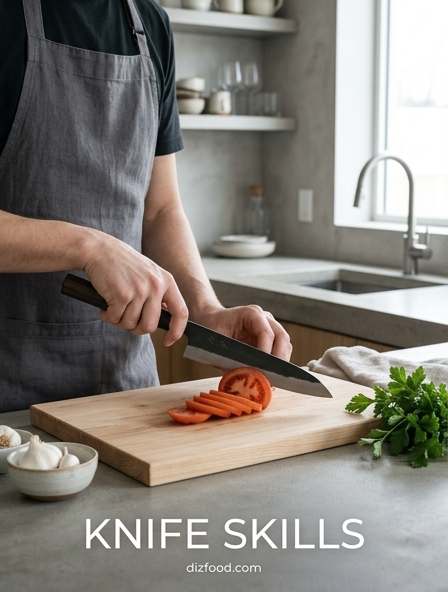
Consistency in stick cuts is achieved through a combination of proper mechanics and repetitive practice. The most common mistake beginners make is moving the knife too fast before they have developed the necessary "muscle memory." To produce identical sticks, the chef must maintain a consistent grip on the knife and use their non-cutting hand-the "guide hand"-to control the thickness of each slice. The "claw grip," where fingertips are tucked under and knuckles act as a guide for the blade, is essential for safety and precision.
- The Pivot Point: Keep the tip of the knife in contact with the board and use a smooth, rocking motion rather than a straight up-and-down chop.
- Stacking: To save time, stack two or three planks on top of each other before making the final stick cuts. Ensure they are perfectly aligned.
- Eye Calibration: Frequently compare your cuts to each other. If one stick is thicker than the others, adjust your guide hand immediately.
- Sharpness Check: If you find yourself "pushing" through the vegetable, stop and hone your blade. A sharp knife does the work for you.
Ultimately, the goal is to reach a state where you no longer need a ruler to produce a 1/4-inch or 1/8-inch cut. Mastery is defined by the ability to produce a pile of vegetables where every single piece looks exactly like the one next to it. This uniformity ensures that every bite the guest takes is cooked to the exact same degree of doneness, which is the hallmark of a high-quality culinary experience.
Visual Guide to Stick Cut Standards
Understanding the visual differences between stick cuts is critical for any cook who wants to follow professional recipes accurately. While the names julienne and batonnet are often used interchangeably in casual settings, they represent very different physical volumes. A batonnet has four times the cross-sectional area of a julienne (1/16 square inch versus 1/64 square inch). This geometric reality explains why their cooking times and applications differ so significantly. Below is a summary of the standards used in culinary schools globally.
| Cut Name | Visual Comparison | Dimensions |
|---|---|---|
| Fine Julienne | Hair-like / Thread-like | 1/16" x 1/16" x 2" |
| Julienne | Standard Matchstick | 1/8" x 1/8" x 2" |
| Allumette | Small French Fry | 3/16" x 3/16" x 2" |
| Batonnet | Little Stick / Thick Fry | 1/4" x 1/4" x 2-2.5" |
When visualizing these cuts, imagine the batonnet as a sturdy building block and the julienne as a delicate straw. In a well-executed dish, the choice of cut should complement the main ingredient. A dense protein like beef can stand up to the bulk of a batonnet, while a delicate protein like sole or scallop requires the lightness of a julienne. By adhering to these visual and dimensional standards, a cook ensures that their food is not only delicious but also aesthetically balanced and professionally prepared.

Comments