
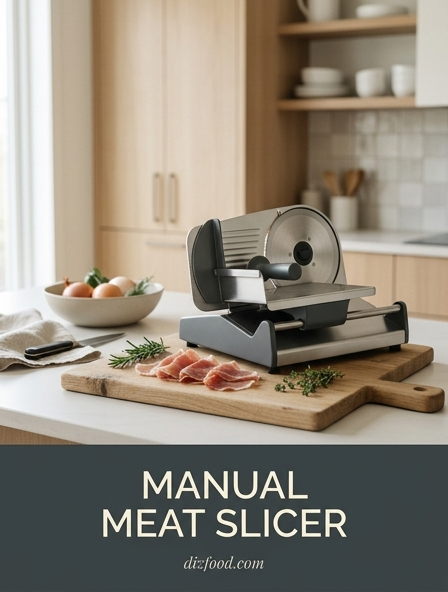
Precision Slicing Control for Home Cooks
Mastering the art of the perfect charcuterie board requires a level of thickness control that only a manual meat slicer can provide. Unlike electric versions that often operate at a single high speed, a manual slicer allows the home cook to dictate the rhythm and pressure of every cut. This tactile feedback is essential when working with delicate cured meats or firm cheeses, ensuring that every slice is uniform and aesthetically pleasing. By adjusting the precision thickness knobs, users can transition from paper-thin prosciutto to hearty slices of roast beef with ease.
- Adjustable thickness settings ranging from 0.2mm to 15mm.
- Ergonomic handle design for consistent pressure application.
- Manual guidance for better alignment of irregularly shaped roasts.
- Reduced friction compared to high-speed motorized blades.
The manual nature of these devices fosters a deeper connection to the food preparation process. Because you are in total control of the blade's movement, there is a significantly lower risk of shredding softer proteins. This precision ensures that your ingredients maintain their structural integrity from the first slice to the last, elevating the professional quality of your home-cooked meals.
Space Saving Benefits of Manual Slicers
In a modern kitchen where counter space is at a premium, the footprint of culinary tools is a major consideration. Manual meat slicers are specifically engineered to offer high-performance utility without the bulk associated with heavy-duty electric motors. Most manual models feature a streamlined profile, allowing them to sit comfortably on a standard countertop without obstructing other essential tasks. Their lightweight construction makes them easy to move, unlike industrial electric slicers that often require a permanent station.
Many manual slicers are designed with a modular or foldable architecture. This means that when the slicing task is complete, the unit can be partially disassembled or tucked into a narrow corner. By eliminating the need for a large motor housing and internal wiring, manufacturers can prioritize the quality of the blade and the stability of the base. This results in a tool that provides professional-grade results while occupying significantly less volume than its powered counterparts, making it an ideal choice for enthusiasts who value both functionality and kitchen organization.
Cost Effective Bulk Meat Processing Solutions
Investing in a manual meat slicer is one of the most effective ways to reduce a household's grocery expenditure. Pre-sliced meats and cheeses at the deli counter carry a significant markup due to the labor and packaging involved. By purchasing whole primals or large blocks of cheese, consumers can take advantage of bulk pricing and handle the processing themselves. Over time, the savings generated by bypassing the deli counter can easily exceed the initial cost of the slicer.
| Product Type | Bulk Price (per lb) | Deli Price (per lb) | Estimated Savings |
|---|---|---|---|
| Roast Beef | $8.50 | $14.00 | 39% |
| Swiss Cheese | $5.00 | $9.50 | 47% |
| Turkey Breast | $6.00 | $11.00 | 45% |
Furthermore, manual slicers do not contribute to your monthly electricity bill. While the energy cost of an electric slicer may seem marginal, the long-term cumulative savings of a manual device add up. Because these tools are built to last with fewer mechanical parts to fail, you also avoid the expensive repair or replacement costs associated with motor burnout in electric models.
Maximum Freshness and Flavor Retention
The moment a piece of meat is sliced, its surface area increases, accelerating the process of oxidation. This exposure to air quickly degrades the flavor, moisture, and color of the food. By using a manual slicer at home, you can slice exactly what you need right before serving, ensuring that the meat retains its peak flavor profile. There is a noticeable difference in the succulence of a roast that is sliced fresh compared to meat that has been sitting in a plastic container for several days.
Another culinary advantage is the lack of heat transfer. Electric blades spinning at high revolutions generate friction heat, which can slightly "cook" or melt the fats in delicate meats like salami or wagyu beef during the slicing process. A manual slicer operates at a much cooler temperature because the blade moves only as fast as your hand. This preserves the natural fats and textures of the meat, providing a superior mouthfeel and a more authentic tasting experience. For the true gourmet, the ability to serve food in its most pristine state is the ultimate benefit of manual processing.
Quiet Operation Without Electric Motors
The kitchen is often the heart of the home, a place for conversation and social interaction. Electric meat slicers are notoriously loud, producing a high-pitched mechanical whine that can disrupt the household environment. Manual meat slicers, however, operate in near silence. The only sound produced is the satisfying "shirr" of the blade passing through the food. This makes manual slicers perfect for early morning meal prep or late-night hosting when you want to avoid waking family members or guests.
- No motor noise or vibration.
- Ideal for open-concept living spaces.
- Allows for comfortable conversation during food preparation.
- Eliminates the stress of loud, intrusive kitchen machinery.
Beyond the acoustic benefits, the lack of vibration provides a more stable slicing environment. High-speed motors can cause a machine to "walk" across the counter if not properly weighted. A manual slicer remains anchored, giving the user a sense of calm and focus. This peaceful operation transforms a chore into a therapeutic culinary ritual, allowing you to enjoy the process of preparing high-quality ingredients without the sensory overload of noisy appliances.
Compact Storage for Small Apartment Kitchens
For those living in urban environments or smaller apartments, kitchen storage is a precious commodity. Large appliances often end up relegated to hard-to-reach top shelves or deep cabinets, where they are eventually forgotten. Manual meat slicers address this challenge through their compact and often lightweight designs. Without the heavy copper windings and steel casings of an electric motor, these units can be easily lifted and tucked away into standard kitchen drawers or narrow pantry shelves.
The vertical profile of many manual slicers allows them to be stored on their side, further maximizing available space. Some models even feature detachable handles or suction-cup bases that can be removed to create a more rectangular, stackable shape. This portability means you can bring the slicer out for a specific task and clear it away in seconds, keeping your workspace tidy and functional. For the minimalist cook, a manual slicer provides all the utility of a professional deli tool without the burdensome footprint of industrial-style equipment, fitting perfectly into the constraints of modern city living.
Low Maintenance and Easy Cleaning Process
One of the primary deterrents to using kitchen machinery is the daunting task of cleanup. Electric slicers are notoriously difficult to sanitize, as users must be extremely careful not to get water into the motor housing or electrical components. Manual slicers simplify this process significantly. Because they are purely mechanical, the entire unit-or at least the primary slicing components-can often be washed more thoroughly without fear of electrical failure.
- Disassemble the blade using the quick-release mechanism.
- Remove the food carriage and sliding track.
- Wash components in warm, soapy water.
- Wipe down the main frame with a sanitizing solution.
- Dry completely and apply a food-grade lubricant to the track.
The absence of complex internal gears and vents means there are fewer places for food particles and bacteria to hide. Most manual slicers are constructed from high-grade stainless steel or specialized plastics that resist staining and odors. This streamlined cleaning routine ensures that the device remains hygienic and ready for use at a moment's notice, encouraging more frequent use in daily meal preparation.
Versatile Slicing Beyond Deli Meats
While often categorized solely for deli applications, the manual slicer is a versatile multi-tool that handles a wide array of kitchen tasks. The steady, controlled movement of the manual blade is exceptionally effective for slicing firm vegetables, fruits, and even hard breads. It provides a level of uniformity that is difficult to achieve with a kitchen knife and offers more safety and control than a standard mandoline for certain types of produce.
- Uniform potato slices for gratin or homemade chips.
- Thinly sliced cabbage for slaws and sauerkraut.
- Precise onion rings for burgers or frying.
- Slicing firm blocks of chocolate for baking garnishes.
- Creating perfectly even slices of crusty baguettes.
The ability to slice semi-frozen items is another significant advantage. By partially freezing a piece of beef or pork, a manual slicer can create paper-thin ribbons for hot pot, Philly cheesesteaks, or beef carpaccio. This versatility transforms the manual meat slicer from a niche gadget into a foundational piece of kitchen equipment that can be utilized in almost every meal, from breakfast garnishes to elaborate dinner entrees.
Durable Manual Design and Longevity
In an era of planned obsolescence, manual meat slicers stand out as examples of enduring craftsmanship. The simplicity of their design is their greatest strength; without capacitors, brushes, or intricate wiring, there is very little that can go wrong. Most manual slicers are built with heavy-duty materials such as die-cast aluminum or reinforced stainless steel, designed to withstand the physical pressure of manual operation year after year. While an electric motor will eventually burn out or lose its torque, a manual slicer's lifespan is typically limited only by the sharpness of its blade.
This durability makes the manual slicer a sustainable choice for the eco-conscious consumer. By choosing a tool that does not rely on electronic components, you reduce electronic waste and the need for frequent replacements. Maintenance usually involves nothing more than the occasional sharpening of the blade and light lubrication of the sliding rails. This "heirloom" quality means that a well-maintained manual slicer can be passed down through generations, remaining as functional decades from now as it was on the day it was purchased.
Portability for Outdoor Cooking and Events
The independence from electrical outlets makes the manual meat slicer the ultimate tool for outdoor culinary enthusiasts. Whether you are hosting a backyard barbecue, tailgating at a stadium, or camping in the wilderness, you can enjoy freshly sliced ingredients anywhere. Electric slicers are tethered to the kitchen, but a manual unit can be set up on any flat surface, from a picnic table to a tailgate, providing professional utility in remote locations.
- No need for heavy battery packs or noisy generators.
- Lightweight enough for transport in a standard cooler or gear bag.
- Perfect for slicing fresh brisket or ribs at a BBQ competition.
- Great for creating fresh sandwich toppings during a picnic.
This portability also extends to catering and community events. For small-scale caterers or church socials, the ability to slice meats on-site ensures the highest quality presentation without worrying about power access or extension cords. The manual slicer empowers the cook to bring the precision of the kitchen to the great outdoors, ensuring that the quality of the meal is never compromised by the environment.





Comments