
Choosing between a rotary cheese grater and a cheese plane depends entirely on whether you're looking for a mountain of fluffy shreds or elegant, uniform slices for your next charcuterie board. Rotary graters are the powerhouses of the kitchen, featuring an enclosed drum that protects your fingers while quickly processing hard cheeses like Parmesan into fine or coarse textures for pasta and salads. In contrast, the classic cheese plane is a minimalist's dream, designed to glide across semi-hard blocks like Gouda or Swiss to produce thin, consistent ribbons that melt beautifully and look professional. Whether you prioritize high-volume efficiency or the delicate aesthetics of a perfectly sliced wedge, understanding the mechanics of these essential tools ensures you get the best flavor and texture out of every block.
| Feature | Rotary Cheese Grater | Cheese Plane |
|---|---|---|
| Primary Result | Fine to coarse shreds/crumbles | Thin, uniform ribbons/slices |
| Best Cheese Type | Hard to firm (Parmesan, Pecorino) | Semi-hard to firm (Cheddar, Gouda) |
| Safety Level | High (Blades enclosed in drum) | Moderate (Exposed sharp edge) |
| Speed & Volume | Fast; ideal for bulk prep | Slower; best for individual servings |
| Storage Profile | Bulky; requires more drawer space | Slim; fits in standard utensil trays |
| Maintenance | Disassembly often required | Easy; usually one-piece construction |
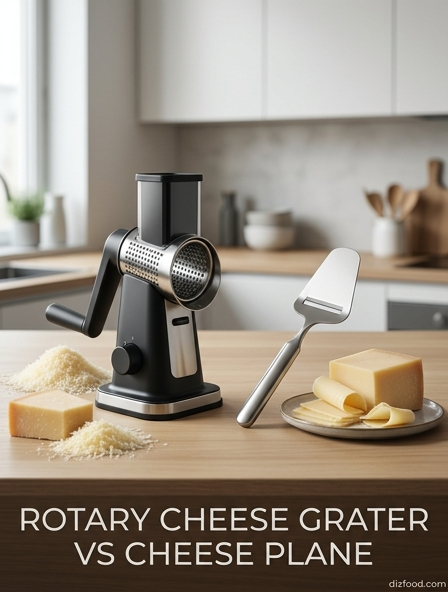
Rotary Cheese Grater vs Cheese Plane Key Differences
When navigating the world of kitchen gadgets, the distinction between a rotary cheese grater and a cheese plane is fundamental to how you prepare and present dairy products. The primary difference lies in the mechanical design and the resulting shape of the cheese. A rotary grater utilizes a drum-like mechanism housed within a casing. As you turn a handle, the drum rotates against the cheese, which is held in place by a weighted or hand-pressed plunger. This creates small, uniform shreds or granules, depending on the drum's perforation size. It is a tool designed for volume and safety, keeping fingers away from the cutting surface.
In contrast, the cheese plane is a handheld tool that resembles a small shovel with a sharp slit or blade across its flat surface. Originating from Norway, this tool is designed to be pulled across the top or side of a block of cheese to produce thin, consistent slices. While the rotary grater is complex with multiple moving parts, the cheese plane is a single-piece implement that relies on the user's manual pressure and angle. The key differences can be summarized by their primary outputs:
- Rotary Grater: Produces shreds, curls, or fine powders; ideal for melting into sauces or topping pasta.
- Cheese Plane: Produces wide, flat slices; ideal for sandwiches, crackers, or snacking.
- Action: Rotary uses a circular cranking motion; the plane uses a linear pulling motion.
- Material Handling: Rotary graters require smaller chunks to fit the hopper; planes work best on large, flat blocks.
Best Tool for Shredding Bulk Cheese Fast
If your culinary goal is to prepare a large quantity of cheese for a family-sized lasagna, a homemade pizza, or a batch of mac and cheese, the rotary cheese grater is the undisputed champion. The efficiency of a rotary grater stems from its continuous motion. Unlike a box grater, which requires a back-and-forth stroke that can be tiring and slow, the rotary grater allows the user to apply consistent centrifugal force. Because the cheese is enclosed in a hopper, you can apply significant pressure without worrying about the block slipping or your knuckles hitting the blades.
The speed advantage of the rotary model is particularly evident when preparing bulk quantities of semi-hard cheeses like mozzarella or young cheddar. To maximize speed and efficiency, users often follow a specific workflow:
- Pre-cut the cheese into rectangular blocks that snugly fit the hopper width to prevent "spinning" inside the chamber.
- Chilling the cheese in the freezer for ten minutes prior to grating to increase structural integrity.
- Using a continuous, steady cranking motion rather than short bursts to maintain momentum.
- Clearing the internal drum periodically to ensure the shreds do not clump and slow down the rotation.
While a cheese plane could technically be used to create slices that you then stack and chop, it would take significantly longer and result in uneven pieces. For high-volume shredding, the rotary tool's design minimizes physical labor while maximizing output, making it the essential choice for bulk meal preparation.
The Art of Creating Perfect Thin Slices
Precision and aesthetics are the hallmarks of the cheese plane. When a recipe or a serving platter requires paper-thin slices of cheese that are uniform in thickness, a rotary grater cannot compete. The cheese plane allows the user to control the thickness of a slice through minor adjustments in the angle of the tool. By tilting the handle slightly upward or downward, you can achieve anything from a translucent shave to a sturdy slice suitable for a hearty sandwich. This level of finesse is vital for "sweating" cheese, where the thinness allows the oils and aromas to release more effectively at room temperature.
Achieving the perfect slice is an art form that requires a firm block and a steady hand. The plane is pulled towards the body with even pressure, ensuring the blade stays submerged just beneath the surface of the cheese block. This results in a smooth, professional finish that is impossible to replicate with a knife or a grater. For charcuterie boards, where visual appeal is as important as taste, the cheese plane creates elegant ribbons of cheese that can be folded or draped. Furthermore, the plane preserves the structural integrity of the cheese, providing a clean bite that showcases the manufacturer's craftsmanship. For anyone who prioritizes the texture of a solid slice over the utility of a shred, the plane is the sophisticated choice.
Comparing Safety Features and Ease of Use
Safety is a significant concern in the kitchen, particularly when dealing with sharp blades and high-pressure tasks. The rotary cheese grater and the cheese plane offer very different safety profiles based on their physical designs. The rotary grater is often cited as the safer option for children or novice cooks because the blades are completely enclosed within the housing. There is virtually no risk of accidental finger nicks as long as the hopper lid or plunger is used correctly. However, the ease of use can be hampered by the need to disassemble the unit for cleaning or the physical effort required to hold the device stable while cranking.
The cheese plane, while simpler to operate, carries a higher risk of minor cuts. Since the blade is exposed on a flat surface, a slip of the hand while pulling across a hard block can lead to injury. Nevertheless, its "ease of use" score is high because it requires no assembly and is intuitive to hold. The following table compares these two tools across key usability metrics:
| Feature | Rotary Cheese Grater | Cheese Plane |
|---|---|---|
| Blade Exposure | Enclosed / Hidden | Exposed / Open |
| Grip Style | Dual-hand (Hold & Crank) | Single-hand (Pull) |
| Setup Time | Moderate (Assembly required) | Instant (Single piece) |
| Risk of Injury | Very Low | Low to Moderate |
Which Tool Works Best for Hard vs Soft Cheeses
The success of a kitchen tool often depends on the density and moisture content of the ingredient. For hard cheeses like Parmesan, Grana Padano, or Pecorino Romano, the rotary grater is the superior option. These cheeses are often too brittle to be sliced with a plane; they tend to crumble or shatter into irregular shards when a blade is pulled across them. The rotary drum, however, excels at turning these hard blocks into fine, snow-like granules that are perfect for garnishing soups or pastas.
Conversely, the cheese plane is specifically engineered for semi-hard and medium cheeses such as Gouda, Edam, Havarti, or Swiss. These varieties have enough moisture to remain flexible, allowing the plane to slide through the fat and protein structure smoothly without the cheese sticking to the blade. Soft cheeses, like Brie or Camembert, are generally unsuitable for both tools, as they are too gummy and will simply clog the rotary drum or smear across the surface of the plane. When choosing between the two, consider the following cheese types:
- Hard (Parmesan): Best with Rotary (Fine Drum).
- Medium-Hard (Aged Cheddar): Works with both, depending on desired shape.
- Semi-Hard (Gouda/Swiss): Best with Cheese Plane.
- Soft (Mozzarella): Best with Rotary (Large Drum, chilled).
Cleaning and Maintenance Comparison for Kitchen Tools
Maintenance is often the deciding factor for home cooks when choosing which tool to pull from the drawer. The cheese plane is the clear winner in terms of simplicity. Being a single piece of stainless steel or plastic, it has no hidden crevices where cheese can hide. It is typically dishwasher safe and can be wiped clean in seconds under a hot tap. Because it is a flat surface, it also dries quickly and does not trap moisture, reducing the risk of rust or bacterial growth over time.
The rotary cheese grater, however, requires a more rigorous cleaning routine. Because cheese is pressed through a drum and into a housing, residue frequently builds up in the "dead zones" between the drum and the outer casing. To clean it properly, the user must follow several steps:
- Disassemble the handle, the drum, and the housing.
- Rinse the drum immediately after use to prevent cheese from hardening in the small holes.
- Use a soft brush to scrub the internal teeth of the drum.
- Ensure all components are completely dry before reassembly to prevent the handle mechanism from squeaking or seizing.
While many modern rotary graters are marketed as dishwasher safe, the high heat can sometimes warp plastic components or dull the blades over time. For those who prioritize a quick cleanup, the plane is the more efficient choice.
Texture and Taste Differences in Slicing vs Shredding
Culinary professionals often argue that the way cheese is cut significantly impacts its flavor profile and melting characteristics. When you use a rotary grater, you are increasing the surface area of the cheese exponentially. These small shreds melt almost instantly when they hit hot food, creating a creamy, integrated texture. Furthermore, grating aerates the cheese; as the shreds fall, they trap air, making the flavor seem lighter and more vibrant on the palate. This is why freshly grated Parmesan tastes so much more "alive" than the pre-packaged, compressed versions found in stores.
Slicing with a cheese plane preserves the density of the cheese. A flat slice provides a different sensory experience, emphasizing the "mouthfeel" and the gradual release of fats as you chew. Because the surface area is lower than that of shreds, slices melt more slowly and retain their individual shape longer. This is ideal for burgers or grilled sandwiches where you want a thick, gooey layer of cheese rather than a fully incorporated sauce. The choice between slicing and shredding is ultimately a choice between intensity and integration; use the plane for a concentrated burst of flavor and the rotary grater for a subtle, even distribution.
The Best Kitchen Tool for Table Side Serving
The "restaurant experience" at home often involves the theatrical flourish of adding fresh cheese to a dish just before eating. In this context, the rotary cheese grater is the iconic choice. Many high-end Italian restaurants use handheld rotary graters because they are clean and efficient for table-side service. The cheese is contained within the unit, so there is no risk of the server's fingers touching the food, and the shreds fall precisely where intended. It allows for a customized portion size, as the diner can signal exactly when they have enough "snow" on their plate.
The cheese plane, while less common for individual pasta bowls, is the superior choice for communal table-side serving, such as a cheese course or a breakfast spread. In Scandinavian cultures, the cheese plane is often left on the table alongside a large block of cheese, allowing guests to shave off their own slices for bread or crackers as they eat. While the rotary grater offers a sense of service and luxury, the cheese plane offers a sense of community and self-sufficiency. If your dinner party involves a central platter, the plane is the better fit; if you are serving plated entrees, the rotary grater provides that professional finishing touch.
Space Efficiency and Storage Considerations
Kitchen storage is often a zero-sum game, where every new gadget must justify the space it occupies. The cheese plane is one of the most space-efficient tools available. Its flat profile allows it to slip into a cutlery drawer or hang from a hook without obstructing other items. It is lightweight and portable, making it an excellent choice for picnic baskets or small apartment kitchens where drawer space is at a premium. Its lack of moving parts also means it won't get "stuck" or tangled with other utensils like whisks or tongs.
The rotary cheese grater is significantly more cumbersome. Due to its cylindrical drum and protruding handle, it occupies a large footprint in a drawer and can be difficult to stack. Some models are "top-heavy," making them prone to tipping over if stored in a vertical utensil crock. To manage this, many users store their rotary graters in the original box or dedicated cabinets. When considering storage, evaluate the following factors:
- Cheese Plane: Fits in flat drawers; excellent for minimalists.
- Rotary Grater: Needs deep drawers or shelf space; often requires disassembly for compact storage.
- Durability: Planes have fewer parts to break; rotary graters have handles and hinges that can snap under pressure.
- Portability: The plane is vastly superior for travel or outdoor dining.
Final Verdict Choosing Between a Grater and a Plane
Choosing between a rotary cheese grater and a cheese plane depends entirely on your frequent cooking habits and the types of cheese you prefer to eat. There is no objective "winner," as both tools serve distinct culinary purposes. If your kitchen routine involves a lot of pasta, pizza, and baking, the rotary grater is a necessary investment. Its ability to process large volumes of cheese safely and quickly makes it a workhorse for family meals and provides a superior texture for melting and garnishing.
On the other hand, if your cheese consumption is centered around snacking, sandwiches, or hosting elegant wine and cheese nights, the cheese plane is the more practical and refined tool. Its simplicity, ease of cleaning, and ability to produce perfect, thin slices make it a favorite for those who appreciate the aesthetic and traditional side of cheese preparation. Many well-equipped kitchens actually find room for both, using each tool to highlight the strengths of different cheese varieties. To help you decide, consider this summary:
| Best For... | Recommended Tool |
|---|---|
| Pasta Toppings | Rotary Cheese Grater |
| Sandwiches & Crackers | Cheese Plane |
| Hard Cheeses (Parmesan) | Rotary Cheese Grater |
| Semi-Hard Cheeses (Gouda) | Cheese Plane |
| Limited Storage Space | Cheese Plane |


Comments