
Whether you are prepping a vibrant stir-fry or a slow-simmering farmhouse soup, choosing between the Paysanne and Rondelle cuts is key to mastering both visual presentation and even cooking. The Rondelle cut is the ultimate choice for simplicity, transforming cylindrical vegetables like carrots and leeks into elegant, uniform disks that highlight the plant's natural shape. On the other hand, the Paysanne-or "country-style"-cut offers a more geometric, tile-like appearance; by squaring off your ingredients before slicing them thinly, you create flat squares or triangles that sit beautifully in rustic broths. While both techniques focus on thinness for quick cooking, the Rondelle celebrates the organic curves of your produce, whereas the Paysanne provides a professional, uniform look perfect for hearty mirepoix and traditional French bases.
| Feature | Rondelle Cut | Paysanne Cut |
|---|---|---|
| Primary Shape | Circular disks or rounds | Thin squares, triangles, or "tiles" |
| Best Vegetable Fit | Cylindrical (carrots, zucchini, parsnips) | Varied (potatoes, turnips, celery) |
| Standard Dimensions | 1/8 to 1/2 inch thick | 1/2" x 1/2" x 1/8" (approx.) |
| Visual Style | Natural, soft, and simplistic | Rustic, geometric, and structured |
| Prep Difficulty | Easy (follows natural veggie shape) | Moderate (requires "squaring off") |
| Best Use Case | Salads, sautéed sides, coin garnishes | Minestrone, stews, aromatic bases |
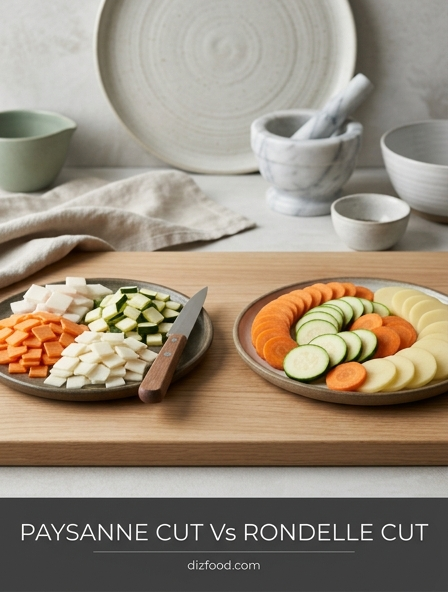
Understanding the Basics: Paysanne vs Rondelle
In the disciplined world of French culinary arts, the precision of a knife cut is not merely about aesthetics; it is a fundamental pillar of consistent cooking and professional presentation. Among the foundational techniques every chef must master are the Paysanne and Rondelle cuts. While both are categorized as relatively thin, flat cuts, they represent two different philosophies of vegetable preparation. Understanding these basics allows a cook to navigate recipes with greater efficiency and ensures that every ingredient in a dish reaches its peak texture simultaneously.
The term "Paysanne" translates to "country-style" or "peasant-style," implying a look that is more rustic than a perfect brunoise or julienne, yet it still requires a high degree of technical skill to achieve uniformity. On the other hand, the "Rondelle" cut is the simplest expression of a vegetable's natural anatomy. By following the cylindrical shape of the produce, the cook creates round disks that celebrate the original form of the ingredient. The primary difference lies in the geometry: the Paysanne is characterized by its thin, square, or rectangular tiles, whereas the Rondelle is strictly circular or oval. Selecting between them often depends on the desired visual rhythm of the finished plate and the specific vegetable being utilized.
- Paysanne: A flat, tile-like cut typically measuring 1/2 inch by 1/2 inch by 1/8 inch.
- Rondelle: A simple round or disk-shaped cut, varying in thickness but maintaining the natural diameter of the vegetable.
- Purpose: Both cuts are designed to expose surface area for quick, even cooking in soups, stews, and sautés.
Defining the Paysanne Cut: Shape and Technique
The Paysanne cut is a versatile technique used to create thin, flat pieces of vegetables that resemble small tiles or shingles. In a professional kitchen, the standard dimensions for a Paysanne cut are roughly 1/2 inch by 1/2 inch with a thickness of about 1/8 inch. This specific shape is highly valued because it offers a large surface area relative to its volume, allowing the vegetable to soften quickly while maintaining enough structural integrity to hold its shape in a simmering liquid. It is frequently applied to firm root vegetables like carrots, potatoes, turnips, and parsnips.
To achieve a proper Paysanne, the chef must first "square off" the vegetable. This process involves trimming the rounded sides of the produce to create a rectangular block, which is then cut into batonnets (thick sticks). These sticks are then bundled together and sliced crosswise into thin squares. While this method results in some vegetable trim-which is usually saved for stocks or purees-it ensures that every piece of the Paysanne is identical. This uniformity is critical for even heat distribution during the cooking process. For a more "rustic" application, the vegetable may not be squared off, resulting in triangular or semi-circular shapes that still maintain the requisite 1/8-inch thickness, though the squared-off version remains the standard in fine dining environments.
- Wash and peel the vegetable thoroughly to remove any surface debris.
- Trim the ends and sides to create a uniform rectangular prism or "brick."
- Cut the brick into long planks approximately 1/2 inch wide.
- Stack the planks and cut them into 1/2-inch batonnets.
- Slice the batonnets crosswise into 1/8-inch thick squares.
Defining the Rondelle Cut: Precision in Rounds
The Rondelle cut, often referred to as a "round" or "disk," is perhaps the most intuitive knife skill in the kitchen, yet it demands a steady hand to maintain consistent thickness. This cut is reserved for vegetables that are naturally cylindrical or conical in shape, such as carrots, leeks, zucchini, and cucumbers. Unlike the Paysanne, which requires altering the vegetable's natural silhouette into a square, the Rondelle embraces the curved exterior of the produce. This makes it an exceptionally efficient cut with virtually zero waste, as no squaring off is necessary.
Precision in a Rondelle cut is measured by the uniformity of the thickness across every slice. Standard thickness can range from a paper-thin 1/16 inch for garnishes to a heartier 1/2 inch for roasted preparations. When a chef desires a more elegant or elongated appearance, they may employ a variation known as the "bias cut." By holding the knife at a 45-degree angle to the vegetable rather than perpendicular, the resulting pieces become elongated ovals. This increases the surface area even further and provides a more sophisticated visual profile on the plate. Regardless of whether the cut is straight or on a bias, the goal remains the same: a clean, sharp edge that showcases the internal rings and textures of the vegetable.
Consistency is the hallmark of a professional Rondelle. If slices vary in thickness, some will turn to mush while others remain crunchy, compromising the integrity of the dish. Therefore, mastering the "claw grip" with the non-cutting hand is essential to guide the knife at exact intervals along the length of the vegetable.
Key Visual Differences Between Paysanne and Rondelle
While both cuts result in thin slices, the visual impact they have on a dish is remarkably different. The Paysanne cut provides a structured, geometric appearance. When viewed in a clear consommé or scattered over a plate, the sharp 90-degree angles and flat faces create an orderly, mosaic-like effect. It is a cut that suggests high-level technique and intentionality. In contrast, the Rondelle cut offers a softer, more organic aesthetic. The circular shapes feel approachable and traditional, reminding the diner of home-cooked meals and classic garden preparations.
The differences are also highlighted by how the vegetables occupy space in a bowl or pan. Paysanne cuts can be stacked neatly or layered, whereas Rondelles tend to overlap or tumble more naturally. Below is a comparison of their primary visual characteristics:
| Feature | Paysanne Cut | Rondelle Cut |
|---|---|---|
| Primary Shape | Square, Rectangular, or Triangular | Circular or Oval |
| Edge Style | Straight and Sharp | Curved and Natural |
| Visual Theme | Geometric and Formal | Organic and Rustic |
| Waste Level | Moderate (due to squaring off) | Minimal to None |
| Symmetry | Highly Symmetrical | Dependent on Vegetable Growth |
Choosing between these two often comes down to the style of the restaurant or the specific tradition of the recipe. A classic French Pot-au-feu might utilize the Rondelle for its traditional feel, while a refined vegetable terrine might demand the precise interlocking nature of the Paysanne.
When to Use Paysanne Cuts in Professional Cooking
The Paysanne cut is a staple in professional kitchens, particularly in the preparation of classic French soups and garnishes where a refined but substantial texture is required. One of the most common applications for the Paysanne is in the preparation of Minestrone-style soups or a traditional "Soupe Paysanne." In these dishes, the small, flat squares of vegetables like potatoes, carrots, and celery create a pleasing "mouthfeel" where multiple ingredients can fit onto a single spoon, allowing the diner to experience a harmony of flavors in every bite. Because the pieces are thin, they release their sugars and flavors into the broth quickly, yet they remain distinct enough to provide a bite.
Beyond soups, the Paysanne is frequently used as a garnish for braised meats or stews. When vegetables are cut this way and blanched separately, they can be folded into a sauce at the last minute to add a pop of color and architectural interest. It is also an excellent choice for a "Mirepoix" variation when the cooking time is relatively short. For instance, in a quick sauté of aromatics for a seafood dish, the thinness of the Paysanne ensures the vegetables translucent and tenderize in the same amount of time it takes to sear a piece of fish. In high-end catering, the Paysanne is often favored over the Rondelle because the flat squares are easier to arrange in precise, overlapping patterns on a plate or within a mold.
Best Vegetable Varieties for the Rondelle Cut
Not every vegetable is a candidate for the Rondelle cut; the technique is specifically designed to work with produce that possesses a naturally rounded, elongated shape. The most iconic vegetable for this cut is the carrot. Because carrots are dense and uniform, they allow for very thin, clean Rondelles that hold their shape through various cooking methods. Similarly, parsnips and daikon radishes provide a stark white alternative that looks beautiful when cut into rounds and glazed. These root vegetables are the "workhorses" of the Rondelle technique in most professional kitchens.
Other excellent candidates include:
- Leeks: When cut into Rondelles, leeks separate into beautiful, delicate concentric rings that melt into sauces or stand out in clear broths.
- Zucchini and Summer Squash: These softer vegetables are perfect for thicker Rondelles used in ratatouille or simple sautéed side dishes.
- Cucumbers: The standard cut for salads and pickling, Rondelles maximize the crisp texture of the cucumber's flesh.
- Celery: While not perfectly circular, the "U" shape of a celery stalk is often treated as a Rondelle in mirepoix and salads.
- Asparagus: The woody stems can be sliced into small Rondelles for use in risottos or omelets, leaving the tips whole.
When selecting vegetables for Rondelles, it is important to choose specimens with a consistent diameter from top to bottom. This ensures that the rounds are uniform in size, which is essential for both presentation and even cooking times.
Knife Skills: Mastering the Paysanne and Rondelle
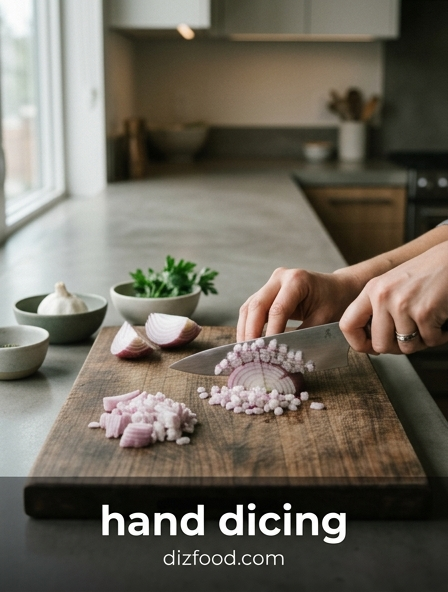
Mastering these cuts requires more than just a sharp knife; it requires a deep understanding of knife anatomy and hand positioning. For both the Paysanne and Rondelle, the chef's knife or a Japanese Santoku is the tool of choice. The key to consistency is the "claw grip," where the fingertips of the non-dominant hand are tucked inward, and the knuckles act as a guide for the blade. This not only protects the fingers but allows the cook to "feel" the thickness of each slice before the cut is even made. The knife should move in a smooth, rhythmic rocking motion, with the tip of the blade rarely leaving the cutting board.
When transitioning from Rondelle to Paysanne, the level of difficulty increases because of the required preparation steps. To master the Paysanne, one must first master the art of "squaring off." This requires the cook to envision the internal rectangle within a round vegetable and remove only as much as necessary to create flat sides. This skill is a test of spatial awareness. For the Rondelle, the challenge is maintaining a consistent angle. If the knife tilts even slightly during the slicing process, the rounds will be uneven-thick on one side and thin on the other. Professionals practice by slicing through a whole carrot, attempting to make every single disk identical in thickness from the crown to the tip. Consistent pressure and a sharp edge are vital to prevent the blade from slipping on the slick skin of vegetables like peppers or zucchini.
Impact on Cooking Time and Texture Consistency
The primary reason for utilizing specific knife cuts like Paysanne and Rondelle is to control the rate of heat transfer. Thermodynamics plays a significant role in the kitchen; the more surface area an ingredient has relative to its volume, the faster it will cook. Both the Paysanne and Rondelle are thin cuts, which means they are designed for relatively fast cooking. However, because a Paysanne is usually squared and uniform in its 1/8-inch thickness, it provides a more predictable cooking window than a Rondelle, which may vary in diameter even if the thickness remains the same.
Texture consistency is another critical factor. When a chef prepares a vegetable medley using Rondelles, the smaller rounds from the tip of the carrot will cook significantly faster than the larger rounds from the top. In a professional setting, this might require the chef to sort the Rondelles by size and add them to the pan at different intervals. The Paysanne cut solves this problem through its "squaring off" phase. By ensuring every piece is roughly 1/2 inch by 1/2 inch, the chef guarantees that every piece of vegetable in the pot reaches the desired "al dente" state at the exact same moment. This prevents the frustration of biting into a soup and finding some vegetables mushy while others remain raw in the center. Uniformity in cutting is the secret to achieving a professional texture that elevates a dish from amateur to gourmet.
Aesthetic Appeal: Choosing the Right Shape for Plating
Plating is often described as "painting with food," and knife cuts provide the geometric shapes that make up the composition. The choice between Paysanne and Rondelle can drastically change the "mood" of a dish. The Paysanne cut, with its sharp corners and tile-like appearance, is often used in modern, minimalist plating. It allows for a high degree of organization; a chef can stack Paysanne-cut potatoes into a neat tower or lay them out in a perfect line to create a sense of order and precision. This cut signals to the diner that the meal is a product of intense labor and technical mastery.
Conversely, the Rondelle cut is the king of "rustic elegance." There is a natural beauty in the cross-section of a vegetable-the starburst pattern inside a carrot or the lime-green spirals of a leek. Using Rondelles allows these natural patterns to take center stage. In a farmhouse-style stew or a vibrant vegetable salad, the varying sizes of the rounds create a sense of abundance and movement. Bias-cut Rondelles are particularly effective for adding height and drama to a plate. By leaning an elongated oval of a roasted parsnip against a protein, the chef adds a diagonal line that draws the eye across the dish. Ultimately, the Paysanne is the choice for structure and formality, while the Rondelle is the choice for celebrating nature's own designs.
Paysanne vs Rondelle: A Quick Guide for Home Cooks
For the home cook, mastering these two cuts is one of the fastest ways to improve both the flavor and appearance of everyday meals. You do not need a professional kitchen to implement these techniques; you only need a sharp knife and a bit of patience. When deciding which cut to use, consider the time you have and the final look you want to achieve. If you are in a hurry and want to minimize food waste, the Rondelle is your best friend. It is perfect for a quick Tuesday night stir-fry or a simple side of buttered carrots. Just focus on keeping your slices at a consistent thickness so everything cooks through at the same time.
If you are hosting a dinner party or following a classic French recipe like a clear vegetable broth, try your hand at the Paysanne. While it takes a few extra minutes to square off the vegetables, the result is a much more "polished" look that will surely impress your guests. Don't throw away the scraps from your squaring off! Keep a "stock bag" in your freezer for these trimmings; they are perfect for making homemade vegetable broth later. Whether you choose the geometric precision of the Paysanne or the natural charm of the Rondelle, focusing on your knife skills will make you a more confident and efficient cook.
- Practice: Start with soft vegetables like zucchini to build confidence before moving to hard roots.
- Safety: Always keep the flat side of the vegetable against the cutting board to prevent rolling.
- Tools: Keep your knife sharp; a dull blade is more likely to slip and cause injury when making thin slices.

Comments