
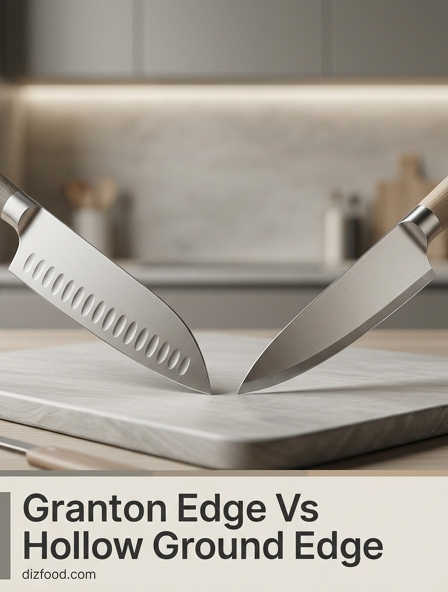
Choosing between a Granton edge and a hollow ground blade can transform your kitchen precision, whether you're carving a holiday roast or julienning delicate vegetables. A Granton edge features those iconic scalloped divots along the side of the blade which create tiny air pockets, effectively breaking the vacuum seal between the steel and your food to ensure an effortless release of thin slices without tearing. In contrast, a hollow ground edge is ground concavely from the midpoint down to the tip, resulting in a remarkably thin, razor-sharp profile ideal for the most intricate, surgical-like cuts where minimal resistance is paramount. Understanding these structural differences allows you to master friction-free slicing and achieve professional-grade consistency by matching the right blade geometry to your specific culinary tasks.
| Feature | Granton Edge | Hollow Ground Edge |
|---|---|---|
| Blade Design | Symmetrical scalloped divots on sides. | Concave grind tapering to a fine point. |
| Primary Function | Anti-suction; prevents food sticking. | Maximum sharpness for delicate depth. |
| Best For | Moist proteins, ham, and fatty fish. | Paper-thin vegetables and sashimi. |
| Cutting Drag | Lowest on wet/sticky ingredients. | Lowest through dense, firm materials. |
| Edge Durability | Higher; thicker secondary bevel. | Lower; prone to chipping if used on bone. |
| Maintenance | Standard honing and stone sharpening. | Requires frequent, precise thinning. |
Understanding Granton Edge vs Hollow Ground Blade Geometry
The culinary world distinguishes between blade modifications and primary grinds to help chefs choose the right tool for specific tasks. A Granton edge is not a primary grind but rather a specialized feature added to a standard blade, such as a flat or saber grind. It is characterized by a series of identical scallops or "dimples" ground into the sides of the blade. These indentations alternate on either side of the knife, positioned just above the cutting edge. The geometry remains robust because the thickness of the spine and the primary taper are maintained, providing a sturdy feel in the hand while introducing surface irregularities to assist in food release.
In contrast, a hollow ground edge refers to the primary geometry of the blade itself. This design features a concave surface where the blade tapers inward from the spine or midsection before narrowing to an extremely fine, razor-sharp edge. Historically associated with straight razors, this geometry creates a distinctive profile where the metal is thinnest just behind the apex of the edge. While both designs aim to improve cutting efficiency, they do so through different physical principles: the Granton edge relies on surface modification, whereas the hollow ground edge relies on a reduction in mass and a thinning of the blade's cross-section.
Key Differences in Slicing Performance and Food Release
The primary performance goal of both blade types is to reduce "stiction"-the tendency of moist food to adhere to the flat surface of a knife. However, their methods and results differ significantly during the slicing motion. A Granton edge is particularly effective when working with large, moist proteins or starchy vegetables. As the knife passes through a roast or a potato, the dimples prevent a vacuum from forming, allowing the slice to fall away easily rather than traveling up the blade. This makes the Granton edge the industry standard for long slicing knives used for ham, smoked salmon, and prime rib.
| Feature | Granton Edge | Hollow Ground Edge |
|---|---|---|
| Primary Benefit | Reduced food adhesion | Maximum sharpness/thinness |
| Slicing Feel | Smooth, consistent glide | Effortless initial "bite" |
| Ideal Material | Moist, sticky, or fatty foods | Soft tissues, delicate skins |
| Edge Profile | Interrupted flat surface | Concave taper |
Hollow ground blades excel in precision and effortless penetration. Because the blade is exceptionally thin at the edge, there is less "wedging" force required to push the knife through the material. This provides a sensation of extreme sharpness that is difficult to replicate with thicker grinds. While the concave shape also reduces surface contact, its primary advantage is the lack of resistance during the first few millimeters of the cut, making it ideal for tasks that require surgical accuracy.
The Science of Air Pockets in Granton Edge Knives
The effectiveness of the Granton edge is rooted in fluid dynamics and the management of surface tension. When a standard flat-sided knife slices through moist food, such as a cucumber or a raw steak, the moisture creates a liquid seal between the food and the metal. This seal generates a vacuum effect, or suction, that makes the food stick to the blade face. This increases drag and can cause the food to tear or the user to lose rhythm during rapid prep work.
The Granton dimples serve as small reservoirs for air. As the blade enters the food, these air pockets are trapped between the scallop and the ingredient. This prevents the formation of a continuous liquid seal, effectively breaking the suction. By introducing air into the interface between the steel and the organic material, the surface tension is disrupted. This allows the food to slide off the blade via gravity or the slight lateral movement of the stroke. Scientific studies in friction reduction show that even small amounts of trapped air can reduce the required "pull force" by significant margins, which is why Granton edges are favored for high-volume slicing where repetitive strain and speed are primary concerns for the chef.
How Hollow Ground Edges Provide Precision for Fine Slicing
The hollow ground edge is the pinnacle of thinning technology in knife manufacturing. By removing a substantial amount of steel from the primary bevel to create a concave arc, manufacturers can create an edge that is significantly thinner than a standard V-ground or convex blade. This extreme thinness translates directly into precision. When a chef performs delicate tasks, such as creating paper-thin radish slices or skinning a delicate fish fillet, a hollow ground blade offers the least amount of resistance at the point of impact.
This design is frequently seen in Japanese Santoku knives and specific paring knives where the goal is a "laser-like" cutting feel. The precision stems from the narrowness of the edge; there is very little shoulder on the blade to push the food apart, which minimizes the crushing of cells in delicate herbs or soft fruits. This allows for cleaner cuts that preserve the aesthetic and structural integrity of the ingredient. However, because the metal is so thin, the precision comes at the cost of lateral strength. Hollow ground edges are built for vertical finesse rather than heavy-duty chopping or prying, making them a specialized choice for the refined technician in the kitchen.
Comparing Blade Durability and Structural Integrity Over Time
When considering longevity, the Granton edge and the hollow ground edge represent two different philosophies of wear. A Granton edge knife typically features a more robust overall blade thickness. The dimples are shallow enough that they do not compromise the structural integrity of the spine or the primary bevel. This makes Granton knives durable enough for professional kitchens where tools are used for hours on end. Even after multiple sharpenings, the blade maintains a thick enough cross-section to withstand impact against cutting boards without chipping easily.
Hollow ground blades are inherently more fragile due to their concave geometry. Because the metal has been hollowed out, the material supporting the edge is thinner than in any other grind. This makes the edge susceptible to "rolling" or chipping if it encounters a bone, a frozen pit, or a hard plastic cutting board. Furthermore, as a hollow ground knife is sharpened over many years, the user eventually grinds past the thinnest part of the concave section and enters the thicker part of the blade near the spine. At this point, the knife requires professional "thinning" to restore its original performance characteristics. In contrast, a Granton edge will eventually be sharpened up into the dimples themselves, which can create a serrated effect that may change the cutting feel but does not necessarily render the knife unusable.
Granton vs Hollow Ground Best Uses for Meat and Vegetables
Choosing between these two edges often depends on the specific ingredients being prepared. Granton edges are the undisputed champions of the meat station. When slicing through large roasts, smoked meats, or fatty fish like salmon, the fat and moisture levels are high, leading to significant suction. A long Granton-edge slicer allows for continuous, clean strokes that result in uniform slices without the meat "bunching" against the blade. They are also excellent for starchy vegetables like potatoes and squash, which are notorious for sticking to knife faces.
Hollow ground edges are better suited for "clean" vegetable prep and soft proteins. Their best uses include:
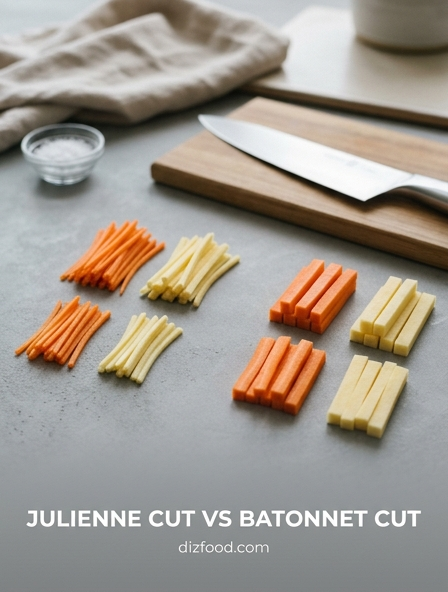
- Julienne Vegetables: The thinness allows for high-speed precision when cutting carrots or peppers.
- Sushi and Sashimi: Providing a clean, un-crushed surface on raw fish.
- Garnishes: Creating intricate cuts in radishes, cucumbers, or citrus peels where a thicker blade would be too clumsy.
- Soft Cheeses: Reducing the surface area to prevent the cheese from deforming during the cut.
While a Granton edge Santoku is a versatile "all-rounder" for a home cook, a specialized hollow ground knife is often reserved for tasks where the quality of the cut's surface is the highest priority, particularly in professional plating environments.
Sharpening and Maintenance Tips for Specialty Knife Edges
Maintaining these specialty edges requires a nuanced approach compared to standard flat-ground knives. For a Granton edge, the sharpening process is relatively straightforward because the dimples are set back from the actual cutting apex. You can sharpen a Granton knife on a whetstone or pull-through sharpener just as you would a regular chef's knife. The key is to ensure that you do not remove so much material that you reach the scalloped indentations prematurely. If the edge begins to intersect with the dimples, the blade will take on a slightly wavy profile, which may require a more aggressive regrind to flatten the edge again.
Hollow ground knives require more care. Because the edge is so thin, using a coarse sharpening stone can easily remove too much metal, shortening the life of the blade. It is recommended to use high-grit stones (3000 to 8000 grit) for regular maintenance to preserve the refined edge. Additionally, honing with a ceramic rod rather than a coarse steel rod is preferable, as the thin edge can chip if struck too hard against a steel hone. Professional sharpening is often recommended for hollow ground blades every 12 to 18 months to ensure the concave geometry is maintained through a process called "thinning behind the edge," which involves removing metal from the primary bevel to keep the blade's "laser" performance intact.
The Impact of Friction and Suction on Cutting Efficiency
The physics of cutting involves overcoming two primary forces: the resistance of the material being severed and the friction of the blade passing through that material. In a kitchen setting, suction is a specialized form of friction caused by atmospheric pressure and liquid adhesion. When a blade is perfectly flat, the food creates a seal that forces the atmospheric pressure to push the food against the knife. This "suction" can increase the perceived weight of the knife and slow down the chef's stroke, leading to fatigue.
Granton edges address this by creating physical gaps that equalize the pressure. By allowing air to enter the space between the blade and the food, the atmospheric pressure is balanced on both sides of the slice, causing the "seal" to fail instantly. Hollow ground blades address efficiency differently; by being thinner, they encounter less physical resistance from the "shoulders" of the blade. While they don't break suction as effectively as a Granton edge, they move through the material with less displacement. Essentially, the Granton edge focuses on the "release" of the food after the cut, while the hollow ground edge focuses on the "penetration" during the cut. Both contribute to overall efficiency by reducing the caloric energy a chef must expend during a long shift of prep work.
Pros and Cons of Dimpled Blades vs Concave Grinds
Evaluating which design to add to a culinary collection involves weighing the trade-offs between performance and durability. Neither design is objectively superior, but they serve different roles in a knife roll.
Granton (Dimpled) Edge
- Pros: Excellent food release; maintains structural strength of a thicker blade; versatile for both meat and vegetables; easier for beginners to maintain.
- Cons: Scallops can eventually interfere with the edge after years of sharpening; slightly heavier than hollow ground alternatives.
Hollow Ground (Concave) Edge
- Pros: Exceptional sharpness and "bite"; creates very little resistance in soft foods; provides a lighter, more nimble feel in the hand.
- Cons: Fragile edge prone to chipping; more difficult to sharpen without changing the blade geometry; can become "wedged" in hard, dense vegetables like large carrots or beets.
Ultimately, the Granton edge is the "workhorse" modification for volume slicing, while the hollow ground edge is the "specialist" tool for precision and finesse. Professionals often carry both: a Granton slicer for the roast station and a hollow ground Santoku or Petty knife for the prep station.
Choosing the Ideal Edge Design for Your Culinary Needs
Deciding between a Granton edge and a hollow ground blade requires an honest assessment of your cooking style and maintenance habits. If you find yourself frequently preparing large family meals with roasts, hams, or starchy side dishes, a Granton edge is likely the better investment. Its ability to handle "sticky" ingredients while maintaining a durable, long-lasting edge makes it a practical choice for most home cooks. It is the forgiving option that provides a noticeable performance boost without requiring specialized sharpening skills or extreme care during use.
Conversely, if you are a culinary enthusiast who prioritizes precision, enjoys making sushi, or values a knife that feels like a surgical instrument, the hollow ground edge is the superior choice. You must be prepared for the maintenance it entails, including using high-quality wooden cutting boards and avoiding any twisting or prying motions. For those who want the best of both worlds, many modern Santoku knives feature a "hybrid" approach: a slightly hollow ground primary bevel with Granton dimples added to the face. This combination aims to provide the easy penetration of a thin blade with the superior release properties of the air pockets. When shopping, always feel the weight and balance of the knife; the geometry should complement your natural grip and the specific types of ingredients that dominate your cutting board.

Comments