
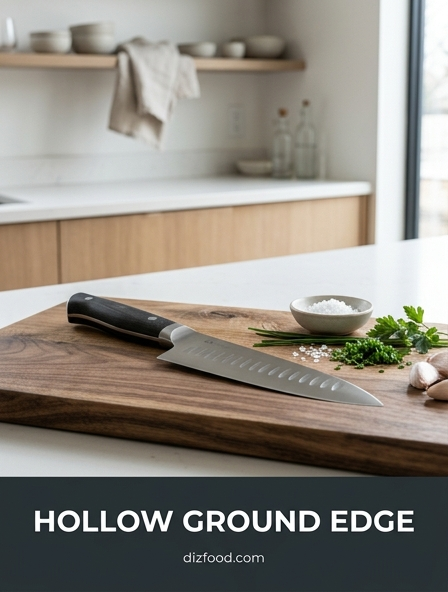
Understanding Hollow Ground Geometry
In the world of culinary cutlery, the hollow ground edge represents a specific geometric profile where the sides of the blade curve inwardly towards the center. Unlike a flat grind, which tapers in a straight line from the spine to the edge, the hollow grind is created using a large grinding wheel. This process removes a significant amount of metal from the blade's primary bevel, resulting in a concave cross-section. This unique shape allows the blade to remain exceptionally thin just behind the cutting edge while maintaining a thicker, more robust spine for structural integrity.
The defining characteristic of this geometry is its ability to create an incredibly acute angle at the final apex. Because the metal thins out so dramatically as it approaches the edge, the knife can achieve a level of sharpness that is difficult to replicate with other grinds. This design is frequently found in straight razors and high-end Japanese slicing knives, where the priority is placed on clean, effortless separation of fibers rather than heavy-duty chopping or bone-crushing durability.
The Mechanics of Surgical Precision
The physics of a hollow ground edge center on the reduction of mass near the cutting surface. When a knife enters an ingredient, the resistance it encounters is directly proportional to the width of the blade. Because a hollow ground blade is concave, it stays thinner for a longer portion of its width compared to a convex or flat grind. This allows the edge to pass through delicate cell structures with minimal displacement, which is why these knives are often described as having "surgical precision."
To understand the mechanical advantages, consider the following structural components of the blade:
- Primary Bevel: The concave area where metal has been hollowed out to reduce weight.
- Shoulder: The point where the concave curve meets the thicker spine, providing lateral strength.
- Edge Apex: The final sharpened point, which benefits from the extreme thinness of the surrounding steel.
- Contact Point: The minimal surface area that touches the food, significantly lowering drag.
This mechanics-first approach ensures that the energy applied by the chef is focused entirely on the cut rather than overcoming the friction of the blade body.
Benefits of Concave Blade Grinds
The primary benefit of a concave or hollow grind is the ease of penetration. Because the blade is so thin at the point of contact, it requires very little downward force to initiate a cut. This is particularly advantageous when working with soft proteins or ripe produce that might otherwise be crushed under the weight of a thicker blade. Additionally, the hollowed-out sections create an air pocket between the food and the knife, which can help prevent starchy items like potatoes from suctioning onto the face of the blade.
Beyond performance, there is a practical maintenance benefit. As the knife is repeatedly sharpened over years of use, the edge moves up into the blade. In a flat or convex grind, the blade gets progressively thicker as you sharpen it, eventually requiring a "thinning" procedure. However, due to the inward curve of a hollow grind, the thickness behind the edge remains relatively consistent for a longer period, extending the lifespan of the knife's peak performance before major regrinding is necessary.
Achieving the Ultimate Razor Edge
To achieve a true razor edge on a hollow ground knife, one must focus on the refinement of the final apex. Because the steel is so thin, it is highly responsive to high-grit whetstones. The process typically begins with a medium-grit stone to establish the bevel, followed by a progression into fine and extra-fine grits. Due to the concavity, the user must be careful not to apply excessive pressure, which could cause the thin edge to deflect or "roll" during the sharpening process.
- Soak your whetstones until they are fully saturated and no air bubbles appear.
- Maintain a consistent angle, usually between 10 and 15 degrees, depending on the steel's hardness.
- Use light, sweeping strokes, ensuring the entire length of the concave edge makes contact with the stone.
- Finish the process with a leather strop loaded with a fine polishing compound to remove the microscopic burr.
This meticulous approach results in an edge capable of "hair-popping" sharpness, ideal for the most demanding kitchen tasks that require delicate touch.
Reducing Friction for Effortless Slicing
Friction is the enemy of a clean cut. When a blade is thick, the sides of the knife rub against the food as it passes through, creating a "wedging" effect. Hollow ground edges mitigate this through their geometry. By curving away from the food immediately after the edge apex, the blade reduces the total surface area in contact with the ingredient. This design is particularly effective when slicing through dense materials where friction normally builds up quickly.
In a professional kitchen, this reduction in friction translates to less hand fatigue during high-volume prep work. When the knife glides through a side of salmon or a rack of roast beef without resistance, the chef can maintain better control over the thickness and uniformity of each slice. This effortless motion is not just about speed; it is about preserving the integrity of the food's texture, as less friction means less tearing of the internal fibers and better retention of natural juices.
Comparing Hollow and Flat Grinds
Choosing between a hollow grind and a flat grind depends largely on the intended use of the knife. While the hollow grind excels in pure sharpness and precision, the flat grind offers superior durability for heavy-duty tasks. The following table highlights the key differences between these two common kitchen knife profiles:
| Feature | Hollow Ground | Flat Ground |
|---|---|---|
| Edge Sharpness | Extreme / Acute | Moderate / Versatile |
| Blade Strength | Lower (Delicate) | Higher (Robust) |
| Food Release | Excellent (Air pockets) | Fair (Can stick) |
| Maintenance | Stays thin longer | Thickens with sharpening |
| Best Use | Slicing / Detail work | Chopping / General Utility |
For tasks like deboning or splitting hard squash, a flat grind is preferred to avoid chipping the thin edge. Conversely, for carpaccio, sushi, or decorative vegetable work, the hollow grind is the undisputed champion.
Maintenance Tips for Peak Sharpness
Maintaining a hollow ground edge requires a different mindset than maintaining a standard western chef's knife. Because the edge is so thin, it is more susceptible to micro-chipping if it hits a hard surface. To preserve peak sharpness, never use these knives on glass, marble, or ceramic cutting boards; instead, opt for end-grain wood or soft synthetic "high-soft" boards that provide a cushioning effect. Regular honing is essential, but it must be done with a ceramic rod or a smooth steel rather than a coarse, ribbed steel, which could damage the delicate edge.
Storage is equally critical for edge preservation. A hollow ground knife should never be stored loose in a utensil drawer where it can clatter against other metal tools. Use a dedicated magnetic knife strip, a wooden knife block, or individual felt-lined blade guards. Finally, always hand wash and dry the knife immediately after use. Even high-quality stainless steel can experience "pitting" or corrosion at the microscopic edge level if left wet, which will quickly dull the precision of the hollow grind.
Best Kitchen Tasks for Hollow Edges
The hollow ground edge is a specialized tool, and its performance is maximized when applied to the correct tasks. Its primary domain is any preparation requiring clean, paper-thin slices where the appearance of the final product is paramount. It is the tool of choice for professional garde manger work and precision meat slicing.
Consider using a hollow ground blade for the following applications:
- Slicing Sashimi: Pulling through raw fish with a single stroke to ensure a mirror-smooth surface.
- Carving Roasts: Gliding through prime rib or turkey breast without shredding the meat.
- Vegetable Carpaccio: Creating translucent slices of radish, beet, or cucumber.
- Skinning Fish: The thin edge easily slides between the skin and the flesh with minimal waste.
- Trimming Silverskin: The precision allows for the removal of tough membranes from tenderloins without losing meat.
Avoid using these knives for tasks involving frozen foods, bones, or heavy-walled vegetables like butternut squash, as the lateral pressure can snap the thin steel.
Techniques for Controlled Thin Slicing
To master the use of a hollow ground edge, one must adopt a refined cutting technique. These knives perform best with a long, drawing stroke rather than a vertical "push-cut" or heavy chopping motion. By utilizing the full length of the blade and pulling it toward you, you allow the acute angle of the hollow grind to sever fibers cleanly. This "slicing" action utilizes the natural geometry of the blade to separate the food with the least amount of resistance.
Proper grip is also essential for control. A "pinch grip," where the thumb and forefinger hold the base of the blade while the other fingers wrap around the handle, provides the maximum tactile feedback. Because the blade is so light and sharp, you do not need to grip the handle tightly. A relaxed hand allows for more subtle adjustments in angle, enabling you to guide the knife through curved or irregular ingredients with total accuracy. Safety is maintained by keeping the "guide hand" in a claw position, tucked well away from the incredibly sharp, thin path of the blade.
Preserving Your Knifes Precision Edge
Longevity for a hollow ground knife is achieved through a combination of proper technique and environmental care. The "precision edge" is a product of high-carbon steel and specialized geometry, making it both a high-performance instrument and a fragile one. One of the most common causes of edge failure is "twisting" the knife while it is embedded in an ingredient. Because the steel behind the edge is so thin, any lateral torque can cause a piece of the edge to flake off. Always keep your cuts straight and vertical.
Finally, professional thinning may eventually be required. While a hollow grind stays thin longer than a flat grind, after years of frequent sharpening, you will eventually reach the thicker "shoulder" area. At this point, the knife will begin to feel "wedgy." To restore its original performance, the hollow must be reground by a professional who has the equipment to replicate the original concave profile. By respecting the limits of the blade and maintaining its geometry, a high-quality hollow ground knife can remain a centerpiece of a chef's kit for decades.

Comments