
Whether you're aiming for Michelin-star elegance or a perfectly textured weekday soup, mastering the distinction between brunoise and small dice is a game-changer for your culinary repertoire. These precision cuts are more than just fancy knife work; they dictate how quickly an ingredient cooks and how its flavor integrates into a dish. While the tiny, meticulous brunoise offers a sophisticated finish for garnishes and clear broths, the slightly larger small dice provides the structural "heft" needed for sautés and stews where you want the vegetable to maintain its identity. Choosing the right cut ensures uniformity in every bite, elevating your cooking from amateur to artisanal by balancing visual appeal with technical consistency.
| Feature | Brunoise | Small Dice |
|---|---|---|
| Dimensions | 1/8" x 1/8" x 1/8" (3mm) | 1/4" x 1/4" x 1/4" (6mm) |
| Base Cut | Fine Julienne | Standard Julienne / Batonnet |
| Best For | Garnishes, consommé, aromatics | Soups, stews, sautés, salsas |
| Cooking Speed | Instant / Near-instant | Fast, but retains texture |
| Skill Level | Advanced (High precision) | Intermediate (Consistent rhythm) |
| Visual Effect | Refined, subtle, professional | Substantial, rustic yet clean |
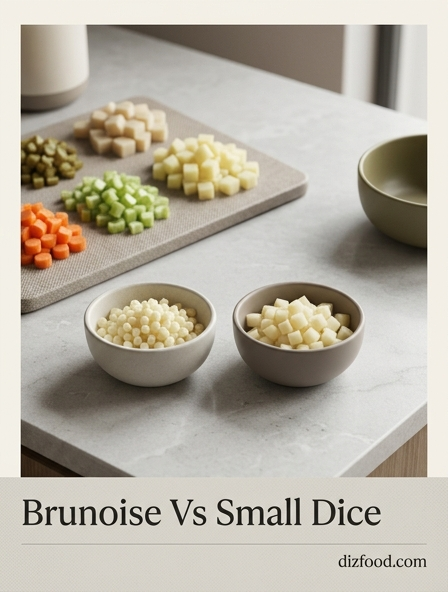
Defining Brunoise and Small Dice Cuts
In the hierarchy of classical French knife skills, the brunoise and the small dice represent two fundamental building blocks for professional culinary preparation. Both techniques prioritize uniformity, ensuring that ingredients cook at the same rate and provide a consistent texture in the finished dish. While they may appear similar to the untrained eye, the distinction lies in their scale and the specific culinary roles they fulfill. Defining these cuts requires an understanding of the geometric precision involved in professional vegetable preparation.
The brunoise is widely considered the finest of all standard cube cuts. It is a derivative of the julienne technique, where vegetables are first cut into matchstick-sized strips before being turned and sliced into tiny, uniform cubes. Conversely, the small dice is a slightly larger, more substantial cut that originates from the batonnet. It serves as a bridge between the delicate brunoise and the medium-sized macédoine. Mastering these definitions is essential for any cook looking to elevate their technique from home cooking to professional-grade execution.
- Brunoise: The smallest standard cube, often used for delicate garnishes.
- Small Dice: A versatile cube used in soups, stews, and sautéed dishes.
- Uniformity: The primary goal of both cuts to ensure even heat distribution.
- Derivation: Both cuts require an initial rectangular or stick-like preparation before the final dicing.
Precise Dimensions of the Brunoise Cut
Precision is the hallmark of a true brunoise. In traditional culinary schools, students are taught that the standard brunoise must measure exactly 1/8 inch by 1/8 inch by 1/8 inch. In metric systems, this translates to approximately 3 millimeters on all sides. This level of exactness is not merely for aesthetic purposes; it dictates how the vegetable interacts with heat and how it releases its aromatic compounds into a liquid or fat. A deviation of even a fraction of an inch can categorize the cut as something else entirely.
Because the brunoise is so small, it is typically reserved for firm vegetables such as carrots, celery, onions, and leeks. Harder root vegetables are ideal because they maintain their structural integrity even at such a minute scale. Soft or watery vegetables are rarely used for a brunoise as they tend to collapse under the weight of the knife. For those seeking even higher levels of refinement, the "fine brunoise" exists, measuring a mere 1/16 inch per side, though this is primarily used in ultra-fine dining for intricate garnishing.
| Dimension Category | Imperial Measurement | Metric Equivalent |
|---|---|---|
| Standard Brunoise | 1/8" x 1/8" x 1/8" | 3mm x 3mm x 3mm |
| Fine Brunoise | 1/16" x 1/16" x 1/16" | 1.5mm x 1.5mm x 1.5mm |
| Julienne Base | 1/8" x 1/8" x 2" | 3mm x 3mm x 5cm |
Standard Measurements for Small Dice
The small dice occupies a practical middle ground in the kitchen. Larger than the brunoise but smaller than the medium dice, it measures exactly 1/4 inch on all sides (6 millimeters). This size is significant because it provides enough surface area for browning while remaining small enough to fit comfortably on a spoon alongside other ingredients. It is the most common cut requested in commercial kitchens for recipes ranging from potato salads to mirepoix for hearty braises.
To achieve a perfect small dice, the chef must follow a specific sequence of measurements to ensure there is no waste while maintaining symmetry. The process begins by "squaring off" the vegetable to create a flat rectangular prism, which is then sliced into planks of 1/4 inch thickness. These planks are stacked and cut into 1/4 inch sticks, known as a batonnet. Finally, the batonnets are grouped together and sliced into the final 1/4 inch cubes. Consistency across these steps is what separates a professional small dice from a generic chopped vegetable.
- Square off the vegetable to create four flat sides.
- Cut 1/4 inch thick planks along the length of the vegetable.
- Stack planks and cut into 1/4 inch wide batonnets.
- Turn batonnets 90 degrees and cut 1/4 inch cubes.
- Discard or repurpose any uneven ends to maintain uniformity.
Key Differences in Knife Technique
The technical transition between a brunoise and a small dice involves more than just a change in measurement; it requires a shift in how the chef manages the knife and the product. For a brunoise, the knife must have a razor-sharp edge to make the incredibly thin julienne cuts without crushing the vegetable fibers. The movement is typically a "rocking" or "locomotive" motion that stays very close to the cutting board. Because the pieces are so small, the fingers of the guiding hand must be tucked tightly in the "claw" position to prevent injury while allowing for millimeter-level adjustments.
When executing a small dice, the chef often utilizes more of the blade's length. Since the vegetable pieces (the batonnets) are thicker, they provide more resistance against the knife. This requires a more pronounced downward and forward stroke to ensure a clean cut through the stack. While the brunoise requires extreme focus on detail, the small dice is more about maintaining a rhythm. Speed becomes a factor with the small dice, as it is often produced in much larger quantities than the delicate brunoise. Both techniques, however, demand that the knife remains vertical; any tilt in the blade will result in trapezoidal shapes rather than perfect cubes.
- Blade Contact: Brunoise requires more tip-of-the-knife precision.
- Finger Guarding: Small dice allows for slightly more clearance but requires a firm grip.
- Waste Management: Brunoise often generates more "trim" due to the need for perfect 3mm strips.
- Stability: Both require a flat base on the vegetable to prevent rolling and uneven cuts.
Best Culinary Uses for Brunoise
The brunoise is the "jewelry" of the culinary world, used primarily where visual precision and quick flavor release are paramount. Because of its tiny size, it is rarely the main structural component of a dish. Instead, it is used in sauces like a classic beurre blanc or a consommé, where the vegetables must look like tiny, sparkling jewels floating in a clear liquid. The high surface-area-to-volume ratio means that a brunoise will release its aromatic essence almost instantly when hit with heat, making it perfect for finishing dishes.
In cold preparations, the brunoise is essential for salsas, steak tartare, or fine vinaigrettes. The small size ensures that no single ingredient overwhelms the palate, allowing for a harmonious blend of flavors in every bite. It is also frequently used as a garnish for plated entrees, scattered over a piece of seared fish or a creamy risotto to add color and a subtle crunch. When a chef wants to demonstrate high-level technical skill or add a touch of elegance to a refined dish, the brunoise is the preferred choice over larger cuts.
- Consommés: Floating vegetables must be perfectly uniform for aesthetic clarity.
- Aromatic Bases: Used for quick-cooking pan sauces where texture should be minimal.
- Cold Garnishes: Ideal for adding color to appetizers without interrupting the mouthfeel.
- Stuffings: Used in poultry or mushroom stuffings where a fine texture is required for binding.
When to Choose Small Dice
The small dice is the workhorse of the professional kitchen, chosen when the vegetable needs to retain its identity and texture throughout the cooking process. Unlike the brunoise, which can easily disappear into a sauce, the small dice is large enough to be felt and chewed. This makes it the ideal choice for vegetable soups, minestrone, or a chunky gazpacho. It is also the standard size for hash browns or home-style potatoes, where the goal is a crispy exterior and a fluffy interior.
Chefs also choose the small dice for sautéed side dishes and grain-based salads like tabbouleh or quinoa bowls. In these contexts, the 1/4 inch cube provides a satisfying "pop" of flavor and a distinct structural element. It is also the preferred size for a mirepoix (onion, carrot, and celery) when making stews or braises that will cook for 30 to 60 minutes. The small dice is robust enough to survive moderate heat without turning into a puree, yet small enough to cook through relatively quickly compared to a medium or large dice.
- Hearty Soups: Provides visible ingredients that fit perfectly on a spoon.
- Braises: Holds up better than brunoise during longer simmering times.
- Sautés: Allows for caramelization on all sides of the cube.
- Vegetable Fillings: Used for pot pies or quiches where a distinct bite is desired.
Impact of Cut Size on Cooking Time
The relationship between cut size and cooking time is a fundamental principle of kitchen science. A brunoise, with its 1/8 inch dimensions, has an incredibly high surface area relative to its mass. This allows heat to penetrate to the center of the cube almost instantaneously. In a hot pan with a small amount of fat, a brunoise of carrots or onions can be fully softened and translucent in under sixty seconds. If cooked for too long, these tiny pieces will quickly brown, dry out, or dissolve into the surrounding liquid.
The small dice, being twice as thick as the brunoise, requires significantly more time for the heat to reach its core. While a brunoise might cook in one minute, a small dice of the same vegetable could take four to six minutes to reach the same level of tenderness. This difference is crucial when timing a multi-ingredient dish. If a chef adds a small dice of potatoes to a pan at the same time as a brunoise of peppers, the peppers will be burnt long before the potatoes are edible. Understanding this allows a cook to stagger the addition of ingredients or choose a cut size that matches the overall cooking window of the recipe.
| Vegetable Type | Brunoise Cook Time | Small Dice Cook Time |
|---|---|---|
| Carrots (Sauté) | 45-60 Seconds | 4-5 Minutes |
| Onions (Sweating) | 30-45 Seconds | 3-4 Minutes |
| Potatoes (Frying) | 1-2 Minutes | 6-8 Minutes |
Visual Appeal and Plate Presentation
In high-end gastronomy, "we eat first with our eyes," and the precision of a brunoise or small dice is a direct indicator of a chef's attention to detail. A perfectly executed brunoise offers a level of sophistication that suggests a disciplined kitchen. When scattered across a dish, the tiny cubes catch the light and distribute color evenly, creating a mosaic effect. This is particularly effective in pale-colored dishes, like a cauliflower velouté, where a vibrant red bell pepper brunoise can provide a striking visual contrast.
The small dice offers a different kind of visual appeal-one of rustic elegance and abundance. It looks intentional and organized, making a simple bowl of soup look professional rather than homemade. When multiple vegetables are diced to the exact same 1/4 inch dimension, it creates a sense of harmony and balance on the plate. If the sizes are inconsistent, the dish can look chaotic and unappealing. Therefore, maintaining the geometric integrity of these cuts is as much about the final "look" of the plate as it is about the flavor and texture of the food.
- Color Distribution: Smaller cuts allow for a more even spread of color throughout a dish.
- Professionalism: Uniform cubes signal to the guest that the meal was prepared with care.
- Symmetry: Matching the cut size to the other elements (like grains of rice or small pasta).
- Negative Space: Brunoise can be used to create clean lines or borders on a plate.
Essential Tools for Precise Cuts
Achieving the geometric perfection required for brunoise and small dice is nearly impossible without the right equipment. The most critical tool is a sharp 8-inch or 10-inch French-style chef's knife. A dull blade will slip on the skin of vegetables or crush the delicate internal cells, leading to uneven edges and loss of moisture. The knife should have a thin bolster to allow the cook to use the full length of the blade, and it must be honed frequently to maintain its edge during long prep sessions.
Beyond the knife, the cutting surface plays a vital role. A heavy, stable wooden or high-density plastic cutting board prevents the vegetable from sliding during the initial squaring-off phase. Many professionals also keep a small ruler or a specialized "knife skills" guide on their station to periodically check their dimensions against the 1/8 inch or 1/4 inch standard. Finally, a bench scraper is an invaluable tool for moving the finished cubes from the board to a container without bruising them or disrupting the organized piles on the workspace.
- Chef's Knife: High-carbon steel is preferred for edge retention.
- Honing Steel: Used to keep the blade perfectly straight between cuts.
- Stable Cutting Board: Essential for preventing slips and ensuring safety.
- Culinary Ruler: A student's best friend for verifying 3mm and 6mm accuracy.
- Bench Scraper: For efficient clean-up and transport of delicate cuts.
Mastering the Transition Between Sizes
The transition from mastering the small dice to the brunoise is often a milestone in a cook's development. It marks the move from basic prep to advanced finesse. To master this transition, one must practice the "squaring" technique religiously. By turning a round carrot into a perfectly rectangular block, the cook removes the variable of rolling, which is the most common cause of irregular cuts. Once the block is achieved, the cook must learn to judge thickness by eye, ensuring that every plank is identical before proceeding to the next stage.
Another key to mastering these sizes is the concept of "mise en place" and organization. A chef should never mix their brunoise and small dice on the same board. Keeping them separate prevents confusion during the cooking process. Practice drills often involve starting with a large vegetable, dicing a portion into small dice, and then further refining the remaining planks into a brunoise. This hierarchical approach reinforces the relationship between the two cuts and helps the cook develop the muscle memory needed to switch between 1/4 inch and 1/8 inch measurements fluidly and accurately.
- Practice Drills: Repeatedly cutting the same vegetable to different specifications.
- Focus on Planks: If the initial planks are wrong, the final cubes will never be right.
- Slow Down: Speed is the enemy of precision during the learning phase.
- Review Trim: Use scraps for stocks or purees to minimize the guilt of waste during practice.


Comments