
Understanding Squaring Off Fundamentals
Squaring off is the foundational technique in professional mise en place that involves trimming the natural, rounded edges of a vegetable to create a perfect rectangular prism. This process is not merely for aesthetic appeal; it is the prerequisite for achieving precise cuts such as julienne, batonnet, and brunoise. By removing the curves of a potato, carrot, or onion, the cook creates a stable block that sits flush against the cutting board. This geometric transformation ensures that every subsequent slice is of an identical thickness, which is critical for even cooking and heat distribution.
When ingredients are squared off, they no longer roll or slip under the blade, significantly reducing the risk of accidental injury. In a professional kitchen, this uniformity allows for predictable results across hundreds of portions. While a novice might view the removal of the outer layers as wasteful, the seasoned chef understands that the integrity of the final dish depends on this initial preparation. The result is a refined presentation where every piece of produce reflects a high level of craftsmanship, technical discipline, and attention to detail.
Selecting Knives for Precision Trimming
The success of squaring off depends heavily on the tool being utilized. A sharp, high-quality chef's knife is the standard choice for most vegetables due to its weight and length, providing the leverage needed for long, straight vertical cuts. A 10-inch blade is often preferred for larger items like butternut squash, while an 8-inch blade offers better control for smaller root vegetables. It is essential that the blade is perfectly straight; any warping or chips in the edge will cause the knife to veer off course, resulting in trapezoids rather than rectangles.
- Chef's Knife: The best all-purpose tool for general squaring of heavy root vegetables.
- Nakiri: An excellent choice for straight vertical chopping due to its flat, rectangular profile.
- Santoku: Suitable for precision work where a rocking motion is less critical than a clean downward stroke.
- Paring Knife: Used for small-scale squaring or cleaning up the edges of delicate, petite items.
Maintaining a razor-sharp edge is non-negotiable. A dull knife requires excessive pressure, which can cause the blade to slip or crush the cellular structure of the ingredient. Consistent honing ensures that each trim is effortless and clean.
Stabilizing Ingredients for Safer Slicing
Safety in the kitchen is directly proportional to the stability of the ingredient on the cutting board. Round vegetables, such as potatoes, beets, and parsnips, are inherently dangerous because they tend to roll during the initial cut. To mitigate this risk, the first step in squaring off is to remove a thin slice from one side of the item to create a "flat." Once this flat surface is placed against the board, the ingredient is anchored, allowing the chef to proceed with confidence and precision.
Furthermore, the environment surrounding the cutting board must be secured. A damp paper towel or a non-slip silicone mat placed beneath the board prevents it from shifting during heavy trimming. This stability allows the cook to focus entirely on the vertical alignment of the blade. By controlling the ingredient firmly with the non-cutting hand using the "claw grip," the chef ensures that fingers are tucked away from the path of the knife. This combination of a stable base and proper hand positioning creates a secure workflow that is essential for high-volume prep work in professional culinary environments.
Creating Flat Surfaces for Consistency
Creating a flat surface is the primary goal of the first few cuts in the squaring process. This "anchor" side serves as the reference point for all subsequent measurements. If the initial cut is diagonal rather than perfectly vertical, every future slice will inherit that error, leading to pieces that are tapered or uneven. The chef must visualize the internal rectangle hidden within the vegetable before the knife even touches the skin. This mental blueprint helps in determining exactly how much of the exterior needs to be removed to achieve a clean geometric shape.
The consistency of the final product depends on the flat surface being perfectly level. When the ingredient sits flat, the knife can move in a strictly vertical plane. This eliminates the need for constant adjustments and allows for a rhythmic cutting motion. Mastering this stage of preparation is what separates a home cook from a professional. By treating the first cut as the foundation of the entire dish, the cook ensures that the thermal transfer during cooking will be identical for every piece, leading to a superior texture and mouthfeel in the finished meal.
Mastering the Initial Four Sided Cut
Mastering the initial four-sided cut is the definitive step in transforming raw produce into professional mise en place. This process turns a round or irregular shape into a uniform cuboid, which then serves as the starting point for various classic French cuts. Precision during this stage prevents the "wedge effect" where pieces become progressively thicker or thinner as you move through the vegetable.
- Trim both ends of the vegetable to reveal the internal structure and provide a height reference.
- Slice a thin strip off one longitudinal side to create a stable base for the ingredient.
- Rotate the vegetable onto the flat side and trim the top to create a parallel surface.
- Turn the vegetable 90 degrees and trim the remaining two sides to achieve a clean rectangular block.
Throughout this process, the knife must remain perpendicular to the cutting board. If the blade tilts even slightly, the block will be skewed, making it impossible to produce uniform batonnets or brunoise. Constant visual checks are necessary to ensure that the angles are exactly 90 degrees, resulting in a clean finish.
Ensuring Uniformity Across All Pieces
Uniformity is the hallmark of professional culinary technique. When vegetables are squared off to identical dimensions, they cook at the same rate, ensuring that no piece is overcooked while others remain crunchy. This is especially vital in dishes like sautés or clear soups where texture is paramount. Achieving this level of precision requires the chef to use the first cut piece as a template for all others, or to utilize the knuckles of the guiding hand as a consistent measuring gauge for every stroke.
| Standard Cut | Dimensions | Primary Culinary Use |
|---|---|---|
| Batonnet | 1/4" x 1/4" x 2.5" | Fries and vegetable side dishes |
| Allumette | 1/8" x 1/8" x 2.5" | Salad garnishes and potato sticks |
| Julienne | 1/16" x 1/16" x 2" | Fine garnishes and stir-fry |
| Brunoise | 1/8" x 1/8" x 1/8" | Consommé and aromatic bases |
By adhering to these standardized sizes, the chef maintains control over the aesthetic and technical quality of the food. Every piece should look as if it were manufactured by a machine, reflecting the rigorous standards of the modern kitchen brigade system.
Maximizing Efficiency in Professional Prep
In a high-volume professional environment, efficiency is just as important as precision. Squaring off can be a time-consuming process if not managed correctly. To maximize speed, chefs utilize batch processing, where several vegetables are trimmed of their ends at once, then all are stabilized with a single flat cut, and finally all are squared into blocks in a continuous sequence. This reduces the number of times the chef has to switch tasks or adjust their grip, creating a faster workflow.
Efficiency also stems from the organization of the workspace. Having a dedicated area for the whole product, a specific spot for the squared blocks, and a clear bin for scraps allows for a fluid motion. The goal is to minimize unnecessary movements and maintain a clean cutting surface. A cluttered board slows down the process and increases the likelihood of errors. By refining the ergonomics of the squaring process, a professional can process dozens of pounds of vegetables in the time it takes an amateur to do a few, all while maintaining strict geometric standards.
Managing Scrap and Ingredient Yield
A common critique of squaring off is the amount of ingredient waste generated by trimming the curved edges. However, in a sustainable professional kitchen, these "scraps" are never discarded; they are managed as valuable byproducts. The yield of an ingredient is the percentage of the usable product compared to the total weight purchased. While the squared block is the primary yield for presentation, the trimmings constitute the secondary yield for internal use.
- Vegetable Stocks: Trimmings from carrots, onions, and celery provide the base for stocks.
- Purées: Oddly shaped pieces can be boiled and blended into smooth sauces or side dishes.
- Staff Meals: Trimmings are used for "family meal" where aesthetic uniformity is less critical.
- Dehydration: Scraps can be dried and ground into vegetable powders for intense seasoning.
Managing yield effectively involves planning how these trimmings will be used before the prep work even begins. This ensures that the food cost remains low while the quality of the primary presentation remains exceptionally high.
Techniques for Advanced Geometric Cuts
Once the basic square block is mastered, the chef can move on to more advanced geometric shapes. These cuts require a higher level of blade control and a deeper understanding of spatial geometry. One such technique is the "Tourné," which involves carving a vegetable into a seven-sided football shape. While not a "square" cut, it relies on the same principles of removing the exterior to find a specific internal form. Other advanced cuts include the lozenge (diamond shape) and the paysanne (thin squares or triangles).
The paysanne cut, for instance, often starts with a squared-off batonnet that is then sliced into thin, flat tiles. These shapes are particularly popular in traditional French soups. The key to these advanced techniques is the ability to maintain consistent angles across multiple planes. It requires a relaxed wrist and a keen eye for symmetry. As the chef progresses, these geometric cuts become muscle memory, allowing for the creation of intricate garnishes that elevate the visual complexity of a plate, demonstrating a mastery over the raw materials.
Improving Speed and Blade Control
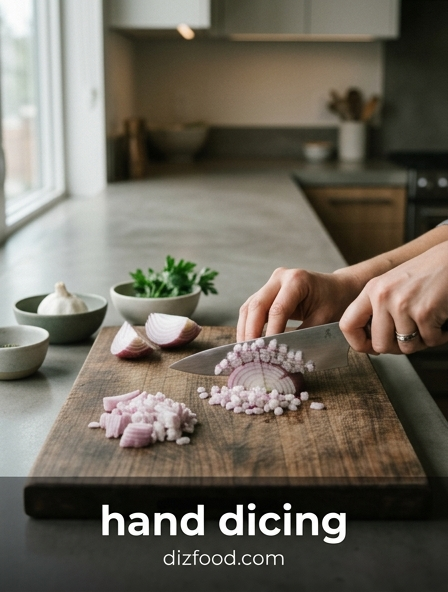
Speed and blade control are the final frontiers in mastering the art of squaring off. Improving these skills requires a combination of proper technique and consistent practice. The "claw grip" is essential; it not only protects the fingertips but also acts as a guide for the blade. By resting the side of the knife against the knuckles, the chef can control the thickness of each slice with microscopic precision. The movement should come from the elbow and shoulder for larger cuts, while the wrist remains stable to ensure vertical accuracy.
To improve speed, one should focus on the "rocking" or "locomotive" motion of the knife, keeping the tip in contact with the board when possible. However, for squaring off, a straight "push-cut" or "draw-cut" is often more effective for maintaining perfectly flat planes. Regular practice with high-moisture vegetables like potatoes can help build rhythm. Over time, the chef develops a tactile sense for the blade's position, allowing for rapid, confident trimming that produces perfectly squared results every time. Consistent repetition turns a technical challenge into a second-nature skill.

Comments