
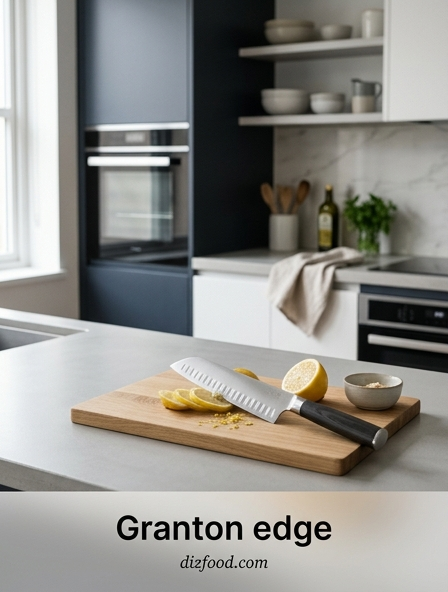
Understanding the Granton Edge Scallops
The Granton edge is a specialized blade design characterized by a series of identical scallops or divots ground into the sides of a knife blade. Originally patented by the Granton Knife Company in 1928, this innovation was designed to enhance the performance of professional slicing knives. Unlike serrated edges that saw through material, the Granton edge remains straight, ensuring a clean and precise cut without tearing the delicate fibers of the food. These scallops are alternatingly positioned on both sides of the blade, extending from the spine toward the cutting edge.
- Origin: Sheffield, England, by the Granton Knife Company.
- Design: Symmetrical hollowed-out grooves along the blade face.
- Primary Function: To prevent food from adhering to the metal surface.
- Knife Types: Most commonly found on Santokus, slicing knives, and chef's knives.
The aesthetic appeal of these "dimples" is secondary to their engineering purpose. In a high-volume kitchen, the Granton edge allows for a rhythmic slicing motion that is difficult to achieve with standard flat-ground blades. By minimizing the physical contact between the steel and the ingredient, the knife glides more freely, making it a favorite among charcuterie experts and professional chefs alike.
Science of Air Pockets and Reduced Suction
The effectiveness of a Granton edge is rooted in the principles of fluid dynamics and atmospheric pressure. When a standard flat blade moves through moist or dense food, it creates a vacuum seal. This suction causes the food to cling to the blade, increasing drag and requiring more force from the user. The Granton scallops solve this by trapping small pockets of air between the blade and the ingredient being sliced.
| Feature | Mechanical Effect |
|---|---|
| Hollow Divots | Creates a localized air cushion. |
| Reduced Surface Area | Lowers the coefficient of friction. |
| Air Pocketing | Breaks the vacuum seal instantly. |
As the blade enters the product, the air trapped within the scallops prevents the moist surface of the food from forming a continuous bond with the steel. This "air-bearing" effect ensures that each slice falls away effortlessly. This is particularly vital when dealing with high-moisture proteins or starches that naturally behave like adhesives under the pressure of a flat metallic surface.
Effortless Slicing for Sticky Ingredients
Sticky ingredients represent the greatest challenge for traditional kitchen knives. Items like cold fats, starches, and sugars can turn a simple prep task into a frustrating experience. The Granton edge is specifically engineered to combat this. When slicing through a block of semi-soft cheese or a cold potato, the surface tension is broken by the scalloped geometry, allowing for continuous movement without the need to manually peel slices off the blade.
- Starchy Vegetables: Potatoes, yams, and squash slide off easily.
- Soft Proteins: Raw fish and scallops maintain their structural integrity.
- Fats: Cold butter or lard-heavy meats do not "gum up" the blade.
- Cured Meats: Salami and prosciutto slices remain intact and separate.
By utilizing a Granton edge, the user can maintain a high level of efficiency. Instead of stopping every two or three cuts to clear the blade, the chef can proceed through an entire ingredient in one fluid sequence. This not only saves time but also reduces the risk of injury, as there is less need to place fingers near the sharp edge to clear away stuck food items during the process.
Optimal Blade Geometry for Frictionless Cuts
The geometry of a Granton edge is a masterclass in functional design. The scallops are not merely surface-level indentations; they are precisely ground to ensure the blade's structural integrity remains uncompromised while maximizing the "release" effect. This geometry works best on thinner blades where the taper is gradual, allowing the hollows to interact with the food at the most critical point of the cut.
- The blade maintains a straight, sharp primary edge for the initial bite.
- The hollows begin just millimeters above the cutting edge to engage immediately.
- The depth of the scallop is calibrated to provide maximum air volume without thinning the steel too much.
In professional cutlery, the relationship between the blade's thickness and the depth of the Granton scallops determines the overall friction. A well-designed blade will feel "greased" as it passes through dense materials. This frictionless quality is essential for maintaining the temperature of sensitive ingredients, such as raw tuna or wagyu beef, where the heat generated by excessive friction could potentially degrade the quality of the fat or the texture of the protein.
Mastering Precision with Hollow Ground Edges
Precision in the kitchen is often a matter of how well the tool responds to the user's touch. Hollow ground edges, specifically those with Granton scallops, provide a unique tactile feedback. Because there is less resistance, the chef can feel the exact moment the blade finishes a pass, leading to more consistent slice thickness. This is especially important for presentation-grade dishes where uniformity is a requirement for both aesthetics and even cooking.
- Consistent Thickness: Reduced drag prevents the blade from "wandering" or curving.
- Tactile Response: Better "feel" for the texture of the ingredient.
- Clean Release: Ends the cut without tearing the bottom of the slice.
The precision offered by these blades allows for the creation of paper-thin slices that would otherwise be impossible with a standard chef's knife. For example, when preparing a carpaccio or a delicate vegetable terrine, the Granton edge provides the control necessary to maintain a thickness of just a few millimeters across dozens of consecutive slices. This level of mastery is what separates professional-grade prep from amateur results, ensuring that every component of a dish is perfectly proportioned.
Best Foods for Granton Edge Performance
While a Granton edge is versatile, it truly shines when paired with specific types of ingredients. It is the gold standard for large roasts and delicate seafood. Understanding which foods benefit most from this blade style can help a cook optimize their toolkit for various tasks. Generally, any food with high moisture, high fat, or a tendency to compress under pressure will be easier to manage with a scalloped blade.
| Food Category | Why Granton Edge? |
|---|---|
| Roast Meats | Prevents juices from creating a seal on the blade. |
| Smoked Salmon | Preserves the oily, delicate texture without tearing. |
| Cucumber/Radish | Prevents "stacking" and sticking during rapid slicing. |
| Hard Cheeses | Reduces the physical effort required to push through. |
Vegetables with a high starch content, such as potatoes, are notorious for sticking to flat blades. The Granton edge allows these slices to fall to the side neatly. Similarly, when slicing a prime rib or a turkey breast, the scallops ensure that the meat doesn't shred, preserving the visual appeal of the serving platter. For these specific applications, the Granton edge is statistically superior to its flat-sided counterparts.
Improving Knife Speed and Food Release
In a commercial kitchen, speed is often as important as precision. The Granton edge is a significant contributor to "mise en place" efficiency. By automating the food release process through its physical design, the knife eliminates the micro-pauses that occur when food clings to the blade. This allows the cook to develop a faster, more consistent rhythm, which is vital during peak service hours.
- Faster Reset: The blade is clear and ready for the next stroke immediately.
- Less Fatigue: Reduced friction means less downward pressure is required.
- Workflow Continuity: Fewer interruptions to clean the blade surface.
The improvement in speed does not come at the cost of safety. In fact, because the knife moves more predictably through the food, the user is less likely to experience "slips" caused by the blade getting stuck and then suddenly releasing. A smooth, continuous motion is the hallmark of a skilled chef, and the Granton edge is the mechanical partner that facilitates this flow, turning repetitive chopping tasks into a streamlined process.
Maintaining Your Scalloped Slicing Blade
Proper maintenance is crucial for ensuring the longevity of a Granton edge knife. While the scallops themselves do not require sharpening, the primary cutting edge below them does. Because the scallops sit close to the edge, users must be careful when using whetstones or electric sharpeners to ensure they do not grind away so much metal that the scallops eventually merge with the cutting edge, which would ruin the blade's profile.
- Honing: Use a ceramic or steel rod regularly to keep the edge centered.
- Whetstone Use: Maintain a consistent angle to avoid scratching the scalloped area.
- Cleaning: Hand wash only; dishwashers can cause pitting within the divots.
- Drying: Ensure the hollows are completely dry to prevent localized oxidation.
Storage is equally important. Using a magnetic knife strip or a dedicated blade guard protects the delicate points between the scallops and the edge. If the edge becomes chipped or rolled, it can be difficult to repair without professional equipment, as the thinness of the metal near the Granton indentations makes it more sensitive to heat and pressure during the grinding process. Regular, gentle maintenance is the best approach.
Comparing Straight Edges to Granton Blades
Deciding between a straight edge and a Granton edge depends largely on the intended use. While the Granton edge offers superior release for wet and sticky foods, a traditional straight edge provides a more robust blade for heavy-duty tasks. A flat-ground blade is often preferred for tasks that require "walking" the knife, such as mincing herbs, where the scallops would offer no specific advantage and might even hinder the rocking motion.
| Blade Type | Primary Advantage | Best Use Case |
|---|---|---|
| Straight Edge | Durability and versatility. | General chopping, mincing, dicing. |
| Granton Edge | Superior food release. | Slicing proteins and starchy vegetables. |
For most home cooks, a Granton edge Santoku provides a middle ground, offering the release benefits for vegetables while maintaining enough weight for daily tasks. However, for specialized slicing of hams or salmon, a dedicated Granton slicer is unrivaled. The choice ultimately comes down to the frequency with which one handles "clingy" ingredients. Professionals often keep both in their roll to ensure they have the perfect tool for every texture encountered in the kitchen.
Professional Techniques for Uniform Slices
To fully leverage the benefits of a Granton edge, one must employ the correct cutting technique. Unlike a chef's knife that is often used in a rocking motion, Granton blades-especially long slicers-are most effective when used with a "draw cut" or a "push cut." This maximizes the movement of air through the scallops and ensures the food release mechanism functions as intended throughout the entire length of the stroke.
- Position the heel of the blade at the start of the ingredient.
- Use a long, smooth pulling motion toward the body.
- Let the weight of the knife do the work, applying minimal downward pressure.
- Maintain a consistent angle to ensure every slice is identical.
When using a Granton Santoku for vegetables, a vertical "push" motion is often preferred. The scallops will push the slices away from the blade as it descends, allowing for a rapid-fire slicing technique that looks as good as it performs. By mastering these motions, a cook can produce professional-level charcuterie boards, sashimi platters, and vegetable garnishes with a level of uniformity that enhances the dining experience through texture and presentation.

Comments