
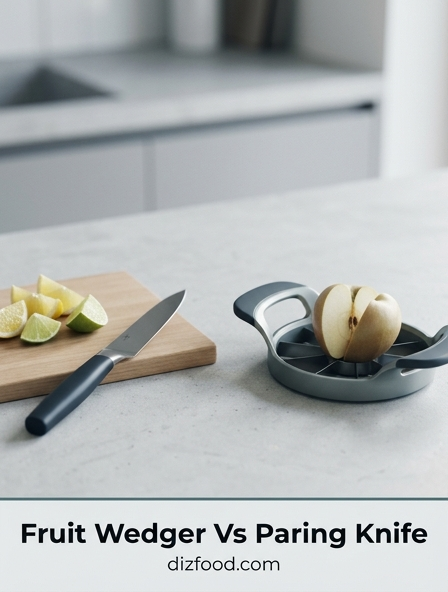
When it comes to prepping snacks or garnishes, the choice between a specialized fruit wedger and a classic paring knife often defines your kitchen efficiency. If you crave instant, uniform results for apples, citrus, or pears, a fruit wedger is your go-to powerhouse, delivering perfectly symmetrical slices in a single, satisfying press. On the other hand, the paring knife offers unmatched versatility and precision, allowing you to tackle intricate peeling or irregular shapes that a fixed-frame blade simply cannot handle. While the wedger wins on pure speed for bulk meal prep, the paring knife remains the essential tool for those who prefer artisanal control and multi-functional dexterity. Ultimately, choosing the right tool depends on whether you prioritize the "one-and-done" convenience of a dedicated slicer or the traditional flexibility of a sharp, manual blade.
| Feature | Fruit Wedger | Paring Knife |
|---|---|---|
| Slicing Speed | Instant (1-2 seconds) | Manual (30-60 seconds) |
| Uniformity | Perfectly symmetrical | Variable (Skill-dependent) |
| Versatility | Specific fruit types only | High (Peel, core, dice, slice) |
| Safety Level | High (Encased/Fixed blades) | Moderate (Exposed sharp edge) |
| Ease of Use | Zero skill required | Requires hand-eye coordination |
| Best For... | Bulk snacking & platters | Intricate work & soft fruits |
Fruit Wedger vs Paring Knife Main Differences
The fundamental difference between a fruit wedger and a paring knife lies in their design philosophy: specialization versus generalization. A fruit wedger is a dedicated kitchen gadget designed with a circular frame and multiple radial blades that meet at a central point. It is engineered to perform one specific movement-pushing down through a fruit to produce symmetrical slices while simultaneously removing the core. In contrast, a paring knife is a small, versatile blade ranging from two to four inches in length, designed for manual control and intricate movements.
| Feature | Fruit Wedger | Paring Knife |
|---|---|---|
| Blade Type | Fixed Radial Blades | Single Straight or Curved Blade |
| Operation | Vertical Pressure | Slicing, Peeling, Paring |
| Output | Identical Wedges | Variable Shapes and Sizes |
| Learning Curve | Minimal | Requires Basic Knife Skills |
While the wedger relies on the physical dimensions of the tool to determine the outcome, the paring knife relies on the skill and grip of the user. The wedger is often restricted by the diameter of its frame, meaning it cannot handle fruits that are significantly larger or smaller than its intended design. The paring knife, however, is unconstrained by size, allowing the cook to transition from hulling a tiny strawberry to slicing a large gala apple without changing tools.
Speed and Efficiency in the Kitchen
When it comes to high-volume food preparation, speed is often the deciding factor for many home cooks and professional chefs. The fruit wedger excels in environments where a large quantity of fruit needs to be processed quickly for snacks or baking. With a single downward stroke, a wedger can turn a whole apple into eight or twelve perfect slices. This "one-and-done" approach eliminates the repetitive motions required by a knife, such as cutting the fruit in half, quartering it, and then individually removing the core from each segment.
Efficiency with a paring knife is more nuanced. While it takes longer to process a single piece of fruit, the knife eliminates the "setup time" often associated with specialized gadgets. You do not need to hunt through a cluttered drawer for the specific tool; you simply grab the knife and begin. However, if you are preparing snacks for a classroom of children or a large family gathering, the cumulative time saved by a wedger is substantial. The following factors influence speed in these scenarios:
- Pre-cutting prep (removing stems or ensuring the fruit is stable).
- The resistance of the fruit skin (wedgers require significant force).
- The time spent removing the core or seeds manually with a knife.
- The volume of fruit being processed in a single session.
Ultimately, the wedger is the champion of bulk processing, while the paring knife remains the go-to for quick, single-item tasks where the overhead of cleaning and retrieving a bulky gadget outweighs its mechanical advantage.
Precision Cutting and Detailed Work
Precision is the hallmark of the paring knife. Because the user holds the handle and often rests their thumb on the fruit for leverage, the level of control is unparalleled. This allows for paper-thin slices, decorative garnishes, and the removal of blemishes without wasting any of the fruit's flesh. If you need to remove the "eyes" from a pineapple or the bruised spot from a pear, a fruit wedger is useless. Its blades are set in a fixed pattern, meaning it will cut through healthy fruit and bruises alike with no discernment.
Detailed work often requires varying the angle of the blade, a feat only possible with a handheld knife. For instance, "veining" a segment of citrus or creating intricate floral patterns out of radishes or strawberries requires the nimble tip of a paring knife. The wedger is a blunt instrument by comparison; it is designed for symmetry, not detail. It provides a standard result every time, but it cannot adapt to the unique topography of an individual piece of produce. In culinary arts where presentation involves more than just standard wedges, the paring knife is the essential tool for artistic expression and waste reduction.
Uniformity for Fruit Platters and Snacks
Uniformity is aesthetically pleasing and functionally important for even cooking or dipping. A fruit wedger guarantees that every slice is identical in width and curvature. This is particularly beneficial for fruit platters where visual consistency makes the arrangement look professional. When all pieces are the same size, they also fit better into containers and are easier for children to handle. Using a paring knife to achieve this level of consistency requires a high degree of focus and steady hand-eye coordination.
Achieving uniformity with a paring knife involves several steps that a wedger skips:
- Halving the fruit perfectly down the center.
- Ensuring each subsequent quarter is cut at the exact same angle.
- Trimming the core at a consistent depth to keep the "C" shape of the wedge uniform.
For those who host parties or prepare lunchboxes, the wedger provides a mechanical shortcut to perfection. If the goal is to serve apple slices with caramel dip or to arrange a citrus wheel on a tray, the wedger's mathematical precision ensures that no guest receives a "thin" piece while another gets a "thick" one. However, the limitation remains that if the fruit is irregularly shaped-such as a lopsided apple-the wedger may produce slightly uneven slices despite its fixed blades, whereas a knife can be adjusted mid-cut to compensate for the fruit's natural skew.
Safety and Ease of Use Comparison
Safety in the kitchen is often a matter of blade exposure and the amount of force required to complete a cut. A fruit wedger keeps the fingers away from the sharp edges because the user typically grips handles on the outside of the blade frame. By pushing downward with both hands, the risk of the tool slipping and hitting a finger is relatively low. However, wedgers require significant downward pressure, especially on hard fruits like underripe pears. If the fruit is not stable on the cutting board, the wedger can slip, potentially causing a jarring impact on the wrists or hands.
Paring knives present a different set of risks. Because the blade is small and the work is often done "in the hand" (cutting toward the thumb), the chance of a nick or deep cut is higher for those without proper technique. However, a sharp paring knife requires very little pressure to slice through skin. Safety with a paring knife is improved by using a cutting board rather than slicing in mid-air. For children or those with limited grip strength, a wedger might feel safer because it feels more stable, but for those with carpal tunnel or joint pain, the heavy pressing motion of a wedger might be more uncomfortable than the light slicing motion of a sharp knife.
Versatility of the Multi Purpose Paring Knife
The paring knife is often cited as one of the "big three" essential knives every kitchen must have, alongside the chef's knife and the serrated bread knife. Its versatility extends far beyond fruit. You can use a paring knife to devein shrimp, score meat, peel garlic, slice small vegetables like shallots, or even open a stubborn plastic package. In the context of fruit, it handles everything from the largest melon (for detail work) to the smallest grape.
Conversely, a fruit wedger is a "unitasker." It takes up a significant amount of space for a tool that can only do one thing. While some modern wedgers come with interchangeable blades for different slice counts (6, 8, or 12), they still only perform the task of wedging. If you are a minimalist or have a small kitchen, the paring knife wins on versatility every time. It adapts to the task at hand, whereas the fruit wedger requires the task to adapt to its fixed dimensions. The ability to switch from slicing an apple to mincing a clove of garlic without switching tools makes the paring knife a more integrated part of the cooking process.
Cleanup and Maintenance Requirements
Maintenance is where the simplicity of the paring knife truly shines. A knife consists of a single blade and a handle, making it incredibly easy to wipe clean or sharpen. Because the blade is flat, there are no hidden crevices where fruit juice or pulp can hide. Sharpening a paring knife is a standard procedure using a whetstone or a honing rod, ensuring it stays useful for decades.
Fruit wedgers are notoriously difficult to clean and maintain. The area where the blades meet in the center often traps fibers and sticky sugars that are hard to reach with a standard sponge. Many wedgers are marketed as dishwasher safe, but the high heat and harsh detergents can dull the multiple blades quickly. Once a wedger becomes dull, it is nearly impossible for the average home cook to sharpen it due to the radial configuration of the blades. Factors affecting cleanup include:
- Number of blade intersections (more blades mean more crevices).
- Material of the frame (plastic can stain or crack).
- Presence of a "base" or "pusher" that may have its own cleaning requirements.
- The risk of rusting in the tight joints where blades are welded or fitted.
For those who despise cleaning intricate gadgets, the paring knife is the clear winner. A quick rinse and a dry are all it needs to remain in top condition.
Best Fruits for Wedgers and Knives
The choice between a wedger and a knife often depends on the specific fruit sitting on your counter. Wedgers are optimized for "round and firm" produce. They work best when the fruit has a central core that needs to be removed or a consistent internal structure. Paring knives, being the "all-terrain" tool of the kitchen, are better for soft, stone, or irregularly shaped fruits.
Specific recommendations include:
- Best for Wedgers: Apples, pears, large citrus (oranges/lemons), and occasionally small potatoes for making potato wedges.
- Best for Paring Knives: Strawberries (hulling), peaches and plums (removing the pit), kiwi (peeling), mangoes (slicing around the large flat stone), and berries.
If you attempt to use a wedger on a soft peach, you will likely end up with a bruised, mushy mess because the pressure required to break the skin will crush the soft flesh before the blades can slice through. Similarly, a wedger cannot handle the large, irregular pit of a mango. The paring knife is necessary for any fruit that requires "investigative" cutting-where you need to feel for the pit or seed as you go to avoid wasting fruit or damaging the blade.
Storage Considerations for Kitchen Tools
Kitchen real estate is valuable, and storage is a major consideration for many homeowners. A paring knife is slim and unobtrusive. It can be stored in a knife block, on a magnetic strip, or in a drawer sheath, taking up virtually no room. Because it is a tool you use daily for multiple tasks, it usually occupies a "prime" location in the kitchen for easy access.
Fruit wedgers are bulky and awkwardly shaped. Due to their circular design and protruding handles, they do not stack well and often become "drawer jammers." They are typically relegated to the back of a cabinet or a deep drawer, which ironically makes them less likely to be used. If you have to dig through three layers of gadgets to find your apple wedger, you might find yourself reaching for the paring knife instead just to avoid the hassle. When considering a wedger, think about:
- Vertical height in your utility drawer.
- Whether the blades are exposed (safety hazard when reaching into a drawer).
- If the tool has a hanging loop for wall storage.
- The frequency of use versus the amount of space it consumes.
For most, the paring knife is the more efficient choice for storage, while the wedger is a luxury for those with ample cabinet space and a high consumption of specific fruits.
Final Verdict on the Best Cutting Tool
The "best" tool is entirely dependent on your lifestyle and culinary habits. There is no doubt that the paring knife is the superior overall tool due to its versatility, ease of maintenance, and precision. It is a fundamental requirement for any functioning kitchen. If you could only own one of the two, the paring knife is the mandatory choice. It can do everything the wedger can do-albeit more slowly-and a thousand things the wedger cannot.
However, the fruit wedger is not without merit. It is a "quality of life" tool. For parents of young children who eat multiple apples a day, or for the hobbyist baker who makes frequent tarts and pies, the wedger is a massive time-saver that reduces the friction of healthy eating. It turns a chore into a three-second task. The ideal kitchen likely has both: a high-quality paring knife for daily precision and a sturdy fruit wedger for those moments when speed and uniformity are the priority. If you value efficiency in bulk, buy the wedger. If you value craft, control, and kitchen minimalism, stick with the paring knife.


Comments