
Choosing between an electric deli slicer and a manual meat slicer often boils down to a balance of volume, precision, and hands-on control. If you're a high-volume home cook or a commercial pro, the motor-driven efficiency of an electric model saves significant time and effort, making paper-thin, uniform cuts of ham or brisket a breeze. On the other hand, manual slicers offer unparalleled portability and a tactile "old-school" feel, perfect for smaller batches or enthusiasts who prioritize silence and storage space over sheer speed. Whether you're building the ultimate charcuterie board or prepping bulk sandwich meats for the week, understanding these mechanical differences ensures you select the specific tool that aligns with your kitchen's workflow and budget.
| Feature | Electric Deli Slicer | Manual Meat Slicer |
|---|---|---|
| Speed & Volume | High; slices large roasts in minutes. | Slow; best for low-volume, occasional use. |
| User Effort | Minimal; motor does the heavy lifting. | High; requires constant arm/hand motion. |
| Cut Precision | Ultra-consistent; adjustable dial settings. | Variable; depends on user pressure/skill. |
| Power Source | Standard 110-120V electrical outlet. | 100% human-powered (No electricity). |
| Size & Storage | Bulky/Heavy; needs dedicated counter space. | Compact/Light; fits easily in cabinets. |
| Maintenance | Complex; motor and gears require care. | Simple; fewer moving parts to break. |
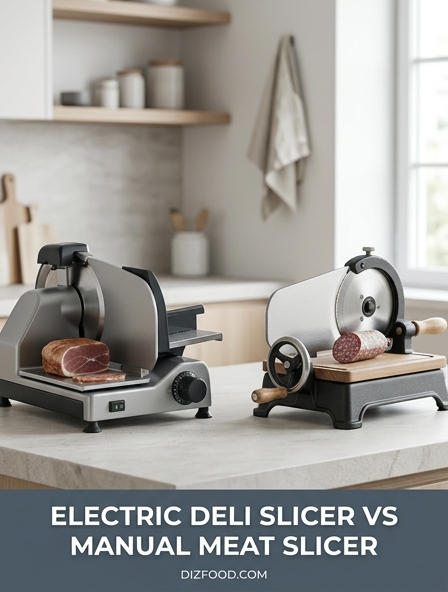
Electric Deli Slicer Performance and Speed Advantages
Electric deli slicers are the gold standard for high-volume kitchen environments where speed and consistency are paramount. Powered by robust motors ranging from 100 to over 400 watts, these machines take the physical labor out of slicing large quantities of meat, cheese, or vegetables. The primary performance advantage lies in the high-speed rotation of the blade, which allows for rapid, rhythmic slicing that far exceeds human capabilities. In a busy commercial setting or a home kitchen preparing for a large gathering, an electric slicer can process a whole ham or roast in a fraction of the time it would take using a manual method.
- Motor Consistency: Maintains a steady blade RPM, ensuring each slice is identical in thickness regardless of the operator's fatigue level.
- Bulk Processing: Ideal for "stacking" tasks where dozens of pounds of product need to be prepped for sandwiches or deli platters.
- Versatility: Most electric models come with adjustable speed settings and torque control to handle different textures, from soft cheeses to dense cured meats.
- Reduced Prep Time: Significantly lowers the labor hours required for daily food preparation tasks.
Beyond raw speed, the automation of the carriage movement in high-end electric models allows operators to multitask. While the machine handles the rhythmic slicing, the chef can organize the output or prepare other ingredients. This performance efficiency makes the electric deli slicer an indispensable tool for businesses that prioritize throughput and rapid service delivery.
Manual Meat Slicer Precision and Control Benefits
While electric slicers dominate in speed, manual meat slicers offer an unparalleled level of tactile feedback and precision control that many artisanal chefs prefer. Because the operator dictates the speed and pressure of every stroke, there is a significantly lower risk of shredding delicate proteins. Manual slicers are particularly favored for high-end charcuterie, such as Prosciutto di Parma or Jamón Ibérico, where the heat generated by a high-speed electric blade could potentially melt the fats and alter the flavor profile of the meat.
- Temperature Control: The slower rotation prevents friction-induced heat, preserving the integrity of sensitive fats and oils.
- Variable Pressure: Operators can adjust the force applied during the stroke to accommodate soft spots or bone-in sections of the meat.
- Artisanal Presentation: Allows for "shaving" meats to paper-thin transparency, which is often difficult to achieve with the aggressive vibration of some electric motors.
- Silent Operation: Provides a quieter kitchen environment, which is often preferred in open-concept residential kitchens or small boutiques.
The manual slicer is an instrument of finesse. It requires a learned technique to master the rhythm of the carriage and the pressure of the blade, but the reward is a level of customization that automated machines struggle to replicate. For the home enthusiast who enjoys the process of food preparation as much as the result, the manual slicer provides a meditative and highly controlled experience.
Key Differences in Slicing Efficiency and Volume
When comparing efficiency and volume, the choice between electric and manual slicers depends entirely on the scale of production. Electric slicers are designed for continuous duty cycles, meaning they can run for extended periods without overheating or requiring the operator to rest. In contrast, manual slicers are limited by the physical endurance of the user. Efficiency in an electric model is measured by pounds per hour, whereas in a manual model, it is measured by the precision of the individual cut.
| Feature | Electric Deli Slicer | Manual Meat Slicer |
|---|---|---|
| Output Volume | High (Commercial scale) | Low to Medium (Artisanal/Home) |
| Operator Fatigue | Low (Automated movement) | High (Manual labor) |
| Consistency | Mechanical precision | Operator-dependent |
| Speed | Fast and continuous | Slow and deliberate |
For a deli that serves hundreds of sandwiches daily, the electric slicer is the only logical choice due to its ability to maintain high efficiency under pressure. However, for a small wine bar or a home kitchen where only a few plates are served at a time, the volume requirements are low enough that the manual slicer's benefits in texture and control outweigh the need for raw speed. Efficiency is not just about how fast a machine can go, but how well it fits the specific workflow of the kitchen.
Maintenance and Cleaning Requirements for Each Type
Maintaining a slicer is critical for both food safety and the longevity of the equipment. Electric and manual slicers present different challenges when it comes to sanitation. Electric slicers have more complex internal components, including the motor housing and electrical wiring, which must be protected from moisture during the cleaning process. Manual slicers, being purely mechanical, often allow for more straightforward deep-cleaning procedures, though they still require careful handling of the razor-sharp blade.
- Electric Maintenance: Requires periodic lubrication of the slide rods and inspection of the drive belt or gears. The motor vents must be kept clear of dust and debris to prevent overheating.
- Manual Maintenance: Primarily involves keeping the mechanical joints greased and ensuring the tension on the hand-crank or lever remains consistent.
- Sanitation Protocols: Both types require full disassembly of the blade guard, meat pusher, and carriage. However, electric models often have "nooks and crannies" near the motor shaft that require specialized brushes.
- Sharpening: Most electric models feature built-in sharpening stones, whereas manual models may require external sharpening tools or professional servicing.
Proper cleaning is a non-negotiable aspect of ownership. Residual meat proteins or dairy fats can quickly lead to bacterial growth. Because electric slicers are used for higher volumes, they typically require more frequent deep-cleaning cycles within a single workday. Manual slicers, used more sporadically, can often be cleaned thoroughly after each use without the complexity of managing electrical components.
Safety Features and Potential Risks Comparison
Slicing equipment is among the most hazardous tools in any kitchen due to the exposed, high-speed blades. Manufacturers incorporate various safety features to mitigate these risks, but the nature of the hazards differs between electric and manual models. Electric slicers carry the risk of high-speed contact; if a finger touches a spinning blade, the damage occurs in a fraction of a second. Manual slicers, while slower, still pose a significant risk if the operator's hand slips during a forceful stroke.
- Blade Guards: Both types utilize permanent and removable guards to cover as much of the blade as possible, but electric guards are often more robust to handle the motor's power.
- Safety Interlocks: Many modern electric slicers feature "no-volt release" switches that prevent the machine from restarting automatically after a power outage.
- Automatic Shut-off: High-end electric models may include sensors that stop the motor if the blade guard is removed or loosened.
- Manual Control: The primary safety feature of a manual slicer is the operator's ability to stop the motion instantly by simply ceasing to move the lever or crank.
The potential for injury is always present, making proper training essential. In a commercial environment, electric slicers require strict adherence to safety protocols, including the use of cut-resistant gloves. Manual slicers require a focused "push-pull" technique to ensure hands remain away from the cutting path. Regardless of the type, the sharpening process remains one of the most dangerous times for an operator, requiring extreme caution and focus.
Long Term Durability and Build Quality Factors
When investing in kitchen hardware, durability is often tied to the materials used and the simplicity of the design. Manual meat slicers often win in terms of pure longevity because they lack electrical components that can fail over time. A well-built manual slicer made of cast aluminum or stainless steel can last for decades with minimal part replacement. Electric slicers, while also built to last, are subject to motor burnout, capacitor failure, or wiring degradation, especially in humid or high-use environments.
- Material Composition: High-quality slicers of both types should utilize anodized aluminum or stainless steel to resist corrosion from food acids and cleaning chemicals.
- Component Wear: In electric models, the drive belt is a common point of failure. In manual models, the gears or bushings in the hand-crank assembly are the primary wear points.
- Repairability: Manual slicers are generally easier for an owner to repair with basic tools. Electric slicers may require specialized technicians to diagnose electrical faults.
- Blade Quality: Chrome-plated carbon steel or high-carbon stainless steel blades are standard for durability and edge retention in both categories.
Commercial-grade electric slicers are designed for heavy-duty use and often feature gear-driven motors which are more durable than belt-driven alternatives. However, the sheer mechanical simplicity of a manual slicer makes it an "heirloom" piece of equipment. For a business, the durability of an electric slicer is measured by its "uptime," whereas for a home user, the manual slicer offers peace of mind through its lack of planned obsolescence or fragile electronics.
Initial Investment and Operating Cost Analysis
The financial commitment for a slicer involves both the upfront purchase price and the ongoing costs associated with power, maintenance, and parts. Generally, electric slicers have a higher initial price point due to the cost of the motor and internal electronics. However, there is a wide range of pricing in both categories, with entry-level home electric slicers being quite affordable, while professional-grade manual "flywheel" slicers can cost thousands of dollars as luxury showpieces.
| Cost Factor | Electric Slicer | Manual Slicer |
|---|---|---|
| Purchase Price | $100 (Home) - $3,000+ (Comm) | $50 (Home) - $5,000+ (Artisanal) |
| Energy Usage | Ongoing electricity costs | Zero energy cost |
| Maintenance | Motor/Belt replacement | Lubrication/Occasional gears |
| Labor Cost | Lower (Faster prep) | Higher (More time required) |
Operating costs for electric models include a slight increase in the utility bill, though this is usually negligible compared to the labor savings in a commercial setting. For a home user, the "cost" of a manual slicer is mostly in time and physical effort. In a professional deli, the electric slicer pays for itself quickly through increased productivity. Conversely, an artisanal shop might justify the high cost of a premium manual flywheel slicer as a marketing tool and a way to provide a superior product texture to customers.
Physical Effort and Ergonomic Design Considerations
Ergonomics play a vital role in kitchen safety and staff well-being. Using a manual slicer for an hour straight is a physically demanding task that can lead to repetitive strain injuries in the wrist, shoulder, and back. Modern manual slicers attempt to mitigate this through ergonomic handle placements and smooth-gliding carriage tracks, but the physical requirement remains. Electric slicers are designed to minimize this strain, especially models with "automatic" modes where the carriage moves on its own.
- Carriage Weight: Electric slicers often have heavier, more stable carriages that require less downward pressure from the operator.
- Stroke Length: Manual slicers require the operator to calibrate their reach and pull for every slice, which can be taxing over long periods.
- Vibration: Electric slicers can produce vibrations that may cause hand numbness during prolonged use; high-quality dampening is a key ergonomic feature.
- Handle Grip: Manual slicers rely heavily on the grip design to prevent slipping and ensure the transfer of power from the arm to the blade.
For home users with mobility issues or arthritis, an electric slicer is almost always the better choice as it requires minimal force to operate. In a commercial kitchen, providing an electric slicer is an investment in employee health, reducing the likelihood of fatigue-related accidents. The manual slicer remains a choice for those who view the physical act of slicing as a craft, but it requires a level of physical fitness and technique that the electric version does not.
Countertop Space and Storage Solutions
Kitchen real estate is often at a premium, and the size of the slicer is a major factor in the purchasing decision. Electric slicers tend to be bulkier and heavier because of the motor housing. A standard 10-inch or 12-inch electric deli slicer can weigh between 30 and 60 pounds, making it a "permanent" fixture on the countertop rather than something that is easily moved in and out of a cabinet. Manual slicers come in two extremes: very small, portable home models and massive, heavy flywheel models.
- Footprint: Electric models require extra clearance for cord management and ventilation.
- Portability: Small manual slicers are often lightweight and can be stored on high shelves, making them ideal for small apartment kitchens.
- Weight Distribution: Electric slicers usually have rubber feet or suction cups to prevent the heavy motor from "walking" across the counter during use.
- Aesthetic Impact: Large manual flywheel slicers are often used as centerpieces in open kitchens or dining rooms due to their vintage, mechanical beauty.
When planning for a slicer, one must consider not just the base dimensions, but the "travel" of the carriage. Both electric and manual slicers need several inches of clear space on either side to allow the food tray to move back and forth without hitting other appliances. For those with limited space, a compact electric model or a foldable manual slicer offers a balance between functionality and storage convenience.
Choosing the Best Slicer for Home or Commercial Use
The final decision between an electric deli slicer and a manual meat slicer hinges on your specific volume requirements and your culinary philosophy. If your primary goal is to save time and process bulk quantities of food for a family or a business, the electric slicer is the superior tool. It offers the power, speed, and consistency needed to handle daily chores with minimal fuss. However, if you view food preparation as an art form and prioritize the texture and temperature of your meats, a manual slicer offers a level of intimacy with the ingredient that a motor cannot match.
- Assess Volume: Choose electric for more than 5 pounds of meat per week; choose manual for occasional artisanal use.
- Consider Budget: Entry-level electrics are versatile for home use, while high-end manual flywheels are for enthusiasts and luxury displays.
- Evaluate Space: Measure your countertops and storage areas before committing to a heavy commercial-grade electric unit.
- Safety Priorities: Ensure you are comfortable with the safety mechanisms and the cleaning requirements of your chosen model.
In a commercial setting, the electric slicer is almost always the workhorse of the deli. In the home, many find that a mid-range electric slicer provides the best utility for the price. Ultimately, both machines serve the same purpose-turning a large roast into uniform, delicious slices-but the "how" of the process determines which one belongs in your kitchen. By weighing the factors of speed, control, and maintenance, you can select the tool that best enhances your culinary workflow.


Comments