
Anatomy of the French Chef Knife
Understanding the anatomy of the French chef knife, or "couteau de chef," is fundamental for any culinary enthusiast. This versatile tool is designed with a broad blade that tapers to a sharp point, allowing for both delicate work and heavy-duty chopping. The most critical components include the tip, which is used for intricate tasks, and the bolster, the thick junction between the handle and the blade that provides balance and safety. The edge is the sharpened side used for cutting, while the spine is the top, unsharpened edge providing stability.
- The Tip: Ideal for fine slicing and small vegetables.
- The Heel: The widest part of the blade, used for tasks requiring force.
- The Tang: The part of the blade extending into the handle; a full tang offers superior balance.
- The Rivets: Metal pins that secure the handle scales to the tang.
A well-forged French knife features a slight curve along the edge, which facilitates a fluid rocking motion during prep. Mastering these components ensures the cook can leverage the tool's center of gravity for maximum efficiency.
Mastering the Professional Pinch Grip
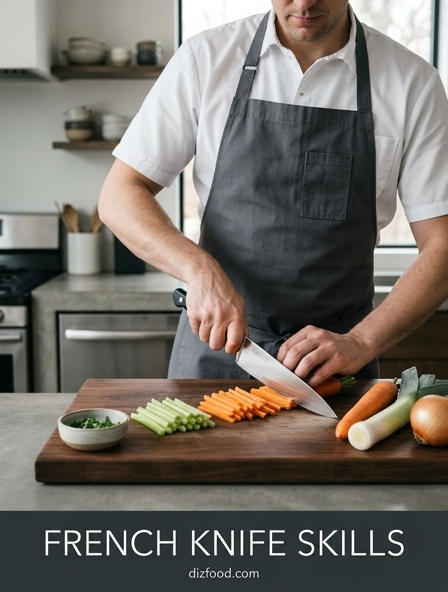
The foundation of professional knife control begins with the pinch grip. Unlike a "hammer grip," where the hand wraps entirely around the handle, the pinch grip involves choking up on the knife for superior leverage. By placing the thumb and the side of the index finger directly onto the blade just past the bolster, the cook effectively turns the knife into an extension of the arm. This reduces wrist fatigue and prevents the blade from twisting during heavy vegetable preparation.
To execute this grip properly, follow these steps:
- Place your thumb on one side of the blade at the base.
- Curl your index finger around the opposite side of the blade.
- Wrap the remaining three fingers comfortably around the handle.
This technique shifts the balance point toward the center of the hand, allowing for more precise movements. While it may feel unnatural at first, the pinch grip is the industry standard for maintaining accuracy and safety over long hours in a professional kitchen environment. It ensures that the blade remains vertical and follows the desired path through the ingredient.
Essential Safety with the Claw Hand
Safety in French knife skills is largely dependent on the positioning of the non-cutting hand, commonly referred to as "the claw." This technique protects the fingertips by tucking them inward, away from the sharp edge of the blade. The knuckles act as a vertical guide for the side of the knife, ensuring that even if the blade slips, it makes contact with the flat surface of the knuckle rather than the soft tissue of the fingers. This allows the chef to maintain high speed without the risk of injury.
The mechanics of the claw hand require the thumb and pinky finger to act as stabilizers on the ingredient, while the middle fingers press down to hold it in place. As the knife moves, the hand "walks" backward across the food, maintaining a consistent distance from the blade. This physical barrier is the most effective way to prevent accidents. Practicing this hand position on stable ingredients, like potatoes or carrots, builds the muscle memory necessary for high-volume prep work and consistent results.
Precision Julienne and Batonnet Cuts
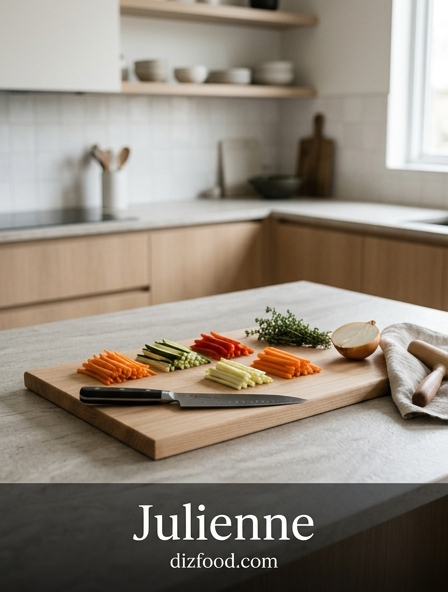
In French cuisine, the consistency of cuts determines both the aesthetic appeal and the evenness of cooking. The julienne and batonnet are the primary stick-shaped cuts from which many others are derived. Achieving these requires squaring off the vegetable first to create a stable base, which minimizes the risk of slipping. Precision is key, as these measurements are standardized across the culinary world to ensure professional quality in every dish.
| Cut Name | Standard Dimensions | Common Uses |
|---|---|---|
| Batonnet | 1/4" x 1/4" x 2-2.5" | French fries, vegetable platters |
| Julienne | 1/8" x 1/8" x 2-2.5" | Salads, garnishes, stir-fry |
| Fine Julienne | 1/16" x 1/16" x 2" | Delicate garnishes, aromatics |
To perform these cuts, slice the vegetable into thin planks of the desired thickness, then stack the planks and cut them lengthwise into uniform strips. Maintaining a perfectly vertical blade is essential to prevent the sticks from tapering at the ends.
The Art of the Perfect Brunoise
The brunoise is arguably the most refined of all French dicing techniques, resulting in tiny, precise cubes. It is almost exclusively used for garnishes or aromatics where a subtle texture is desired. This cut is derived directly from the julienne. To create a brunoise, you must first master the 1/8-inch julienne strips. Once you have a bundle of uniform sticks, you turn them 90 degrees and cut them into 1/8-inch cubes. The result should be a collection of identical squares that appear almost identical in size.
Precision is the hallmark of the brunoise. If the initial julienne strips are uneven, the final cubes will be irregular, leading to uneven cooking and a messy presentation. Because the pieces are so small, they cook extremely quickly, making them ideal for finishing sauces or being folded into delicate mousses. The "fine brunoise" is even smaller, starting from a fine julienne to create 1/16-inch cubes. Mastery of this cut demonstrates a chef's commitment to technical excellence and attention to detail.
Achieving Uniform Macédoine Dicing
The macédoine is a medium-sized dice that serves as the workhorse for many rustic yet professional French dishes. Measuring exactly 1/4 inch on all sides, the macédoine is larger than the brunoise and is derived from the batonnet cut. It is commonly utilized in hearty soups, stews, and vegetable medleys where the ingredient needs to hold its shape through a longer cooking process. The uniform surface area ensures that every piece of vegetable reaches the same level of tenderness at the same time.
To achieve a perfect macédoine, begin by cutting your vegetable into 1/4-inch batonnet sticks. Gather these sticks into a tight bundle, using the claw hand to secure them. Using a rhythmic rocking motion, cut across the sticks at 1/4-inch intervals. Consistency is vital; if some cubes are 1/2 inch and others are 1/4 inch, the larger pieces will remain crunchy while the smaller ones turn to mush. This cut balances elegance with practicality, making it a staple for high-volume kitchen production.
Elegant Chiffonade for Fresh Herbs
Chiffonade is a specialized cutting technique used primarily for leafy greens and herbs like basil, mint, or spinach. The term translates to "made of rags," referring to the delicate, ribbon-like strips produced by this method. Unlike chopping, which can bruise tender leaves and cause them to turn black, the chiffonade technique uses a clean slicing motion to preserve the herb's color and essential oils. This results in a garnish that is both visually stunning and aromatically potent.
To perform a chiffonade:
- Stack the leaves neatly, placing the largest ones on the bottom.
- Roll the stack tightly into a cigar shape.
- Using the heel of the knife, make thin, perpendicular slices through the roll.
Avoid running the knife back and forth over the herbs once they are cut, as this will lead to oxidation and loss of flavor. The resulting ribbons can be scattered over pasta, soups, or salads to provide a burst of freshness and professional flair.
Efficient Mincing and Paysanne Techniques
Mincing and paysanne represent two ends of the culinary spectrum regarding texture and formality. Mincing is the process of cutting food into very small, non-uniform pieces, typically used for garlic, shallots, or ginger where the goal is to release maximum flavor. This is often done by placing the non-dominant hand on the spine of the knife and rocking the blade rapidly over the pile of ingredients. The result is a fine texture that dissolves easily into sauces or dressings.
In contrast, the paysanne cut, or "country-style," is a more informal, thin cut that follows the natural shape of the vegetable. While still requiring uniformity, paysanne pieces are usually 1/2 inch by 1/2 inch by 1/8 inch thick. This cut is perfect for traditional French soups like Minestrone or Pot-au-feu, where a more rustic, homemade appearance is desired. By mastering both, a cook can navigate between high-end fine dining aesthetics and the comforting visuals of traditional bistro cooking with ease.
Blade Maintenance for Razor Sharpness
A chef is only as good as the sharpness of their blade. In a French kitchen, maintaining the edge is a daily ritual. There is a critical distinction between honing and sharpening. Honing is performed frequently with a ceramic or steel rod to realign the microscopic teeth of the edge that bend during use. Sharpening, however, involves removing metal to create a new edge, typically using a series of whetstones with varying grits.
To maintain a razor-sharp edge, consider the following routine:
- Hone: Use a honing steel at a 20-degree angle before every major prep session.
- Sharpen: Use whetstones when the knife no longer glides through a tomato skin.
- Clean: Hand wash and dry immediately; never use a dishwasher.
- Store: Use a magnetic strip or knife roll to prevent the edge from chipping.
A sharp knife is significantly safer than a dull one because it requires less pressure to cut, reducing the likelihood of the blade slipping and causing a deep laceration.
Streamlining Prep for Professional Speed
Efficiency in the kitchen is not just about moving the knife quickly; it is about the organization of the workspace, known as "mise en place." To streamline prep, a cook must organize their station so that movement is minimized. This involves placing the cutting board in the center, with the "trash" bowl to one side and "finished product" containers to the other. By creating a logical flow, the cook avoids crossing their arms or reaching unnecessarily, which saves seconds on every cut.
Speed is also gained through rhythmic consistency. Instead of focusing on fast movements, focus on fluid, repetitive motions. Using the full length of the blade from heel to tip allows the knife to do the work, reducing the physical effort required. Additionally, prepping similar items together-such as dicing all root vegetables before moving to delicate herbs-keeps the mind focused on a single technique, further increasing output. In professional environments, the goal is to achieve a state of flow where the knife moves with effortless precision and unwavering speed.

Comments