
Ever wondered why some herbs look like elegant ribbons while others appear as a rustic heap? Choosing between the chiffonade and shredding techniques is about more than just aesthetics; it is about unlocking the precise flavor profile and texture for your culinary creations. Chiffonade involves stacking and rolling flat-leaf herbs-like basil or mint-into tight cylinders before slicing them into delicate, uniform strips, a process that minimizes bruising and preserves precious essential oils. Conversely, shredding is a quicker, more vigorous method used to break down leafy greens or hardy herbs into irregular pieces, making it the go-to for hearty salads or stews where a more textured, "home-cooked" feel is desired. Mastering these two knife skills ensures your fresh garnishes always provide the perfect balance of visual appeal and aromatic impact.
| Feature | Chiffonade Technique | Shredding Technique |
|---|---|---|
| Visual Style | Uniform, long, delicate ribbons. | Irregular, rustic, varied shapes. |
| Best For | Broad-leaf herbs (Basil, Mint, Sage). | Hardy greens and bunch herbs (Parsley, Kale). |
| Flavor Profile | Clean, subtle, and aromatically focused. | Bold, intense, and immediate release. |
| Bruising Risk | Low (requires a very sharp blade). | High (tearing/crushing of cell walls). |
| Skill Level | Intermediate; requires precision slicing. | Beginner; prioritizes speed over form. |
| Primary Goal | Garnishing and high-end presentation. | Bulk preparation and texture integration. |
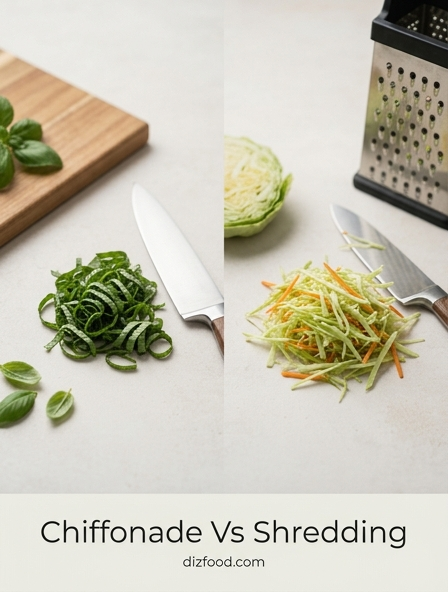
Chiffonade vs Shredding Key Culinary Differences
In the world of culinary arts, the precision of a cut can fundamentally alter both the flavor profile and the aesthetic of a dish. While Chiffonade and shredding might appear similar to the untrained eye-both resulting in long, thin strips-they are distinct techniques with different purposes, tools, and outcomes. Chiffonade is a specialized knife technique used primarily for leafy greens and herbs, producing elegant, uniform ribbons. Shredding, conversely, is a broader term that can be applied to a wide variety of produce, from firm tubers to dense brassicas, resulting in more irregular, often thinner pieces that serve as a structural base or a textural component.
The primary difference lies in the mechanical approach and the intended culinary application. Chiffonade is decorative and delicate, often used as a finishing touch to preserve the integrity of fragile leaves. Shredding is a more industrial, high-volume preparation style focused on breaking down tough fibers. Understanding these differences allows a chef to control the release of moisture and the rate of oxidation. Key distinctions include:
- Origin: Chiffonade is a refined French technique, while shredding is a universal preparation method.
- Geometry: Chiffonade produces wide, flat ribbons; shredding produces thin, multi-faceted strands.
- Cellular Impact: Chiffonade minimizes bruising of delicate cell walls, whereas shredding intentionally ruptures them to release juices.
Choosing between them is not just about the look of the plate; it is about how the ingredient interacts with heat, acid, and oil. A shredded carrot provides a different crunch and surface area for dressing than a julienned or chiffonade-style cut would, making the distinction vital for professional-grade cooking.
Understanding the Chiffonade Cutting Technique
The term "chiffonade" translates from French as "made of rags," but in the kitchen, it represents one of the most sophisticated and visually appealing ways to process leafy vegetables. This technique is specifically designed for leaves that can be rolled, such as basil, mint, spinach, kale, and sorrel. The goal is to create long, fine, hair-like ribbons that are uniform in width, typically between one and two millimeters. Because it requires a sharp knife and a steady hand, it is often used as a benchmark for a cook's fundamental knife skills.
To execute a perfect chiffonade, the chef begins by stacking the leaves neatly on top of one another, aligning their stems and tips. The stack is then rolled tightly into a cigar-like shape, known as a "roulade." By securing the roll with the non-dominant hand using a "claw" grip, the chef uses a rocking motion with a chef's knife to slice through the roll perpendicularly. This process creates a series of concentric circles that unfurl into long, delicate strips when tossed gently with the fingers.
One of the critical benefits of the chiffonade is its ability to minimize bruising. Delicate herbs like basil turn black when crushed or handled roughly; the clean, vertical cut of a chiffonade preserves the vibrant green color and locks in the essential oils until the very moment of consumption. This makes it the preferred method for garnishing pasta, soups, and salads where visual vibrance is just as important as taste.
How Shredding Transforms Vegetable Texture
Shredding is a transformative process that drastically alters the structural integrity of a vegetable. Unlike slicing, which preserves the cross-section of a plant's fibers, shredding creates numerous jagged edges and increases the overall surface area relative to the volume of the piece. This transformation is particularly useful for dense, fibrous vegetables like carrots, beets, potatoes, and cabbage. By shredding these items, you break down the tough cellulose walls, making them easier to chew and more receptive to heat and seasonings.
The impact on texture is profound. For example, a whole cabbage leaf is rigid and waxy, but when shredded for a coleslaw, it becomes a soft yet crunchy medium that readily absorbs vinegar and mayonnaise. This happens because the shredding process creates "openings" in the vegetable's structure, allowing osmotic pressure to draw out internal moisture and replace it with external flavors. This is why shredded vegetables often seem more flavorful than their whole counterparts; they are essentially "marinating" from the inside out.
Furthermore, shredding affects how a vegetable behaves during the cooking process. In a pan, shredded potatoes (as seen in hash browns) create more contact points with the hot oil, leading to a much higher ratio of crispy Maillard-reacted surface to soft interior. In a raw application, shredding allows for a denser "pack" on the plate, providing a mouthfeel that is simultaneously light and substantial. This versatility makes shredding an essential technique for everything from fermentation (like sauerkraut) to high-heat stir-frying.
Best Tools for Precise Chiffonade Ribbons
To achieve the precision required for a professional chiffonade, the quality and type of tools used are non-negotiable. Because the technique involves cutting through multiple layers of rolled leaves, any dullness in the blade will result in crushing rather than slicing. This leads to the release of chlorophyll and subsequent browning, particularly in sensitive herbs like basil or mint. Therefore, the most essential tool is a razor-sharp Chef's Knife or a Santoku.
The Chef's Knife, with its curved belly, is ideal for the rocking motion necessary to slice through the roulade smoothly. A Santoku, with its flatter edge, is preferred by some for a more direct "push-cut" motion. Regardless of the style, the blade must be thin and well-honed. In addition to the knife, the following tools are crucial for success:
- Large Wooden Cutting Board: Wood or heavy-duty plastic provides the necessary "give" for the knife edge, preventing it from dulling too quickly while ensuring the leaves stay in place.
- Honing Rod: Used immediately before cutting to ensure the edge is perfectly straight.
- Kitchen Towel: Essential for drying leaves completely after washing; wet leaves will stick together and result in a mushy, uneven chiffonade.
While some modern gadgets like multi-blade herb scissors exist, they rarely provide the clean, surgical cut of a single, well-maintained blade. For the serious cook, the combination of a high-carbon steel knife and a steady surface remains the gold standard for producing the elegant, translucent ribbons that define the chiffonade style.
When to Choose Shredding Over Chiffonade
Deciding between shredding and chiffonade is usually determined by the density of the ingredient and the final application of the dish. While chiffonade is reserved for thin, flexible leaves, shredding is the superior choice when dealing with bulk, hardness, or high-volume preparation. If the goal is to incorporate a vegetable into a batter, a sauce, or a heavy salad, shredding provides the necessary integration that a chiffonade simply cannot achieve.
One should choose shredding over chiffonade in the following scenarios:
- High-Volume Output: When preparing food for a large group, using a box grater or a food processor attachment to shred cabbage or carrots is significantly faster than hand-cutting ribbons.
- Cooking for Consistency: In dishes like potato pancakes or carrot cake, the vegetable needs to "disappear" into the texture of the dough or batter. Shredded pieces have the surface area required to cook through rapidly and distribute evenly.
- Developing "Slump": For fermented foods like kimchi or sauerkraut, shredding allows the salt to penetrate the vegetable quickly, causing it to wilt or "slump" into its own juices, which is necessary for the fermentation process.
- Hiding Vegetables: For picky eaters, shredding zucchini or carrots into pasta sauces allows the nutrients to be included without the distinct visual or textural "interruptions" of larger ribbons.
Ultimately, shredding is a utility cut-built for efficiency and integration-whereas chiffonade is an artisanal cut, built for beauty and the preservation of delicate aromatics.
Ideal Vegetables for Chiffonade and Shredding
Not all vegetables are created equal when it comes to these two techniques. The anatomy of the plant dictates which method will yield the best results. Chiffonade requires leaves that are broad enough to be rolled, while shredding requires a certain level of rigidity to withstand the pressure of a grater or the swift movement of a blade. Selecting the wrong technique for a specific vegetable can result in a messy, unappealing pile of produce.
| Vegetable Type | Recommended Technique | Reasoning |
|---|---|---|
| Basil and Mint | Chiffonade | Prevents bruising of delicate essential oils. |
| Cabbage (Green/Red) | Shredding | Breaks down tough fibers for easier consumption. |
| Spinach and Chard | Chiffonade | Creates elegant ribbons for soups or salads. |
| Carrots and Beets | Shredding | Maximizes surface area for dressing absorption. |
| Lacinato Kale | Chiffonade | Tenders the tough leaf into manageable strips. |
| Potatoes | Shredding | Ensures even browning and crispness when fried. |
Beyond these, consider the "roll-ability" of the item. If you can roll it like a cigar, it is a candidate for chiffonade. If it is a solid root or a tight head of brassica, shredding is almost always the more effective path. Some items, like iceberg lettuce, are often "shredded" with a knife to create the classic taco topping, which occupies a middle ground between the two techniques but leans toward shredding due to the desired irregular texture.
Comparing Visual Appeal and Plate Presentation
The visual impact of a dish is often the first thing a diner notices, and the choice between chiffonade and shredding plays a massive role in setting the tone of the meal. Chiffonade is synonymous with elegance and fine dining. The long, uniform ribbons of herbs scattered over a plate of pomodoro pasta or a creamy bisque suggest a level of care and precision. Because the ribbons are thin and light, they can be piled high to create "height" on a plate, which is a key principle of professional food styling.
Shredding, on the other hand, offers a more rustic, "farm-to-table" or home-style aesthetic. A mound of shredded carrots or cabbage looks bountiful and substantial. It conveys a sense of freshness and crunch. In casual dining, shredded components are often used as a bed for other ingredients, such as a nest of shredded daikon radish beneath sashimi. While perhaps less "refined" than the chiffonade, shredding is visually superior when the goal is to show abundance and texture.
Color also plays a role in this comparison. A chiffonade of purple basil provides sharp, distinct lines of color that pop against a light background. Shredded vegetables tend to bleed their colors more easily-especially beets or red cabbage-which can be used artistically to "stain" a salad or coleslaw into a vibrant, monochromatic palette. Ultimately, use chiffonade for a "surgical" beauty and shredding for a "textural" beauty.
Knife Skills vs Grater Techniques Explained
Mastering the chiffonade is a rite of passage for many culinary students because it relies entirely on manual dexterity. It requires the "claw" hand to guide the blade while the "knife" hand maintains a consistent rhythm. The challenge lies in the consistency; every ribbon must be the same width to ensure they all wilt at the same rate when hit by the heat of a dish. This requires high-level focus and a deep understanding of how the blade interacts with the friction of the vegetable roll.
Shredding, while it can be done with a knife, is more commonly associated with the use of a box grater, a mandoline, or a food processor. Using a box grater requires a specific downward force and a careful awareness of finger placement to avoid injury. It is a more "brute force" technique compared to the delicate rocking of a chiffonade. However, shredding with a knife-often called "shaving"-requires a different skill set known as "tapered slicing," where the chef aims to cut through the edge of a vegetable as thinly as possible without the benefit of the "roll" used in chiffonade.
Safety is a major factor in both. In chiffonade, the primary risk is the blade slipping off the curved surface of the rolled leaves. In shredding, the risk is the "end-of-the-vegetable" problem, where the fingers get too close to the grater teeth or the mandoline blade. Professionals often use a "guard" or a sacrificial piece of the vegetable to protect their hands, whereas the chiffonade relies on the knuckles of the claw grip to act as a natural fence for the knife.
Impact on Flavor Release and Cooking Times
The way a vegetable is cut directly influences how it tastes and how quickly it cooks. A chiffonade is designed to maximize aromatics. When you slice herbs like basil or sage into fine ribbons, you are creating a large amount of surface area for the volatile oils to escape and hit the diner's nose. However, because the pieces are so thin, they are incredibly heat-sensitive. A chiffonade of spinach will wilt in seconds when tossed into a hot pan, making it ideal for "last-minute" additions where you want the vegetable to be just barely cooked.
Shredding has a different impact on flavor. Because the process often involves crushing or tearing fibers (especially with a grater), it releases more of the internal sugars and juices. This is why shredded onions or carrots often taste sweeter than chopped ones; the cell walls are more thoroughly decimated, allowing the tongue to access the sugars immediately. In terms of cooking times, shredding is the ultimate "fast-track" method. A shredded potato can be fully cooked and crispy in under five minutes, whereas a diced potato might take fifteen.
This also affects the "carry-over" flavor in sauces. Shredded aromatics like ginger or garlic will disperse their flavor into a liquid almost instantly, creating a cohesive sauce. A chiffonade of the same ingredients would stay as distinct "islands" of flavor. Therefore, if you want a unified flavor profile, shred; if you want distinct bursts of flavor and aroma, use the chiffonade technique.
Practical Kitchen Uses for Both Cutting Styles
In a high-functioning kitchen, both styles are used daily, often within the same dish. For instance, a classic Vietnamese Banh Mi might utilize shredded carrots and daikon for a pickled crunch, while being finished with a chiffonade of mint or cilantro to provide a fresh aromatic lift. Understanding the practical application of each helps in planning the workflow of a meal.
Common practical uses for Chiffonade include:
- Garnishing: Topping soups, stews, and pastas with basil or parsley.
- Salad Bases: Using a chiffonade of kale or romaine to create a more tender, "shaved" salad texture.
- Wraps: Slicing large collard green leaves into ribbons to be used as a filling for spring rolls.
Common practical uses for Shredding include:
- Frying: Creating nests for bird's nest soup or making classic latkes and hash browns.
- Baking: Incorporating moisture into zucchini bread or carrot cakes.
- Stuffing: Making fillings for dumplings or gyoza where the vegetables must be fine enough to fit in a small wrapper.
- Slaws: The foundation of any traditional coleslaw or broccoli slaw.
By mastering both, the home cook or professional chef gains control over the "mouthfeel" of their food. Whether it is the sophisticated ribbon of a chiffonade or the rugged, juice-releasing strand of a shred, these techniques are the building blocks of varied and interesting culinary textures.

Comments