
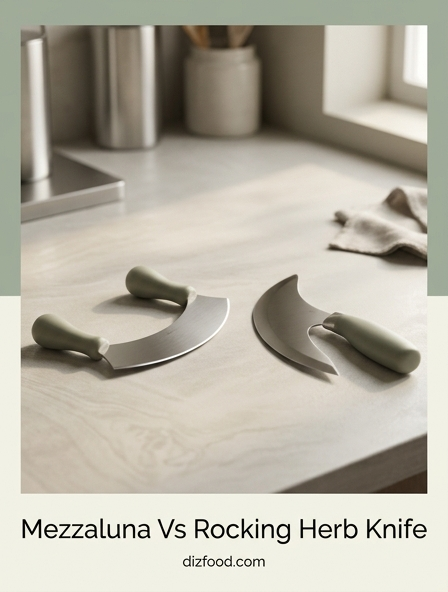
If you've ever struggled to finely mince fresh cilantro or rosemary without bruising the delicate leaves, choosing between a Mezzaluna and a Rocking Herb Knife will be a total game-changer for your kitchen prep. The Mezzaluna, with its iconic half-moon blade and dual-handle design, is a traditional powerhouse built for rhythmic, high-volume mincing of herbs, nuts, and even garlic. On the other hand, the modern Rocking Herb Knife offers a sleek, single-handed alternative that provides superior agility and precision for smaller batches. Both tools utilize a curved edge to maintain constant contact with the cutting board, but the right choice depends on whether you value the stable, symmetrical power of the "half-moon" or the compact, versatile control of a single-handle rocker.
| Feature | Mezzaluna | Rocking Herb Knife |
|---|---|---|
| Blade Design | Wide, curved (single or double blade) | Narrower, high-arc single blade |
| Control Style | Two-handed symmetrical grip | Single-handed top or vertical grip |
| Cutting Speed | High; covers large surface area | Moderate; focused on precision |
| Best For | Bulk herbs, nuts, and heavy mincing | Delicate garnishes and quick prep |
| Storage | Bulky; often requires a dedicated bowl | Compact; fits easily in cutlery drawers |
| Ease of Use | Stable; great for those with wrist strain | Agile; easy to pivot and change angles |
Mezzaluna vs Rocking Herb Knife Comparison
The culinary world offers a variety of specialized tools designed to streamline the labor-intensive task of mincing herbs. At the center of this niche are the mezzaluna and the rocking herb knife. While the terms are often used interchangeably by casual home cooks, they represent distinct design philosophies. The mezzaluna, which translates to "half-moon" in Italian, is characterized by its significant curvature and typically features two upright handles. In contrast, the rocking herb knife is a broader category that includes single-handle designs, ulu-style blades, and specialized chef's knives with an exaggerated belly. Both tools aim to keep the blade in constant contact with the cutting board, utilizing a rhythmic motion rather than the lift-and-chop technique seen with standard utility knives.
When comparing the two, the primary differences lie in the distribution of force and the mechanical advantage provided to the user. The mezzaluna is designed for high-volume processing, often available in double-blade configurations that double the cutting surface per stroke. The rocking herb knife is generally more maneuverable, allowing the cook to guide the blade through smaller piles of herbs with higher precision. Understanding these nuances is essential for any cook looking to minimize prep time while maximizing the freshness of their ingredients. Choosing between them often comes down to the volume of greens being processed and the specific ergonomic preferences of the chef.
- Mezzaluna: Best for large batches and two-handed stability.
- Rocking Herb Knife: Preferred for precision and single-handed versatility.
- Cutting Surface: Both require a flat or slightly concave wooden board for optimal performance.
Anatomy of the Traditional Mezzaluna
The traditional mezzaluna is a marvel of geometric efficiency. Its defining feature is the crescent-shaped blade, which allows for a smooth, rocking transition from tip to tip. This curvature is not merely aesthetic; it is calculated to ensure that at any point during the rock, a portion of the edge is applying downward pressure. Most traditional models feature two vertical handles, or "knobs," positioned at either end of the blade. This setup encourages a symmetrical posture, allowing the user to utilize their body weight and the strength of both arms to press through tougher stems or denser piles of leafy greens like kale or parsley.
Materials play a significant role in the anatomy of a high-quality mezzaluna. High-carbon stainless steel is the standard for the blade to ensure it retains a sharp edge while resisting the corrosive acids found in many herbs. Handles can range from classic turned wood to modern ergonomic plastics or even integrated stainless steel. A critical variation in mezzaluna anatomy is the double-blade model. By placing two parallel blades a few centimeters apart, the tool can mince herbs into a fine dust in half the time. However, this design requires a specific cleaning approach, as debris often becomes trapped between the steel sheets. The height of the blade is also crucial, as it provides the clearance needed to prevent the handles from hitting the mounds of herbs during deep rocks.
Design Features of Rocking Herb Knives
Rocking herb knives encompass a wider variety of shapes than the rigid definition of the mezzaluna. One of the most popular iterations is the single-handle rocking knife, which features a long, curved blade with a handle that runs parallel to the spine or sits atop the center. This design allows for a one-handed operation, leaving the other hand free to feed herbs under the blade or steady the cutting board. These knives often borrow design cues from the Alaskan Ulu, utilizing a centered grip that places the force directly over the cutting edge, which significantly reduces the leverage required to cut through thick bundles of rosemary or thyme.
Another common design feature in modern rocking knives is the inclusion of "bolster" weights. Since these knives rely on momentum, a slightly heavier spine can assist the rocking motion, making the tool do more of the work. Some rocking knives are also designed with a "closed" handle system, where the handle is a continuous loop of steel or plastic, protecting the fingers from the top of the blade. The blade geometry itself is often more "bellied" than a standard chef's knife but less exaggerated than a mezzaluna. This middle-ground curvature makes the rocking herb knife a hybrid tool, capable of performing some slicing tasks that a traditional mezzaluna would find difficult or impossible.
Precision vs Speed in Herb Prep
In the professional kitchen, the debate between the mezzaluna and the rocking herb knife often centers on the trade-off between speed and precision. The mezzaluna, particularly the double-bladed variety, is the undisputed king of speed. Because it covers a wider surface area and utilizes two blades simultaneously, it can reduce a bunch of cilantro to a fine mince in seconds. This speed is vital when preparing large quantities of pesto, chimichurri, or gremolata. However, this speed comes at the cost of precision. The rocking motion of a wide mezzaluna can sometimes bruise delicate herbs like basil if the blades are not exceptionally sharp, as the weight and surface area can crush the cell walls instead of slicing through them cleanly.
Rocking herb knives offer a higher degree of control. Because most are operated with one hand, the cook can use their free hand to gather the herbs into a tight "chiffonade" or pile, ensuring that every pass of the blade is intentional. This leads to a more uniform cut, which is aesthetically pleasing for garnishes. While it may take more passes to achieve the same fineness as a mezzaluna, the resulting herbs often retain more of their aromatic oils because they have been sliced more cleanly. For home cooks who prioritize the visual appeal of their dishes and work with smaller quantities, the precision of the rocking knife often outweighs the raw speed of the mezzaluna.
| Feature | Mezzaluna | Rocking Herb Knife |
|---|---|---|
| Action | Two-handed rock | One-handed rock/pivot |
| Speed | Very High (especially double blade) | Moderate |
| Precision | Lower (better for bulk) | High (better for garnish) |
| Learning Curve | Low | Moderate |
Ergonomics and Hand Fatigue Comparison
Ergonomics are a primary consideration for anyone suffering from repetitive strain issues or arthritis, and it is here that the mezzaluna and rocking herb knife differ most significantly. The mezzaluna is widely considered one of the most ergonomic cutting tools in the kitchen. By utilizing both hands, the user distributes the physical workload across both shoulders and arms. The motion is a natural, rhythmic sway that does not require the tight, focused grip of a traditional knife handle. This makes it an excellent choice for individuals who find the "pinching" grip of a chef's knife painful over long periods. The vertical handles allow for a neutral wrist position, which is essential for preventing carpal tunnel irritation.
Rocking herb knives, particularly those with a top-mounted handle, offer a different ergonomic advantage. They allow the user to apply downward pressure using the palm or the weight of the arm rather than relying on grip strength. However, because they are often used with one hand, they can lead to asymmetrical fatigue if used for extended periods. The rocking motion requires a certain amount of wrist flexion and extension which, while less taxing than traditional chopping, is more demanding than the balanced motion of the mezzaluna. For quick tasks, the rocking knife is convenient, but for a marathon of prep work, the mezzaluna's two-handed stability provides a superior ergonomic experience that protects the smaller joints of the hand and wrist.
Versatility Beyond Herbs and Greens
While both tools are marketed for herbs, their utility extends into various other areas of food preparation. The mezzaluna is surprisingly effective as a pizza cutter. Its long, curved blade can cross the diameter of a medium pizza in one or two rocks, ensuring a clean cut through the crust without dragging the toppings-a common issue with rolling wheel cutters. Furthermore, larger mezzalunas are excellent for dicing cooked meats, chopping nuts for baking, or even breaking down large heads of lettuce for salads. The double-handle design provides the leverage needed to press through firm items like chocolate blocks or hard cheeses.
The rocking herb knife, being more compact and maneuverable, excels in "micro-prep" tasks. It is an ideal tool for mincing garlic cloves or ginger, where a standard knife might feel too large. It is also highly effective for dicing small vegetables like scallions or radishes. Some cooks use the rocking knife for "mezzaluna-style" mincing of sundried tomatoes or olives, where the oily texture requires a tool that won't let the ingredients stick and slide. Because the rocking knife often features a thinner blade profile than a heavy mezzaluna, it can also be used for delicate tasks like shaving thin ribbons of parmesan or citrus zest if the user is skilled with the rocking pivot. This versatility makes it a more frequent "reach-for" tool in kitchens where herbs are only a small part of the daily prep list.
- Mezzaluna: Pizza, nuts, chocolate, cabbage, large-batch salads.
- Rocking Knife: Garlic, ginger, scallions, small garnishes, olives.
Safety Profiles and Blade Storage
Safety is a significant factor, especially in households with children or in crowded professional kitchens. The mezzaluna presents a unique safety profile; because both hands are occupied on the handles during use, the risk of cutting one's fingers is virtually zero. There is no "free hand" near the blade to be nicked. However, the sheer size of the blade and its dual-pointed ends make it a hazard when stored improperly. Many mezzalunas do not come with sheaths, and their awkward shape makes them difficult to fit into standard knife blocks. Storing an exposed mezzaluna in a utility drawer is a recipe for accidental cuts when reaching for other tools.
Rocking herb knives, particularly the ulu-style or single-handle variants, often come with dedicated wooden stands or plastic guards. Their smaller footprint makes them easier to store safely. However, because they are often used with one hand, the other hand is frequently used to steady the ingredients. This creates a higher risk of injury compared to the mezzaluna, as a slip in the rocking motion could bring the blade into contact with the stabilizing fingers. Safety with a rocking knife depends heavily on the user's technique-specifically, keeping the fingertips tucked or using a "claw" grip. When evaluating safety, the mezzaluna wins for "in-use" safety, while the rocking herb knife is generally easier to manage for "post-use" storage and maintenance.
Maintenance and Sharpening Requirements
Maintaining a sharp edge on a curved blade requires a different approach than sharpening a straight-edged chef's knife. Both the mezzaluna and the rocking herb knife cannot be pulled through a standard electric sharpener or a V-shaped pull-through sharpener. To maintain these tools, one must use a ceramic honing rod or a whetstone. For the mezzaluna, the sharpening process involves following the curve of the blade in a sweeping motion. This can be cumbersome due to the handles, which often get in the way of a full stroke on a large stone. Double-bladed mezzalunas are notoriously difficult to sharpen at home, as the narrow gap between the blades prevents easy access to the inner edges.
Rocking herb knives are generally easier to maintain because of their single-blade design and more conventional handle placements. A honing rod can be used before every use to realign the edge, which is vital given how much contact these knives have with the cutting board. Because rocking involves constant friction against the board, the edge can dull faster than a knife used for slicing. Hygiene is another maintenance factor; the mezzaluna's handle attachments can sometimes harbor food particles if they are not seamlessly integrated with the blade. Stainless steel models are often dishwasher safe, but wooden-handled versions require hand washing and occasional oiling to prevent the wood from cracking or harboring bacteria from herb juices.
Choosing the Best Tool for Your Cooking Style
The decision between a mezzaluna and a rocking herb knife should be dictated by the frequency and volume of your cooking. If you are a "weekend warrior" who makes large batches of pesto to freeze or frequently hosts pizza nights for a crowd, the mezzaluna is the superior investment. Its ability to process bulk greens with minimal effort and its secondary use as a heavy-duty cutter make it a powerhouse for high-volume tasks. It is also the best choice for those who value ergonomic safety and want a tool that reduces the strain on their hands and wrists through a balanced, two-handed motion.
Conversely, the rocking herb knife is the better choice for the gourmet home cook who prepares fresh meals daily. If your herb needs are usually limited to a handful of parsley for a garnish or a few basil leaves for a pasta dish, the rocking knife offers the precision and ease of setup that the mezzaluna lacks. It takes up less counter space, is easier to clean, and fits more naturally into the workflow of someone already comfortable with traditional knife skills. Consider your storage space as well; a mezzaluna requires a dedicated spot or a large drawer, whereas a rocking herb knife can often reside on a magnetic strip or in a standard knife block. Ultimately, the rocking knife is for the precisionist, while the mezzaluna is for the production-oriented cook.
Final Verdict on Herb Chopping Efficiency
In the final analysis of herb chopping efficiency, the mezzaluna wins on sheer speed and ergonomic comfort for large tasks, while the rocking herb knife wins on versatility and precision. Efficiency is not just about how fast a tool cuts, but also how much time is spent on setup, cleaning, and maintenance. The mezzaluna, while fast at cutting, can be slower to clean-especially the double-blade versions-and more difficult to store. The rocking herb knife offers a "grab-and-go" efficiency that suits the fast-paced environment of a home kitchen where multiple different ingredients are being prepped simultaneously.
To maximize efficiency, one must also consider the cutting surface. Both tools perform significantly better on a wooden board than on plastic or marble. Some mezzalunas even come with a "bowl" board-a wooden block with a carved indentation that matches the arc of the blade. Using a mezzaluna with a matched bowl board is perhaps the most efficient herb-mincing setup available, as it keeps the herbs contained and ensures the blade makes perfect contact throughout the entire rock. However, for the average cook, a high-quality single-blade rocking herb knife provides the best balance of speed, precision, and ease of maintenance, making it the more practical addition to a standard culinary kit. The mezzaluna remains a specialized, highly effective tool for those who truly love the art of the mince.

Comments