
Finding the perfect tool to conquer a crusty sourdough boule or a delicate brioche shouldn't be a struggle, yet the debate between the traditional bread bow and the modern offset bread knife continues to sizzle in home kitchens. While the bread bow-often called a fiddle bow-utilizes a tensioned, ultra-thin blade within a wooden frame to act as a built-in guide for uniform, professional slices, the offset bread knife offers a more versatile, ergonomic approach by keeping your knuckles safely elevated off the cutting board. Whether you prioritize the rhythmic, guided precision of a bow for thick-crusted artisan loaves or the nimble control and multi-use functionality of a high-carbon offset blade, understanding how each tool manages downward pressure and serration is the secret to mastering that perfect, crumb-preserving slice every time.
| Feature | Bread Bow (Fiddle Bow) | Offset Bread Knife |
|---|---|---|
| Cutting Mechanism | Tensioned blade in wood frame | L-shaped ergonomic handle |
| Slice Consistency | Fixed guide for uniform thickness | Manual control (requires steady hand) |
| Hand Clearance | High; hand is well above the board | Maximum; knuckles never touch board |
| Versatility | Strictly for bread and soft cheeses | Bread, large fruits, and tough veggies |
| Maintenance | Simple blade replacement available | Requires specialized serrated sharpening |
| Best For | Symmetrical slices of hard sourdough | General kitchen utility and soft loaves |
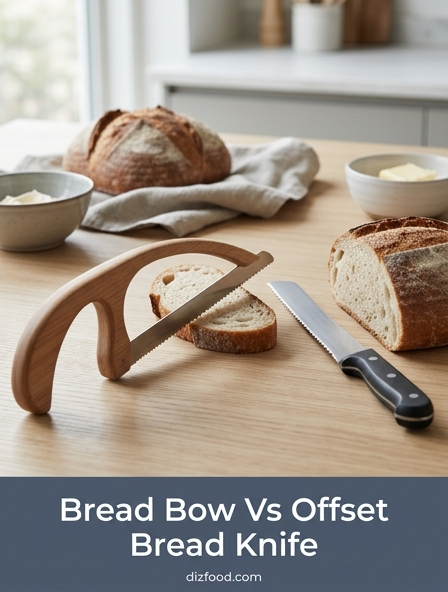
Bread Bow vs Offset Bread Knife Key Differences
The primary distinction between a bread bow and an offset bread knife lies in their physical architecture and the way they interact with the loaf. A bread bow, often referred to as a fiddle bow knife, consists of a thin, serrated blade tensioned between two points of a wooden frame. This design mimics a traditional saw, where the frame provides the structure and the blade remains exceptionally thin. In contrast, an offset bread knife features a rigid steel blade where the handle is positioned higher than the cutting edge. This "L-shaped" geometry is designed specifically to provide clearance for the user's hand, preventing knuckles from hitting the cutting board during the downward stroke.
Functionally, the two tools cater to different slicing philosophies. The bread bow relies on a rhythmic sawing motion with very little downward pressure, making it ideal for delicate textures. The offset knife is a more traditional culinary tool that allows for versatility and force. While both tools are serrated, the tooth profile often differs; bow blades are usually thinner and sharper out of the box, whereas offset knives feature robust scallops designed to tear through dense crusts. The following table summarizes the core hardware differences:
| Feature | Bread Bow | Offset Bread Knife |
|---|---|---|
| Blade Type | Thin, tensioned strip | Rigid, thick steel |
| Handle Position | Parallel to blade | Raised above blade |
| Primary Motion | Horizontal sawing | Downward slicing |
| Adjustability | Often fixed width | Fully manual control |
Design and Mechanics of Bow Slicers Versus Offset Blades
The mechanics of a bow slicer are rooted in tension. Because the blade is held taut by a wooden or composite frame, the steel can be significantly thinner than that of a free-standing knife. This thinness reduces friction as the blade passes through the bread, which prevents the "crushing" effect often seen with thicker blades. The frame also acts as a natural guide; many users find that the width of the wooden side-bar helps maintain a consistent angle, ensuring that each slice is uniform from top to bottom. However, this design limits the height of the loaf you can cut, as the frame must be able to clear the top of the bread.
Offset knives operate on the principle of leverage and clearance. By raising the handle, the manufacturer allows the cook to utilize the entire length of the blade without the hand interfering with the cutting surface. This is mechanically advantageous when dealing with wide loaves or long baguettes where a full, sweeping stroke is required. The rigidity of the offset blade means it does not flex under pressure, allowing the user to steer the cut even through uneven densities. Unlike the bow slicer, the offset knife has no frame to obstruct the view or limit the depth of the cut, making it the superior choice for oversized artisan boules or tall cakes.
Ergonomics and Comfort for Slicing Crusty Sourdough
Slicing through a high-hydration sourdough with a thick, caramelized crust requires a combination of grip stability and repetitive motion. For many home bakers, the bread bow offers superior ergonomics because it utilizes the larger muscle groups of the arm and shoulder. The grip on a bow knife is typically a neutral, "hammer-style" hold, which reduces strain on the wrist. Because the tool does the work through the tension of the blade, the user doesn't need to press down hard, which is often the cause of hand fatigue when processing multiple loaves.
The offset bread knife, however, is designed for the high-intensity environment of a professional kitchen. Its ergonomic benefit is focused on "knuckle clearance." By keeping the hand away from the board, it prevents the awkward wrist-cocking required by standard straight-handled knives. For those who prefer a traditional pinch grip, the offset knife provides more tactical feedback. When tackling a particularly stubborn sourdough crust, the offset knife allows the user to apply directed downward force at the heel of the blade, which can be more effective for "breaking" the initial crust than the lighter sawing action of a bow. Key ergonomic considerations include:
- Wrist Alignment: Bow knives keep the wrist straight; offset knives require a slight forward tilt.
- Grip Type: Bows use a full-palm grip; offsets allow for precision finger placement.
- Effort Distribution: Bows favor long, easy strokes; offsets favor powerful, short strokes.
- Surface Contact: Offsets ensure zero interference between knuckles and the cutting board.
Precision and Slice Uniformity Comparison
Achieving a perfectly even slice is the hallmark of a skilled baker, but the tool used can significantly influence the outcome. The bread bow is often praised for its "built-in" precision. Because the blade is encased in a frame, it is less prone to "walking" or veering off to the side as it enters the loaf. Many users find that they can produce paper-thin slices of dense rye or brioche with a bow knife that would be nearly impossible with a standard blade. The tension prevents the blade from bowing outward, which is a common issue with cheaper, flexible serrated knives.
Offset bread knives offer a different kind of precision-one based on visibility and reach. Because there is no frame obstructing the user's line of sight, it is easier to see exactly where the teeth are landing on the crust. This is crucial for decorative slicing or when trying to match the thickness of a previous cut by eye. While the offset knife requires more "hand-eye coordination" to keep the slice vertical, it provides the freedom to adjust the thickness mid-cut. If you are slicing a loaf with varying internal densities, such as a fruit and nut bread, the offset knife allows you to feel the resistance and adjust your angle accordingly, whereas a bow knife might feel more restrictive in its path.
Safety Features of Bow Knives Versus Serrated Offset Knives
Safety is a paramount concern in the kitchen, especially when dealing with the aggressive serrations required to cut bread. The bread bow is inherently safer in several respects. First, the blade is partially shielded by the wooden frame, meaning there is less exposed "live" edge when the tool is resting on the counter. Furthermore, the design of the handle keeps the fingers tucked well away from the cutting path. Because the motion is a guided saw action, there is a lower risk of the knife slipping off a hard crust and striking the hand holding the loaf.
Offset knives, while more exposed, offer safety through control. The offset handle gives the user a very stable center of gravity, which prevents the knife from tipping or rolling during a heavy cut. High-quality offset knives also feature a "bolster" or a finger guard that prevents the hand from sliding forward onto the blade. However, because the tip of an offset knife is often pointed and the entire length of the blade is exposed, it requires more care during storage and cleaning. When comparing safety, the bow knife is often recommended for those with limited grip strength or mobility issues, as the frame provides a secondary level of stability that a free-standing blade simply cannot match.
Versatility of Offset Bread Knives in Professional Kitchens
In a professional culinary environment, a tool that can only perform one task is often seen as a luxury. This is where the offset bread knife excels. While its primary purpose is slicing bread, its rigid, long, and serrated blade makes it a "multi-tool" for various prep tasks. Chefs frequently reach for an offset knife to level cakes, as the raised handle allows the blade to sweep across the top of a cake without the hand marring the frosting or the sponge. The serrations are also perfect for cutting through the slippery skins of large fruits and vegetables, such as pineapples, watermelons, or thick-skinned tomatoes.
The bread bow, by contrast, is a specialist tool. Its frame prevents it from being used on anything wider than the distance between the blade and the spine. You cannot use a bow knife to slice a large sheet cake or to carve a roast. In a professional setting, the offset knife is also preferred for its ease of sanitation. Most professional offset knives feature molded plastic or composite handles that are NSF-certified and can be bleached or run through high-temp dishwashers. Bread bows, usually made of wood, require hand washing and occasional oiling, making them more suited for home use than the high-volume, sanitized environment of a commercial kitchen line.
Why Bow Slicers Are Preferred for Soft Homemade Loaves
Home bakers who specialize in soft-crust breads like brioche, Challah, or Japanese milk bread often find that a standard serrated knife is too aggressive. The weight and downward pressure of a traditional knife can compress the delicate air cells of a soft loaf, resulting in a squashed slice. The bread bow is the antidote to this problem. Because the blade is incredibly thin and held under high tension, it acts more like a surgical instrument than a saw. It zips through soft crumbs with minimal resistance, preserving the interior structure of the bread.
The preference for bow slicers in the home kitchen is also tied to the "crush factor." When a loaf is fresh out of the oven and still slightly warm (though not recommended for cutting), it is at its most vulnerable. A bow slicer allows the baker to use very long, light strokes that "tickle" through the bread. Additionally, many bow slicers are handmade by artisans, making them a beautiful addition to a home kitchen display. For those who bake primarily for family consumption, the ritual of using a wooden bow slicer adds to the tactile experience of artisanal baking. Key reasons for this preference include:
- Low Friction: The thin blade gauge prevents "drag" through the crumb.
- Aesthetic Appeal: Often crafted from exotic hardwoods like walnut or cherry.
- Gentle Cutting: Ideal for breads with high fat and sugar content that are structurally soft.
- Clean Edges: Leaves a smooth surface without the "shredding" often caused by heavy serrations.
Knuckle Clearance and Blade Control Performance
The "offset" in an offset bread knife refers specifically to the vertical displacement of the handle. This is the single most important design feature for blade control. When using a standard chef's knife or a straight bread knife, as you reach the bottom of a cut, your knuckles will inevitably strike the cutting board before the blade finishes its journey. To compensate, users often have to move the loaf to the edge of the counter or tilt the knife at an awkward angle. The offset knife solves this by elevating the hand, allowing for a flat, parallel stroke across the entire board.
This clearance does more than just protect the knuckles; it improves the physics of the cut. Because the hand is positioned above the blade, the user can apply more even pressure across the entire length of the serrations. This results in a cleaner finish at the bottom of the loaf, avoiding that frustrating "hinge" where the bottom crust isn't fully severed. With a bread bow, knuckle clearance is achieved by the height of the frame itself. However, because the bow requires a horizontal "back and forth" motion rather than a downward "rocking" motion, the mechanical feedback is different. The offset knife feels more like a precision tool for "driving" through the bread, while the bow feels like a guide for "navigating" through it.
Maintenance and Sharpening for Specialty Bread Tools
Maintenance is where these two tools diverge significantly. A high-quality offset bread knife is made of tempered stainless or high-carbon steel. Sharpening a serrated blade is notoriously difficult and usually requires a specialized ceramic honing rod to sharpen each individual scallop. Because the steel is thick and durable, an offset knife can last a lifetime with proper care, but once it becomes dull, many home cooks find it easier to send it to a professional sharpener than to attempt the process themselves.
Bread bows take a completely different approach to longevity. Many bow slicers are designed with replaceable blades. Since the blades are thin strips of steel (similar to a bandsaw blade), they are relatively inexpensive to swap out when they lose their edge. This eliminates the need for complex sharpening altogether. However, the frame of the bow knife requires its own maintenance. Usually made of wood, it must be kept dry and occasionally treated with food-grade mineral oil to prevent warping or cracking. If the tensioning screw on a bow knife becomes loose, the blade will flex and "wander," so regular checks of the hardware are necessary to maintain cutting performance. Ultimately, the offset knife is "low maintenance" in terms of structure but "high maintenance" in terms of sharpening, while the bow is the opposite.
Which Slicing Tool is Best for Your Kitchen Needs
Choosing between a bread bow and an offset bread knife depends on your volume of baking and the variety of tasks you perform in the kitchen. If you are a dedicated home baker who produces soft, artisanal loaves, the bread bow is likely the superior choice. Its ability to produce consistent, thin slices without compressing the bread makes it a specialist's dream. It is also a safer and more ergonomic option for those who find traditional knife grips uncomfortable. However, you must be prepared for the fact that it is a "unitasker" that cannot easily be used for other kitchen chores.
For the general cook or the professional chef, the offset bread knife is the more practical investment. Its versatility extends far beyond the bread board, handling everything from delicate cakes to tough vegetables. It is easier to clean, fits better in a standard knife block, and offers the durability required for heavy daily use. When making your decision, consider the following points:
- Space: Bow knives are bulky and may not fit in drawers; offset knives are sleek.
- Bread Type: Frequent sourdough bakers may prefer the power of an offset; soft bread fans should go for the bow.
- Skill Level: Beginners often find the guided nature of the bow knife easier to master for straight slices.
- Budget: High-quality offset knives are an investment in steel; bow knives offer affordable blade replacement.

Comments